Sri Lanka Aerostructures Market Size, Share & Growth Rate
The Sri Lanka Aerostructures Market was estimated at USD 163 Million in 2025 and is projected to reach USD 213 Million by 2032, growing at a CAGR of 3.9% from 2026 to 2032. This upward trajectory is primarily fueled by a robust increase in demand for both commercial and military aircraft, alongside a significant rise in investments targeting aerospace manufacturing capabilities. Companies are increasingly focused on innovation and integration of advanced technologies to address the evolving requirements of the aviation industry.
Sri Lanka Aerostructures Market Year-wise Growth Rate and Key Drivers
This graph highlights how the Sri Lanka Aerostructures Market has steadily grown over the years, supported by major growth factors.
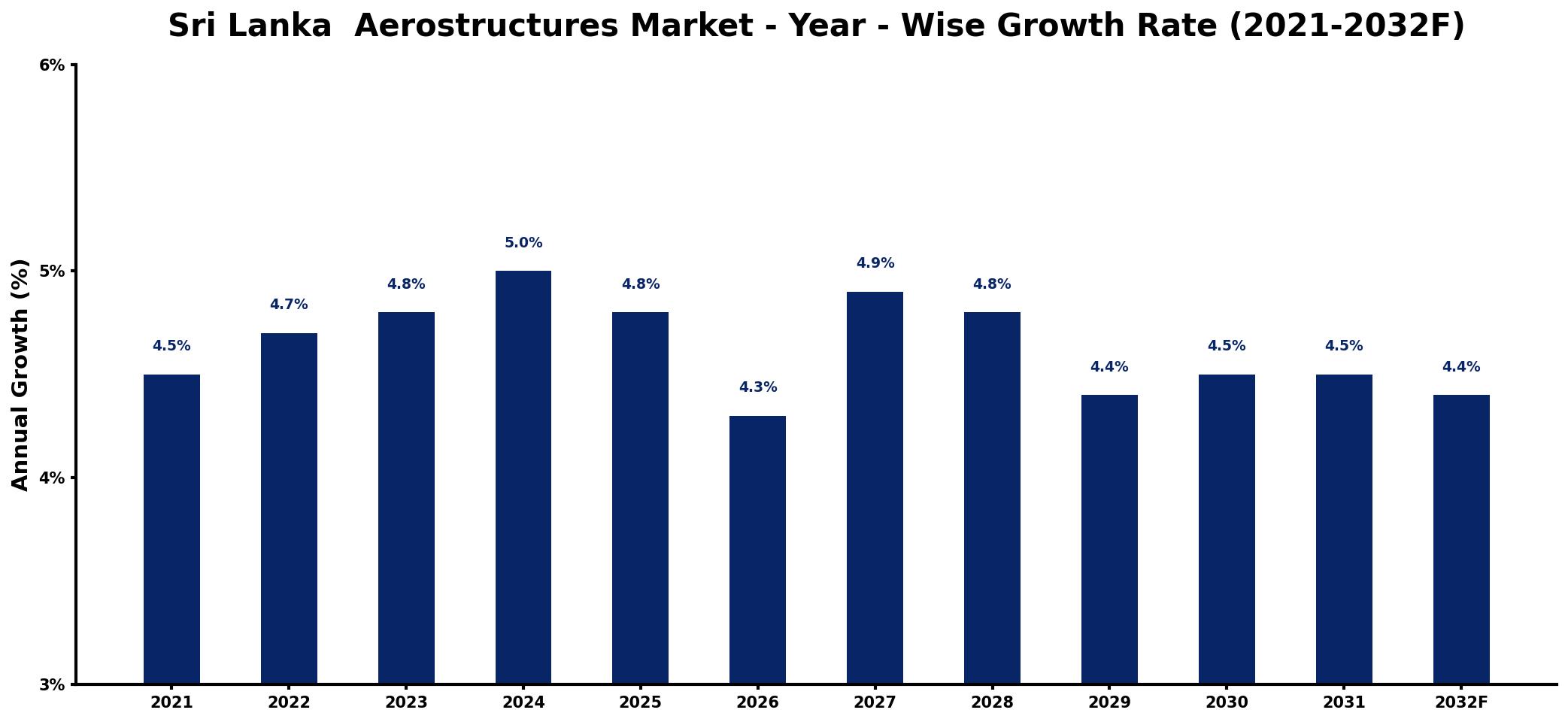
The table below presents the year‑wise growth rates along with the key drivers influencing the market
| Year | Growth Rate | Major Drivers |
| 2021 | 4.5% | Increased defense sector investments |
| 2022 | 4.7% | Rising demand for commercial aircraft |
| 2023 | 4.8% | Expansion of aerospace manufacturing facilities |
| 2024 | 5.0% | Growth in regional air travel |
| 2025 | 4.8% | Technological advancements in manufacturing |
| 2026 | 4.3% | Emerging markets seeking modernization |
| 2027 | 4.9% | Surge in aerospace research funding |
| 2028 | 4.8% | Collaborations with international manufacturers |
| 2029 | 4.4% | Increased focus on sustainability initiatives |
| 2030 | 4.5% | Growing interest in space exploration |
| 2031 | 4.5% | Enhanced training programs for workforce |
| 2032 | 4.4% | Strategic partnerships fostering innovation |
Note: Market size estimations and growth projections presented in this report are based on 6Wresearch's proprietary forecasting methodology, utilizing the latest available industry data, government publications, and primary research inputs.
Sri Lanka Aerostructures Market Synopsis
The Sri Lanka Aerostructures Market is undergoing a transformation, marked by a strong emphasis on developing lightweight materials that enhance fuel efficiency. This focus is critical as global aerospace manufacturers strive for more sustainable and environmentally friendly production processes. Furthermore, collaborations between local manufacturers and international aerospace companies are fostering knowledge transfer and expanding local capabilities.
As global aerospace Original Equipment Manufacturers (OEMs) seek cost-effective manufacturing solutions, Sri Lanka stands to benefit significantly due to its strategic geographic position in the Indian Ocean and a skilled workforce. Government initiatives aimed at promoting the aerospace industry are also playing a crucial role in advancing the local aerostructures market.
Sri Lanka Aerostructures Market Key Takeaways
- The market is projected to reach USD 213 Million by 2032, indicating sustained growth opportunities.
- Innovations in lightweight and composite materials are driving advancements in aircraft structure design.
- Strategic partnerships between local and international players are enhancing technological capabilities.
- The government is implementing supportive policies to attract investment in the aerospace sector.
- Increased demand for new aircraft will serve as a significant growth driver in the coming years.
Evaluation of Restraints in Sri Lanka Aerostructures Market
Despite its promising growth potential, the Sri Lanka Aerostructures Market faces notable constraints. Limited domestic capabilities in producing advanced aerostructures hinder progress, alongside a significant dependency on imported components for critical manufacturing processes. Additionally, the workforce lacks the skills necessary to support advanced manufacturing technologies, which creates a bottleneck for innovation. Regulatory barriers and high operational costs further challenge local companies, making it difficult for them to compete on a global scale.
Sri Lanka Aerostructures Market Trends
Current trends in the Sri Lanka Aerostructures Market are leaning towards the adoption of sustainable manufacturing practices and the use of composite materials. These materials not only improve aircraft performance but also align with the industry's shift towards reducing environmental impacts. Moreover, technology integration, focusing on automation and smart manufacturing, is set to enhance operational efficiency and safety standards, ultimately defining the future landscape of the aerostructures sector.
Sri Lanka Aerostructures Market Opportunities
Investors looking for growth opportunities will find the Sri Lanka Aerostructures Market particularly attractive due to its position as an emerging hub for aerospace manufacturing. With the ongoing trend of outsourcing aerostructure production to cost-effective markets, Sri Lankas skilled labor and government incentives create a fertile ground for establishing manufacturing facilities. The rise in demand for aerostructures such as fuselages and wings further opens doors for significant investment in this sector.
Government Initiatives in the Sri Lanka Aerostructures Market
The Sri Lankan government is actively promoting the aerospace industry, including the aerostructures market, through a series of initiatives aimed at attracting foreign investment. These include tax incentives and financial support for research and development to bolster local manufacturing capabilities. Efforts to improve infrastructure are also underway, creating a more conducive environment for growth and innovation in the aerospace sector. Such policies are designed to enhance Sri Lanka's position in the global aerospace supply chain.
Future Insights of the Sri Lanka Aerostructures Market
The future of the Sri Lanka Aerostructures Market looks optimistic, driven by increasing investments and a growing demand for both commercial and military aircraft. The governments commitment to developing the aerospace sector, combined with a favorable labor cost structure, suggests that Sri Lanka could become a key player in the global supply chain. However, the market must navigate global economic uncertainties and rapid technological advancements to fully capitalize on its growth potential in the period from 2026 to 2032.
Sri Lanka Aerostructures Market Latest Developments (2025 - 2026)
In recent months, the Sri Lanka Aerostructures Market has seen a marked shift towards more collaborative ventures between local firms and international aerospace manufacturers. These developments are largely focused on technological enhancements and capacity building, reflecting a concerted effort to address the limitations in local manufacturing capabilities. Furthermore, ongoing government efforts to streamline regulatory processes are expected to bolster investment activity and sectoral growth.
Sri Lanka Aerostructures Market - Key Attractiveness of the Report
- 10 Years of Market Numbers
- Historical Data Starting from 2022 to 2025
- Base Year: 2025
- Forecast Data until 2032
- Key Performance Indicators Impacting the Market
- Major Upcoming Developments and Projects
Key Highlights of the Report:
- Sri Lanka Aerostructures Market Outlook
- Market Size of Sri Lanka Aerostructures Market, 2025
- Forecast of Sri Lanka Aerostructures Market, 2032
- Historical Data and Forecast of Sri Lanka Aerostructures Revenues & Volume for the Period 2022-2032F
- Sri Lanka Aerostructures Market Trend Evolution
- Sri Lanka Aerostructures Market Drivers and Challenges
- Sri Lanka Aerostructures Price Trends
- Sri Lanka Aerostructures Porter's Five Forces
- Sri Lanka Aerostructures Industry Life Cycle
- Historical Data and Forecast of Sri Lanka Aerostructures Market Revenues & Volume By Component for the Period 2022-2032F
- Historical Data and Forecast of Sri Lanka Aerostructures Market Revenues & Volume By Wings for the Period 2022-2032F
- Historical Data and Forecast of Sri Lanka Aerostructures Market Revenues & Volume By Nose for the Period 2022-2032F
- Historical Data and Forecast of Sri Lanka Aerostructures Market Revenues & Volume By Fuselage for the Period 2022-2032F
- Historical Data and Forecast of Sri Lanka Aerostructures Market Revenues & Volume By Nacelle and Pylon for the Period 2022-2032F
- Historical Data and Forecast of Sri Lanka Aerostructures Market Revenues & Volume By Empennage for the Period 2022-2032F
- Historical Data and Forecast of Sri Lanka Aerostructures Market Revenues & Volume By Others for the Period 2022-2032F
- Historical Data and Forecast of Sri Lanka Aerostructures Market Revenues & Volume By Material for the Period 2022-2032F
- Historical Data and Forecast of Sri Lanka Aerostructures Market Revenues & Volume By Alloys for the Period 2022-2032F
- Historical Data and Forecast of Sri Lanka Aerostructures Market Revenues & Volume By Metal for the Period 2022-2032F
- Historical Data and Forecast of Sri Lanka Aerostructures Market Revenues & Volume By Composite for the Period 2022-2032F
- Historical Data and Forecast of Sri Lanka Aerostructures Market Revenues & Volume By Platform for the Period 2022-2032F
- Historical Data and Forecast of Sri Lanka Aerostructures Market Revenues & Volume By Fixed-wing aircraft for the Period 2022-2032F
- Historical Data and Forecast of Sri Lanka Aerostructures Market Revenues & Volume By Rotary-wing aircraft for the Period 2022-2032F
- Historical Data and Forecast of Sri Lanka Aerostructures Market Revenues & Volume By End-Use for the Period 2022-2032F
- Historical Data and Forecast of Sri Lanka Aerostructures Market Revenues & Volume By Aftermarket for the Period 2022-2032F
- Historical Data and Forecast of Sri Lanka Aerostructures Market Revenues & Volume By OEM for the Period 2022-2032F
- Sri Lanka Aerostructures Import Export Trade Statistics
- Market Opportunity Assessment By Component
- Market Opportunity Assessment By Material
- Market Opportunity Assessment By Platform
- Market Opportunity Assessment By End-Use
- Sri Lanka Aerostructures Top Companies Market Share
- Sri Lanka Aerostructures Competitive Benchmarking By Technical and Operational Parameters
- Sri Lanka Aerostructures Company Profiles
- Sri Lanka Aerostructures Key Strategic Recommendations






































