Sri Lanka Automotive collision repair Market Size, Share & Growth Rate
The Sri Lanka Automotive collision repair Market was estimated at USD 353 Million in 2025 and is projected to reach USD 598 Million by 2032, growing at a CAGR of 7.8% from 2026 to 2032. This upward trajectory is primarily fueled by the surge in vehicle ownership, stemming from increasing disposable incomes and urbanization. As more vehicles hit the roads, the frequency of traffic incidents necessitating repair services is also on the rise, ensuring a robust demand for collision repair solutions across the nation.
Sri Lanka Automotive collision repair Market Year-wise Growth Rate and Key Drivers
This graph highlights how the Sri Lanka Automotive collision repair Market has steadily grown over the years, supported by major growth factors.
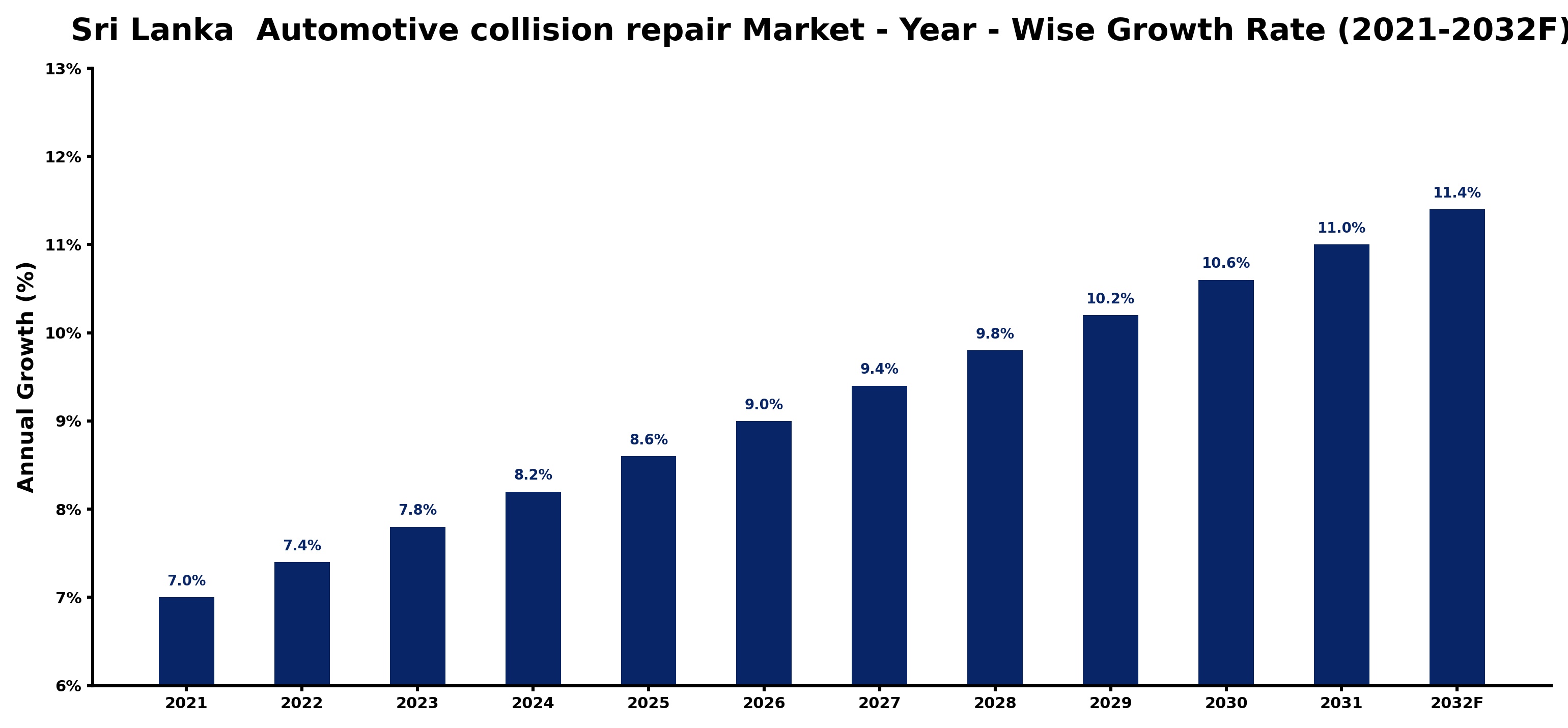
The table below presents the year‑wise growth rates along with the key drivers influencing the market
| Year | Growth Rate | Major Drivers |
| 2021 | 7.0% | Rising vehicle ownership rates |
| 2022 | 7.4% | Increased demand for repairs |
| 2023 | 7.8% | Technological advancements in repairs |
| 2024 | 8.2% | Growing insurance coverage options |
| 2025 | 8.6% | Expansion of service centers |
| 2026 | 9.0% | Enhanced customer service experiences |
| 2027 | 9.4% | Emergence of electric vehicles |
| 2028 | 9.8% | Investment in training programs |
| 2029 | 10.2% | Collaboration with automotive manufacturers |
| 2030 | 10.6% | Improved supply chain efficiencies |
| 2031 | 11.0% | Adoption of sustainable practices |
| 2032 | 11.4% | Growth in online service bookings |
Note - Market size estimations and growth projections presented in this report are based on 6Wresearch’s advanced forecasting approach, validated with industry datasets as of June 2026.
Sri Lanka Automotive collision repair Market Synopsis
A pivotal force currently shaping the Sri Lanka Automotive collision repair Market is the escalating focus on advanced repair technologies. With a rising emphasis on quality and efficiency, both independent shops and authorized centers are investing in sophisticated equipment and training to better serve their customers.
Furthermore, eco-friendly practices are gaining momentum as consumers become increasingly environmentally conscious. This shift not only addresses customer demands but also aligns with global sustainability trends, pushing repair centers to adopt greener materials and methods.
Sri Lanka Automotive collision repair Market Key Takeaways
- The market is experiencing steady growth driven by rising vehicle ownership and urbanization.
- There is a marked shift towards sustainable repair practices and advanced technology integration.
- Fragmentation in the market presents both challenges and opportunities for differentiation.
- Investment in skilled labor and training programs is essential for improving service quality.
- Government regulations are fostering a safer and more standardized repair environment.
Evaluation of Restraints in Sri Lanka Automotive collision repair Market
While the Sri Lanka automotive collision repair market exhibits promising growth potential, it faces significant restraints that could impact its trajectory. A notable challenge is the lack of standardized processes, which leads to variability in repair quality and safety across different service providers. This inconsistency can erode consumer trust. Additionally, many small to medium-sized repair shops face fierce competition, driving prices down and potentially compromising quality. The shortage of adequately trained technicians in modern repair techniques further hinders operational efficiency and limits the industry's ability to keep pace with technological advancements.
Sri Lanka Automotive collision repair Market Trends
Several trends are currently shaping the Sri Lanka Automotive collision repair Market. A growing consumer preference for eco-friendly repair options is evident, with many centers adopting water-based paints and sustainable materials. The integration of advanced technologies is also notable, as businesses begin to leverage computerized diagnostics, 3D printing for parts replacement, and digital estimating tools. Moreover, the rise of mobile repair services is catering to the demand for convenience, providing on-the-spot assistance to vehicle owners and enhancing customer satisfaction.
Sri Lanka Automotive collision repair Market Opportunities
The Sri Lanka automotive collision repair market is ripe with investment opportunities for both local entrepreneurs and international investors. As vehicle ownership continues to rise, the need for high-quality collision repair services will escalate. Establishing state-of-the-art repair facilities equipped with modern technologies can attract discerning customers. Additionally, specialized services like paintless dent repair and detailing can set businesses apart in a competitive landscape. Partnering with insurance companies to become preferred service providers can also create a lucrative business avenue.
Government Initiatives in the Sri Lanka Automotive collision repair Market
The Sri Lankan government has introduced several initiatives to enhance the automotive collision repair market, aiming to ensure safety and service quality. Regulations mandate the use of genuine spare parts and enforce mandatory insurance coverage for all vehicles, promoting accountability within the industry. Additionally, measures to encourage the adoption of eco-friendly materials and technologies are being implemented, reinforcing the commitment to sustainability while enhancing the overall consumer experience.
Future Insights of the Sri Lanka Automotive collision repair Market
Looking ahead to 2026-2032, the outlook for the Sri Lanka automotive collision repair market remains positive. The continuous rise in urbanization, coupled with increasing disposable incomes, will likely contribute to a higher volume of vehicles and, consequently, more frequent repair needs. Embracing advancements in repair technologies will enable businesses to improve service efficiency and quality, attracting a larger customer base. Furthermore, ongoing government initiatives aimed at enhancing road safety standards will create a conducive environment for market growth, fostering further innovation and competition.
Sri Lanka Automotive collision repair Market Latest Developments (May 2025 - June 2026)
Recent developments in the Sri Lanka automotive collision repair market have seen a notable shift toward modernization and innovation. Industry players are increasingly adopting digital tools for customer engagement and service management, resulting in enhanced operational efficiencies. Furthermore, collaborations between repair centers and technology firms are emerging, aimed at integrating advanced diagnostic and repair solutions. This trend aligns with the growing consumer demand for high-quality, timely, and convenient repair services.
Sri Lanka Automotive collision repair Market - Key Attractiveness of the Report
- 10 Years of Market Numbers
- Historical Data Starting from 2022 to 2025
- Base Year: 2025
- Forecast Data until 2032
- Key Performance Indicators Impacting the Market
- Major Upcoming Developments and Projects
Key Highlights of the Report:
- Sri Lanka Automotive collision repair Market Outlook
- Market Size of Sri Lanka Automotive collision repair Market, 2025
- Forecast of Sri Lanka Automotive collision repair Market, 2032
- Historical Data and Forecast of Sri Lanka Automotive collision repair Revenues & Volume for the Period 2022-2032F
- Sri Lanka Automotive collision repair Market Trend Evolution
- Sri Lanka Automotive collision repair Market Drivers and Challenges
- Sri Lanka Automotive collision repair Price Trends
- Sri Lanka Automotive collision repair Porter's Five Forces
- Sri Lanka Automotive collision repair Industry Life Cycle
- Historical Data and Forecast of Sri Lanka Automotive collision repair Market Revenues & Volume By Vehicle Type for the Period 2022-2032F
- Historical Data and Forecast of Sri Lanka Automotive collision repair Market Revenues & Volume By Light-duty for the Period 2022-2032F
- Historical Data and Forecast of Sri Lanka Automotive collision repair Market Revenues & Volume By Heavy-duty for the Period 2022-2032F
- Historical Data and Forecast of Sri Lanka Automotive collision repair Market Revenues & Volume By Product for the Period 2022-2032F
- Historical Data and Forecast of Sri Lanka Automotive collision repair Market Revenues & Volume By Paints & coatings for the Period 2022-2032F
- Historical Data and Forecast of Sri Lanka Automotive collision repair Market Revenues & Volume By Consumables for the Period 2022-2032F
- Historical Data and Forecast of Sri Lanka Automotive collision repair Market Revenues & Volume By Spare parts for the Period 2022-2032F
- Historical Data and Forecast of Sri Lanka Automotive collision repair Market Revenues & Volume By Service Channel for the Period 2022-2032F
- Historical Data and Forecast of Sri Lanka Automotive collision repair Market Revenues & Volume By DIY for the Period 2022-2032F
- Historical Data and Forecast of Sri Lanka Automotive collision repair Market Revenues & Volume By DIFM for the Period 2022-2032F
- Historical Data and Forecast of Sri Lanka Automotive collision repair Market Revenues & Volume By OE for the Period 2022-2032F
- Sri Lanka Automotive collision repair Import Export Trade Statistics
- Market Opportunity Assessment By Vehicle Type
- Market Opportunity Assessment By Product
- Market Opportunity Assessment By Service Channel
- Sri Lanka Automotive collision repair Top Companies Market Share
- Sri Lanka Automotive collision repair Competitive Benchmarking By Technical and Operational Parameters
- Sri Lanka Automotive collision repair Company Profiles
- Sri Lanka Automotive collision repair Key Strategic Recommendations






































