Sri Lanka Automotive Seat Belts Market Size, Share & Growth Rate
The Sri Lanka Automotive Seat Belts Market was estimated at USD 1431 Million in 2025 and is projected to reach USD 2036 Million by 2032, growing at a CAGR of 5.2% from 2026 to 2032. This growth trajectory is primarily fueled by heightened awareness regarding road safety standards and a government push towards enforcing stricter regulations. The increasing number of vehicle sales coupled with a burgeoning automotive sector further reinforces the demand for advanced seat belt systems, marking an essential shift towards prioritizing passenger safety.
Sri Lanka Automotive Seat Belts Market Year-wise Growth Rate and Key Drivers
This graph highlights how the Sri Lanka Automotive Seat Belts Market has steadily grown over the years, supported by major growth factors.
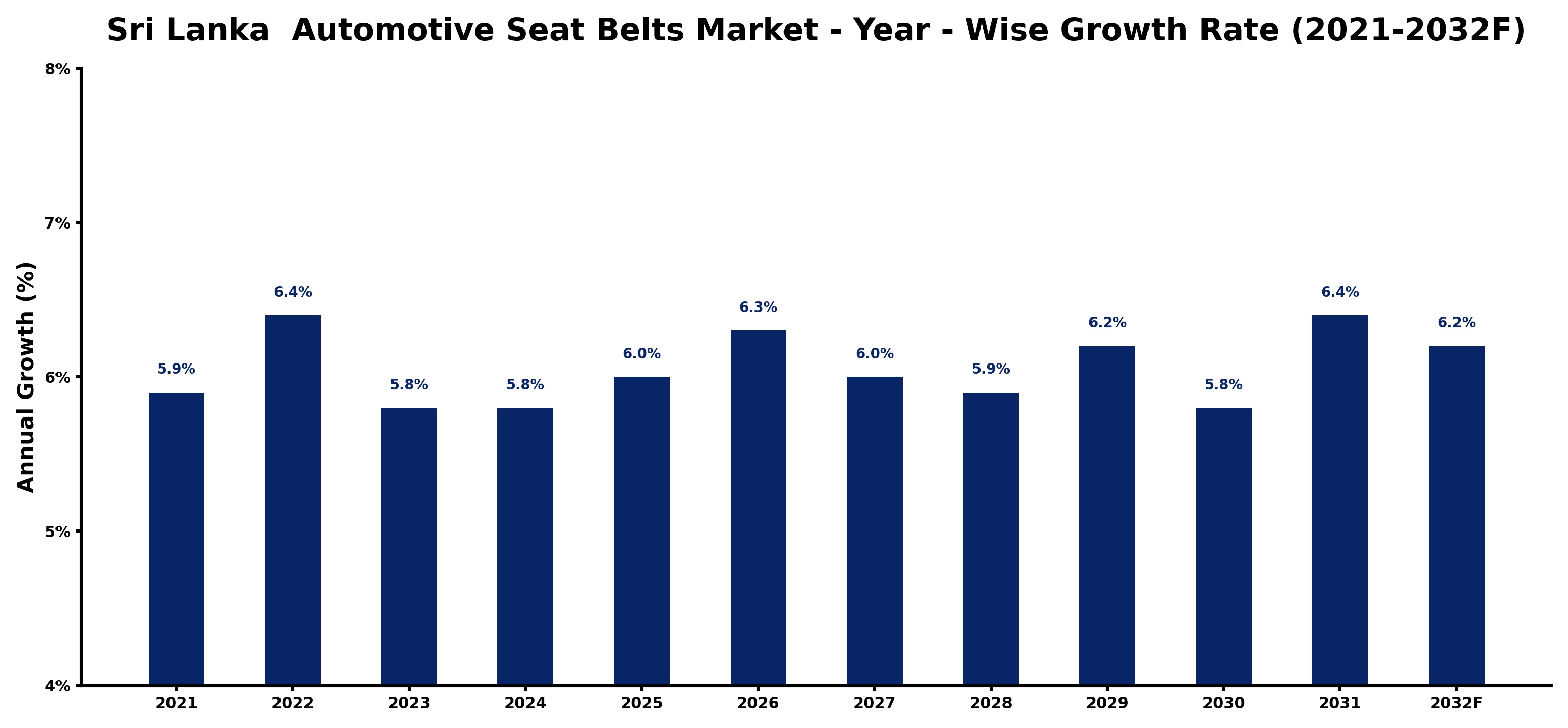
The table below presents the year‑wise growth rates along with the key drivers influencing the market
| Year | Growth Rate | Major Drivers |
| 2021 | 5.9% | Rising vehicle production demands safety |
| 2022 | 6.4% | Increased consumer safety awareness growth |
| 2023 | 5.8% | Government regulations enhanced compliance standards |
| 2024 | 5.8% | Technological advancements improved product quality |
| 2025 | 6.0% | Growing automotive sector expanded options |
| 2026 | 6.3% | Rising disposable income increased purchases |
| 2027 | 6.0% | Enhanced manufacturing capabilities drove efficiency |
| 2028 | 5.9% | Export opportunities expanded market reach |
| 2029 | 6.2% | Emerging electric vehicles increased demand |
| 2030 | 5.8% | Sustainability trends influenced consumer choices |
| 2031 | 6.4% | Partnerships with automakers strengthened supply |
| 2032 | 6.2% | Innovative designs attracted new customers |
Note - Market size estimations and growth projections presented in this report are based on 6Wresearch's advanced forecasting approach, validated with industry datasets as of June 2026.
Sri Lanka Automotive Seat Belts Market Synopsis
The strongest force currently shaping the Sri Lanka Automotive Seat Belts Market is the rising consumer awareness regarding road safety. As motorists and passengers become more cognizant of the risks associated with driving without seat belts, there is a noticeable shift in consumer behavior towards adopting enhanced safety features in vehicles.
Additionally, government regulations mandating the use of seat belts are increasingly being enforced. This shift not only aims to enhance road safety but also contributes significantly to the overall market growth, as manufacturers respond to the demand for high-quality seat belt systems that incorporate advanced safety technologies.
Sri Lanka Automotive Seat Belts Market Key Takeaways
- The market is projected to grow significantly as consumers prioritize safety and compliance with government regulations.
- Technological advancements are leading to the development of innovative seat belt systems featuring smart sensors and integrated airbags.
- Enhanced comfort features in seat belts are becoming popular, with consumers seeking adjustable straps and improved padding.
- Government initiatives are focusing on strict enforcement of seat belt usage, promoting greater compliance among drivers and passengers.
- Investment opportunities abound due to the rising demand for high-quality, compliant seat belts that enhance passenger safety.
Evaluation of Restraints in Sri Lanka Automotive Seat Belts Market
Despite the promising growth potential, the Sri Lanka Automotive Seat Belts Market faces significant restraints. One of the primary challenges is the inconsistent enforcement of seat belt regulations, which results in a lack of public awareness regarding their crucial role in vehicle safety. Additionally, the presence of counterfeit or substandard seat belts poses safety risks, undermining trust in legitimate manufacturers. The high costs associated with advanced seat belt features may also deter consumers, further limiting market expansion.
Sri Lanka Automotive Seat Belts Market Trends
A notable trend in the Sri Lanka Automotive Seat Belts Market is the growing demand for advanced safety features such as seat belts equipped with smart sensors that can detect accidents. This technological evolution not only enhances occupant protection but also aligns with a broader global movement towards smarter vehicle technologies. Furthermore, there is a shift towards integrating comfort features into seat belt designs, as manufacturers seek to improve the overall driving experience while maintaining safety standards.
Sri Lanka Automotive Seat Belts Market Opportunities
The market presents lucrative investment opportunities, particularly in the domain of high-quality seat belts. As consumer awareness surrounding safety measures continues to rise, there is an increasing demand for seat belts that comply with stringent government regulations. This creates a fertile ground for investors interested in collaborating with automobile manufacturers to provide innovative and compliant seat belt solutions. Expanding distribution channels and leveraging digital marketing strategies to engage a wider consumer base are also promising avenues for growth.
Government Initiatives in the Sri Lanka Automotive Seat Belts Market
The Sri Lankan government has enacted policies aimed at improving road safety through stringent seat belt regulations. The Motor Traffic Act requires all passengers in vehicles to wear seat belts, supported by regular enforcement measures and penalties for non-compliance. In addition, the Department of Motor Traffic sets quality standards for seat belts, ensuring their efficacy in protecting occupants during accidents. These initiatives underscore the government's commitment to enhancing public safety and reducing road traffic injuries.
Future Insights of the Sri Lanka Automotive Seat Belts Market
Looking ahead to 2026-2032, the Sri Lanka Automotive Seat Belts Market appears to be on a robust growth path. The combination of rising vehicle sales, an evolving automotive landscape, and a sustained emphasis on safety regulations will likely drive market expansion. Furthermore, advancements in seat belt technologies, including smart features and enhanced safety mechanisms, are expected to meet the growing consumer demand for improved safety options. As both domestic and international players vie for market share, opportunities for innovation and compliance will flourish.
Sri Lanka Automotive Seat Belts Market Latest Developments (May 2025 - June 2026)
Recent developments in the Sri Lanka Automotive Seat Belts Market reflect a growing trend towards the incorporation of advanced safety features in vehicle designs. Manufacturers are increasingly introducing seat belts equipped with smart technologies that enhance safety during accidents. Additionally, industry stakeholders are prioritizing the promotion of compliance with seat belt laws through public awareness campaigns, aiming to educate consumers about the importance of seat belt usage for personal safety.
Sri Lanka Automotive Seat Belts Market - Key Attractiveness of the Report
- 10 Years of Market Numbers
- Historical Data Starting from 2022 to 2025
- Base Year: 2025
- Forecast Data until 2032
- Key Performance Indicators Impacting the Market
- Major Upcoming Developments and Projects
Key Highlights of the Report:
- Sri Lanka Automotive Seat Belts Market Outlook
- Market Size of Sri Lanka Automotive Seat Belts Market, 2025
- Forecast of Sri Lanka Automotive Seat Belts Market, 2032
- Historical Data and Forecast of Sri Lanka Automotive Seat Belts Revenues & Volume for the Period 2022-2032F
- Sri Lanka Automotive Seat Belts Market Trend Evolution
- Sri Lanka Automotive Seat Belts Market Drivers and Challenges
- Sri Lanka Automotive Seat Belts Price Trends
- Sri Lanka Automotive Seat Belts Porter's Five Forces
- Sri Lanka Automotive Seat Belts Industry Life Cycle
- Historical Data and Forecast of Sri Lanka Automotive Seat Belts Market Revenues & Volume By Type for the Period 2022-2032F
- Historical Data and Forecast of Sri Lanka Automotive Seat Belts Market Revenues & Volume By 2-point Seatbelt for the Period 2022-2032F
- Historical Data and Forecast of Sri Lanka Automotive Seat Belts Market Revenues & Volume By 3-point Seatbelt for the Period 2022-2032F
- Historical Data and Forecast of Sri Lanka Automotive Seat Belts Market Revenues & Volume By Vehicle for the Period 2022-2032F
- Historical Data and Forecast of Sri Lanka Automotive Seat Belts Market Revenues & Volume By Passenger Cars for the Period 2022-2032F
- Historical Data and Forecast of Sri Lanka Automotive Seat Belts Market Revenues & Volume By Light Commercial Vehicles for the Period 2022-2032F
- Historical Data and Forecast of Sri Lanka Automotive Seat Belts Market Revenues & Volume By Heavy Commercial Vehicles for the Period 2022-2032F
- Historical Data and Forecast of Sri Lanka Automotive Seat Belts Market Revenues & Volume By Component for the Period 2022-2032F
- Historical Data and Forecast of Sri Lanka Automotive Seat Belts Market Revenues & Volume By Webbing strap for the Period 2022-2032F
- Historical Data and Forecast of Sri Lanka Automotive Seat Belts Market Revenues & Volume By Retractor for the Period 2022-2032F
- Historical Data and Forecast of Sri Lanka Automotive Seat Belts Market Revenues & Volume By Buckle for the Period 2022-2032F
- Historical Data and Forecast of Sri Lanka Automotive Seat Belts Market Revenues & Volume By Tongue for the Period 2022-2032F
- Historical Data and Forecast of Sri Lanka Automotive Seat Belts Market Revenues & Volume By Pillar Loop for the Period 2022-2032F
- Historical Data and Forecast of Sri Lanka Automotive Seat Belts Market Revenues & Volume By Distribution Channels for the Period 2022-2032F
- Historical Data and Forecast of Sri Lanka Automotive Seat Belts Market Revenues & Volume By OEM for the Period 2022-2032F
- Historical Data and Forecast of Sri Lanka Automotive Seat Belts Market Revenues & Volume By Aftermarket for the Period 2022-2032F
- Sri Lanka Automotive Seat Belts Import Export Trade Statistics
- Market Opportunity Assessment By Type
- Market Opportunity Assessment By Vehicle
- Market Opportunity Assessment By Component
- Market Opportunity Assessment By Distribution Channels
- Sri Lanka Automotive Seat Belts Top Companies Market Share
- Sri Lanka Automotive Seat Belts Competitive Benchmarking By Technical and Operational Parameters
- Sri Lanka Automotive Seat Belts Company Profiles
- Sri Lanka Automotive Seat Belts Key Strategic Recommendations






































