Sri Lanka Bulletproof Glass Market Size, Share & Growth Rate
The Sri Lanka Bulletproof Glass Market was estimated at USD 424 Million in 2025 and is projected to reach USD 563 Million by 2032, growing at a CAGR of 4.1% from 2026 to 2032. This growth trajectory is largely fueled by rising security concerns among both individuals and businesses, driven by increasing crime rates and a heightened need for safety in various sectors, including banking and public infrastructure. Additionally, government initiatives aimed at reinforcing safety standards in construction and public transport are accelerating the adoption of bulletproof glass solutions.
Sri Lanka Bulletproof Glass Market Year-wise Growth Rate and Key Drivers
This graph highlights how the Sri Lanka Bulletproof Glass Market has steadily grown over the years, supported by major growth factors.
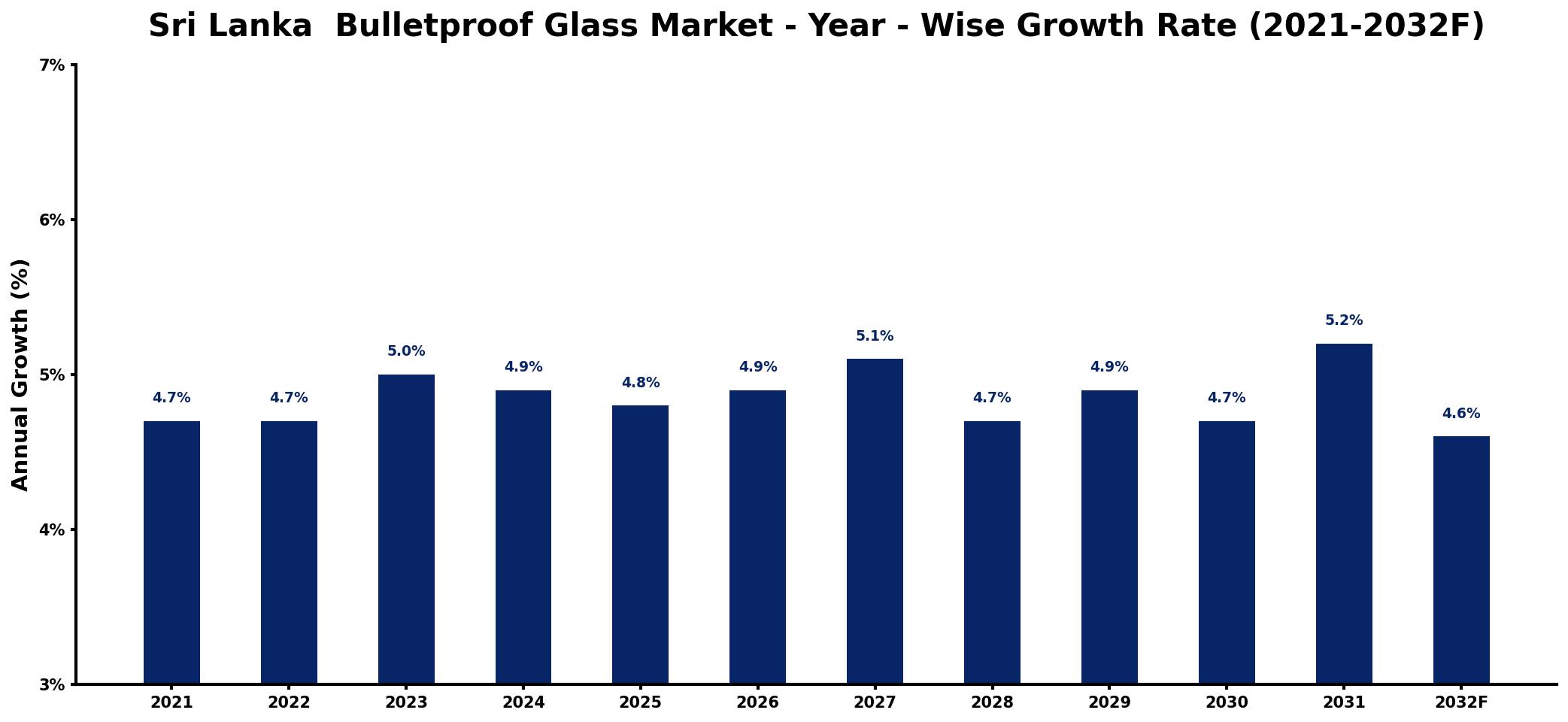
The table below presents the year‑wise growth rates along with the key drivers influencing the market
| Year | Growth Rate | Major Drivers |
| 2021 | 4.7% | increased security demand from sectors |
| 2022 | 4.7% | growing investments in safety technologies |
| 2023 | 5.0% | expansion of construction industry projects |
| 2024 | 4.9% | rising concerns over personal safety |
| 2025 | 4.8% | enhanced regulations for building safety |
| 2026 | 4.9% | growing awareness of security features |
| 2027 | 5.1% | increased government spending on security |
| 2028 | 4.7% | higher demand from automotive sector |
| 2029 | 4.9% | surge in residential security installations |
| 2030 | 4.7% | expanding healthcare application demand |
| 2031 | 5.2% | growing international security collaborations |
| 2032 | 4.6% | increased focus on luxury properties |
Note: Market size estimations and growth projections presented in this report are based on 6Wresearch's proprietary forecasting methodology, utilizing the latest available industry data, government publications, and primary research inputs.
Sri Lanka Bulletproof Glass Market Synopsis
Recent events in Sri Lanka have led to a growing urgency for enhanced security measures, making bulletproof glass a crucial investment in various sectors. With rising concerns over safety, institutions are increasingly opting for advanced protective solutions, prompting significant market activity.
The bulletproof glass sector is not just expanding in terms of demand but also evolving technologically. The pursuit of lighter, stronger materials is transforming production practices, ensuring that the market aligns with contemporary safety expectations without sacrificing performance.
Sri Lanka Bulletproof Glass Market Key Takeaways
- Rising crime rates and safety regulations are prime drivers for market growth.
- Technological advancements are enhancing product performance, appealing to diverse sectors.
- Government initiatives focus on public safety, boosting demand for security solutions.
- Market growth is supported by increased construction activities in urban areas.
- Limited local production capabilities create dependencies on imports, affecting costs.
Evaluation of Restraints in Sri Lanka Bulletproof Glass Market
Despite the promising growth outlook for the Sri Lanka bulletproof glass market, several factors limit its expansion. The high cost of production remains a significant barrier, compounded by the necessity for advanced manufacturing technologies that are not yet widely available locally. Stricter safety standards and certification requirements impose additional challenges, further escalating operational expenses. Additionally, the relative lack of awareness regarding the benefits of bulletproof glass limits its adoption across sectors that would otherwise benefit from enhanced security features.
Sri Lanka Bulletproof Glass Market Trends
The trend towards customization in bulletproof glass products is gaining traction, as consumers seek solutions tailored to specific security needs. Furthermore, the integration of smart technology with bulletproof glass solutions is on the rise, creating opportunities for enhanced security features that go beyond traditional protection. As urbanization accelerates, the demand for bulletproof glass in both commercial and residential construction continues to rise, reflecting a growing expectation of safety in everyday environments.
Sri Lanka Bulletproof Glass Market Opportunities
As the market matures, several growth opportunities are emerging. Investment in R&D to develop innovative materials could reduce costs and improve product performance, attracting a broader customer base. Additionally, sectors like automotive are increasingly integrating bulletproof glass in their offerings, especially within the banking and security sectors. The expansion of infrastructure projects in high-risk areas presents another lucrative avenue for growth, as government mandates increasingly emphasize security.
Government Initiatives in the Sri Lanka Bulletproof Glass Market
The Sri Lankan government is actively enhancing public safety protocols, particularly in regions identified as high-risk. This initiative includes implementing regulations that require safety measures in public buildings and transportation systems, thus boosting demand for bulletproof glass. Additionally, ongoing investments in infrastructure improvement are linked to security enhancements, further establishing a favorable environment for market expansion.
Future Insights of the Sri Lanka Bulletproof Glass Market
Looking forward to the period between 2026 and 2032, the Sri Lanka bulletproof glass market is poised for significant growth. An increasing focus on safety and security will drive both demand and innovation in product offerings. Furthermore, the ongoing rise in urbanization and commercial development will provide a robust foundation for market expansion, making bulletproof glass a staple in security solutions across various sectors.
Sri Lanka Bulletproof Glass Market Latest Developments (2025 - 2026)
The industry is witnessing a notable shift towards sustainable practices, with manufacturers exploring eco-friendly materials and production techniques. There is also a surge in collaborative efforts between government and private sectors to enhance safety standards and product availability, reflecting a broader commitment to public welfare. Additionally, advances in technology are enabling the introduction of new product lines that cater to emerging security needs.
Sri Lanka Bulletproof Glass Market - Key Attractiveness of the Report
- 10 Years of Market Numbers
- Historical Data Starting from 2022 to 2025
- Base Year: 2025
- Forecast Data until 2032
- Key Performance Indicators Impacting the Market
- Major Upcoming Developments and Projects
Key Highlights of the Report:
- Sri Lanka Bulletproof Glass Market Outlook
- Market Size of Sri Lanka Bulletproof Glass Market, 2025
- Forecast of Sri Lanka Bulletproof Glass Market, 2032
- Historical Data and Forecast of Sri Lanka Bulletproof Glass Revenues & Volume for the Period 2022-2032F
- Sri Lanka Bulletproof Glass Market Trend Evolution
- Sri Lanka Bulletproof Glass Market Drivers and Challenges
- Sri Lanka Bulletproof Glass Price Trends
- Sri Lanka Bulletproof Glass Porter's Five Forces
- Sri Lanka Bulletproof Glass Industry Life Cycle
- Historical Data and Forecast of Sri Lanka Bulletproof Glass Market Revenues & Volume By Type for the Period 2022-2032F
- Historical Data and Forecast of Sri Lanka Bulletproof Glass Market Revenues & Volume By Solid Acrylic for the Period 2022-2032F
- Historical Data and Forecast of Sri Lanka Bulletproof Glass Market Revenues & Volume By Traditional Laminated for the Period 2022-2032F
- Historical Data and Forecast of Sri Lanka Bulletproof Glass Market Revenues & Volume By Polycarbonate for the Period 2022-2032F
- Historical Data and Forecast of Sri Lanka Bulletproof Glass Market Revenues & Volume By Glass-clad Polycarbonate for the Period 2022-2032F
- Historical Data and Forecast of Sri Lanka Bulletproof Glass Market Revenues & Volume By Other Types for the Period 2022-2032F
- Historical Data and Forecast of Sri Lanka Bulletproof Glass Market Revenues & Volume By End-user Industry for the Period 2022-2032F
- Historical Data and Forecast of Sri Lanka Bulletproof Glass Market Revenues & Volume By Automotive for the Period 2022-2032F
- Historical Data and Forecast of Sri Lanka Bulletproof Glass Market Revenues & Volume By Buildings and Construction for the Period 2022-2032F
- Historical Data and Forecast of Sri Lanka Bulletproof Glass Market Revenues & Volume By Defense for the Period 2022-2032F
- Historical Data and Forecast of Sri Lanka Bulletproof Glass Market Revenues & Volume By Other End-user Industries for the Period 2022-2032F
- Sri Lanka Bulletproof Glass Import Export Trade Statistics
- Market Opportunity Assessment By Type
- Market Opportunity Assessment By End-user Industry
- Sri Lanka Bulletproof Glass Top Companies Market Share
- Sri Lanka Bulletproof Glass Competitive Benchmarking By Technical and Operational Parameters
- Sri Lanka Bulletproof Glass Company Profiles
- Sri Lanka Bulletproof Glass Key Strategic Recommendations






































