Sri Lanka Coir Market Size Growth Rate
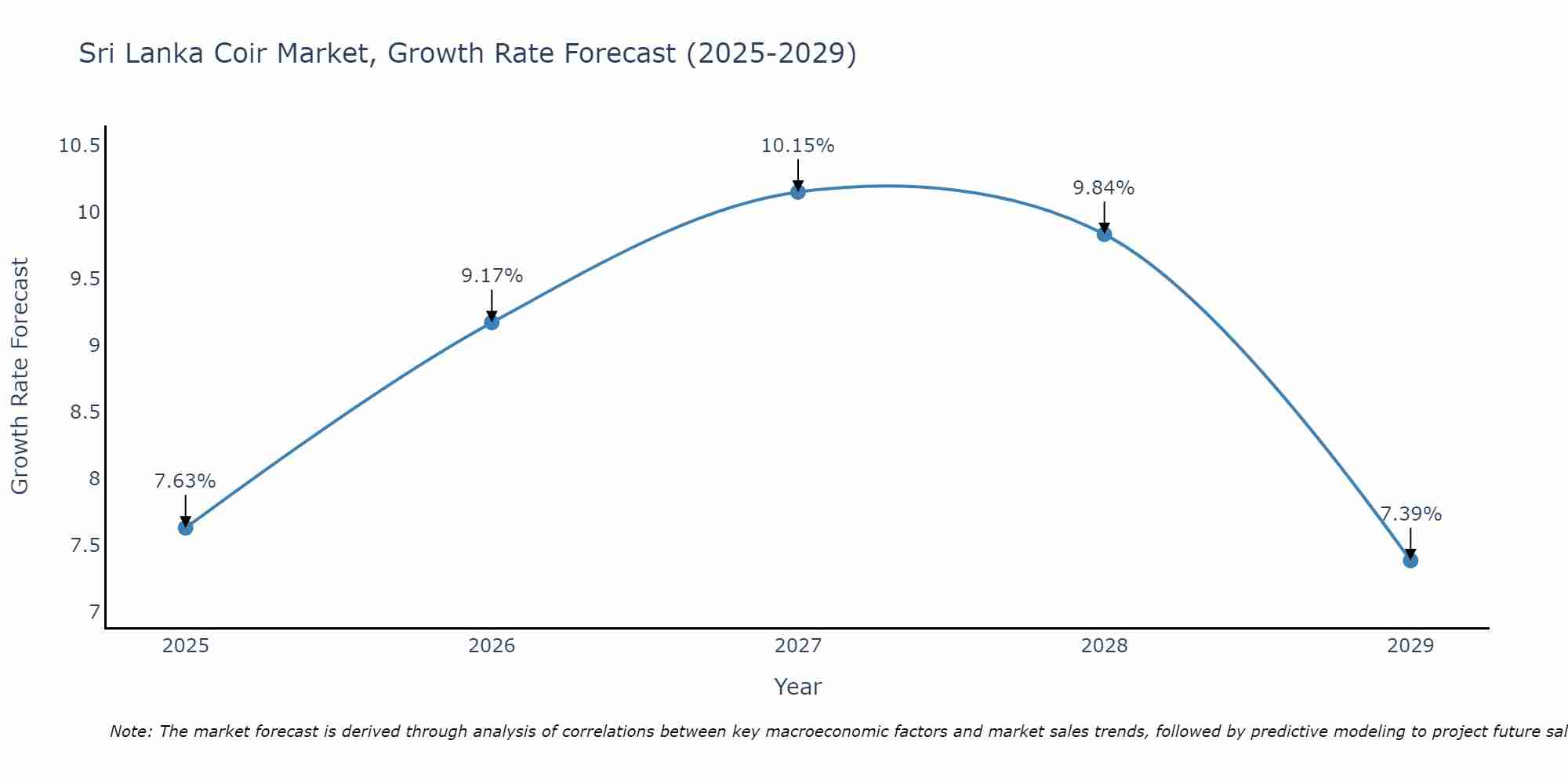
The Sri Lanka Coir Market is projected to witness mixed growth rate patterns during 2025 to 2029. The growth rate begins at 7.63% in 2025, climbs to a high of 10.15% in 2027, and moderates to 7.39% by 2029.
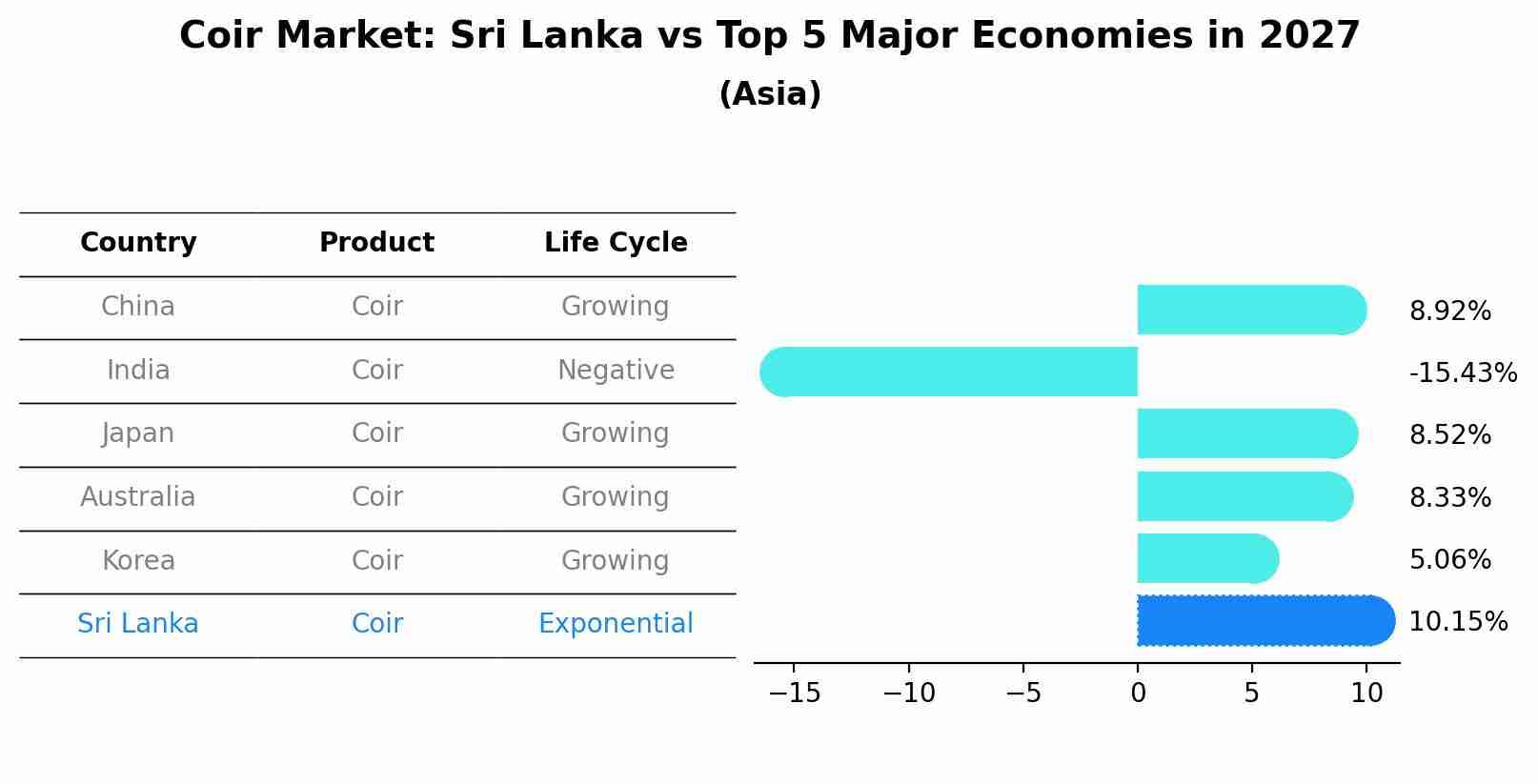
Coir Market: Sri Lanka vs Top 5 Major Economies in 2027 (Asia)
By 2027, the Coir market in Sri Lanka is anticipated to reach a growth rate of 10.15%, as part of an increasingly competitive Asia region, where China remains at the forefront, supported by India, Japan, Australia and South Korea, driving innovations and market adoption across sectors.
Sri Lanka Coir Market Synopsis
The Sri Lanka coir market is a significant industry within the country`s agricultural sector, with coir products being a major export commodity. Coir, derived from coconut husks, is widely used for various applications such as mats, ropes, geotextiles, and erosion control products. The market is driven by the country`s abundant coconut plantations, which provide a sustainable source of raw material for coir production. Sri Lanka`s reputation for producing high-quality coir products has helped it establish a strong presence in the global market, with key export destinations including Europe, North America, and Asia. The market is characterized by a mix of small-scale producers and larger manufacturing companies, with a focus on innovation and sustainability to meet the growing demand for eco-friendly products.
Sri Lanka Coir Market Trends
The Sri Lanka Coir Market is experiencing several key trends. Firstly, there is a growing demand for eco-friendly and sustainable products, which has led to an increased interest in coir-based products due to their biodegradability and renewability. Additionally, manufacturers are focusing on product innovation to cater to diverse consumer preferences, such as coir mats, brushes, and geotextiles. The market is also witnessing a rise in export opportunities, with Sri Lanka being a major player in the global coir industry. Furthermore, there is a trend towards mechanization and modernization of coir production processes to enhance efficiency and quality standards. Overall, the Sri Lanka Coir Market is evolving to meet the demands of environmentally conscious consumers while also exploring new avenues for growth and expansion.
Sri Lanka Coir Market Challenges
In the Sri Lankan coir market, one of the main challenges faced is fluctuating raw material prices due to factors such as climate change impacting coconut production. This can lead to instability in production costs for coir manufacturers. Additionally, competition from synthetic alternatives in the global market poses a threat to the traditional coir industry in Sri Lanka. Lack of technological advancements and modernization in the production processes also hinders the industry`s ability to meet quality and efficiency standards demanded by international buyers. Furthermore, issues related to labor availability, skills training, and compliance with environmental and labor regulations present ongoing challenges for coir producers in Sri Lanka. Overcoming these challenges will require strategic investments in technology, sustainable practices, and market diversification.
Sri Lanka Coir Market Investment Opportunities
Investment opportunities in the Sri Lanka Coir Market include potential for growth in coir products such as coir fiber, coir yarn, and coir-based products like mats, rugs, and geotextiles. The demand for eco-friendly and sustainable products is increasing globally, presenting an opportunity for coir as a renewable and biodegradable material. Investing in modernizing production processes, expanding product lines, and improving quality standards could help companies in Sri Lanka capture a larger share of the international coir market. Additionally, exploring new applications for coir, such as in the construction industry for reinforcement or insulation, could open up new revenue streams. Overall, investing in the Sri Lanka Coir Market offers the potential for long-term growth and profitability in a sector that aligns with sustainability trends.
Jordan Agar Market Government Policies
Government policies related to the Sri Lanka Coir Market aim to support and promote the coir industry, which is a significant sector in the country. The government provides various incentives and subsidies to coir producers, such as financial assistance for modernizing production techniques and infrastructure, promoting research and development in the industry, and facilitating access to international markets through trade agreements. Additionally, there are regulations in place to ensure sustainable practices in coir production, including environmental protection measures and fair labor standards. The government also encourages the use of coir products in domestic construction and agriculture sectors to boost local demand. Overall, government policies in Sri Lanka are focused on fostering the growth and competitiveness of the coir market while promoting sustainable and ethical practices.
Sri Lanka Coir Market Future Outlook
The Sri Lanka coir market is expected to witness steady growth in the coming years due to the increasing demand for eco-friendly and sustainable products globally. Coir, derived from coconut husks, is gaining popularity as an alternative to traditional materials for various applications such as agriculture, horticulture, geotextiles, and erosion control. The country`s well-established coir industry, skilled labor force, and favorable agro-climatic conditions are key factors driving the market growth. Additionally, the rising awareness about the environmental benefits of coir products, such as biodegradability and renewable sourcing, is expected to further propel market expansion. With ongoing research and innovation in coir processing techniques and product development, the Sri Lanka coir market is poised for continuous development and diversification in the foreseeable future.
Key Highlights of the Report:
- Sri Lanka Coir Market Outlook
- Market Size of Sri Lanka Coir Market, 2021
- Forecast of Sri Lanka Coir Market, 2031
- Historical Data and Forecast of Sri Lanka Coir Revenues & Volume for the Period 2018 - 2031
- Sri Lanka Coir Market Trend Evolution
- Sri Lanka Coir Market Drivers and Challenges
- Sri Lanka Coir Price Trends
- Sri Lanka Coir Porter's Five Forces
- Sri Lanka Coir Industry Life Cycle
- Historical Data and Forecast of Sri Lanka Coir Market Revenues & Volume By Product Type for the Period 2018 - 2031
- Historical Data and Forecast of Sri Lanka Coir Market Revenues & Volume By White Fiber for the Period 2018 - 2031
- Historical Data and Forecast of Sri Lanka Coir Market Revenues & Volume By Brown Fiber for the Period 2018 - 2031
- Historical Data and Forecast of Sri Lanka Coir Market Revenues & Volume By Nature for the Period 2018 - 2031
- Historical Data and Forecast of Sri Lanka Coir Market Revenues & Volume By Organic for the Period 2018 - 2031
- Historical Data and Forecast of Sri Lanka Coir Market Revenues & Volume By Conventional for the Period 2018 - 2031
- Historical Data and Forecast of Sri Lanka Coir Market Revenues & Volume By Source for the Period 2018 - 2031
- Historical Data and Forecast of Sri Lanka Coir Market Revenues & Volume By Green Coconuts for the Period 2018 - 2031
- Historical Data and Forecast of Sri Lanka Coir Market Revenues & Volume By Brown Coconuts for the Period 2018 - 2031
- Historical Data and Forecast of Sri Lanka Coir Market Revenues & Volume By Form for the Period 2018 - 2031
- Historical Data and Forecast of Sri Lanka Coir Market Revenues & Volume By Bales for the Period 2018 - 2031
- Historical Data and Forecast of Sri Lanka Coir Market Revenues & Volume By Blocks for the Period 2018 - 2031
- Historical Data and Forecast of Sri Lanka Coir Market Revenues & Volume By Disks & Coins for the Period 2018 - 2031
- Historical Data and Forecast of Sri Lanka Coir Market Revenues & Volume By Husk Chips for the Period 2018 - 2031
- Historical Data and Forecast of Sri Lanka Coir Market Revenues & Volume By Grow Bags & Open Top for the Period 2018 - 2031
- Historical Data and Forecast of Sri Lanka Coir Market Revenues & Volume By Rope for the Period 2018 - 2031
- Sri Lanka Coir Import Export Trade Statistics
- Market Opportunity Assessment By Product Type
- Market Opportunity Assessment By Nature
- Market Opportunity Assessment By Source
- Market Opportunity Assessment By Form
- Sri Lanka Coir Top Companies Market Share
- Sri Lanka Coir Competitive Benchmarking By Technical and Operational Parameters
- Sri Lanka Coir Company Profiles
- Sri Lanka Coir Key Strategic Recommendations






































