Sri Lanka Confectionery Market: Import Trend Analysis
In 2023-2024, Sri Lanka confectionery market import trend exhibited a growth rate of 1.83%, contrasting with a negative Compound Annual Growth Rate (CAGR) of -10.16% from 2020-2024. This decline in CAGR could be attributed to shifts in consumer preferences or changes in trade policies impacting imports.
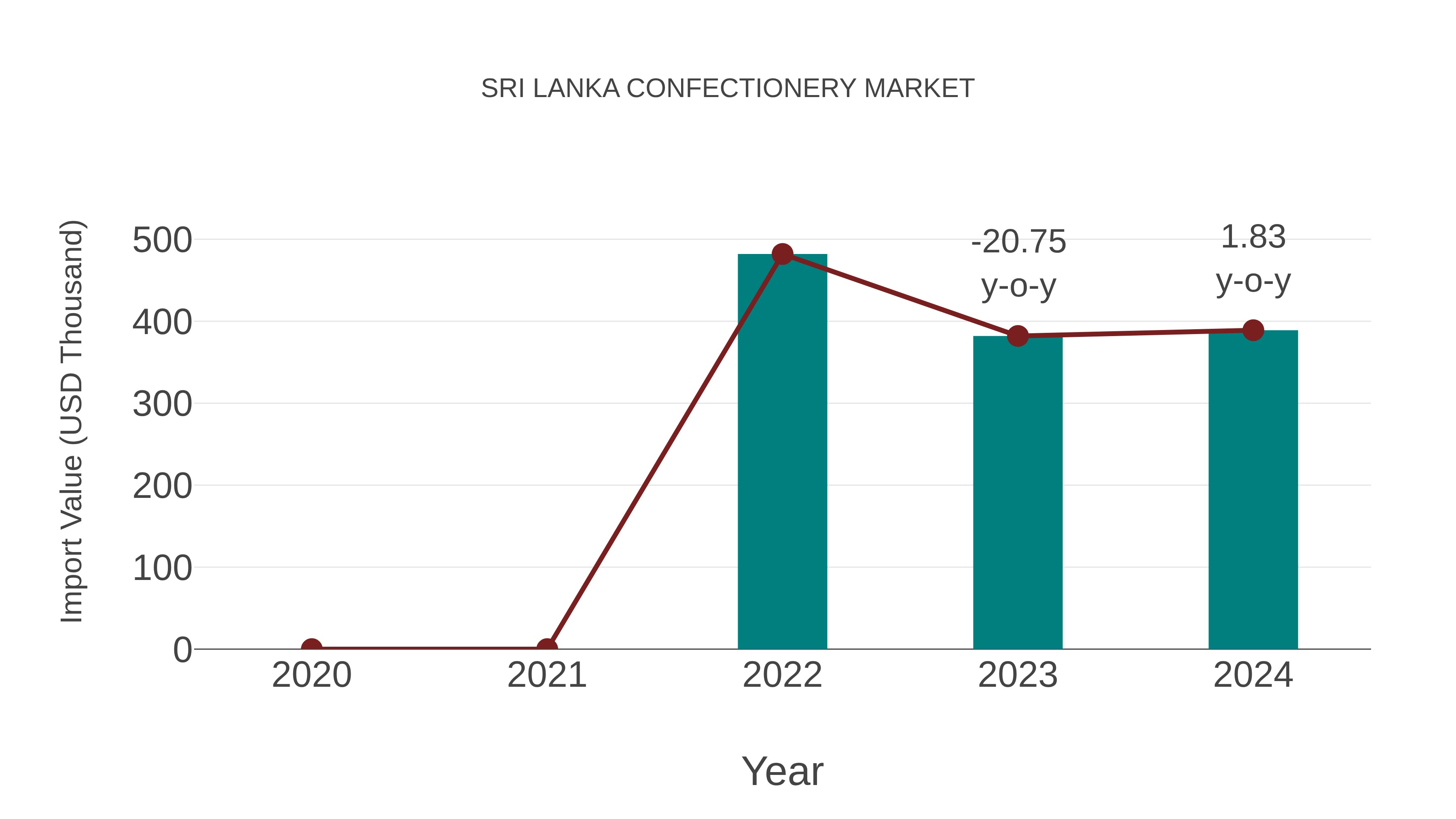
Sri Lanka Confectionery Market Growth Rate
According to 6Wresearch internal database and industry insights,
Topics Covered in the Sri Lanka Confectionery Market Report
The Sri Lanka Confectionery Market report thoroughly covers the market by type and distribution channels. The report provides an unbiased and detailed analysis of ongoing market trends, opportunities/high growth areas, and market drivers, helping stakeholders align strategies with current and future market dynamics.
Sri Lanka Confectionery Market Highlights
| Report Name | Sri Lanka Confectionery Market |
| Forecast period | 2026-2032 |
| CAGR | 7.2% |
| Growing Sector | Supermarket/Hypermarket |
Sri Lanka Confectionery Market Synopsis
The Sri Lanka Confectionery Market is expected to experience rapid growth throughout its development. The market expansion is driven by increasing demand for sugar and chocolate and fine bakery products in both domestic markets and retail stores which is further enhanced by rising urbanization and higher consumer spending power. The market growth receives additional support from government policies which provide tax incentives for local confectionery manufacturing and export promotion initiatives. The increasing demand for high-end and imported candy products in urban regions drives the growth of the market.
Evaluation of Growth Drivers in the Sri Lanka Confectionery Market
Below mentioned are some growth drivers and their impact on market dynamics:
| Drivers | Primary Segments Affected | Why It Matters |
| Government Support & Export Incentives | Type (Chocolate, Sugar) | Encourages local manufacturing and export growth. |
| Rising Urban Consumption | Type (Chocolate, Fine Bakery Wares) | Expands demand in cities and retail outlets. |
| Health-Conscious Consumer Trends | Type (Sugar, Chocolate) | Drives demand for low-sugar, fortified, or healthier confectionery options. |
| Expansion of Retail Chains | Distribution Channels (Supermarkets/Hypermarkets) | Enhances product availability and market penetration. |
| Product Innovation & Premiumization | Type (Chocolate, Fine Bakery Wares) | Attracts consumers seeking quality and novel flavors. |
Sri Lanka Confectionery Market is expected to grow robustly at a CAGR of 7.2% during the forecast period of 2026-2032. The Sri Lanka Confectionery Market experiences growth as urban areas become more populated and people in cities gain more money to spend on expensive sweet treats. Consumers who want healthier choices drive the development of sweet products which contain reduced sugar content and added health benefits and natural organic components. The growth of new retail stores and online shopping websites provides customers with better access to products which helps increase sales. The government programs which support domestic sugar and cocoa production and offer financial support for factory upgrades, create a stronger base for local production. The market expands and investment opportunities grow as changes in human behavior and increased tourism and export grows.
Evaluation of Restraints in the Sri Lanka Confectionery Market
Below mentioned are some major restraints and their influence on market dynamics:
| Restraints | Primary Segments Affected | What This Means |
| Price Volatility of Raw Materials | All Segments | Affects product costs and profit margins. |
| High Import Dependence | Type (Chocolate, Fine Bakery Wares) | Limits local supply and increases reliance on imports. |
| Competition from Alternative Snacks | Type (Sugar, Chocolate) | Reduces demand for traditional confectionery products. |
| Limited Cold Chain Infrastructure | Distribution Channels (Specialist Retailers, Online Stores) | Affects quality and shelf life of perishable confectionery. |
| Regulatory Compliance Costs | Type (Sugar, Chocolate) | Increases production costs due to labeling and safety regulations. |
Sri Lanka Confectionery Market Challenges
The Sri Lanka confectionery market encounters difficulties as high import costs for cocoa and sugar and packaging materials cause product prices to rise. The local manufacturing capacity restricts production of high-quality and specialty confectionery products. The changing prices of raw materials create unpredictable cost challenges for producers. Imported brands create strong competition that decreases the market share of domestic companies. The company faces two major challenges which include distribution problems in rural areas and distribution network limitations. The companies needs to follow regulations and quality standards to ensure profit and expand into new markets.
Sri Lanka Confectionery Market Trends
Some major trends contributing to the Sri Lanka Confectionery Market growth are:
- Health-Conscious Confectionery: There is a growing demand among consumers for healthy and low sugar options due to increased fitness and health trends.
- Premium & Imported Products: The premium and imported goods are expected to have accelerated demand by urban consumers seeking quality, luxury, and international confectionery experiences.
- E-commerce & Online Retail Growth: The increased internet penetration and usage of online retail home delivery platforms is expected to encourage the market growth.
Investment Opportunities in the Sri Lanka Confectionery Market
Here are some investment opportunities in the Sri Lanka Confectionery Industry:
- Product Innovation & Premium Offerings: The consumers are demanding more of unique flavors and ready-to-eat snacks which are healthier and have enhanced taste.
- Functional & Health-Focused Confectionery: The investment can be made upon the making of low sugar and organic confectionary items due to increasing health consciousness trends.
- E-commerce & Direct-to-Consumer Platforms: The online retail platforms are expected to accelerate the industry growth by providing ease of accessibility and wide range product offerings to the consumers.
Top 5 Leading Players in the Sri Lanka Confectionery Market
Here are some top companies contributing to Sri Lanka Confectionery Market Share:
1. Ceylon Biscuits Limited
| Company Name | Ceylon Biscuits Limited |
|---|---|
| Established Year | 1968 |
| Headquarters | Colombo, Sri Lanka |
| Official Website | Click Here |
Ceylon Biscuits Limited produces a wide range of biscuits, chocolates, and confectionery products. The company focuses on quality, product innovation, and export expansion, enabling it to maintain a strong position in Sri Lanka’s confectionery market.
2. Anchor Lanka
| Company Name | Anchor Dairy |
|---|---|
| Established Year | 1991 |
| Headquarters | Colombo, Sri Lanka |
| Official Website | Click Here |
Anchor Dairy offers chocolate and sugar confectionery products designed for both domestic and international markets. The company focuses on modern manufacturing processes and efficient distribution networks to strengthen its market presence.
3. Cargills Ceylon PLC
| Company Name | Cargills Ceylon PLC |
|---|---|
| Established Year | 1844 |
| Headquarters | Colombo, Sri Lanka |
| Official Website | Click Here |
Cargills Ceylon PLC produces and distributes a variety of confectionery and bakery products. The company leverages its strong retail network and brand recognition across Sri Lanka to support widespread product availability.
4. Nestlé Lanka
| Company Name | Nestlé Lanka |
|---|---|
| Established Year | 1990 |
| Headquarters | Colombo, Sri Lanka |
| Official Website | Click Here |
Nestlé Lanka offers a broad portfolio of chocolate, candy, and sugar confectionery products. The company emphasizes strict quality standards, research and development, and continuous innovation to maintain a strong presence in the premium confectionery segment.
5. Fine Confectionery Ltd.
| Company Name | Fine Confectionery Ltd. |
|---|---|
| Established Year | 1985 |
| Headquarters | Colombo, Sri Lanka |
| Official Website | Click Here |
Fine Confectionery Ltd. manufactures chocolates, sugar confectionery, and specialty bakery products. The company focuses on developing innovative flavors, maintaining export-quality standards, and adapting to evolving consumer preferences in both domestic and international markets.
Government Regulations Introduced in the Sri Lanka Confectionery Market
According to Sri Lankan government data, the Sri Lanka Confectionery Market is well regulated by various government policy ensuring the smooth expansion of the industry. All the regulations are aimed at ensuring food safety and quality standards. Also, Sri Lanka Standards Institution (SLSI) monitors confectionery production, enforcing labeling, hygiene, and nutritional guidelines. Initiatives that promote local sugar and cocoa sourcing work to support domestic manufacturers while they simultaneously decrease their need to import materials. Tax incentives and grants for modernizing production facilities encourage compliance with international quality norms. The regulations work together to improve consumer safety while they build market trust and support growth.
Future Insights of the Sri Lanka Confectionery Market
The Sri Lanka Confectionery Market is expected to have consistent growth. the market growth is driven by growing demand among consumers for high-quality modern products. Other than that, the market growth is driven by increasing spending power of consumers and growth in urbanization. Besides the market expansion is driven by the growth of online retail platforms ensuring the smooth expansion of the industry by providing ease of accessibility and wide range product offering sto the consumers.
Market Segmentation Analysis
The report offers a comprehensive study of the subsequent market segments and their leading categories.
Chocolate to Dominate the Market – By Type
According to Guneet Kaur, Senior Research Analyst, 6Wresearch, chocolate dominates the market due to its widespread consumption across age groups. Premium and imported chocolate products are highly preferred in urban areas, boosting sales in both domestic retail and modern distribution channels.
Supermarkets/Hypermarkets to Dominate the Market – By Distribution Channel
Supermarkets and hypermarkets control the distribution system in Sri Lanka because of their easy access and their extensive product range. The retail stores create an interactive shopping environment through their valuable product displays and special promotional offers which attract customers who live in cities and have higher spending power.
Key attractiveness of the report
- 10 Years Market Numbers.
- Historical Data Starting from 2022 to 2025.
- Base Year: 2025
- Forecast Data until 2032.
- Key Performance Indicators Impacting the Market.
- Major Upcoming Developments and Projects.
Key Highlights of the Report:
- Sri Lanka Confectionery Market Outlook
- Market Size of Sri Lanka Confectionery Market, 2025
- Forecast of Sri Lanka Confectionery Market, 2032
- Historical Data and Forecast of Sri Lanka Confectionery Revenues & Volume for the Period 2022-2032F
- Sri Lanka Confectionery Market Trend Evolution
- Sri Lanka Confectionery Market Drivers and Challenges
- Sri Lanka Confectionery Price Trends
- Sri Lanka Confectionery Porter's Five Forces
- Sri Lanka Confectionery Industry Life Cycle
- Historical Data and Forecast of Sri Lanka Confectionery Market Revenues & Volume By Type for the Period 2022-2032F
- Historical Data and Forecast of Sri Lanka Confectionery Market Revenues & Volume By Sugar for the Period 2022-2032F
- Historical Data and Forecast of Sri Lanka Confectionery Market Revenues & Volume By Chocolate for the Period 2022-2032F
- Historical Data and Forecast of Sri Lanka Confectionery Market Revenues & Volume By Fine Bakery Wares for the Period 2022-2032F
- Historical Data and Forecast of Sri Lanka Confectionery Market Revenues & Volume By Others for the Period 2022-2032F
- Historical Data and Forecast of Sri Lanka Confectionery Market Revenues & Volume By Distribution Channel for the Period 2022-2032F
- Historical Data and Forecast of Sri Lanka Confectionery Market Revenues & Volume By Supermarket/Hypermarket for the Period 2022-2032F
- Historical Data and Forecast of Sri Lanka Confectionery Market Revenues & Volume By Specialist Retailers for the Period 2022-2032F
- Historical Data and Forecast of Sri Lanka Confectionery Market Revenues & Volume By Online Retail Stores for the Period 2022-2032F
- Historical Data and Forecast of Sri Lanka Confectionery Market Revenues & Volume By Convenience Stores for the Period 2022-2032F
- Historical Data and Forecast of Sri Lanka Confectionery Market Revenues & Volume By Other Distribution Channels for the Period 2022-2032F
- Sri Lanka Confectionery Import Export Trade Statistics
- Market Opportunity Assessment By Type
- Market Opportunity Assessment By Distribution Channel
- Sri Lanka Confectionery Top Companies Market Share
- Sri Lanka Confectionery Competitive Benchmarking By Technical and Operational Parameters
- Sri Lanka Confectionery Company Profiles
- Sri Lanka Confectionery Key Strategic Recommendations
Markets Covered
The report provides a detailed analysis of the following market segments:
By Type
- Sugar
- Chocolate
- Fine Bakery Wares
- Others
By Distribution Channel
- Supermarket/Hypermarket
- Specialist Retailers
- Online Retail Stores
- Convenience Stores
- Other Distribution Channels






































