Sri Lanka Contactless Payment Market Size & Growth Rate (2026-2032)
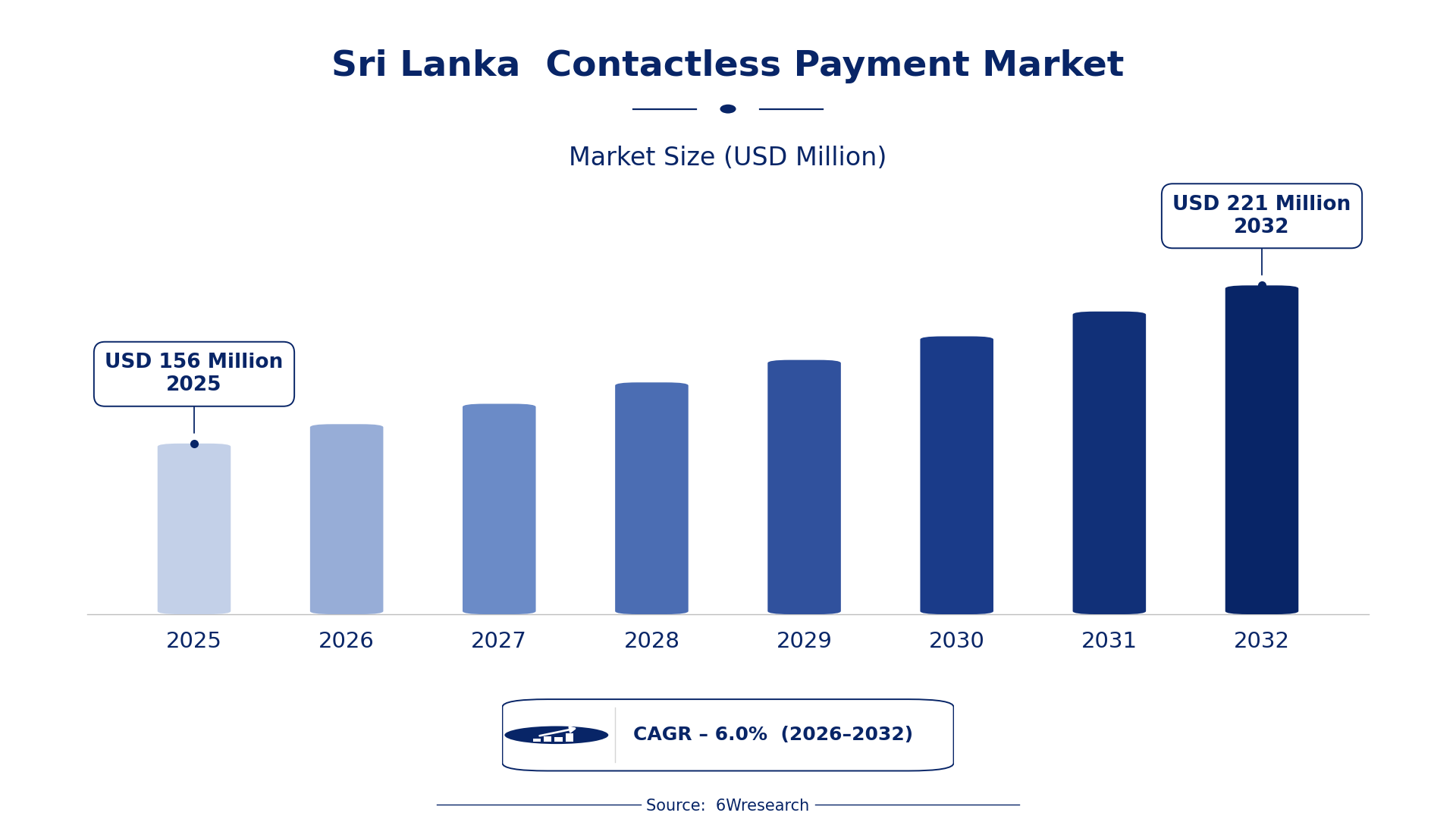
The Sri Lanka Contactless Payment Market was estimated at USD 156 Million in 2025 and is projected to reach USD 221 Million by 2032, growing at a CAGR of 6.0% from 2026 to 2032.
Sri Lanka Contactless Payment Market Synopsis
In Sri Lanka, the contactless payment market is witnessing a marked increase, with a notable shift in consumer preferences towards quicker and safer transactions. The ongoing digital transformation, coupled with heightened smartphone usage, has made contactless payments more accessible to a broader audience.
The COVID-19 pandemic acted as a catalyst for this shift, as more people sought hygienic payment methods. As merchants adapt to this change, the integration of digital wallets and contactless cards is gaining traction, fundamentally reshaping the payment ecosystem in the country.
Sri Lanka Contactless Payment Market Year-wise Growth Rate and Key Drivers
This graph illustrates the annual growth rates of the Sri Lanka Contactless Payment Market from 2021 to 2032, highlighting a steady upward trajectory and projected expansion over the forecast period.
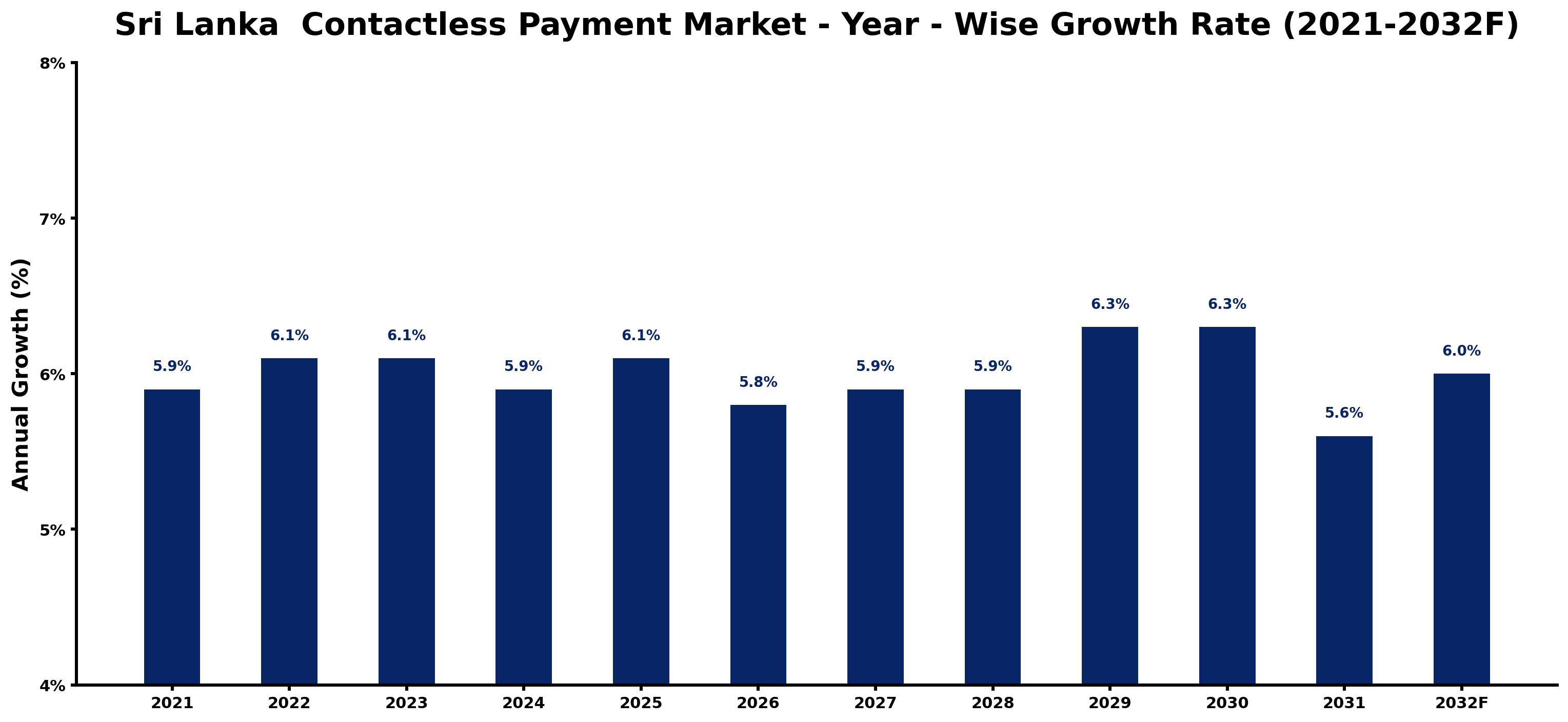
The table below presents the year‑wise growth rates along with the key drivers influencing the market
| Year | Growth Rate | Major Drivers |
| 2021 | 5.9% | Central Bank's push for digital transaction adoption |
| 2022 | 6.1% | Increased smartphone penetration among urban consumers |
| 2023 | 6.1% | Rise in e-commerce activity post-pandemic recovery |
| 2024 | 5.9% | Government incentives for cashless transactions implementation |
| 2025 | 6.1% | Growing youth demographic embracing digital wallets |
| 2026 | 5.8% | Launch of local fintech startups facilitating contactless payments |
| 2027 | 5.9% | Partnerships between banks and retailers expanding payment options |
| 2028 | 5.9% | Improved internet connectivity enhancing online payment security |
| 2029 | 6.3% | Regulatory support for mobile payment ecosystem development |
| 2030 | 6.3% | Cultural shift towards convenience and speed in transactions |
| 2031 | 5.6% | Increased consumer awareness of contactless payment benefits |
| 2032 | 6.0% | Integration of contactless technology in public transport systems |
Note: Market size estimations and growth projections presented in this report are based on 6Wresearch's proprietary forecasting methodology, utilizing the latest available industry data, government publications, and primary research inputs.
Sri Lanka Contactless Payment Market Key Takeaways
Below are some of the specific key takeaways from the market, including:
- The market is driven by increasing smartphone penetration and growing acceptance among merchants.
- COVID-19 has accelerated the adoption of contactless payment methods significantly.
- Government initiatives are focused on enhancing financial inclusion through digital payment systems.
- Security concerns and infrastructure limitations remain barriers to widespread adoption.
- Consumer behavior is shifting towards a preference for cashless transactions.
Evaluation of Restraints in Sri Lanka Contactless Payment Market
Despite its growth potential, the contactless payment market in Sri Lanka faces some critical obstacles. One of the primary challenges is the limited infrastructure, particularly in rural areas where contactless payment options are still sparse. This lack of access restricts usage, making it difficult for consumers to transition from cash. on top of that, ongoing concerns regarding transaction security and fraud prevention hinder consumer confidence. Stakeholders must work collaboratively to address these issues, enhancing security measures and expanding infrastructure to facilitate a wider acceptance of contactless payment solutions.
Sri Lanka Contactless Payment Market Trends
Several trends are currently shaping the Sri Lanka contactless payment market. The rise of mobile banking and digital wallets is redefining consumer expectations around payment convenience. Additionally, an increasing number of merchants are integrating contactless payment options into their operations, reflecting a growing acceptance of digital transactions. Emerging technologies, such as biometric authentication, are also gaining traction, promising to enhance security while streamlining the payment process. As consumers continue to prioritize ease and safety, these trends are expected to define the market's trajectory in the coming years.
Sri Lanka Contactless Payment Market Opportunities
The Sri Lanka contactless payment market presents several avenues for growth and investment. There is a substantial opportunity for expanding infrastructure in underserved areas, which could facilitate greater adoption of contactless payment methods. Additionally, partnerships between financial institutions and technology providers can drive innovation, particularly in enhancing security features. With the government actively promoting digital payments, companies that align their offerings with public initiatives stand to benefit from increased consumer trust and market penetration. The ongoing shift towards cashless transactions further underscores the potential for lucrative investments in this sector.
Government Initiatives in the Sri Lanka Contactless Payment Market
The Central Bank of Sri Lanka is at the forefront of initiatives aimed at fostering a secure and inclusive digital payment environment. Regulatory frameworks are being developed to enhance the safety of contactless transactions while ensuring interoperability among various payment systems. These government efforts are crucial in shaping the contactless payment market, especially in promoting the adoption of digital wallets and contactless methods in the post-COVID era.
- A national digital infrastructure upgrade programme initiated in 2023 aims to enhance payment accessibility across urban and rural areas.
- Current regulatory measures are being implemented to improve transaction security and encourage interoperability among payment systems.
- A planned public-private initiative set for 2025 will focus on educating consumers about the benefits of contactless payments.
- Ongoing efforts are underway to promote digital financial literacy as part of a broader strategy to improve financial inclusion.
- The government is evaluating pilot projects to incentivize merchants to adopt contactless payment solutions.
Future Insights of the Sri Lanka Contactless Payment Market
Looking ahead to 2026-2032, the Sri Lanka contactless payment market is expected to continue its upward trajectory. As infrastructure expands and consumer awareness grows, the reliance on cash transactions will diminish. The integration of advanced technologies, such as AI and machine learning, will enhance security measures and streamline transaction processes. The ongoing support from the government will further drive market growth, positioning Sri Lanka as a key player in the regional contactless payment ecosystem.
Sri Lanka Contactless Payment Market Latest Developments
Recent activity in the Sri Lanka contactless payment market reflects a growing commitment to enhancing digital transactions. Over the past year, stakeholders have been actively developing solutions to address both consumer needs and infrastructure gaps. The overall focus has been on improving security and user experience as the market continues to evolve.
- A major technology vendor announced the rollout of a new digital wallet service in early 2023, aimed at providing enhanced features for contactless payments.
- In Q1 2023, a leading regional operator launched an initiative to partner with local merchants, facilitating the integration of contactless payment systems across various sectors.
- Ongoing collaborations between fintech companies and banks are expected to produce innovative solutions by mid-2024, further boosting consumer adoption.
- A planned awareness campaign scheduled for late 2023 aims to educate the public about the benefits and safety of contactless payments.
- In early 2024, a pilot programme will be introduced to test new security measures in contactless transactions, enhancing consumer confidence.
Sri Lanka Contactless Payment Market - Key Attractiveness of the Report
- 10 Years of Market Numbers
- Historical Data Starting from 2022 to 2025
- Base Year: 2025
- Forecast Data until 2032
- Key Performance Indicators Impacting the Market
- Major Upcoming Developments and Projects
Key Highlights of the Report:
- Sri Lanka Contactless Payment Market Outlook
- Market Size of Sri Lanka Contactless Payment Market, 2025
- Forecast of Sri Lanka Contactless Payment Market, 2032
- Historical Data and Forecast of Sri Lanka Contactless Payment Revenues & Volume for the Period 2022-2032F
- Sri Lanka Contactless Payment Market Trend Evolution
- Sri Lanka Contactless Payment Market Drivers and Challenges
- Sri Lanka Contactless Payment Price Trends
- Sri Lanka Contactless Payment Porter's Five Forces
- Sri Lanka Contactless Payment Industry Life Cycle
- Historical Data and Forecast of Sri Lanka Contactless Payment Market Revenues & Volume By Component for the Period 2022-2032F
- Historical Data and Forecast of Sri Lanka Contactless Payment Market Revenues & Volume By Hardware for the Period 2022-2032F
- Historical Data and Forecast of Sri Lanka Contactless Payment Market Revenues & Volume By Solutions for the Period 2022-2032F
- Historical Data and Forecast of Sri Lanka Contactless Payment Market Revenues & Volume By Services for the Period 2022-2032F
- Historical Data and Forecast of Sri Lanka Contactless Payment Market Revenues & Volume By Vertical for the Period 2022-2032F
- Historical Data and Forecast of Sri Lanka Contactless Payment Market Revenues & Volume By Retail for the Period 2022-2032F
- Historical Data and Forecast of Sri Lanka Contactless Payment Market Revenues & Volume By Hospitality for the Period 2022-2032F
- Historical Data and Forecast of Sri Lanka Contactless Payment Market Revenues & Volume By Healthcare for the Period 2022-2032F
- Historical Data and Forecast of Sri Lanka Contactless Payment Market Revenues & Volume By Energy and Utilities for the Period 2022-2032F
- Historical Data and Forecast of Sri Lanka Contactless Payment Market Revenues & Volume By Transportation and Logistics for the Period 2022-2032F
- Historical Data and Forecast of Sri Lanka Contactless Payment Market Revenues & Volume By BFSI for the Period 2022-2032F
- Historical Data and Forecast of Sri Lanka Contactless Payment Market Revenues & Volume By Others (Government, telecommunications, and education) for the Period 2022-2032F
- Sri Lanka Contactless Payment Import Export Trade Statistics
- Market Opportunity Assessment By Component
- Market Opportunity Assessment By Vertical
- Sri Lanka Contactless Payment Top Companies Market Share
- Sri Lanka Contactless Payment Competitive Benchmarking By Technical and Operational Parameters
- Sri Lanka Contactless Payment Company Profiles
- Sri Lanka Contactless Payment Key Strategic Recommendations






































