Sri Lanka Distribution Boards Market Size, Share & Growth Rate
The Sri Lanka Distribution Boards Market was estimated at USD 1024 Million in 2025 and is projected to reach USD 1492 Million by 2032, growing at a CAGR of 5.5% from 2026 to 2032. This growth trajectory is fueled by the ongoing urbanization and infrastructure development initiatives across the country. As both residential and commercial sectors expand, there is an increasing demand for sophisticated distribution boards that prioritize safety, energy efficiency, and technological integration.
Sri Lanka Distribution Boards Market Year-wise Growth Rate and Key Drivers
This graph highlights how the Sri Lanka Distribution Boards Market has steadily grown over the years, supported by major growth factors.
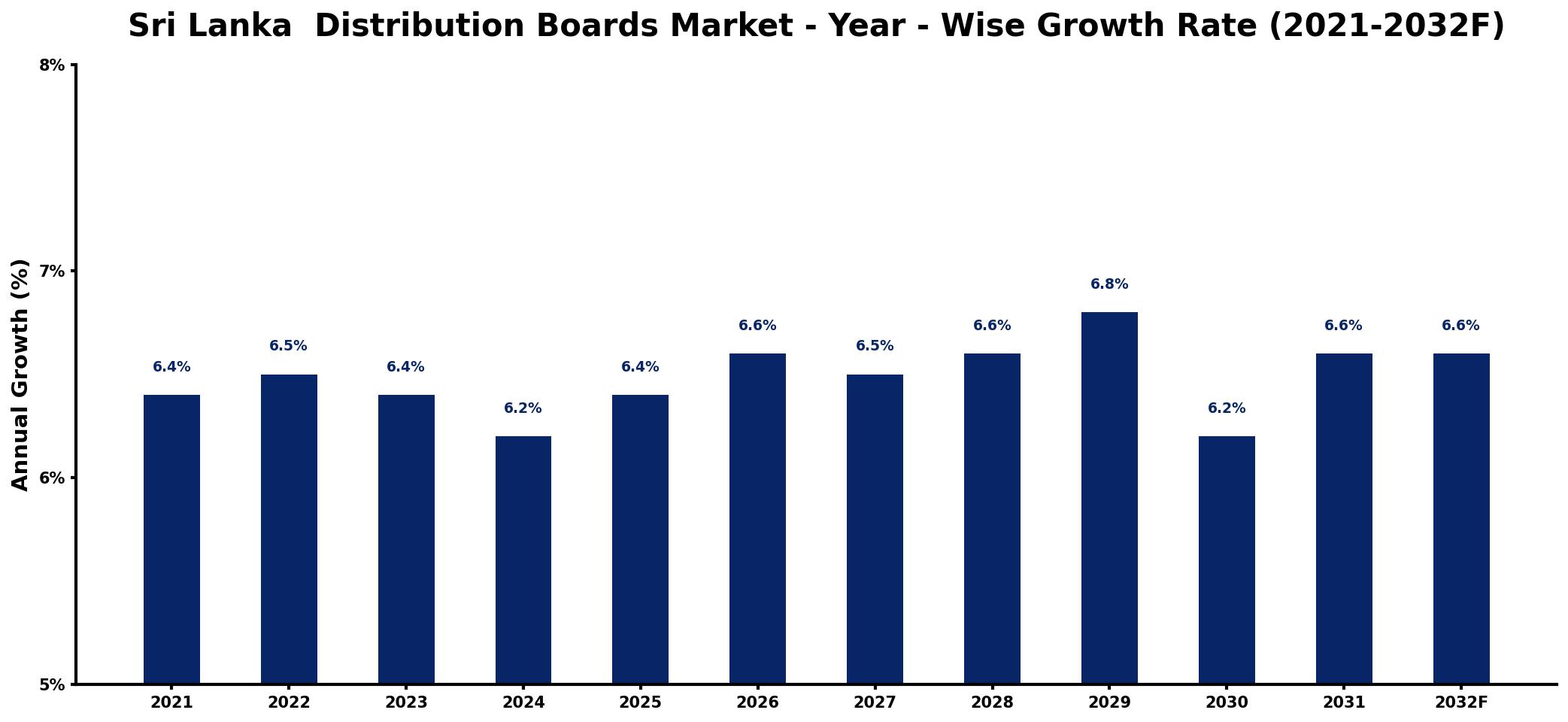
The table below presents the year‑wise growth rates along with the key drivers influencing the market
| Year | Growth Rate | Major Drivers |
| 2021 | 6.4% | Rising infrastructure development projects |
| 2022 | 6.5% | Increased urbanization and population growth |
| 2023 | 6.4% | Higher demand for renewable energy |
| 2024 | 6.2% | Expansion of residential construction sector |
| 2025 | 6.4% | Growing industrial automation initiatives |
| 2026 | 6.6% | Investments in smart grid technology |
| 2027 | 6.5% | Surge in commercial real estate |
| 2028 | 6.6% | Enhanced government regulations on safety |
| 2029 | 6.8% | Growth in electric vehicle adoption |
| 2030 | 6.2% | Strengthened focus on energy efficiency |
| 2031 | 6.6% | Emerging markets for smart technology |
| 2032 | 6.6% | Boost in manufacturing capacity utilization |
Note: Market size estimations and growth projections presented in this report are based on 6Wresearch's proprietary forecasting methodology, utilizing the latest available industry data, government publications, and primary research inputs.
Sri Lanka Distribution Boards Market Synopsis
In recent years, the Sri Lanka Distribution Boards Market has experienced significant momentum driven by advancements in technology and a rising awareness of energy conservation. However, the market is transitioning towards more intelligent solutions, such as smart distribution boards that offer remote monitoring and enhanced energy management capabilities. This transition reflects a growing consumer preference for products that not only meet regulatory standards but also contribute to sustainability goals.
Looking forward, the market is expected to maintain its upward trajectory, supported by government initiatives encouraging renewable energy and infrastructure modernization. As the demand for reliable electricity distribution systems increases, manufacturers are likely to innovate further, aligning their products with the trends of safety, aesthetics, and energy efficiency.
Sri Lanka Distribution Boards Market Key Takeaways
- The market is set for substantial growth driven by urbanization and infrastructure upgrades.
- Technological advancements, including smart distribution boards, are transforming the landscape.
- Investment in renewable energy solutions is gaining traction among consumers.
- Government initiatives are enhancing the regulatory environment, promoting safety and quality.
- There are promising opportunities for tailored solutions in commercial and industrial sectors.
Evaluation of Restraints in Sri Lanka Distribution Boards Market
The Sri Lanka Distribution Boards Market faces notable challenges, primarily due to fluctuating raw material prices for essential components like copper and aluminum. These variations can impact production costs, leading to heightened competition among local and international players. Additionally, supply chain disruptions, whether stemming from customs delays or transportation issues, can hinder timely delivery and inventory management. Companies must also navigate an evolving landscape of regulations that mandate compliance with safety and energy efficiency standards, adding complexity to their operations.
Sri Lanka Distribution Boards Market Trends
There is a pronounced shift towards smart and energy-efficient distribution boards, reflecting a broader trend towards sustainable living. Consumers are increasingly opting for products that integrate renewable energy sources and smart technology, such as remote connectivity features that allow for real-time energy management. Furthermore, manufacturers are focusing on enhancing the durability and aesthetics of distribution boards to better serve the residential, commercial, and industrial sectors.
Sri Lanka Distribution Boards Market Opportunities
The market is rife with investment opportunities, particularly in the realm of smart distribution boards that cater to the growing need for advanced energy management solutions. As infrastructure projects proliferate, there is ample scope for customized offerings that meet specific demands of industrial and commercial clients. Collaborations with local electricians for installation services can further enhance market entry strategies for investors, positioning them advantageously within the evolving energy landscape.
Government Initiatives in the Sri Lanka Distribution Boards Market
Government policies play a pivotal role in shaping the Sri Lanka Distribution Boards Market. The Sri Lanka Standards Institution (SLSI) has established essential safety and quality standards for distribution boards, ensuring compliance across the industry. Additionally, the Public Utilities Commission of Sri Lanka (PUCSL) oversees the electricity sector, fostering a competitive environment while safeguarding consumer interests. Import regulations are also critical, as they help maintain product standards through careful oversight of electrical product imports.
Future Insights of the Sri Lanka Distribution Boards Market
The Sri Lanka Distribution Boards Market is poised for continuous expansion through 2026-2032, driven by rising industrial activities and urban growth. The increasing appetite for sustainable energy solutions will likely influence product development, pushing manufacturers to innovate further in smart distribution technologies. Moreover, government-backed initiatives aimed at enhancing energy efficiency and modernizing power distribution infrastructure will provide a strong foundation for sustained market growth.
Sri Lanka Distribution Boards Market Latest Developments (2025 - 2026)
The market is witnessing a trend towards innovative product offerings, particularly with the introduction of smart distribution boards equipped with cutting-edge features for energy management. Recent developments in public policies have also focused on enhancing infrastructure reliability, promoting energy efficiency initiatives. As more projects are rolled out, stakeholders are aligning their strategies to meet the growing demand for sustainable electrical distribution solutions.
Sri Lanka Distribution Boards Market - Key Attractiveness of the Report
- 10 Years of Market Numbers
- Historical Data Starting from 2022 to 2025
- Base Year: 2025
- Forecast Data until 2032
- Key Performance Indicators Impacting the Market
- Major Upcoming Developments and Projects
Key Highlights of the Report:
- Sri Lanka Distribution Boards Market Outlook
- Market Size of Sri Lanka Distribution Boards Market, 2025
- Forecast of Sri Lanka Distribution Boards Market, 2032
- Historical Data and Forecast of Sri Lanka Distribution Boards Revenues & Volume for the Period 2022-2032F
- Sri Lanka Distribution Boards Market Trend Evolution
- Sri Lanka Distribution Boards Market Drivers and Challenges
- Sri Lanka Distribution Boards Price Trends
- Sri Lanka Distribution Boards Porter's Five Forces
- Sri Lanka Distribution Boards Industry Life Cycle
- Historical Data and Forecast of Sri Lanka Distribution Boards Market Revenues & Volume By Voltage Rating for the Period 2022-2032F
- Historical Data and Forecast of Sri Lanka Distribution Boards Market Revenues & Volume By Low Voltage for the Period 2022-2032F
- Historical Data and Forecast of Sri Lanka Distribution Boards Market Revenues & Volume By Medium Voltage for the Period 2022-2032F
- Historical Data and Forecast of Sri Lanka Distribution Boards Market Revenues & Volume By End Use for the Period 2022-2032F
- Historical Data and Forecast of Sri Lanka Distribution Boards Market Revenues & Volume By Transmission & Distribution Utilities for the Period 2022-2032F
- Historical Data and Forecast of Sri Lanka Distribution Boards Market Revenues & Volume By Manufacturing & Processing Industry for the Period 2022-2032F
- Historical Data and Forecast of Sri Lanka Distribution Boards Market Revenues & Volume By Commercial & Residential for the Period 2022-2032F
- Historical Data and Forecast of Sri Lanka Distribution Boards Market Revenues & Volume By Others for the Period 2022-2032F
- Sri Lanka Distribution Boards Import Export Trade Statistics
- Market Opportunity Assessment By Voltage Rating
- Market Opportunity Assessment By End Use
- Sri Lanka Distribution Boards Top Companies Market Share
- Sri Lanka Distribution Boards Competitive Benchmarking By Technical and Operational Parameters
- Sri Lanka Distribution Boards Company Profiles
- Sri Lanka Distribution Boards Key Strategic Recommendations






































