Sri Lanka Electrical Testing Equipment Market Size, Share & Growth Rate
The Sri Lanka Electrical Testing Equipment Market was estimated at USD 460 Million in 2025 and is projected to reach USD 603 Million by 2032, growing at a CAGR of 3.9% from 2026 to 2032. This growth trajectory is primarily driven by heightened infrastructure investments and the rapid industrial expansion across various sectors. Furthermore, as the nation increasingly prioritizes the adoption of renewable energy, the demand for reliable testing equipment is becoming essential to ensure safety and compliance.
Sri Lanka Electrical Testing Equipment Market Year-wise Growth Rate and Key Drivers
This graph highlights how the Sri Lanka Electrical Testing Equipment Market has steadily grown over the years, supported by major growth factors.
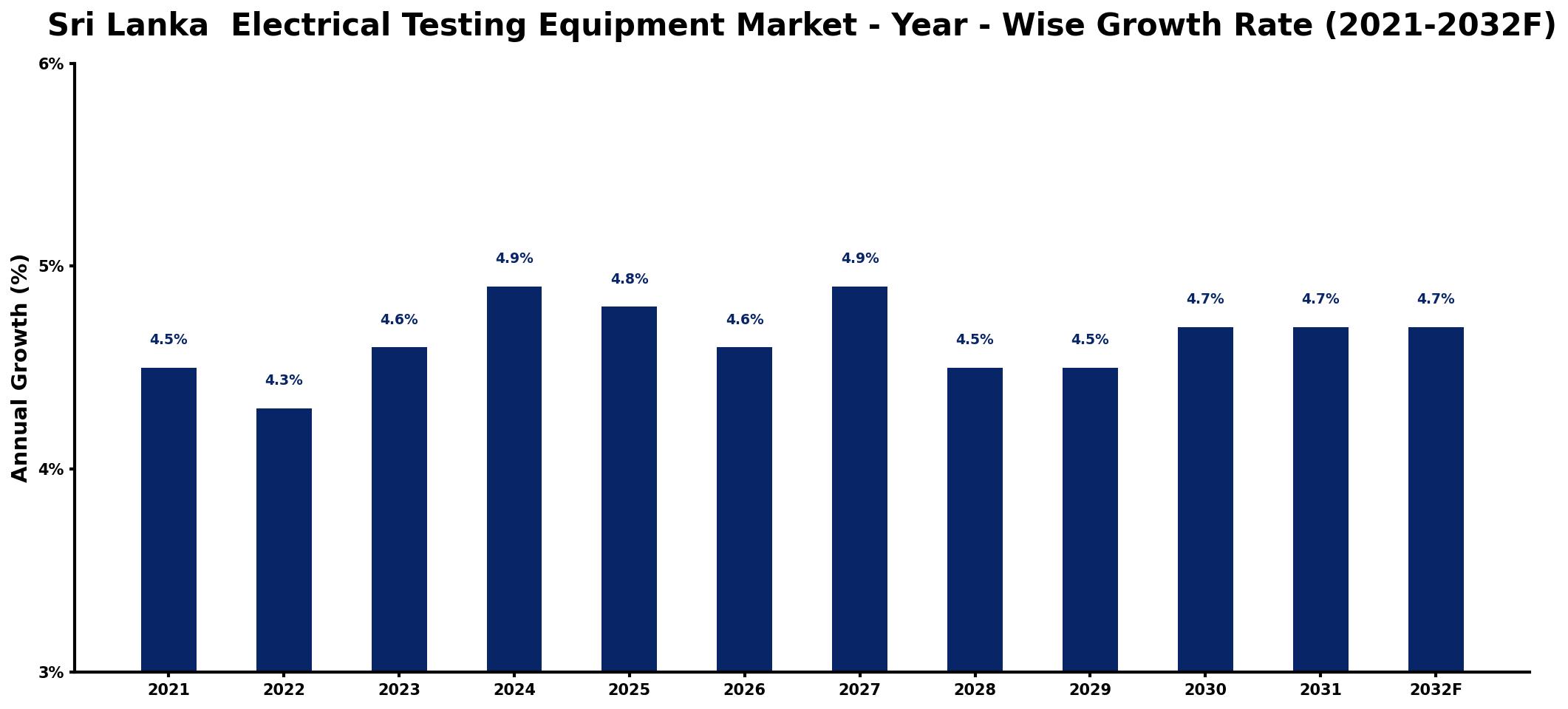
The table below presents the year‑wise growth rates along with the key drivers influencing the market
| Year | Growth Rate | Major Drivers |
| 2021 | 4.5% | Rising industrial automation demand |
| 2022 | 4.3% | Investment in renewable energy projects |
| 2023 | 4.6% | Expansion of manufacturing facilities |
| 2024 | 4.9% | Growth in infrastructure development |
| 2025 | 4.8% | Increased safety regulation compliance |
| 2026 | 4.6% | Technological advancements in industries |
| 2027 | 4.9% | Surge in construction activities |
| 2028 | 4.5% | Growing adoption of smart technologies |
| 2029 | 4.5% | Enhanced focus on energy efficiency |
| 2030 | 4.7% | Development of urban infrastructure projects |
| 2031 | 4.7% | Rising demand for maintenance services |
| 2032 | 4.7% | Boost in commercial sector investments |
Note: Market size estimations and growth projections presented in this report are based on 6Wresearch's proprietary forecasting methodology, utilizing the latest available industry data, government publications, and primary research inputs.
Sri Lanka Electrical Testing Equipment Market Synopsis
The Sri Lankan market for electrical testing equipment is witnessing a notable surge, particularly in the power generation and telecommunications sectors. The rising complexity of electrical systems necessitates more sophisticated testing solutions, which cater to an array of applications from installation to maintenance.
Moreover, the local industry's transition towards automated and more accurate testing instruments is reshaping market dynamics. As businesses and government initiatives emphasize compliance with safety standards, there is a corresponding increase in demand for high-quality electrical testing equipment to ensure operational reliability and efficiency.
Sri Lanka Electrical Testing Equipment Market Key Takeaways
- The market is characterized by a diverse range of testing equipment including multimeters, oscilloscopes, and insulation testers.
- Technological advancements are leading to increased demand for automated and portable testing devices.
- Government regulations are driving the need for compliance and safety in electrical systems.
- Investment opportunities abound for advanced testing solutions integrated with smart technologies.
- Challenges such as the high cost of equipment and limited skilled technicians must be addressed for growth.
Evaluation of Restraints in Sri Lanka Electrical Testing Equipment Market
Several restraints currently hold back the Sri Lanka Electrical Testing Equipment Market. A significant barrier is the high cost of advanced testing equipment, which can inhibit smaller companies from making necessary investments. Additionally, a prevailing lack of awareness around the importance of electrical safety and routine testing among businesses limits overall market potential. Compounding this issue is a shortage of skilled technicians capable of operating specialized equipment, as well as the presence of counterfeit products that undermine consumer trust in testing solutions.
Sri Lanka Electrical Testing Equipment Market Trends
Current trends indicate a shift towards highly sophisticated testing devices that provide greater accuracy, efficiency, and integrated features such as remote diagnostics. Industries are increasingly adopting portable and handheld equipment, emphasizing mobility and convenience, while regulatory pressures continue to spur the inclusion of enhanced safety features. Additionally, digital transformation initiatives are permeating the electrical testing landscape, driving innovation in smart testing solutions.
Sri Lanka Electrical Testing Equipment Market Opportunities
Opportunities for investment within the Sri Lanka Electrical Testing Equipment Market are abundant, especially as the emphasis on safety and compliance grows. Companies can explore avenues in developing cutting-edge testing instruments, such as insulation testers and circuit analyzers, that align with local industry needs. The ongoing transition towards digital technologies offers fertile ground for innovative testing solutions, particularly those that integrate seamlessly with smart infrastructure projects. Forming strategic partnerships with local distributors could facilitate market entry and enhance competitive positioning.
Government Initiatives in the Sri Lanka Electrical Testing Equipment Market
The Sri Lankan government is actively engaging in measures that bolster the electrical testing equipment sector. With a commitment to enforce stringent safety standards, regulatory frameworks are being established to ensure that testing equipment meets high-quality benchmarks. Moreover, initiatives promoting the use of energy-efficient testing solutions aim to lessen environmental impact, while various incentives are encouraging local manufacturers to enhance their technological capabilities through R&D support.
Future Insights of the Sri Lanka Electrical Testing Equipment Market
Looking ahead to 2026-2032, the outlook for the Sri Lanka Electrical Testing Equipment Market appears robust. Continuous government efforts towards modernizing the electrical grid, coupled with an increasing focus on renewable energy, will drive demand for innovative testing solutions. Heightened awareness of electrical safety and compliance mandates will further fuel market expansion, providing a landscape ripe with opportunities for both local and international firms to thrive.
Sri Lanka Electrical Testing Equipment Market Latest Developments (2025 - 2026)
Recent developments within the Sri Lanka Electrical Testing Equipment Market have highlighted a pronounced shift towards digital and automated testing solutions. The ongoing focus on enhancing safety standards has led to new innovations in product design and functionality. Collaborations between technology providers and local industries are emerging, aimed at improving the adaptability of testing equipment to meet specific sector requirements.
Sri Lanka Electrical Testing Equipment Market - Key Attractiveness of the Report
- 10 Years of Market Numbers
- Historical Data Starting from 2022 to 2025
- Base Year: 2025
- Forecast Data until 2032
- Key Performance Indicators Impacting the Market
- Major Upcoming Developments and Projects
Key Highlights of the Report:
- Sri Lanka Electrical Testing Equipment Market Outlook
- Market Size of Sri Lanka Electrical Testing Equipment Market, 2025
- Forecast of Sri Lanka Electrical Testing Equipment Market, 2032
- Historical Data and Forecast of Sri Lanka Electrical Testing Equipment Revenues & Volume for the Period 2022-2032F
- Sri Lanka Electrical Testing Equipment Market Trend Evolution
- Sri Lanka Electrical Testing Equipment Market Drivers and Challenges
- Sri Lanka Electrical Testing Equipment Price Trends
- Sri Lanka Electrical Testing Equipment Porter's Five Forces
- Sri Lanka Electrical Testing Equipment Industry Life Cycle
- Historical Data and Forecast of Sri Lanka Electrical Testing Equipment Market Revenues & Volume By Service Type for the Period 2022-2032F
- Historical Data and Forecast of Sri Lanka Electrical Testing Equipment Market Revenues & Volume By Electrical Testing Equipment Calibration Services for the Period 2022-2032F
- Historical Data and Forecast of Sri Lanka Electrical Testing Equipment Market Revenues & Volume By Electrical Testing Equipment Repair Services or After Sales Services for the Period 2022-2032F
- Historical Data and Forecast of Sri Lanka Electrical Testing Equipment Market Revenues & Volume By Product Type for the Period 2022-2032F
- Historical Data and Forecast of Sri Lanka Electrical Testing Equipment Market Revenues & Volume By General Purpose Electrical Testing Equipment for the Period 2022-2032F
- Historical Data and Forecast of Sri Lanka Electrical Testing Equipment Market Revenues & Volume By Mechanical Electrical Test Equipment for the Period 2022-2032F
- Historical Data and Forecast of Sri Lanka Electrical Testing Equipment Market Revenues & Volume By End User for the Period 2022-2032F
- Historical Data and Forecast of Sri Lanka Electrical Testing Equipment Market Revenues & Volume By Aerospace and Defense for the Period 2022-2032F
- Historical Data and Forecast of Sri Lanka Electrical Testing Equipment Market Revenues & Volume By Telecommunications for the Period 2022-2032F
- Historical Data and Forecast of Sri Lanka Electrical Testing Equipment Market Revenues & Volume By Semiconductor and Electronics for the Period 2022-2032F
- Sri Lanka Electrical Testing Equipment Import Export Trade Statistics
- Market Opportunity Assessment By Service Type
- Market Opportunity Assessment By Product Type
- Market Opportunity Assessment By End User
- Sri Lanka Electrical Testing Equipment Top Companies Market Share
- Sri Lanka Electrical Testing Equipment Competitive Benchmarking By Technical and Operational Parameters
- Sri Lanka Electrical Testing Equipment Company Profiles
- Sri Lanka Electrical Testing Equipment Key Strategic Recommendations






































