Sri Lanka Food & Grocery Retail Market Size, Share & Growth Rate
The Sri Lanka Food & Grocery Retail Market was estimated at USD 794 Million in 2025 and is projected to reach USD 1383 Million by 2032, growing at a CAGR of 8.3% from 2026 to 2032. This significant growth is propelled by an expanding urban population and rising disposable incomes, which are leading to increased consumer spending on quality food and grocery products. Additionally, a shift towards health-conscious and premium products indicates a transformation in consumer preferences, further solidifying the market's upward trajectory.
Sri Lanka Food & Grocery Retail Market Year-wise Growth Rate and Key Drivers
This graph highlights how the Sri Lanka Food & Grocery Retail Market has steadily grown over the years, supported by major growth factors.
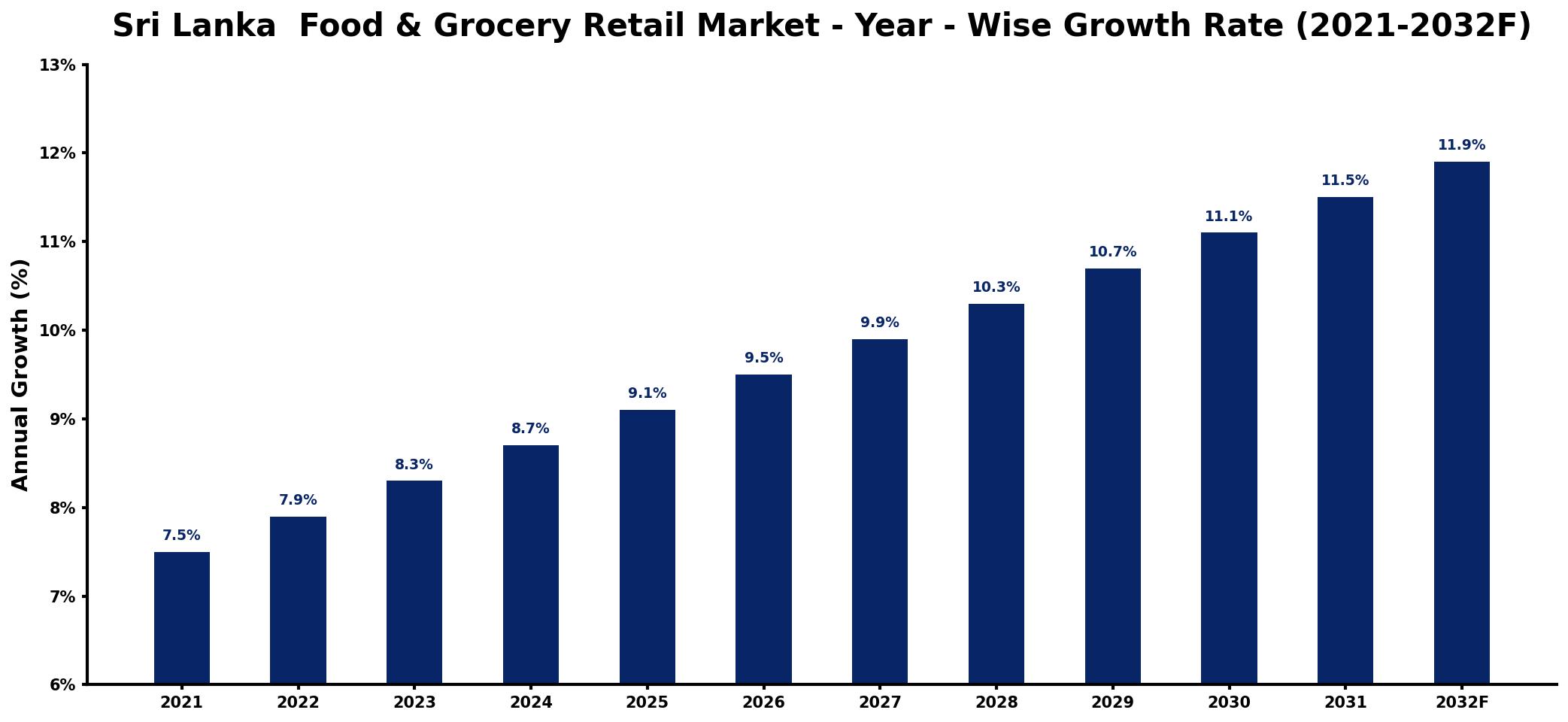
The table below presents the year‑wise growth rates along with the key drivers influencing the market
| Year | Growth Rate | Major Drivers |
| 2021 | 7.5% | Rising consumer spending habits |
| 2022 | 7.9% | Increased urbanization trends observed |
| 2023 | 8.3% | Expansion of online shopping platforms |
| 2024 | 8.7% | Growing health consciousness among consumers |
| 2025 | 9.1% | Investment in sustainable packaging solutions |
| 2026 | 9.5% | Emergence of local brands popularity |
| 2027 | 9.9% | Enhanced distribution network efficiency |
| 2028 | 10.3% | Adoption of digital payment methods |
| 2029 | 10.7% | Diversification of product offerings |
| 2030 | 11.1% | Strengthening of supply chain resilience |
| 2031 | 11.5% | Focus on organic product demand |
| 2032 | 11.9% | Rising popularity of convenience options |
Note: Market size estimations and growth projections presented in this report are based on 6Wresearch's proprietary forecasting methodology, utilizing the latest available industry data, government publications, and primary research inputs.
Sri Lanka Food & Grocery Retail Market Synopsis
Currently, the strongest force shaping the Sri Lanka Food & Grocery Retail Market is the increasing health consciousness among consumers. This shift is evident as more individuals prioritize nutrition and opt for organic and locally sourced products. Retailers are responding to this trend by diversifying their offerings and enhancing product quality to cater to this new demand.
Moreover, the rise of e-commerce is revolutionizing how consumers shop for groceries, providing them with the convenience of online purchasing and home delivery. This trend not only meets the needs of busy urban dwellers but also introduces a broader array of product choices, enhancing overall customer experience.
- The market is experiencing a substantial shift towards health-focused and organic products.
- E-commerce is rapidly gaining ground, reshaping traditional shopping behaviors.
- Rising urbanization and disposable income levels are driving demand for premium products.
- Retailers are increasingly implementing sustainability practices to meet consumer preferences.
- Government regulations ensure food safety and support local agricultural products.
Despite the promising growth prospects, several restraints affect the Sri Lanka Food & Grocery Retail Market. Intense competition between traditional retailers and modern supermarket formats creates pressure on pricing and profit margins. Additionally, infrastructure challenges hinder efficient distribution networks, complicating logistics for retailers. Regulatory complexities further add to the operational burden, demanding constant adaptation from businesses. Addressing food safety and quality standards remains crucial, as any lapses can seriously undermine consumer trust and brand reputation.
Several key trends are shaping the Sri Lanka Food & Grocery Retail Market. First and foremost, the demand for healthier food options is on the rise, influenced by greater awareness of nutrition and well-being. Furthermore, ready-to-eat meals and convenience foods are becoming increasingly popular due to busy lifestyles. Another important trend is the shift towards sustainability; consumers are now seeking products with ethical sourcing and minimal environmental impact. As digital platforms proliferate, e-commerce solutions are evolving to meet the diverse needs of consumers, providing an attractive alternative to traditional shopping.
Investment opportunities in the Sri Lanka Food & Grocery Retail Market are abundant, particularly in the expansion of supermarkets and hypermarkets, as well as the development of specialized stores aimed at health-conscious consumers. The growth of online grocery platforms presents a significant area for investment, as technology integration and enhanced logistics can streamline operations and improve customer experience. Collaborating with local farmers for fresh produce not only supports local agriculture but also appeals to environmentally aware consumers, making it a winning strategy for retailers.
The Sri Lankan government has introduced various policies aimed at regulating the food and grocery retail market. Emphasis on strict food safety regulations helps ensure consumer health and well-being. Additionally, the government promotes local agriculture by enforcing restrictions on the importation of specific food products, encouraging retailers to source domestically. Sustainability is also a priority, with initiatives designed to reduce waste and promote eco-friendly practices within the sector. These government efforts aim to foster a competitive and secure environment for both consumers and retailers alike.
Looking ahead to the years 2026-2032, the Sri Lanka Food & Grocery Retail Market is expected to continue its upward momentum. Sustained economic growth, urbanization, and an expanding middle class are likely to further enhance consumer spending power. The ongoing shift towards convenience and quality, coupled with advancements in e-commerce, positions the market for innovative solutions and strategic partnerships. However, stakeholders must remain vigilant about supply chain vulnerabilities and price sensitivity, ensuring adaptability to the ever-evolving market landscape.
In recent months, the Sri Lanka Food & Grocery Retail Market has seen significant shifts, particularly with a noticeable increase in e-commerce activity. Traditional retailers are enhancing their online presence to compete effectively against emerging digital platforms. Additionally, there has been a marked focus on sourcing organic and locally produced goods, reflecting consumer preferences for healthier options. Furthermore, several initiatives aimed at improving food safety standards have been introduced, helping to strengthen consumer trust in the retail environment.
- 10 Years of Market Numbers
- Historical Data Starting from 2022 to 2025
- Base Year: 2025
- Forecast Data until 2032
- Key Performance Indicators Impacting the Market
- Major Upcoming Developments and Projects
Key Highlights of the Report:
- Sri Lanka Food & Grocery Retail Market Outlook
- Market Size of Sri Lanka Food & Grocery Retail Market, 2025
- Forecast of Sri Lanka Food & Grocery Retail Market, 2032
- Historical Data and Forecast of Sri Lanka Food & Grocery Retail Revenues & Volume for the Period 2022-2032F
- Sri Lanka Food & Grocery Retail Market Trend Evolution
- Sri Lanka Food & Grocery Retail Market Drivers and Challenges
- Sri Lanka Food & Grocery Retail Price Trends
- Sri Lanka Food & Grocery Retail Porter's Five Forces
- Sri Lanka Food & Grocery Retail Industry Life Cycle
- Historical Data and Forecast of Sri Lanka Food & Grocery Retail Market Revenues & Volume By Product for the Period 2022-2032F
- Historical Data and Forecast of Sri Lanka Food & Grocery Retail Market Revenues & Volume By Fresh Food for the Period 2022-2032F
- Historical Data and Forecast of Sri Lanka Food & Grocery Retail Market Revenues & Volume By Frozen Food for the Period 2022-2032F
- Historical Data and Forecast of Sri Lanka Food & Grocery Retail Market Revenues & Volume By Food Cupboard for the Period 2022-2032F
- Historical Data and Forecast of Sri Lanka Food & Grocery Retail Market Revenues & Volume By Beverages for the Period 2022-2032F
- Historical Data and Forecast of Sri Lanka Food & Grocery Retail Market Revenues & Volume By Cleaning & Household for the Period 2022-2032F
- Historical Data and Forecast of Sri Lanka Food & Grocery Retail Market Revenues & Volume By Others for the Period 2022-2032F
- Historical Data and Forecast of Sri Lanka Food & Grocery Retail Market Revenues & Volume By Distribution Channel for the Period 2022-2032F
- Historical Data and Forecast of Sri Lanka Food & Grocery Retail Market Revenues & Volume By Supermarkets & Hypermarkets for the Period 2022-2032F
- Historical Data and Forecast of Sri Lanka Food & Grocery Retail Market Revenues & Volume By Convenience Stores for the Period 2022-2032F
- Historical Data and Forecast of Sri Lanka Food & Grocery Retail Market Revenues & Volume By Departmental Stores & Clubs for the Period 2022-2032F
- Historical Data and Forecast of Sri Lanka Food & Grocery Retail Market Revenues & Volume By Online for the Period 2022-2032F
- Sri Lanka Food & Grocery Retail Import Export Trade Statistics
- Market Opportunity Assessment By Product
- Market Opportunity Assessment By Distribution Channel
- Sri Lanka Food & Grocery Retail Top Companies Market Share
- Sri Lanka Food & Grocery Retail Competitive Benchmarking By Technical and Operational Parameters
- Sri Lanka Food & Grocery Retail Company Profiles
- Sri Lanka Food & Grocery Retail Key Strategic Recommendations






































