Sri Lanka Food Processing & Handling Equipment Market Summary
The sri lanka food processing & handling equipment market was estimated at USD 454 Million in 2025 and is projected to reach USD 650 Million by 2032, growing at a CAGR of 6.4% from 2026 to 2032.
Sri Lanka Food Processing & Handling Equipment Market Year-wise Growth Rate and Key Drivers
This graph highlights how the Sri Lanka Food Processing & Handling Equipment Market has steadily grown over the past five years, supported by major growth factors.
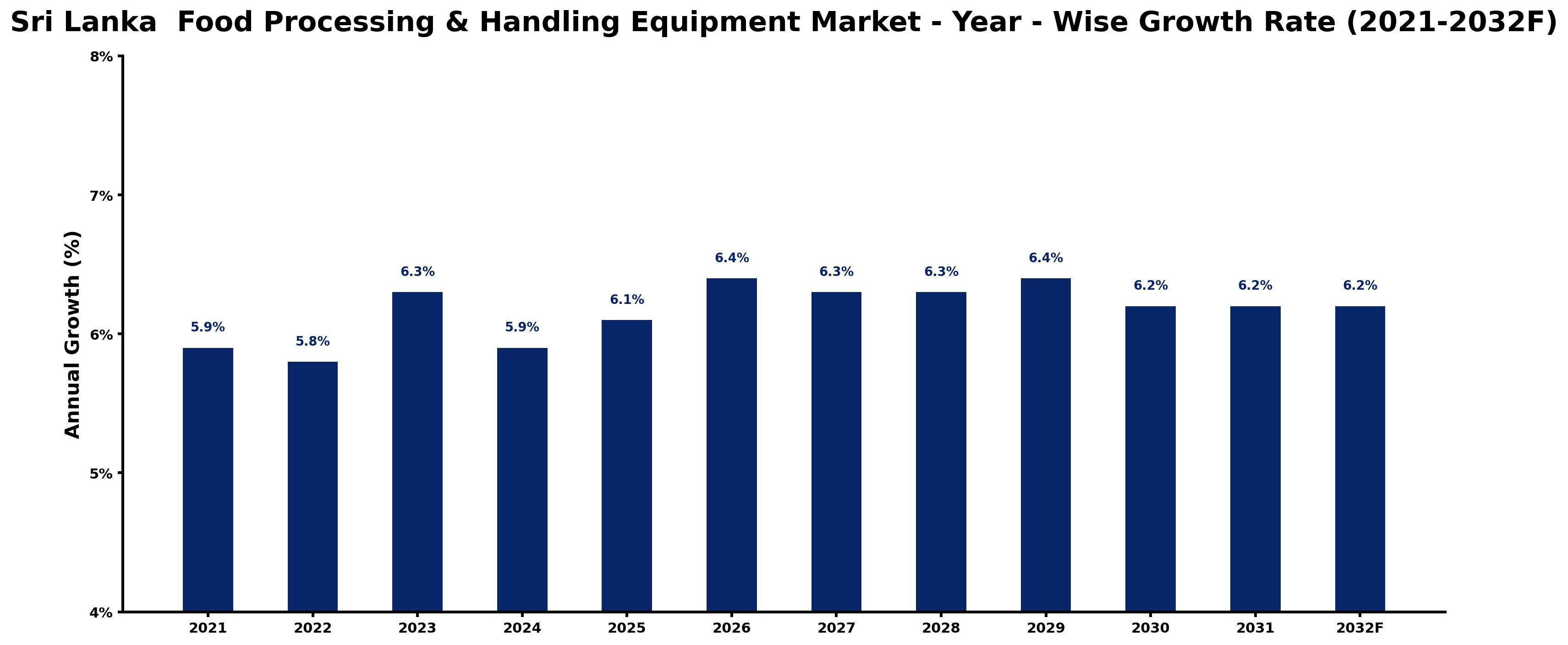
The table below presents the year wise growth rates along with the key drivers influencing the market
| Year | Growth Rate | Major Drivers |
| 2021 | 5.9% | Post-lockdown retail projects revitalized consumer interest in diverse food offerings. |
| 2022 | 5.8% | Investment in modern supply chain solutions became essential for operational efficiency. |
| 2023 | 6.3% | Sustainability practices prompted companies to upgrade their processing equipment. |
| 2024 | 5.9% | Emerging food trends fueled innovative equipment designs to meet consumer preferences. |
| 2025 | 6.1% | Technological integration in processing enhanced productivity metrics across food sectors. |
| 2026 | 6.4% | Rural electrification projects improved accessibility to advanced food handling technologies. |
| 2027 | 6.3% | Demand for frozen and packaged foods transformed processing standards in factories. |
| 2028 | 6.3% | Industry partnerships facilitated knowledge sharing and technology transfer for growth. |
| 2029 | 6.4% | Local food production initiatives encouraged investments in specialized processing machinery. |
| 2030 | 6.2% | Consumer health awareness pushed manufacturers toward healthier processing methods. |
| 2031 | 6.2% | Foreign investments in food technology began reshaping local equipment markets significantly. |
| 2032 | 6.2% | Robust export potential for processed foods drove innovation and expansion efforts. |
Note - Market size estimations and growth projections presented in this report are based on 6Wresearch's advanced forecasting approach, validated with industry datasets as of June 2026.
Sri Lanka Food Processing & Handling Equipment Market Synopsis
The Sri Lanka Food Processing Handling Equipment Market is projected to reach 6.4% and witness significant growth during the forecast period (2026-2032). This growth trajectory is primarily driven by the escalating demand for processed food products, increasing urbanization, and rising disposable incomes across the country. These factors are reshaping consumer preferences, thereby creating a substantial need for advanced food processing equipment that enhances production capabilities and meets stringent safety standards.
Sri Lanka Food Processing & Handling Equipment Market Growth Drivers
The growth of the Sri Lanka Food Processing & Handling Equipment Market is underpinned by several key drivers:
- The rising demand for processed and packaged food reflects changing dietary habits influenced by urban lifestyles and convenience.
- Continuous innovations in food processing technology, including automation and digitization, enhance operational efficiencies and reduce overall production costs.
- Government initiatives aimed at boosting the local food processing sector are creating a favorable business environment for manufacturers and suppliers.
- Increased urbanization is contributing to a larger consumer base with higher purchasing power, thus driving the demand for diverse food products.
- Growing health consciousness among consumers is leading to a higher demand for efficiently processed and packaged nutritious food items.
Sri Lanka Food Processing & Handling Equipment Market Trends and Opportunities
As the Sri Lanka Food Processing & Handling Equipment Market evolves, several notable trends are emerging:
- Automation is increasingly becoming prevalent in food processing operations, allowing for improved efficiency and reduced labor costs.
- Companies are placing greater emphasis on sustainability, which is evident in the adoption of energy-efficient machinery and waste reduction technologies.
- The integration of advanced technologies such as artificial intelligence and robotics is enhancing quality control measures and production consistency.
- Consumer preference is shifting toward convenience, driving the demand for packaging solutions that extend product shelf-life while ensuring food safety.
- Collaborative partnerships between local and international firms for technology transfer and knowledge sharing present significant growth opportunities in the market.
Sri Lanka Food Processing & Handling Equipment Market Challenges and Restraints
Despite the positive outlook, the Sri Lanka Food Processing & Handling Equipment Market faces several challenges that may impede its growth:
- Limited access to advanced technology and sophisticated machinery restricts local companies from enhancing their production capabilities.
- The existing infrastructure for food processing facilities is often inadequate, affecting efficiency and safety in storage and transport.
- Financial constraints present significant barriers to investment in modern processing equipment, limiting the ability of companies to scale operations.
- A deficiency in a skilled workforce poses challenges in the effective operation of advanced machinery and technology.
- Inconsistent government regulations and policies create an unpredictable business environment, adding to the operational complexities for market participants.
Sri Lanka Food Processing & Handling Equipment Market Investment Opportunities
The Sri Lanka Food Processing & Handling Equipment Market presents numerous investment opportunities for both domestic and international investors:
- Investment in modern and efficient food processing equipment allows companies to boost productivity and better align with consumer demands.
- Exploring technologies that enhance food safety and quality control systems can provide lucrative returns in a growing market.
- Establishing joint ventures with local companies can facilitate market entry and enable technology transfer to improve processing standards.
- Involvement in government-supported infrastructure projects can create synergies that enhance the supply chain for food processing.
- Investors can leverage the rising trend of health-conscious consumerism by focusing on equipment that supports nutritious food production.
Sri Lanka Food Processing & Handling Equipment Market Government Investment and Initiatives
The Sri Lankan government is actively fostering the growth of the Food Processing & Handling Equipment Market through various initiatives:
- Tax incentives and duty concessions are provided to encourage the import of advanced machinery, enhancing local production capabilities.
- The Board of Investment (BOI) promotes investment in the sector, offering support and incentives for foreign investors to establish operations.
- Public spending on improving food processing infrastructure is integral to enhancing efficiency and safety across the supply chain.
- Regulatory frameworks are being strengthened to ensure compliance with food safety and quality standards, building consumer trust in local products.
- The government is also focusing on skill development programs to cultivate a workforce adept in operating modern food processing technologies.
Sri Lanka Food Processing & Handling Equipment Market Latest Developments (May 2025 - June 2026)
During the period from May 2025 to June 2026, the Sri Lanka Food Processing & Handling Equipment Market demonstrated dynamic developments:
- Significant investments in automation technologies are being observed, reflecting a shift towards more efficient production systems.
- New regulatory measures introduced by the government aim to streamline the food safety certification process, benefiting industry participants.
- The integration of digital solutions in supply chain management has gained momentum, enhancing transparency and traceability.
- Environmental sustainability initiatives have led to the adoption of eco-friendly processing practices among manufacturers.
- Industry players are increasingly focusing on research and development to innovate equipment that aligns with evolving consumer trends and preferences.
Sri Lanka Food Processing & Handling Equipment Market - Key Attractiveness of the Report
- 10 Years of Market Numbers
- Historical Data Starting from 2022 to 2025
- Base Year: 2025
- Forecast Data until 2032
- Key Performance Indicators Impacting the Market
- Major Upcoming Developments and Projects
Key Highlights of the Report:
- Sri Lanka Food Processing & Handling Equipment Market Outlook
- Market Size of Sri Lanka Food Processing & Handling Equipment Market, 2025
- Forecast of Sri Lanka Food Processing & Handling Equipment Market, 2032F
- Historical Data and Forecast of Sri Lanka Food Processing & Handling Equipment Revenues & Volume for the Period 2022-2032F
- Sri Lanka Food Processing & Handling Equipment Market Trend Evolution
- Sri Lanka Food Processing & Handling Equipment Market Drivers and Challenges
- Sri Lanka Food Processing & Handling Equipment Price Trends
- Sri Lanka Food Processing & Handling Equipment Porter's Five Forces
- Sri Lanka Food Processing & Handling Equipment Industry Life Cycle
- Historical Data and Forecast of Sri Lanka Food Processing & Handling Equipment Market Revenues & Volume By Equipment Type for the Period 2022-2032F
- Historical Data and Forecast of Sri Lanka Food Processing & Handling Equipment Market Revenues & Volume By Food Processing equipment for the Period 2022-2032F
- Historical Data and Forecast of Sri Lanka Food Processing & Handling Equipment Market Revenues & Volume By Foodservice equipment for the Period 2022-2032F
- Historical Data and Forecast of Sri Lanka Food Processing & Handling Equipment Market Revenues & Volume By Food Packaging equipment for the Period 2022-2032F
- Historical Data and Forecast of Sri Lanka Food Processing & Handling Equipment Market Revenues & Volume By Application for the Period 2022-2032F
- Historical Data and Forecast of Sri Lanka Food Processing & Handling Equipment Market Revenues & Volume By Bakery & confectionery products for the Period 2022-2032F
- Historical Data and Forecast of Sri Lanka Food Processing & Handling Equipment Market Revenues & Volume By Meat & poultry products for the Period 2022-2032F
- Historical Data and Forecast of Sri Lanka Food Processing & Handling Equipment Market Revenues & Volume By Dairy products for the Period 2022-2032F
- Historical Data and Forecast of Sri Lanka Food Processing & Handling Equipment Market Revenues & Volume By Alcoholic beverages for the Period 2022-2032F
- Historical Data and Forecast of Sri Lanka Food Processing & Handling Equipment Market Revenues & Volume By Non-alcoholic beverages for the Period 2022-2032F
- Historical Data and Forecast of Sri Lanka Food Processing & Handling Equipment Market Revenues & Volume By Fish & seafood products for the Period 2022-2032F
- Historical Data and Forecast of Sri Lanka Food Processing & Handling Equipment Market Revenues & Volume By Others? for the Period 2022-2032F
- Historical Data and Forecast of Sri Lanka Food Processing & Handling Equipment Market Revenues & Volume By Form for the Period 2022-2032F
- Historical Data and Forecast of Sri Lanka Food Processing & Handling Equipment Market Revenues & Volume By Solid for the Period 2022-2032F
- Historical Data and Forecast of Sri Lanka Food Processing & Handling Equipment Market Revenues & Volume By Liquid for the Period 2022-2032F
- Historical Data and Forecast of Sri Lanka Food Processing & Handling Equipment Market Revenues & Volume By Semi-solid for the Period 2022-2032F
- Sri Lanka Food Processing & Handling Equipment Import Export Trade Statistics
- Market Opportunity Assessment By Equipment Type
- Market Opportunity Assessment By Application
- Market Opportunity Assessment By Form
- Sri Lanka Food Processing & Handling Equipment Top Companies Market Share
- Sri Lanka Food Processing & Handling Equipment Competitive Benchmarking By Technical and Operational Parameters
- Sri Lanka Food Processing & Handling Equipment Company Profiles
- Sri Lanka Food Processing & Handling Equipment Key Strategic Recommendations






































