Sri Lanka Gaming Market Size, Share & Growth Rate
The Sri Lanka Gaming Market was estimated at USD 424 Million in 2025 and is projected to reach USD 556 Million by 2032, growing at a CAGR of 3.9% from 2026 to 2032. This growth is primarily driven by increased internet accessibility and smartphone usage, particularly among the youth. Mobile gaming, spearheaded by popular titles like PUBG Mobile, is catalyzing market expansion, alongside the rise of local game developers creating both regional and global content.
Sri Lanka Gaming Market Year-wise Growth Rate and Key Drivers
This graph highlights how the Sri Lanka Gaming Market has steadily grown over the years, supported by major growth factors.
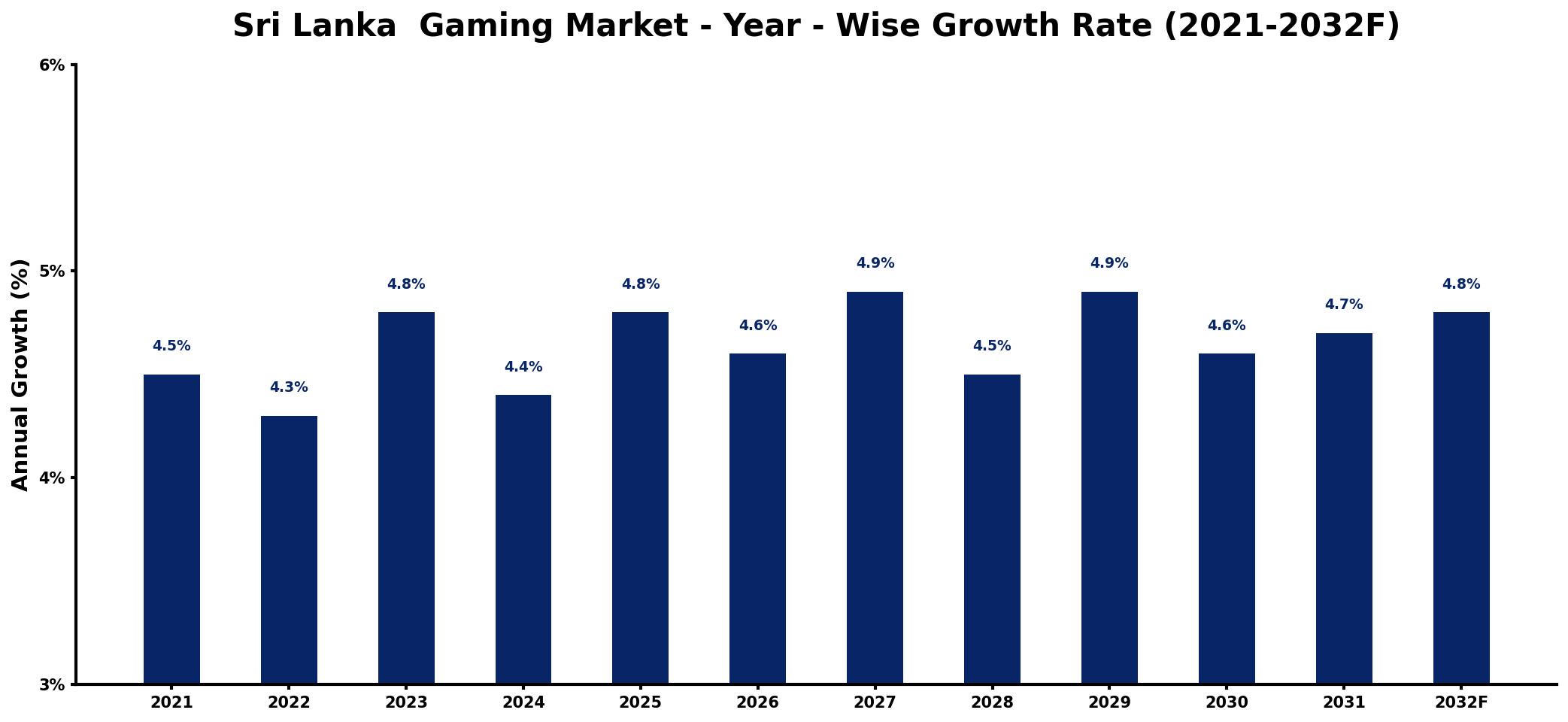
The table below presents the year‑wise growth rates along with the key drivers influencing the market
| Year | Growth Rate | Major Drivers |
| 2021 | 4.5% | Rise in disposable income levels |
| 2022 | 4.3% | Increased digital infrastructure investments |
| 2023 | 4.8% | Growth in mobile device usage |
| 2024 | 4.4% | Expansion of online entertainment options |
| 2025 | 4.8% | Higher youth engagement in activities |
| 2026 | 4.6% | Boost in technological advancements |
| 2027 | 4.9% | Surge in social media interaction |
| 2028 | 4.5% | Development of local content creation |
| 2029 | 4.9% | Enhancement of payment processing systems |
| 2030 | 4.6% | Increase in cross-platform accessibility |
| 2031 | 4.7% | Wider adoption of virtual reality |
| 2032 | 4.8% | growing emerging market penetration |
Note: Market size estimations and growth projections presented in this report are based on 6Wresearch's proprietary forecasting methodology, utilizing the latest available industry data, government publications, and primary research inputs.
Sri Lanka Gaming Market Synopsis
The burgeoning popularity of mobile gaming is the strongest force shaping the Sri Lanka Gaming Market. With a young population that is increasingly engaged in digital entertainment, the demand for mobile games has skyrocketed, creating substantial opportunities for developers and investors alike.
Additionally, the rise of esports is transforming the gaming landscape in Sri Lanka. Competitive gaming events are drawing enthusiastic participants and spectators, indicating a shift towards a more vibrant gaming culture and increased acceptance of gaming as a legitimate form of entertainment.
Sri Lanka Gaming Market Key Takeaways
- The Sri Lankan gaming sector is on a growth trajectory driven by mobile gaming and esports.
- Increased disposable income and smartphone adoption are significant enablers of market expansion.
- Local game development is gaining momentum, supporting both domestic and international markets.
- Government regulations are shaping the industry, emphasizing consumer protection and responsible gaming.
- Investment opportunities abound in gaming infrastructure and events, particularly in esports and mobile gaming.
Evaluation of Restraints in Sri Lanka Gaming Market
Despite its growth potential, the Sri Lanka Gaming Market faces several limitations. Limited infrastructure and inadequate access to high-speed internet restrain the growth of online gaming, particularly multiplayer platforms. Additionally, there is a pervasive lack of awareness about the gaming industry among the general populace, creating barriers for developers and publishers in effectively reaching their target audiences. Moreover, regulatory issues related to censorship can hinder the availability of certain gaming content, further complicating the market landscape.
Sri Lanka Gaming Market Trends
Current trends within the Sri Lanka Gaming Market indicate a strong shift towards mobile and free-to-play gaming models. The rise of in-app purchases reflects consumer willingness to spend on gaming enhancements. Esports events are becoming increasingly popular, leading to a growth in related merchandise and gaming peripherals. As a result, the demand for high-quality accessories is rising, as gamers seek to enhance their overall gaming experience.
Sri Lanka Gaming Market Opportunities
The evolving landscape of the Sri Lankan gaming market presents significant investment opportunities. With an expanding middle-class population and a tech-savvy youth demographic, there is burgeoning demand for gaming consoles, mobile games, and online subscriptions. Stakeholders can capitalize on this growth by investing in gaming infrastructure, organizing esports tournaments, and partnering with local developers. Additionally, there is a ripe opportunity for game publishing and distribution, catering to an expanding consumer base eager for new content.
Government Initiatives in the Sri Lanka Gaming Market
The Sri Lankan government has established a framework for regulating the gaming market through various policies. The Computer Crimes Act of 2007, for example, prohibits online gambling, ensuring a level of consumer protection. Additionally, the Betting and Gaming Levy Act mandates taxes on gaming establishments, generating revenue for public spending. Licensing requirements for operators also promote accountability and transparency within the industry, aiming to combat illegal gaming and promote responsible practices.
Future Insights of the Sri Lanka Gaming Market
Looking ahead to 2026-2032, the future of the Sri Lankan gaming market appears bright. Factors such as increasing internet penetration, rising disposable incomes, and a cultural shift towards gaming as entertainment will likely fuel market expansion. The mobile gaming segment is set to continue its momentum, benefiting from the proliferation of affordable smartphones and data plans. With emerging local developers and ongoing government support, the market is poised for significant growth and innovation.
Sri Lanka Gaming Market Latest Developments (2025 - 2026)
In recent months, the Sri Lankan gaming market has witnessed notable activity, particularly in the esports sector, where various tournaments have gained traction. Local gaming cafes are becoming popular hubs for both social interaction and competitive play. Additionally, advancements in internet infrastructure are being discussed, which could potentially alleviate some barriers currently faced by online gamers. These developments reflect a responsive and evolving market dynamic that continues to adapt to consumer preferences.
Sri Lanka Gaming Market - Key Attractiveness of the Report
- 10 Years of Market Numbers
- Historical Data Starting from 2022 to 2025
- Base Year: 2025
- Forecast Data until 2032
- Key Performance Indicators Impacting the Market
- Major Upcoming Developments and Projects
Key Highlights of the Report:
- Sri Lanka Gaming Market Outlook
- Market Size of Sri Lanka Gaming Market, 2025
- Forecast of Sri Lanka Gaming Market, 2032
- Historical Data and Forecast of Sri Lanka Gaming Revenues & Volume for the Period 2022-2032F
- Sri Lanka Gaming Market Trend Evolution
- Sri Lanka Gaming Market Drivers and Challenges
- Sri Lanka Gaming Price Trends
- Sri Lanka Gaming Porter's Five Forces
- Sri Lanka Gaming Industry Life Cycle
- Historical Data and Forecast of Sri Lanka Gaming Market Revenues & Volume By Game Type for the Period 2022-2032F
- Historical Data and Forecast of Sri Lanka Gaming Market Revenues & Volume By Shooter for the Period 2022-2032F
- Historical Data and Forecast of Sri Lanka Gaming Market Revenues & Volume By Action for the Period 2022-2032F
- Historical Data and Forecast of Sri Lanka Gaming Market Revenues & Volume By Sports for the Period 2022-2032F
- Historical Data and Forecast of Sri Lanka Gaming Market Revenues & Volume By Role-Playing for the Period 2022-2032F
- Historical Data and Forecast of Sri Lanka Gaming Market Revenues & Volume By Others for the Period 2022-2032F
- Historical Data and Forecast of Sri Lanka Gaming Market Revenues & Volume By Device Type for the Period 2022-2032F
- Historical Data and Forecast of Sri Lanka Gaming Market Revenues & Volume By PC/MMO for the Period 2022-2032F
- Historical Data and Forecast of Sri Lanka Gaming Market Revenues & Volume By Tablet for the Period 2022-2032F
- Historical Data and Forecast of Sri Lanka Gaming Market Revenues & Volume By Mobile Phone for the Period 2022-2032F
- Historical Data and Forecast of Sri Lanka Gaming Market Revenues & Volume By TV/Console for the Period 2022-2032F
- Historical Data and Forecast of Sri Lanka Gaming Market Revenues & Volume By End-User for the Period 2022-2032F
- Historical Data and Forecast of Sri Lanka Gaming Market Revenues & Volume By Male for the Period 2022-2032F
- Historical Data and Forecast of Sri Lanka Gaming Market Revenues & Volume By Female for the Period 2022-2032F
- Sri Lanka Gaming Import Export Trade Statistics
- Market Opportunity Assessment By Game Type
- Market Opportunity Assessment By Device Type
- Market Opportunity Assessment By End-User
- Sri Lanka Gaming Top Companies Market Share
- Sri Lanka Gaming Competitive Benchmarking By Technical and Operational Parameters
- Sri Lanka Gaming Company Profiles
- Sri Lanka Gaming Key Strategic Recommendations






































