Sri Lanka Gift Packaging Market Summary
The sri lanka gift packaging market was estimated at USD 514 Million in 2025 and is projected to reach USD 735 Million by 2032, growing at a CAGR of 6.2% from 2026 to 2032.
Sri Lanka Gift Packaging Market Year-wise Growth Rate and Key Drivers
This graph highlights how the Sri Lanka Gift Packaging Market has steadily grown over the past five years, supported by major growth factors.
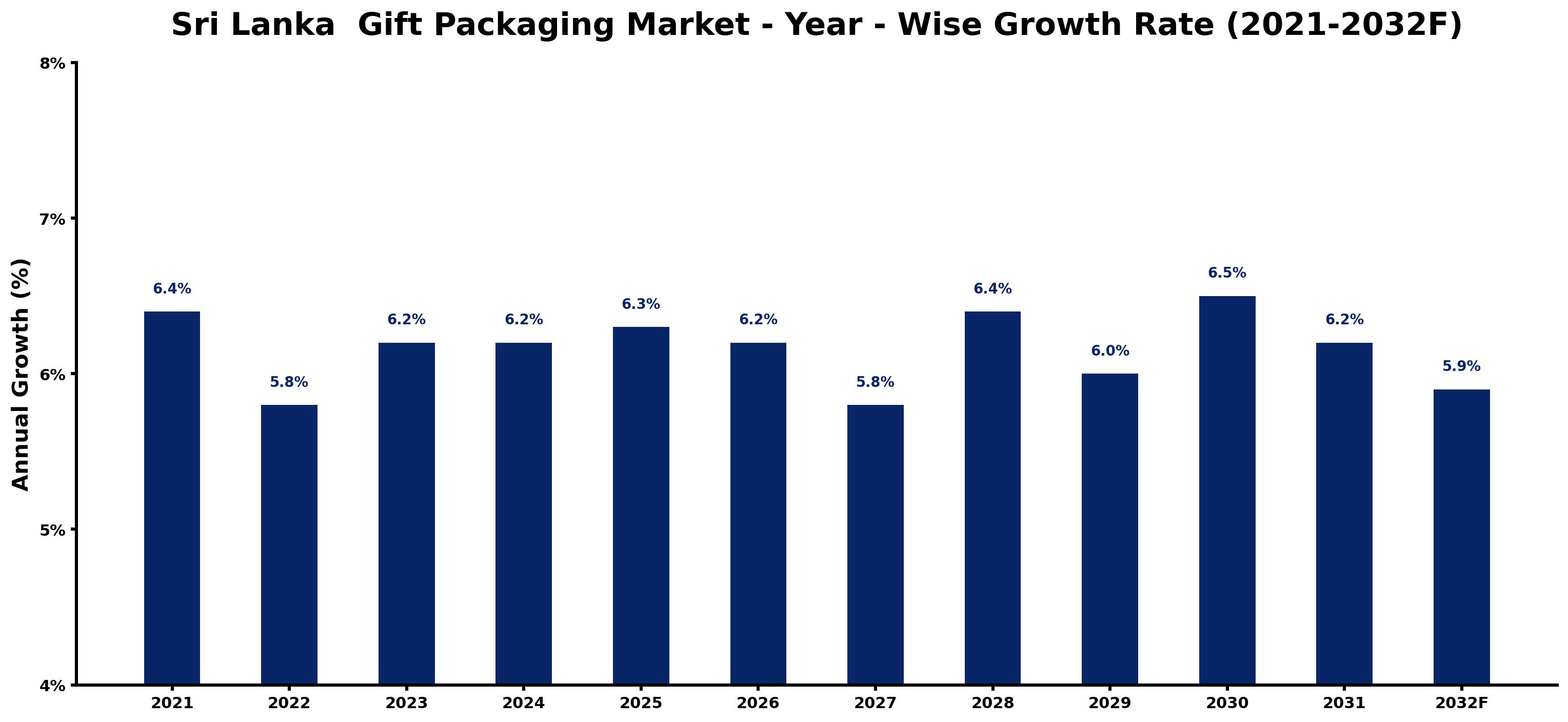
The table below presents the year wise growth rates along with the key drivers influencing the market
| Year | Growth Rate | Major Drivers |
| 2021 | 6.4% | Post-lockdown retail projects prompted an increase in personalized gift packaging options. |
| 2022 | 5.8% | E-commerce platforms embraced unique packaging to enhance customer unboxing experiences. |
| 2023 | 6.2% | Focusing on sustainability, brands introduced eco-friendly packaging materials for gifts. |
| 2024 | 6.2% | Social media trends showcased custom packaging designs, boosting consumer interest significantly. |
| 2025 | 6.3% | Cultural celebrations emphasized traditional gift packaging styles, influencing local market offerings. |
| 2026 | 6.2% | Corporate gifting strategies began investing in premium packaging to enhance brand image. |
| 2027 | 5.8% | Collaboration with local artisans fostered innovative packaging solutions, appealing to niche markets. |
| 2028 | 6.4% | Technological advancements in printing enabled vibrant designs and faster production processes. |
| 2029 | 6.0% | Luxury market segments demonstrated a growing preference for bespoke packaging experiences. |
| 2030 | 6.5% | Environmental awareness shifted consumer preferences towards biodegradable packaging alternatives. |
| 2031 | 6.2% | Events and festivals spurred demand for festive-themed packaging throughout the year. |
| 2032 | 5.9% | Increased disposable income allowed consumers to invest in higher-quality gift packaging. |
Note - Market size estimations and growth projections presented in this report are based on 6Wresearch's advanced forecasting approach, validated with industry datasets as of June 2026.
Sri Lanka Gift Packaging Market Synopsis
The Sri Lanka Gift Packaging Market is projected to reach 6.2% and witness significant growth during the forecast period (2026-2032). The market is characterized by a rich cultural emphasis on gifting, which manifests through a variety of gift packaging products including decorative boxes, wrapping papers, ribbons, and customized packaging solutions. The demand for these products experiences notable peaks during festive seasons and significant events, compelling businesses to continually innovate in design and sustainability.
Sri Lanka Gift Packaging Market Growth Drivers
Several factors are driving growth in the Sri Lanka Gift Packaging Market. First, the enduring cultural tradition of gifting during key occasions such as weddings, festivals, and corporate events enhances market demand. Second, there is a notable increase in e-commerce activities, with online gift retailing fueling the necessity for attractive and unique packaging solutions tailored for digital sales. Third, the growing consumer consciousness regarding eco-friendly packaging materials has sparked a shift towards sustainable options. Fourth, the preference for personalized packaging is on the rise, as consumers seek distinctive ways to express their sentiments through customized wrappers and boxes. Lastly, technological advancements in packaging design and manufacturing are improving production efficiency and broadening product offerings.
Sri Lanka Gift Packaging Market Challenges and Restraints
Despite the positive growth trajectory, the Sri Lanka Gift Packaging Market faces significant challenges. Fluctuating raw material prices, particularly for paper and plastic, can adversely affect the cost structure and profit margins for packaging producers. Furthermore, the industry is encountering increasing pressure to transition towards sustainable and eco-friendly packaging solutions, necessitating considerable investment in new technologies and materials. Additionally, local manufacturers are confronting stiff competition from imported packaging products that often promise higher quality at lower prices, making it challenging to maintain market share. The evolving regulatory landscape also imposes additional compliance costs on businesses striving to meet eco-friendly standards. Lastly, the dependence on seasonal demand fluctuations poses risks to manufacturers' stability.
Sri Lanka Gift Packaging Market Trends and Opportunities
Emerging trends in the Sri Lanka Gift Packaging Market highlight lucrative opportunities for growth and innovation. A trend towards minimalistic and aesthetically pleasing designs is gaining popularity among consumers, influencing packaging choices. There is also an increasing focus on recyclable and biodegradable materials, promoting environmentally responsible consumption. The integration of technology, such as augmented reality in packaging design, is enhancing consumer engagement and offering innovative ways for brands to connect with their customers. Moreover, collaborative efforts between packaging manufacturers and e-commerce platforms are creating tailored solutions that enhance the unboxing experience. Finally, the rise of social media as a powerful marketing tool is further driving the need for visually appealing packaging that resonates with a wider audience.
Sri Lanka Gift Packaging Market Government Investment and Initiatives
Government policy plays a pivotal role in shaping the landscape of the Sri Lanka Gift Packaging Market. Recent initiatives emphasize innovation and sustainability as core tenets of packaging development. The government is advocating for the adoption of recyclable and biodegradable materials, encouraging manufacturers to align with international environmental standards. Incentives are being offered to firms that commit to sustainable practices, including research and development grants aimed at cultivating innovative packaging technologies. Furthermore, trade policies are designed to facilitate the importation of advanced machinery and technologies that enhance local manufacturing capabilities. Public spending in infrastructure related to recycling and waste management initiatives reflects a comprehensive approach to promoting sustainable packaging practices across the industry.
Sri Lanka Gift Packaging Market Latest Developments (May 2025 - June 2026)
Between May 2025 and June 2026, the Sri Lanka Gift Packaging Market has witnessed notable developments that reflect industry dynamics and consumer preferences. A surge in demand for eco-friendly packaging solutions has prompted many businesses to adopt sustainable materials and processes. Additionally, collaborations have formed between packaging firms and e-commerce platforms, leading to improved packaging designs tailored for the online shopping experience. Firms are increasingly investing in technology and innovation to create visually appealing and functional packaging. Events focused on sustainable packaging practices have gained traction, fostering knowledge exchange and encouraging best practices within the industry. This environment of innovation and adaptation is expected to shape the future of the market and further stimulate growth.
Sri Lanka Gift Packaging Market - Key Attractiveness of the Report
- 10 Years of Market Numbers
- Historical Data Starting from 2022 to 2025
- Base Year: 2025
- Forecast Data until 2032
- Key Performance Indicators Impacting the Market
- Major Upcoming Developments and Projects
Key Highlights of the Report:
- Sri Lanka Gift Packaging Market Outlook
- Market Size of Sri Lanka Gift Packaging Market, 2025
- Forecast of Sri Lanka Gift Packaging Market, 2032
- Historical Data and Forecast of Sri Lanka Gift Packaging Revenues & Volume for the Period 2022-2032F
- Sri Lanka Gift Packaging Market Trend Evolution
- Sri Lanka Gift Packaging Market Drivers and Challenges
- Sri Lanka Gift Packaging Price Trends
- Sri Lanka Gift Packaging Porter's Five Forces
- Sri Lanka Gift Packaging Industry Life Cycle
- Historical Data and Forecast of Sri Lanka Gift Packaging Market Revenues & Volume By Types for the Period 2022-2032F
- Historical Data and Forecast of Sri Lanka Gift Packaging Market Revenues & Volume By Primary Gift Packaging for the Period 2022-2032F
- Historical Data and Forecast of Sri Lanka Gift Packaging Market Revenues & Volume By Secondary Gift Packaging for the Period 2022-2032F
- Historical Data and Forecast of Sri Lanka Gift Packaging Market Revenues & Volume By Applications for the Period 2022-2032F
- Historical Data and Forecast of Sri Lanka Gift Packaging Market Revenues & Volume By Personal for the Period 2022-2032F
- Historical Data and Forecast of Sri Lanka Gift Packaging Market Revenues & Volume By Commercial for the Period 2022-2032F
- Sri Lanka Gift Packaging Import Export Trade Statistics
- Market Opportunity Assessment By Types
- Market Opportunity Assessment By Applications
- Sri Lanka Gift Packaging Top Companies Market Share
- Sri Lanka Gift Packaging Competitive Benchmarking By Technical and Operational Parameters
- Sri Lanka Gift Packaging Company Profiles
- Sri Lanka Gift Packaging Key Strategic Recommendations






































