Sri Lanka Helicopter Market Size, Share & Growth Rate
The Sri Lanka Helicopter Market was estimated at USD 220 Million in 2025 and is projected to reach USD 292 Million by 2032, growing at a CAGR of 4.1% from 2026 to 2032. This growth trajectory is fueled by a surging demand for aerial services in tourism, medical emergencies, and government operations. The increasing need for efficient transport solutions in remote and challenging terrains further solidifies the market's positive outlook.
Sri Lanka Helicopter Market Year-wise Growth Rate and Key Drivers
This graph highlights how the Sri Lanka Helicopter Market has steadily grown over the years, supported by major growth factors.
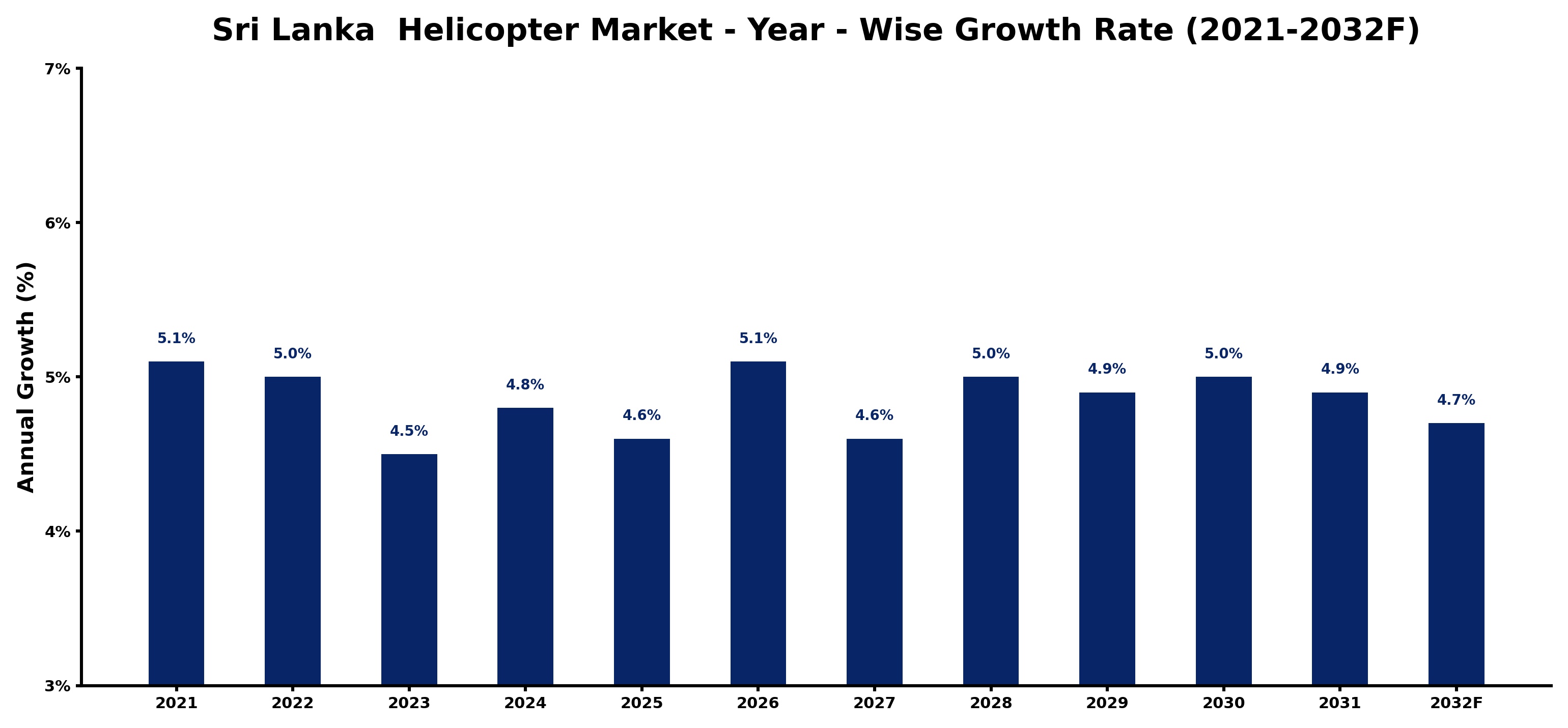
The table below presents the year‑wise growth rates along with the key drivers influencing the market
| Year | Growth Rate | Major Drivers |
| 2021 | 5.1% | Modernized supply chain logistics boosted helicopter component manufacturing efficiency |
| 2022 | 5.0% | Higher technology integration boosted local helicopter assembly capabilities |
| 2023 | 4.5% | Infrastructure projects drive helicopter maintenance and service demand growth |
| 2024 | 4.8% | Local assembly facilities boost helicopter manufacturing investment attractiveness |
| 2025 | 4.6% | Helicopter component manufacturing investment boosted local production capabilities |
| 2026 | 5.1% | Government contracts for emergency services boost helicopter manufacturing orders |
| 2027 | 4.6% | Export driven helicopter components manufacturing attracts foreign direct investment |
| 2028 | 5.0% | Helicopter modernization drives component manufacturing and supply chain investments |
| 2029 | 4.9% | New assembly lines boost local helicopter production capabilities significantly |
| 2030 | 5.0% | Helicopter maintenance upgrades boosted component manufacturing facility capacity utilization |
| 2031 | 4.9% | Local helicopter assembly initiatives boost supply chain resilience and efficiency |
| 2032 | 4.7% | Helicopter fleet upgrades drive composite materials demand for production |
Note - Market size estimations and growth projections presented in this report are based on 6Wresearch's advanced forecasting approach, validated with industry datasets as of June 2026.
Sri Lanka Helicopter Market Synopsis
The Sri Lanka helicopter market has witnessed dynamic growth, particularly in the tourism sector, where helicopters serve both luxury transport and aerial sightseeing needs. However, as the market matures, future developments indicate potential expansion into areas such as emergency medical services and agricultural surveys, reflecting changing consumer demands.
Looking ahead, the market is poised for sustained growth as government initiatives promote infrastructure improvement and bolster disaster response capabilities. As new technology emerges, the transition to more cost-effective and environmentally friendly helicopter models is also likely to reshape operational practices across the sector.
Sri Lanka Helicopter Market Key Takeaways
- The Sri Lanka helicopter market is experiencing growth due to increased demand from the tourism sector and medical services.
- Government policies are actively fostering investment and infrastructure development in the aviation industry.
- Challenges such as high operational costs and limited infrastructure are impacting market expansion.
- Advancements in helicopter technology are expected to enhance service offerings and attract new customers.
- Investment opportunities exist in luxury travel, medical evacuations, and disaster management solutions.
Evaluation of Restraints in Sri Lanka Helicopter Market
Several factors currently hinder the robust growth of the Sri Lanka helicopter market. High acquisition costs pose a significant barrier, limiting access for many potential operators. Additionally, ongoing maintenance, fuel prices, and insurance further elevate the financial strain on existing companies. Compounding these economic challenges are the limited operational infrastructures, which can impede the efficient deployment of services, particularly in remote regions. Navigating the stringent regulatory landscape adds another layer of complexity, as compliance can be resource-intensive and slow-moving.
Sri Lanka Helicopter Market Trends
The Sri Lanka helicopter market is currently embracing a trend towards diversified applications, as operators increasingly offer specialized services such as aerial surveys and emergency response. The rise in demand for eco-friendly and fuel-efficient helicopter models is shaping purchasing decisions, attracting operators interested in reducing operational costs. Simultaneously, tourism continues to be a driving force, with more operators seeking to capitalize on the breathtaking natural landscape for sightseeing flights.
Sri Lanka Helicopter Market Opportunities
The future presents promising opportunities for investment across various sectors within the Sri Lanka helicopter market. The tourism industry's expansion calls for enhanced aerial services, notably in luxury travel and unique sightseeing experiences. There is also a growing need for medical evacuation services, especially in rural areas where timely care is critical. As the government continues to emphasize disaster management capabilities, opportunities for helicopter leasing, maintenance services, and partnerships with local businesses are emerging, providing a pathway for growth and profitability.
Government Initiatives in the Sri Lanka Helicopter Market
The Sri Lankan government is implementing several initiatives designed to support the helicopter market. Stricter safety regulations enforced by the Civil Aviation Authority ensure compliance with international standards, thereby increasing safety across the sector. Additionally, the government is encouraging investment through incentives such as tax breaks and subsidies. Training programs for pilots and maintenance personnel are also being promoted to develop the necessary skills within the industry, further enhancing the operational capacity of helicopter services in the country.
Future Insights of the Sri Lanka Helicopter Market
As we look towards 2026-2032, the Sri Lanka helicopter market is set for steady growth driven by an increasing demand for air transportation services. The government's commitment to infrastructure development and disaster management initiatives is likely to bolster market expansion. Moreover, the integration of more efficient helicopter models and technology will enhance service offerings. However, addressing financial constraints and regulatory challenges will be essential for sustained growth, making strategic planning crucial for market players.
Sri Lanka Helicopter Market Latest Developments (May 2025 - June 2026)
Recently, the Sri Lanka helicopter market has seen a renewed focus on enhancing safety protocols, with increased government oversight aimed at ensuring compliance with international aviation standards. Simultaneously, operators are beginning to adopt more advanced technologies, allowing for improved service efficiency and reduced operational costs. The push towards better infrastructure is also resulting in more partnerships between private operators and government entities, paving the way for improved helicopter service offerings across the nation.
Sri Lanka Helicopter Market - Key Attractiveness of the Report
- 10 Years of Market Numbers
- Historical Data Starting from 2022 to 2025
- Base Year: 2025
- Forecast Data until 2032
- Key Performance Indicators Impacting the Market
- Major Upcoming Developments and Projects
Key Highlights of the Report:
- Sri Lanka Helicopter Market Outlook
- Market Size of Sri Lanka Helicopter Market, 2025
- Forecast of Sri Lanka Helicopter Market, 2032
- Historical Data and Forecast of Sri Lanka Helicopter Revenues & Volume for the Period 2022-2032F
- Sri Lanka Helicopter Market Trend Evolution
- Sri Lanka Helicopter Market Drivers and Challenges
- Sri Lanka Helicopter Price Trends
- Sri Lanka Helicopter Porter's Five Forces
- Sri Lanka Helicopter Industry Life Cycle
- Historical Data and Forecast of Sri Lanka Helicopter Market Revenues & Volume By End-users for the Period 2022-2032F
- Historical Data and Forecast of Sri Lanka Helicopter Market Revenues & Volume By Commercial for the Period 2022-2032F
- Historical Data and Forecast of Sri Lanka Helicopter Market Revenues & Volume By Military for the Period 2022-2032F
- Historical Data and Forecast of Sri Lanka Helicopter Market Revenues & Volume By Component for the Period 2022-2032F
- Historical Data and Forecast of Sri Lanka Helicopter Market Revenues & Volume By Aerostructures/Airframes for the Period 2022-2032F
- Historical Data and Forecast of Sri Lanka Helicopter Market Revenues & Volume By Rotary System for the Period 2022-2032F
- Historical Data and Forecast of Sri Lanka Helicopter Market Revenues & Volume By Engine for the Period 2022-2032F
- Historical Data and Forecast of Sri Lanka Helicopter Market Revenues & Volume By Undercarriage for the Period 2022-2032F
- Historical Data and Forecast of Sri Lanka Helicopter Market Revenues & Volume By Avionics for the Period 2022-2032F
- Historical Data and Forecast of Sri Lanka Helicopter Market Revenues & Volume By Cabin Interiors for the Period 2022-2032F
- Historical Data and Forecast of Sri Lanka Helicopter Market Revenues & Volume By Environmental Control System for the Period 2022-2032F
- Historical Data and Forecast of Sri Lanka Helicopter Market Revenues & Volume By Sales Channels for the Period 2022-2032F
- Historical Data and Forecast of Sri Lanka Helicopter Market Revenues & Volume By OEM for the Period 2022-2032F
- Historical Data and Forecast of Sri Lanka Helicopter Market Revenues & Volume By Maintenance for the Period 2022-2032F
- Historical Data and Forecast of Sri Lanka Helicopter Market Revenues & Volume By Repair for the Period 2022-2032F
- Historical Data and Forecast of Sri Lanka Helicopter Market Revenues & Volume By Overhaul for the Period 2022-2032F
- Sri Lanka Helicopter Import Export Trade Statistics
- Market Opportunity Assessment By End-users
- Market Opportunity Assessment By Component
- Market Opportunity Assessment By Sales Channels
- Sri Lanka Helicopter Top Companies Market Share
- Sri Lanka Helicopter Competitive Benchmarking By Technical and Operational Parameters
- Sri Lanka Helicopter Company Profiles
- Sri Lanka Helicopter Key Strategic Recommendations






































