Sri Lanka Industrial Burner Market Size, Share & Growth Rate
The Sri Lanka Industrial Burner Market was estimated at USD 148 Million in 2025 and is projected to reach USD 161 Million by 2032, growing at a CAGR of 1.2% from 2026 to 2032. This growth trajectory is fueled by a marked increase in industrial activities, particularly in sectors like food processing and textiles, where the need for efficient heating solutions is paramount. Additionally, the push for advanced manufacturing processes and energy efficiency standards continues to shape the market dynamics favorably.
Sri Lanka Industrial Burner Market Year-wise Growth Rate and Key Drivers
This graph highlights how the Sri Lanka Industrial Burner Market has steadily grown over the years, supported by major growth factors.
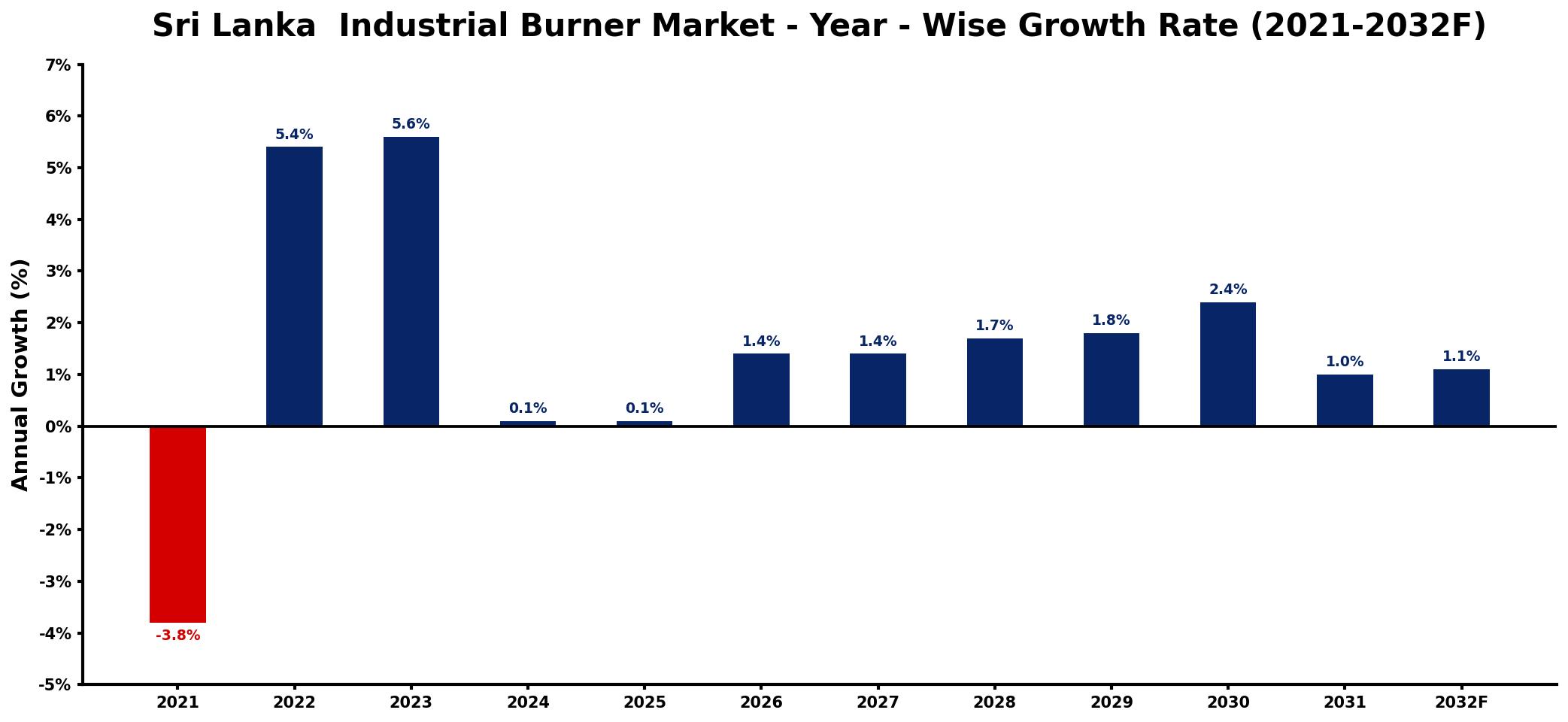
The table below presents the year‑wise growth rates along with the key drivers influencing the market
| Year | Growth Rate | Major Drivers |
| 2021 | -3.8% | decreased demand from manufacturing sector |
| 2022 | 5.4% | increased investments in infrastructure projects |
| 2023 | 5.6% | higher energy efficiency regulations implemented |
| 2024 | 0.1% | growth in food processing industry |
| 2025 | 0.1% | rising demand for renewable energy |
| 2026 | 1.4% | expansion of commercial cooking applications |
| 2027 | 1.4% | increased automation in production facilities |
| 2028 | 1.7% | increased pharmaceutical industry usage |
| 2029 | 1.8% | surge in textile production activities |
| 2030 | 2.4% | demand from hospitality industry rising |
| 2031 | 1.0% | growing automotive sector requirements |
| 2032 | 1.1% | growing interest in eco-friendly solutions |
Note: Market size estimations and growth projections presented in this report are based on 6Wresearch's proprietary forecasting methodology, utilizing the latest available industry data, government publications, and primary research inputs.
Sri Lanka Industrial Burner Market Synopsis
In recent years, the Sri Lanka Industrial Burner Market has experienced notable momentum, driven largely by expanding industrial operations and technological advancements. As manufacturers increasingly prioritize efficiency and sustainability, the market is poised for further evolution, indicating a shift towards more innovative burner technologies.
Looking forward, the market is expected to align with global standards for emissions and efficiency. The continuous improvement in burner technologies will likely see local manufacturers enhancing their offerings while global suppliers introduce state-of-the-art solutions tailored to the Sri Lankan context.
Sri Lanka Industrial Burner Market Key Takeaways
- The market is supported by the growing demand for energy-efficient heating solutions across various industrial sectors.
- Technological innovations are central to meeting stringent environmental regulations and enhancing operational performance.
- Local manufacturers are increasingly collaborating with global suppliers to diversify their product offerings.
- Government policies aim to incentivize the adoption of cleaner technologies, impacting market growth positively.
- Challenges remain, particularly regarding the availability and cost of quality combustion fuels.
Evaluation of Restraints in Sri Lanka Industrial Burner Market
Despite the growth potential, the Sri Lanka Industrial Burner Market faces significant restraints. The primary challenge centers around the increasing demand for energy efficiency, which places pressure on manufacturers to innovate continuously. Furthermore, stringent environmental regulations necessitate compliance with evolving emission standards, which can be resource-intensive. Additionally, the market grapples with the availability and cost of high-quality combustion fuels, which can affect the financial feasibility of upgrading existing burner systems. These factors create a complex landscape that requires strategic navigation for market participants.
Sri Lanka Industrial Burner Market Trends
A notable trend shaping the Sri Lanka Industrial Burner Market is the integration of smart technologies aimed at enhancing operational efficiency. Features such as remote monitoring and automated controls are gaining traction among end-users. Furthermore, a shift towards biofuels and other renewable energy sources is beginning to redefine the landscape, supported by increasing governmental incentives. This transition not only aligns with global sustainability goals but also addresses local environmental concerns.
Sri Lanka Industrial Burner Market Opportunities
Opportunities within the Sri Lanka Industrial Burner Market lie prominently in the areas of technological innovation and sustainable practices. As industries pivot towards cleaner operations, there is significant potential for the introduction of advanced burner technologies that minimize emissions while improving energy efficiency. Additionally, collaboration with international partners could unlock new markets and bolster local manufacturing capabilities, ultimately enhancing competitiveness in both domestic and export arenas.
Government Initiatives in the Sri Lanka Industrial Burner Market
The Sri Lankan government has established various initiatives aimed at promoting energy efficiency and environmental sustainability within the industrial sector. Policies encouraging the use of cleaner burning technologies are in place, complemented by incentives such as tax benefits for companies investing in energy-efficient systems. Moreover, subsidies aimed at integrating renewable energy sources into manufacturing processes reflect the governments commitment to aligning with global environmental standards and fostering a more sustainable industrial framework.
Future Insights of the Sri Lanka Industrial Burner Market
From 2026 to 2032, the Sri Lanka Industrial Burner Market is projected to evolve significantly. The increasing focus on operational reliability and precise temperature control will drive demand for advanced burner technologies. Furthermore, as industries adapt to stringent environmental regulations, the market will likely see an uptick in the adoption of hybrid and renewable fuel technologies. This shift not only emphasizes the importance of sustainability but also positions Sri Lanka as a competitive player in the global industrial landscape.
Sri Lanka Industrial Burner Market Latest Developments (2025 - 2026)
In the period from & to June 2026, the Sri Lanka Industrial Burner Market has witnessed several pivotal developments. Companies are increasingly focusing on R&D to enhance the energy efficiency of their products while complying with new regulatory standards. Additionally, partnerships between local and international players have been instrumental in introducing innovative technologies designed to improve burner performance. There is also a growing trend of integrating IoT solutions into burner systems, aimed at optimizing operations and reducing emissions.
Sri Lanka Industrial Burner Market - Key Attractiveness of the Report
- 10 Years of Market Numbers
- Historical Data Starting from 2022 to 2025
- Base Year: 2025
- Forecast Data until 2032
- Key Performance Indicators Impacting the Market
- Major Upcoming Developments and Projects
Key Highlights of the Report:
- Sri Lanka Industrial Burner Market Outlook
- Market Size of Sri Lanka Industrial Burner Market, 2025
- Forecast of Sri Lanka Industrial Burner Market, 2032
- Historical Data and Forecast of Sri Lanka Industrial Burner Revenues & Volume for the Period 2022-2032F
- Sri Lanka Industrial Burner Market Trend Evolution
- Sri Lanka Industrial Burner Market Drivers and Challenges
- Sri Lanka Industrial Burner Price Trends
- Sri Lanka Industrial Burner Porter's Five Forces
- Sri Lanka Industrial Burner Industry Life Cycle
- Historical Data and Forecast of Sri Lanka Industrial Burner Market Revenues & Volume By Type for the Period 2022-2032F
- Historical Data and Forecast of Sri Lanka Industrial Burner Market Revenues & Volume By Cold Chamber Die Casting Machine for the Period 2022-2032F
- Historical Data and Forecast of Sri Lanka Industrial Burner Market Revenues & Volume By Hot Chamber Die Casting Machine for the Period 2022-2032F
- Historical Data and Forecast of Sri Lanka Industrial Burner Market Revenues & Volume By Gravity Die Casting Machine for the Period 2022-2032F
- Historical Data and Forecast of Sri Lanka Industrial Burner Market Revenues & Volume By Material for the Period 2022-2032F
- Historical Data and Forecast of Sri Lanka Industrial Burner Market Revenues & Volume By Aluminum for the Period 2022-2032F
- Historical Data and Forecast of Sri Lanka Industrial Burner Market Revenues & Volume By Zinc for the Period 2022-2032F
- Historical Data and Forecast of Sri Lanka Industrial Burner Market Revenues & Volume By Magnesium for the Period 2022-2032F
- Historical Data and Forecast of Sri Lanka Industrial Burner Market Revenues & Volume By End User for the Period 2022-2032F
- Historical Data and Forecast of Sri Lanka Industrial Burner Market Revenues & Volume By Transportation for the Period 2022-2032F
- Historical Data and Forecast of Sri Lanka Industrial Burner Market Revenues & Volume By Mechanical & Manufacturing Equipment for the Period 2022-2032F
- Historical Data and Forecast of Sri Lanka Industrial Burner Market Revenues & Volume By Building & Construction for the Period 2022-2032F
- Sri Lanka Industrial Burner Import Export Trade Statistics
- Market Opportunity Assessment By Type
- Market Opportunity Assessment By Material
- Market Opportunity Assessment By End User
- Sri Lanka Industrial Burner Top Companies Market Share
- Sri Lanka Industrial Burner Competitive Benchmarking By Technical and Operational Parameters
- Sri Lanka Industrial Burner Company Profiles
- Sri Lanka Industrial Burner Key Strategic Recommendations






































