Sri Lanka Industrial Machinery Market Size, Share & Growth Rate
The Sri Lanka Industrial Machinery Market was estimated at USD 230 Million in 2025 and is projected to reach USD 253 Million by 2032, growing at a CAGR of 1.4% from 2026 to 2032. This growth trajectory is largely driven by a surge in industrial activities fueled by infrastructure projects and the increasing need for automation across key sectors such as textiles, food processing, and automotive. The focus on enhancing production efficiency and product quality, alongside the modernization efforts within various manufacturing processes, is set to further propel market demand.
Sri Lanka Industrial Machinery Market Year-wise Growth Rate and Key Drivers
This graph highlights how the Sri Lanka Industrial Machinery Market has steadily grown over the years, supported by major growth factors.
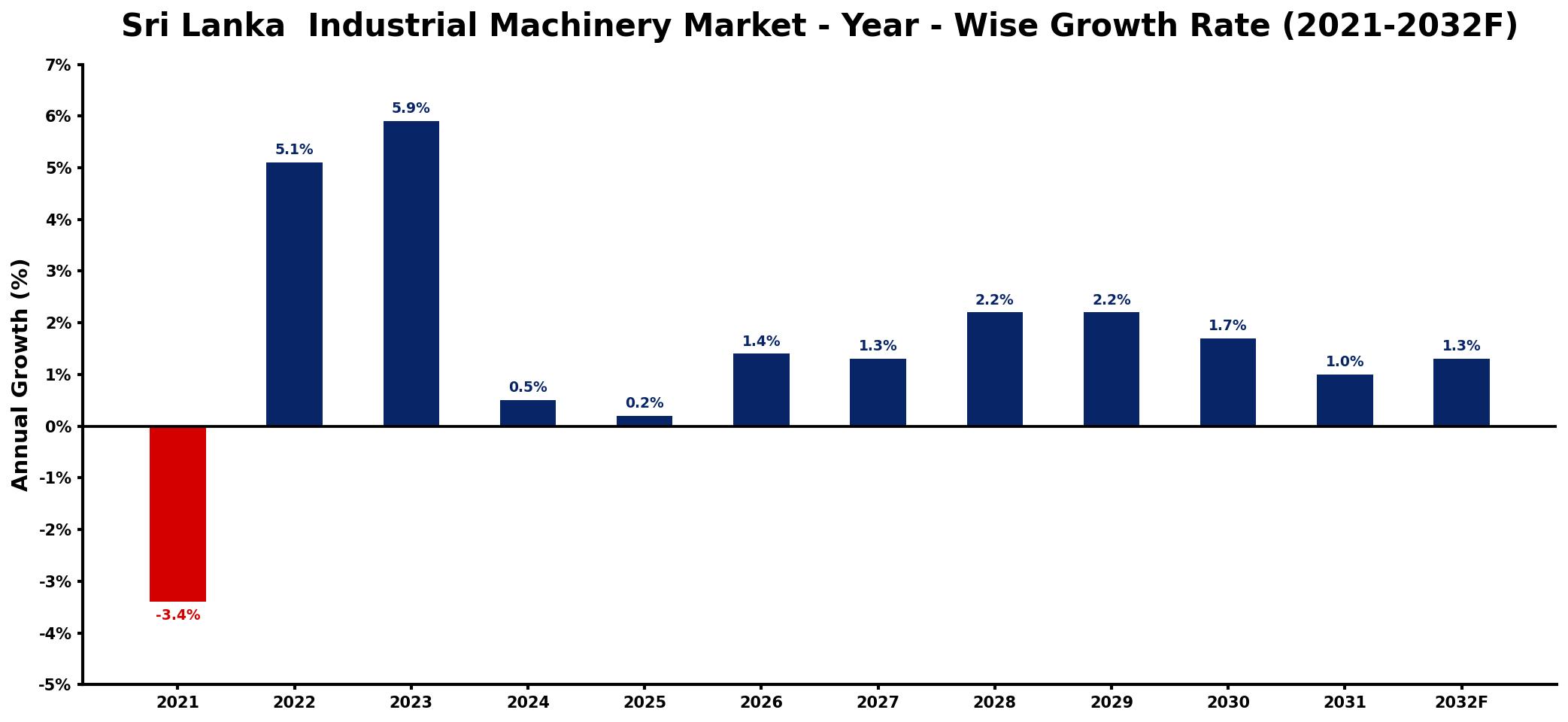
The table below presents the year‑wise growth rates along with the key drivers influencing the market
| Year | Growth Rate | Major Drivers |
| 2021 | -3.4% | decreased investment in infrastructure projects |
| 2022 | 5.1% | rising demand from construction sector |
| 2023 | 5.9% | expansion of manufacturing capabilities |
| 2024 | 0.5% | increased government infrastructure spending |
| 2025 | 0.2% | growth in renewable energy projects |
| 2026 | 1.4% | surge in export-oriented industries |
| 2027 | 1.3% | enhanced technological adoption trends |
| 2028 | 2.2% | development of smart factories initiative |
| 2029 | 2.2% | strengthened logistics and supply chains |
| 2030 | 1.7% | emphasis on automation and efficiency |
| 2031 | 1.0% | growing focus on sustainability practices |
| 2032 | 1.3% | rising foreign direct investments influx |
Note: Market size estimations and growth projections presented in this report are based on 6Wresearch's proprietary forecasting methodology, utilizing the latest available industry data, government publications, and primary research inputs.
Sri Lanka Industrial Machinery Market Synopsis
The demand for advanced industrial machinery is being notably shaped by the textile sector, which remains a cornerstone of the Sri Lankan economy. With local manufacturers striving to meet international standards, there is a consistent push for more sophisticated and efficient machinery that can enhance output and quality.
Moreover, the food processing industry is also experiencing significant growth, requiring advanced processing equipment to meet both domestic consumption and export demands. This has resulted in an increasing reliance on high-quality machinery that can not only boost productivity but also ensure compliance with global food safety standards.
Sri Lanka Industrial Machinery Market Key Takeaways
- The market is projected to grow steadily, reaching USD 253 Million by 2032, driven by sector-specific demands.
- Key sectors, including textiles and food processing, are pivotal in shaping the machinery landscape.
- Government policies are aimed at promoting local manufacturing and technological advancements.
- Investment in automation technologies is critical for enhancing productivity and maintaining competitiveness.
- SMEs face significant challenges in accessing financing, hindering modernization efforts.
Evaluation of Restraints in Sri Lanka Industrial Machinery Market
Despite the positive growth outlook, the Sri Lanka Industrial Machinery Market faces several key restraints. Notably, the cost of importing advanced machinery remains a significant barrier, particularly for small and medium-sized enterprises (SMEs) that struggle with limited financing options. These challenges are compounded by the ongoing competition from cheaper machinery imports from neighboring countries, which undercuts the local manufacturers' ability to compete effectively. To overcome these restraints, targeted investments in local production capabilities and initiatives for skill development are essential.
Sri Lanka Industrial Machinery Market Trends
There is a marked trend towards greater automation across various sectors in Sri Lanka. Manufacturers are increasingly adopting smart machinery that integrates IoT technologies, thereby enhancing operational efficiency and real-time data analytics capabilities. Furthermore, sustainability is becoming a focal point, with companies seeking energy-efficient machinery that minimizes environmental impact while maintaining high production standards.
Sri Lanka Industrial Machinery Market Opportunities
The evolving landscape presents numerous growth opportunities, particularly within the realm of technological innovation. Investments in R&D are essential for developing locally manufactured machinery that meets international standards, thereby reducing import dependencies. Additionally, there is significant potential in partnerships between local firms and international machinery manufacturers, which could lead to knowledge transfer and improved technical competencies.
Government Initiatives in the Sri Lanka Industrial Machinery Market
The Sri Lankan government has implemented several initiatives aimed at promoting growth within the industrial machinery sector. These include providing investment incentives, improving trade facilitation, and investing in infrastructure development to create a more favorable business environment. Additionally, regulations that emphasize quality standards and encourage technological advancements play a crucial role in bolstering local manufacturing capabilities.
Future Insights of the Sri Lanka Industrial Machinery Market
Looking ahead to 2026-2032, the Sri Lanka Industrial Machinery Market is poised for gradual expansion. The continual push for modernization across key sectors will likely fuel demand for advanced machinery. As local industries increasingly adopt automation and innovative technologies, the market is expected to attract more foreign investments, especially as government policies become increasingly favorable toward local manufacturing initiatives.
Sri Lanka Industrial Machinery Market Latest Developments (2025 - 2026)
In the recent months leading to mid-2026, the Sri Lanka industrial machinery sector has seen various initiatives focused on upgrading existing manufacturing facilities. There is a growing emphasis on embracing smart technologies, with local manufacturers beginning to adopt automation solutions that enhance productivity and reduce operational costs. Additionally, the government has ramped up efforts to streamline regulations, making it easier for businesses to invest in new machinery and technology.
Sri Lanka Industrial Machinery Market - Key Attractiveness of the Report
- 10 Years of Market Numbers
- Historical Data Starting from 2022 to 2025
- Base Year: 2025
- Forecast Data until 2032
- Key Performance Indicators Impacting the Market
- Major Upcoming Developments and Projects
Key Highlights of the Report:
- Sri Lanka Industrial Machinery Market Outlook
- Market Size of Sri Lanka Industrial Machinery Market, 2025
- Forecast of Sri Lanka Industrial Machinery Market, 2032
- Historical Data and Forecast of Sri Lanka Industrial Machinery Revenues & Volume for the Period 2022-2032F
- Sri Lanka Industrial Machinery Market Trend Evolution
- Sri Lanka Industrial Machinery Market Drivers and Challenges
- Sri Lanka Industrial Machinery Price Trends
- Sri Lanka Industrial Machinery Porter's Five Forces
- Sri Lanka Industrial Machinery Industry Life Cycle
- Historical Data and Forecast of Sri Lanka Industrial Machinery Market Revenues & Volume By Application for the Period 2022-2032F
- Historical Data and Forecast of Sri Lanka Industrial Machinery Market Revenues & Volume By Agriculture for the Period 2022-2032F
- Historical Data and Forecast of Sri Lanka Industrial Machinery Market Revenues & Volume By Construction for the Period 2022-2032F
- Historical Data and Forecast of Sri Lanka Industrial Machinery Market Revenues & Volume By Packaging for the Period 2022-2032F
- Historical Data and Forecast of Sri Lanka Industrial Machinery Market Revenues & Volume By Food Processing for the Period 2022-2032F
- Historical Data and Forecast of Sri Lanka Industrial Machinery Market Revenues & Volume By Mining for the Period 2022-2032F
- Historical Data and Forecast of Sri Lanka Industrial Machinery Market Revenues & Volume By Semiconductor Manufacturing for the Period 2022-2032F
- Sri Lanka Industrial Machinery Import Export Trade Statistics
- Market Opportunity Assessment By Application
- Sri Lanka Industrial Machinery Top Companies Market Share
- Sri Lanka Industrial Machinery Competitive Benchmarking By Technical and Operational Parameters
- Sri Lanka Industrial Machinery Company Profiles
- Sri Lanka Industrial Machinery Key Strategic Recommendations






































