Sri Lanka Manganese Mining Market Size, Share & Growth Rate
The Sri Lanka Manganese Mining Market was estimated at USD 234 Million in 2025 and is projected to reach USD 307 Million by 2032, growing at a CAGR of 4.0% from 2026 to 2032. This growth trajectory is primarily driven by the escalating demand for manganese in key sectors such as steel production and battery manufacturing. Additionally, the country's rich deposits and strategic initiatives to attract investment further contribute to the positive market outlook.
Sri Lanka Manganese Mining Market Year-wise Growth Rate and Key Drivers
This graph highlights how the Sri Lanka Manganese Mining Market has steadily grown over the years, supported by major growth factors.
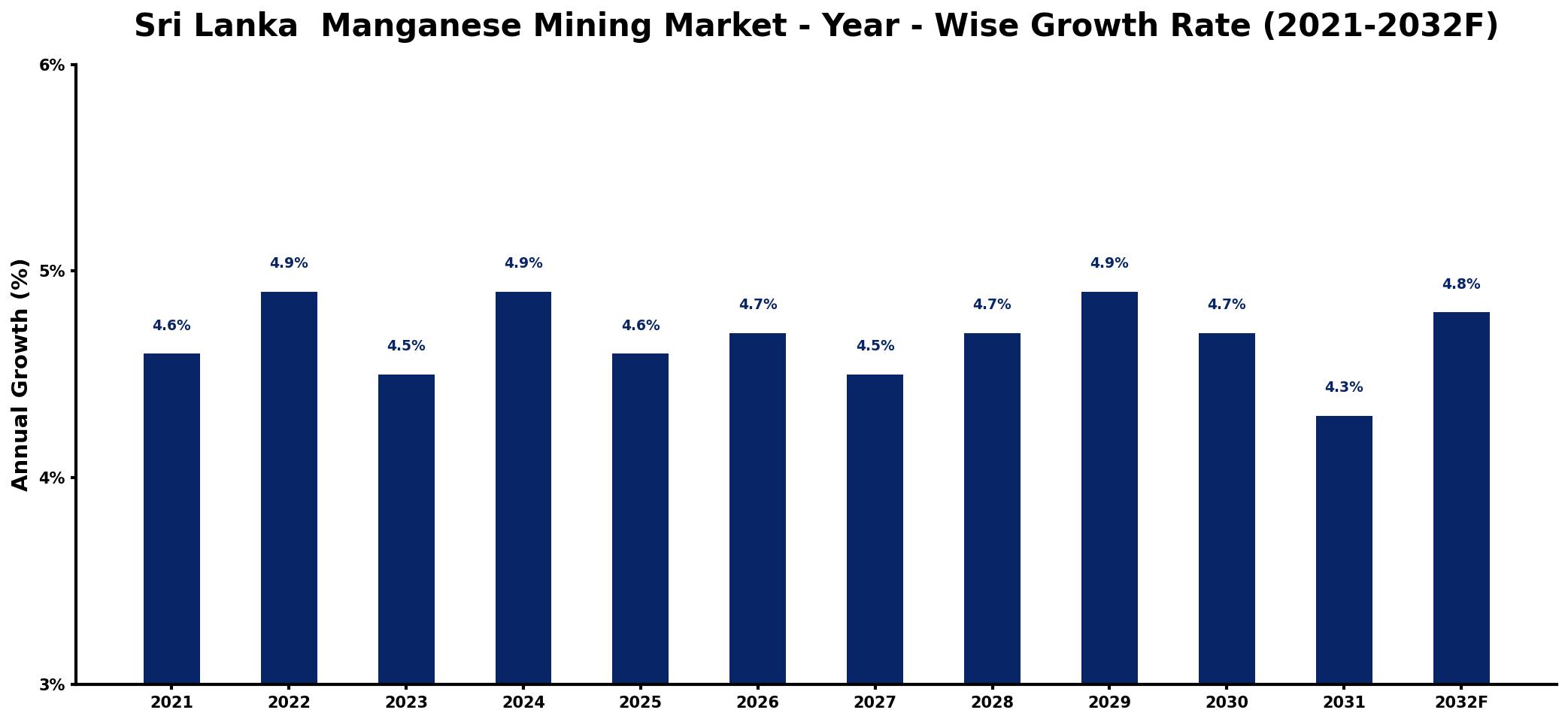
The table below presents the year‑wise growth rates along with the key drivers influencing the market
| Year | Growth Rate | Major Drivers |
| 2021 | 4.6% | increased demand from battery production |
| 2022 | 4.9% | expansion of electric vehicle market |
| 2023 | 4.5% | growing construction sector requirements |
| 2024 | 4.9% | rising global steel production needs |
| 2025 | 4.6% | enhanced infrastructure development projects |
| 2026 | 4.7% | surge in renewable energy investments |
| 2027 | 4.5% | increased foreign direct investments |
| 2028 | 4.7% | higher demand for alloy applications |
| 2029 | 4.9% | growth in aerospace industry usage |
| 2030 | 4.7% | growing regional consumption patterns |
| 2031 | 4.3% | new technological advancements adoption |
| 2032 | 4.8% | growing automotive sector requirements |
Note: Market size estimations and growth projections presented in this report are based on 6Wresearch's proprietary forecasting methodology, utilizing the latest available industry data, government publications, and primary research inputs.
Sri Lanka Manganese Mining Market Synopsis
The Sri Lanka Manganese Mining Market is witnessing a notable upsurge, bolstered by high-quality manganese ore deposits predominantly located in the central and southern regions. As industries increasingly seek manganese for its critical applications, mining activities are expanding, inviting both domestic and foreign investments.
Despite the positive outlook, the market faces several challenges, particularly regarding environmental regulations and logistical constraints. Addressing these concerns while fostering growth will be crucial for the sustainable development of the manganese mining sector in Sri Lanka.
Sri Lanka Manganese Mining Market Key Takeaways
- The market is projected to grow from USD 234 Million in 2025 to USD 307 Million by 2032.
- Increased demand from steel production and battery manufacturing is driving market expansion.
- Environmental regulations and logistical challenges pose significant hurdles for mining operations.
- The government is implementing policies to promote sustainable mining practices.
- Investment opportunities exist in exploration, mining operations, and infrastructure development.
Evaluation of Restraints in Sri Lanka Manganese Mining Market
Several factors are currently restraining the growth of the Sri Lanka Manganese Mining Market. Regulatory hurdles can delay the acquisition of necessary mining licenses, complicating project timelines. Additionally, environmental issues, including land degradation and pollution, necessitate strict compliance with regulations that can add further complexities. Infrastructure challenges, particularly in transportation and power supply, impede efficient operations and increase operational costs, hampering potential profit margins.
Sri Lanka Manganese Mining Market Trends
A pivotal trend in the Sri Lanka Manganese Mining Market is the growing focus on sustainable mining practices. As stakeholders acknowledge environmental impacts, initiatives for eco-friendly mining techniques are being prioritized. Furthermore, advancements in technology are enhancing extraction efficiency and ore processing methods, contributing to reduced environmental footprints. The burgeoning electric vehicle market is also reshaping demand dynamics, driving further interest in manganese for battery applications.
Sri Lanka Manganese Mining Market Opportunities
The Sri Lanka Manganese Mining Market is ripe with opportunities for investors looking to tap into unexplored manganese deposits. Partnerships with local mining companies can facilitate entry into the market, while investments in mining technology and infrastructure improvements can yield significant returns. Additionally, the expansion of the electric vehicle sector presents a unique avenue for growth, as the demand for manganese-based batteries continues to rise.
Government Initiatives in the Sri Lanka Manganese Mining Market
The Sri Lankan government is actively promoting the manganese mining sector through a series of policies aimed at ensuring sustainable practices. Regulations governing mining licenses are designed to support both economic development and environmental stewardship. Furthermore, the government is investing in infrastructure projects and simplifying regulatory processes to attract foreign investments, fostering a conducive environment for growth in the manganese mining industry.
Future Insights of the Sri Lanka Manganese Mining Market
Looking ahead to the period from 2026 to 2032, the Sri Lanka Manganese Mining Market is expected to flourish, driven by the increasing global demand for manganese. The synergy between rising infrastructure projects and the expansion of battery manufacturing for electric vehicles will fuel growth in the sector. However, addressing environmental concerns and enhancing logistical capabilities will be essential to sustain this growth trajectory in the coming years.
Sri Lanka Manganese Mining Market Latest Developments (2025 - 2026)
Recent developments within the Sri Lanka Manganese Mining Market indicate a heightened focus on regulatory compliance and sustainable practices. The government has begun streamlining licensing processes, aiming to reduce barriers for new entrants. Additionally, local mining companies are increasingly adopting green technologies in their operations, reflecting a commitment to environmentally responsible mining. These shifts are expected to shape the industry landscape positively as stakeholders align with sustainable development goals.
Sri Lanka Manganese Mining Market - Key Attractiveness of the Report
- 10 Years of Market Numbers
- Historical Data Starting from 2022 to 2025
- Base Year: 2025
- Forecast Data until 2032
- Key Performance Indicators Impacting the Market
- Major Upcoming Developments and Projects
Key Highlights of the Report:
- Sri Lanka Manganese Mining Market Outlook
- Market Size of Sri Lanka Manganese Mining Market, 2025
- Forecast of Sri Lanka Manganese Mining Market, 2032
- Historical Data and Forecast of Sri Lanka Manganese Mining Revenues & Volume for the Period 2022-2032F
- Sri Lanka Manganese Mining Market Trend Evolution
- Sri Lanka Manganese Mining Market Drivers and Challenges
- Sri Lanka Manganese Mining Price Trends
- Sri Lanka Manganese Mining Porter's Five Forces
- Sri Lanka Manganese Mining Industry Life Cycle
- Historical Data and Forecast of Sri Lanka Manganese Mining Market Revenues & Volume By Application for the Period 2022-2032F
- Historical Data and Forecast of Sri Lanka Manganese Mining Market Revenues & Volume By Alloys for the Period 2022-2032F
- Historical Data and Forecast of Sri Lanka Manganese Mining Market Revenues & Volume By Othes for the Period 2022-2032F
- Sri Lanka Manganese Mining Import Export Trade Statistics
- Market Opportunity Assessment By Application
- Sri Lanka Manganese Mining Top Companies Market Share
- Sri Lanka Manganese Mining Competitive Benchmarking By Technical and Operational Parameters
- Sri Lanka Manganese Mining Company Profiles
- Sri Lanka Manganese Mining Key Strategic Recommendations






































