Sri Lanka Metal Recycling Market Size, Share & Growth Rate
The Sri Lanka Metal Recycling Market was estimated at USD 223 Million in 2025 and is projected to reach USD 308 Million by 2032, growing at a CAGR of 4.7% from 2026 to 2032. This growth trajectory is primarily fueled by a rising awareness of environmental sustainability and the urgent need for raw materials in various sectors. Furthermore, the governments commitment to promoting recycling practices and reducing waste generation is creating a favorable environment for market expansion.
Sri Lanka Metal Recycling Market Year-wise Growth Rate and Key Drivers
This graph highlights how the Sri Lanka Metal Recycling Market has steadily grown over the years, supported by major growth factors.
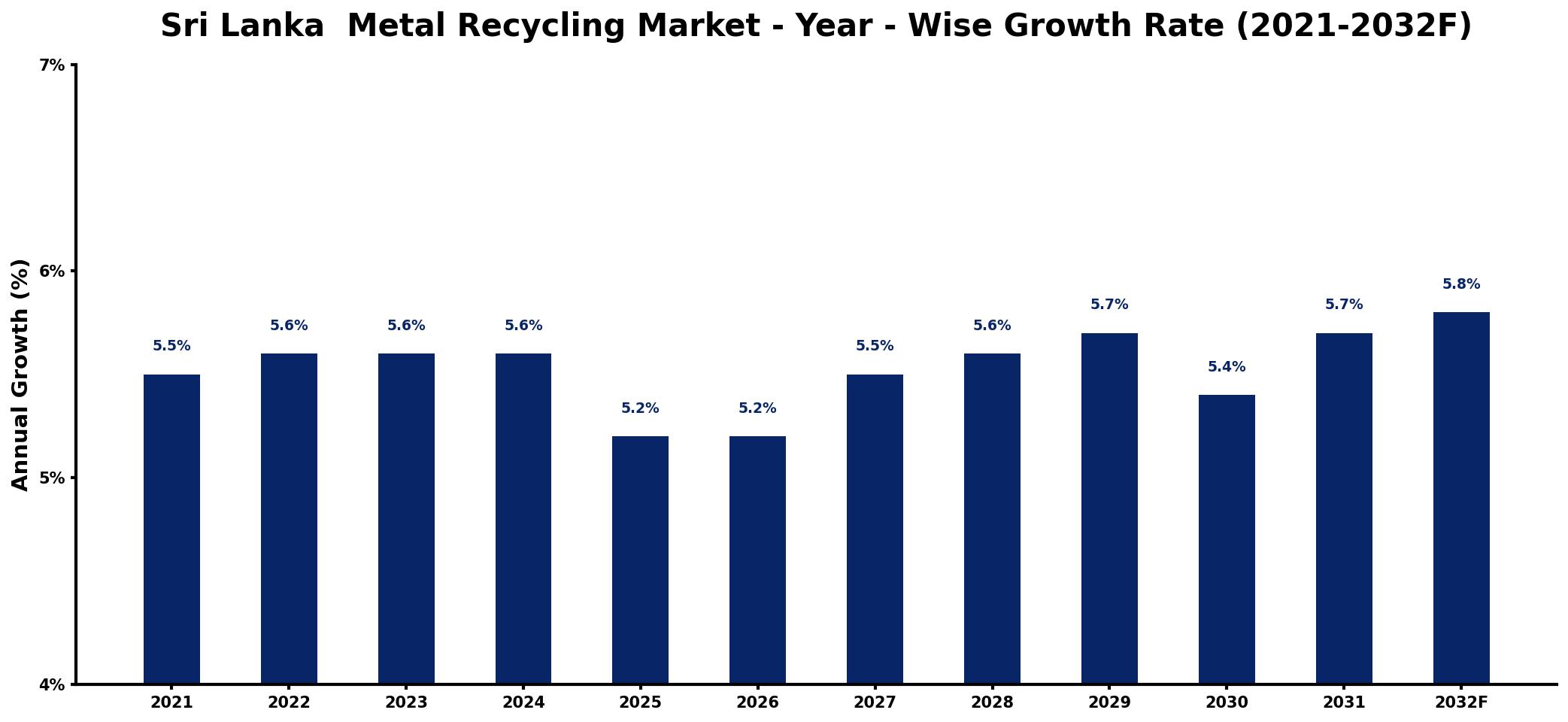
The table below presents the year‑wise growth rates along with the key drivers influencing the market
| Year | Growth Rate | Major Drivers |
| 2021 | 5.5% | Rising industrial manufacturing activities |
| 2022 | 5.6% | Increased government sustainability initiatives |
| 2023 | 5.6% | Growing consumer awareness campaigns |
| 2024 | 5.6% | Expansion of construction projects |
| 2025 | 5.2% | Emergence of new market players |
| 2026 | 5.2% | Enhanced technological advancements adoption |
| 2027 | 5.5% | Strengthened export opportunities abroad |
| 2028 | 5.6% | Increased urban development investments |
| 2029 | 5.7% | Surge in renewable energy projects |
| 2030 | 5.4% | Growing automotive sector demands |
| 2031 | 5.7% | Rising demand for green products |
| 2032 | 5.8% | expanding healthcare application demand |
Note: Market size estimations and growth projections presented in this report are based on 6Wresearch's proprietary forecasting methodology, utilizing the latest available industry data, government publications, and primary research inputs.
Sri Lanka Metal Recycling Market Synopsis
Recently, the metal recycling market in Sri Lanka has gained momentum, driven by environmental concerns and the need for sustainable practices. As industries increasingly adopt circular economy principles, this market is poised for robust growth, with investments in advanced recycling technologies enhancing efficiency and output.
Looking ahead, the Sri Lanka Metal Recycling Market is set to evolve further, as both public and private sectors seek innovative solutions to bolster recycling efforts. This evolution presents new opportunities for both established and emerging players in the sector, making it a dynamic area for investment.
Sri Lanka Metal Recycling Market Key Takeaways
- The market is experiencing steady growth fueled by environmental awareness and increasing demand for recycled metals.
- Government initiatives play a critical role in supporting and promoting recycling practices across the country.
- Technological advancements are improving efficiency in recycling processes, making operations more sustainable.
- Investment opportunities abound, particularly in advanced recycling facilities and partnerships with local businesses.
- Addressing infrastructure gaps will be essential for realizing the full potential of the metal recycling market.
Evaluation of Restraints in Sri Lanka Metal Recycling Market
Despite the positive outlook, several factors hinder the growth of the Sri Lanka Metal Recycling Market. One significant restraint is the inadequate infrastructure for the efficient collection and processing of scrap metal. Additionally, there exists a lack of awareness among the general population about the benefits of recycling, which limits participation in recycling initiatives. The presence of unregulated scrap collection practices further complicates the landscape, creating unfair competition for formal businesses. Addressing these challenges requires targeted investments in education, infrastructure, and regulatory frameworks to promote sustainable practices effectively.
Sri Lanka Metal Recycling Market Trends
The market is seeing a pronounced trend toward sustainability, as both individuals and organizations recognize the critical importance of recycling metals. A growing preference for circular economy principles is driving demand for more efficient recycling processes. Technological advancements are emerging as a key element, as innovations in sorting and processing techniques make operations more streamlined and cost-effective. This shift toward environmental consciousness is not only beneficial for the planet but also positions businesses for long-term success.
Sri Lanka Metal Recycling Market Opportunities
There are significant investment opportunities within the Sri Lanka Metal Recycling Market, particularly in the establishment and expansion of recycling facilities. Investors can capitalize on the growing demand for sustainable practices by integrating advanced technologies that enhance efficiency and minimize environmental impact. Collaborations with local enterprises and government initiatives focused on recycling and waste management can provide strategic advantages, while the increasing urbanization and industrial activities in Sri Lanka ensure a steady supply of scrap metal for recycling. The markets alignment with sustainability goals further enhances its attractiveness for investors.
Government Initiatives in the Sri Lanka Metal Recycling Market
The government of Sri Lanka has implemented various initiatives aimed at fostering sustainable practices within the metal recycling market. Regulations have been established to encourage the recycling of metal waste, including taxes on the import of raw materials to incentivize the use of recycled metals. Additionally, there are licensing requirements for metal recycling businesses to ensure compliance with environmental standards and prevent illegal operations. Public awareness campaigns are also supported by the government, aimed at highlighting the benefits of recycling and encouraging community participation in sustainable practices.
Future Insights of the Sri Lanka Metal Recycling Market
As we look toward the future, the Sri Lanka Metal Recycling Market holds promising prospects driven by increasing public awareness and government initiatives aimed at enhancing recycling practices. The demand for recycled metals across industries such as construction, automotive, and manufacturing is expected to rise significantly. Moreover, advancements in recycling technology will further improve operational efficiency and reduce environmental footprints. The ongoing focus on circular economy principles, alongside potential investments in infrastructure, positions the market for substantial growth from 2026 to 2032.
Sri Lanka Metal Recycling Market Latest Developments (2025 - 2026)
In recent months, the Sri Lanka Metal Recycling Market has seen a surge in interest from both local and international investors, driven by a greater focus on sustainability. Industry stakeholders are increasingly looking at technological innovations to enhance the efficiency of recycling operations. Collaborative efforts between government bodies and private enterprises have also gained momentum, aimed at improving recycling infrastructure and public engagement. Such initiatives signal a positive direction for the market, reinforcing its potential for growth.
Sri Lanka Metal Recycling Market - Key Attractiveness of the Report
- 10 Years of Market Numbers
- Historical Data Starting from 2022 to 2025
- Base Year: 2025
- Forecast Data until 2032
- Key Performance Indicators Impacting the Market
- Major Upcoming Developments and Projects
Key Highlights of the Report:
- Sri Lanka Metal Recycling Market Outlook
- Market Size of Sri Lanka Metal Recycling Market, 2025
- Forecast of Sri Lanka Metal Recycling Market, 2032
- Historical Data and Forecast of Sri Lanka Metal Recycling Revenues & Volume for the Period 2022-2032F
- Sri Lanka Metal Recycling Market Trend Evolution
- Sri Lanka Metal Recycling Market Drivers and Challenges
- Sri Lanka Metal Recycling Price Trends
- Sri Lanka Metal Recycling Porter's Five Forces
- Sri Lanka Metal Recycling Industry Life Cycle
- Historical Data and Forecast of Sri Lanka Metal Recycling Market Revenues & Volume By Scrap Type for the Period 2022-2032F
- Historical Data and Forecast of Sri Lanka Metal Recycling Market Revenues & Volume By Old Scrap for the Period 2022-2032F
- Historical Data and Forecast of Sri Lanka Metal Recycling Market Revenues & Volume By New Scrap for the Period 2022-2032F
- Historical Data and Forecast of Sri Lanka Metal Recycling Market Revenues & Volume By Type for the Period 2022-2032F
- Historical Data and Forecast of Sri Lanka Metal Recycling Market Revenues & Volume By Ferrous for the Period 2022-2032F
- Historical Data and Forecast of Sri Lanka Metal Recycling Market Revenues & Volume By Non-Ferrous for the Period 2022-2032F
- Historical Data and Forecast of Sri Lanka Metal Recycling Market Revenues & Volume By Equipment for the Period 2022-2032F
- Historical Data and Forecast of Sri Lanka Metal Recycling Market Revenues & Volume By Shredders for the Period 2022-2032F
- Historical Data and Forecast of Sri Lanka Metal Recycling Market Revenues & Volume By Shears for the Period 2022-2032F
- Historical Data and Forecast of Sri Lanka Metal Recycling Market Revenues & Volume By Granulating Machines for the Period 2022-2032F
- Historical Data and Forecast of Sri Lanka Metal Recycling Market Revenues & Volume By Briquetting Machines for the Period 2022-2032F
- Historical Data and Forecast of Sri Lanka Metal Recycling Market Revenues & Volume By End-use Sector for the Period 2022-2032F
- Historical Data and Forecast of Sri Lanka Metal Recycling Market Revenues & Volume By Building & Construction for the Period 2022-2032F
- Historical Data and Forecast of Sri Lanka Metal Recycling Market Revenues & Volume By Automotive for the Period 2022-2032F
- Historical Data and Forecast of Sri Lanka Metal Recycling Market Revenues & Volume By Equipment Manufacturing for the Period 2022-2032F
- Historical Data and Forecast of Sri Lanka Metal Recycling Market Revenues & Volume By Shipbuilding for the Period 2022-2032F
- Historical Data and Forecast of Sri Lanka Metal Recycling Market Revenues & Volume By Packaging for the Period 2022-2032F
- Historical Data and Forecast of Sri Lanka Metal Recycling Market Revenues & Volume By Consumer Appliances for the Period 2022-2032F
- Historical Data and Forecast of Sri Lanka Metal Recycling Market Revenues & Volume By Others for the Period 2022-2032F
- Sri Lanka Metal Recycling Import Export Trade Statistics
- Market Opportunity Assessment By Scrap Type
- Market Opportunity Assessment By Type
- Market Opportunity Assessment By Equipment
- Market Opportunity Assessment By End-use Sector
- Sri Lanka Metal Recycling Top Companies Market Share
- Sri Lanka Metal Recycling Competitive Benchmarking By Technical and Operational Parameters
- Sri Lanka Metal Recycling Company Profiles
- Sri Lanka Metal Recycling Key Strategic Recommendations






































