Sri Lanka Mortar Market Summary
The sri lanka mortar market was estimated at USD 581 Million in 2025 and is projected to reach USD 845 Million by 2032, growing at a CAGR of 6.7% from 2026 to 2032.
Sri Lanka Mortar Market Year-wise Growth Rate and Key Drivers
This graph highlights how the Sri Lanka Mortar Market has steadily grown over the past five years, supported by major growth factors.
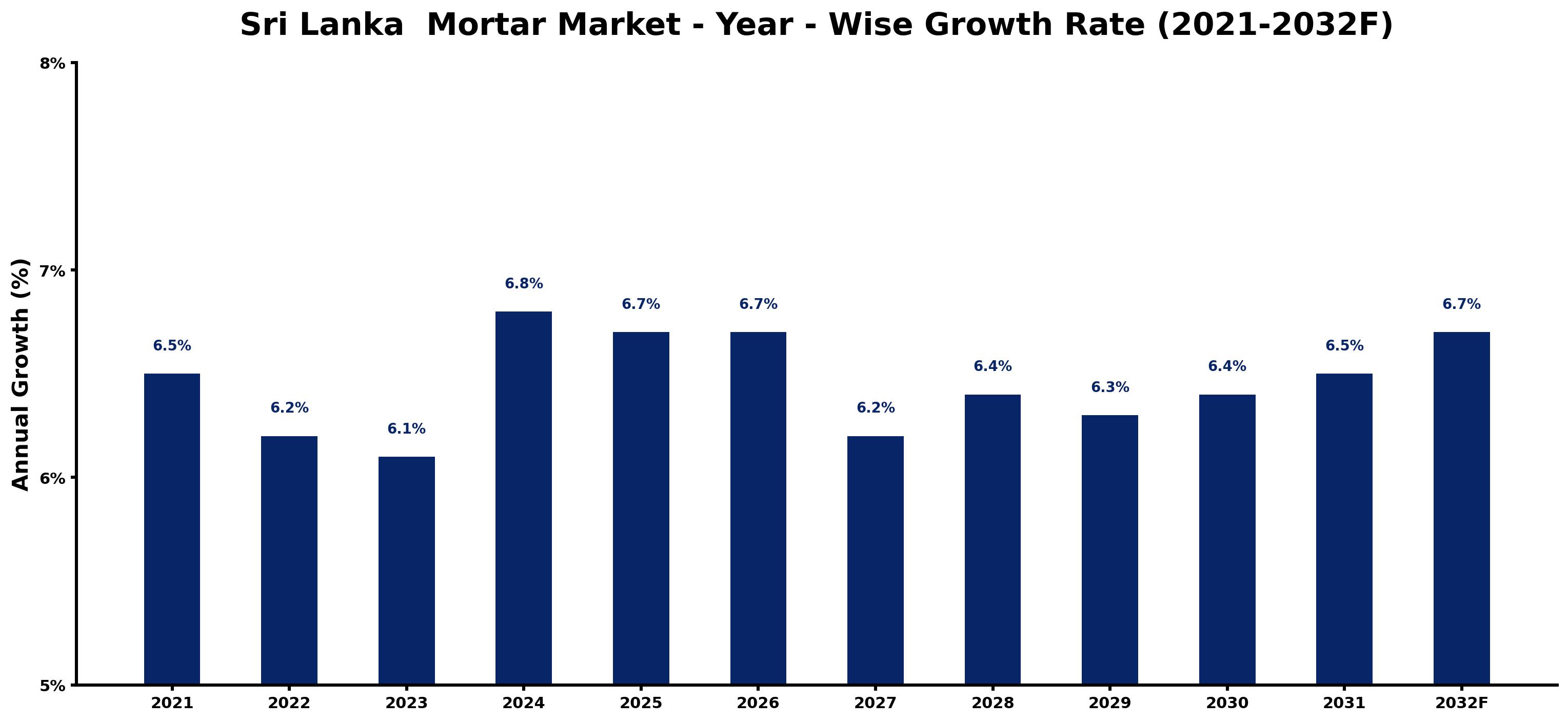
The table below presents the year wise growth rates along with the key drivers influencing the market
| Year | Growth Rate | Major Drivers |
| 2021 | 6.5% | Construction activities ramped up, fueled by urban development projects and investments. |
| 2022 | 6.2% | Local manufacturing capabilities improved, resulting in reduced reliance on imported materials. |
| 2023 | 6.1% | Infrastructure development initiatives focused on housing and transportation sectors surged significantly. |
| 2024 | 6.8% | Sustainability trends influenced builders to prefer eco-friendly mortar options in projects. |
| 2025 | 6.7% | Emerging SMEs entered the market, increasing competition and innovative product offerings. |
| 2026 | 6.7% | Regional trade agreements strengthened, facilitating easier access to raw materials and supplies. |
| 2027 | 6.2% | Technological innovations in production led to enhanced quality and performance of mortars. |
| 2028 | 6.4% | Consumer preferences shifted towards customized solutions for diverse construction needs. |
| 2029 | 6.3% | Post-pandemic recovery efforts emphasized infrastructure resilience and durability in construction. |
| 2030 | 6.4% | Increased urbanization resulted in higher demand for residential and commercial developments. |
| 2031 | 6.5% | Climate change concerns prompted enhanced regulations on construction material sustainability. |
| 2032 | 6.7% | Investment in smart city projects created new opportunities for advanced mortar applications. |
Note - Market size estimations and growth projections presented in this report are based on 6Wresearch's advanced forecasting approach, validated with industry datasets as of June 2026.
Sri Lanka Mortar Market Synopsis
The Sri Lanka Mortar Market is projected to reach 6.7% and witness significant growth during the forecast period (2026-2032). This growth is attributed to the flourishing construction sector in the country, characterized by increased demand for high-quality mortar products essential for diverse construction projects. Factors such as urbanization, population growth, and government initiatives aimed at bolstering the construction industry are pivotal in shaping the market dynamics.
Sri Lanka Mortar Market Growth Drivers
The Sri Lanka Mortar Market is being propelled forward by several key growth drivers:
- The ongoing construction boom, spurred by infrastructure development and housing projects, is increasing the consumption of mortar materials across various sectors.
- Urbanization is leading to higher demand for residential and commercial buildings, thereby enhancing the need for quality mortar solutions that provide structural integrity.
- Government initiatives, including investments in public infrastructure, are stimulating demand for construction materials, thereby driving the mortar market.
- The trend towards ready-mix mortar is gaining traction due to its ease of use, which is attractive for contractors and builders aiming to complete projects efficiently and with minimal waste.
- Environmental concerns are leading to increased interest in sustainable construction practices, which in turn is boosting demand for eco-friendly mortar products.
Sri Lanka Mortar Market Trends and Opportunities
The Sri Lanka Mortar Market is currently witnessing several trends that are creating opportunities for industry stakeholders:
- There is a marked increase in the preference for ready-mix mortar among builders, stemming from its consistent quality and reduction in labor costs.
- Specialized mortars, such as polymer-modified types, are gaining popularity due to their superior performance in specific applications like flooring and facades.
- As the emphasis on sustainability grows, the demand for green mortar products, which utilize recycled materials or have a lower environmental impact, is becoming more pronounced.
- Technological innovations in mortar production are leading to the development of products that cater to unique requirements of modern construction practices.
- Strategic collaborations among manufacturers and construction companies are emerging as a significant trend aimed at enhancing product offerings and market reach.
Sri Lanka Mortar Market Challenges and Restraints
Despite the positive outlook, the Sri Lanka Mortar Market faces several challenges that could hinder growth:
- Intense competition among local and international manufacturers often leads to aggressive pricing strategies, impacting profit margins.
- Volatility in raw material prices, especially for cement and sand, poses a risk to stable pricing and profitability for mortar manufacturers.
- A lack of standardized regulations governing mortar quality can result in inconsistencies in product offerings, affecting consumer confidence.
- The emerging trend towards sustainable materials may require additional investments in research and development for manufacturers to adapt their product lines.
- Economic fluctuations can impact consumer spending on construction, which directly affects the mortar market demand.
Sri Lanka Mortar Market Investment Opportunities
Investment opportunities within the Sri Lanka Mortar Market are abundant, primarily driven by ongoing infrastructure projects:
- The increasing focus on ready-mix mortar creates opportunities for manufacturers to enhance their production capabilities and expand their offerings.
- Investors can benefit from the rising demand for green mortar solutions, aligning with the global shift towards sustainable construction practices.
- Public-private partnerships in infrastructure developments provide a unique avenue for investment, particularly in large-scale projects where mortar plays a crucial role.
- Technological advancements in production processes may attract investment aimed at improving efficiency and product quality.
- The expansion of urban areas is likely to sustain demand for construction materials, making the mortar market an attractive sector for long-term investment.
Sri Lanka Mortar Market Government Investment and Initiatives
The Sri Lankan government has enacted several policies aimed at regulating the mortar market to ensure quality and consumer safety:
- Standards have been established for mortar production to guarantee consistency and durability, crucial for maintaining the integrity of construction projects.
- Regulations governing labeling practices are in place, ensuring consumers receive accurate information about mortar products, which assists in making informed decisions.
- The government encourages manufacturers to adopt environmentally friendly practices, which aligns with global sustainability goals.
- Public spending on infrastructure is rising, indicating a commitment to supporting the construction sector, indirectly bolstering the mortar market.
- Continuous monitoring of market practices is conducted to promote transparency and fair competition among manufacturers.
Sri Lanka Mortar Market Latest Developments (May 2025 - June 2026)
Recent developments in the Sri Lanka Mortar Market from May 2025 to June 2026 reveal significant industry direction:
- There has been an uptick in demand for innovative mortar solutions, driven by advancements in construction technology and materials science.
- Manufacturers are increasingly focusing on eco-friendly formulations, responding to both regulatory pressures and consumer preferences.
- Partnerships between construction companies and mortar suppliers are becoming more common, aiming to streamline supply chains and enhance product quality.
- Government initiatives to expedite infrastructure projects have led to increased demand for ready-mix solutions, which have become a preferred choice among contractors.
- Investments in manufacturing facilities have been observed, indicating a long-term commitment from companies to expand their operational capabilities in response to growing market requirements.
Sri Lanka Mortar Market - Key Attractiveness of the Report
- 10 Years of Market Numbers
- Historical Data Starting from 2022 to 2025
- Base Year: 2025
- Forecast Data until 2032
- Key Performance Indicators Impacting the Market
- Major Upcoming Developments and Projects
Key Highlights of the Report:
- Sri Lanka Mortar Market Outlook
- Market Size of Sri Lanka Mortar Market, 2025
- Forecast of Sri Lanka Mortar Market, 2032F
- Historical Data and Forecast of Sri Lanka Mortar Revenues & Volume for the Period 2022-2032F
- Sri Lanka Mortar Market Trend Evolution
- Sri Lanka Mortar Market Drivers and Challenges
- Sri Lanka Mortar Price Trends
- Sri Lanka Mortar Porter's Five Forces
- Sri Lanka Mortar Industry Life Cycle
- Historical Data and Forecast of Sri Lanka Mortar Market Revenues & Volume By Type for the Period 2022-2032F
- Historical Data and Forecast of Sri Lanka Mortar Market Revenues & Volume By Wet Mixed Mortar for the Period 2022-2032F
- Historical Data and Forecast of Sri Lanka Mortar Market Revenues & Volume By Dry Mortar for the Period 2022-2032F
- Historical Data and Forecast of Sri Lanka Mortar Market Revenues & Volume By Application for the Period 2022-2032F
- Historical Data and Forecast of Sri Lanka Mortar Market Revenues & Volume By Construction Industry for the Period 2022-2032F
- Historical Data and Forecast of Sri Lanka Mortar Market Revenues & Volume By Home Decoration Industry for the Period 2022-2032F
- Historical Data and Forecast of Sri Lanka Mortar Market Revenues & Volume By Others for the Period 2022-2032F
- Sri Lanka Mortar Import Export Trade Statistics
- Market Opportunity Assessment By Type
- Market Opportunity Assessment By Application
- Sri Lanka Mortar Top Companies Market Share
- Sri Lanka Mortar Competitive Benchmarking By Technical and Operational Parameters
- Sri Lanka Mortar Company Profiles
- Sri Lanka Mortar Key Strategic Recommendations






































