Sri Lanka Oil Country Tubular Goods Market Size, Share & Growth Rate
The Sri Lanka Oil Country Tubular Goods Market was estimated at USD 342 Million in 2025 and is projected to reach USD 451 Million by 2032, growing at a CAGR of 4.0% from 2026 to 2032. This growth is largely driven by the burgeoning exploration activities in both onshore and offshore oil fields. Additionally, the increasing emphasis on domestic energy production by the government is creating a more favorable investment climate, further propelling the demand for OCTG products.
Sri Lanka Oil Country Tubular Goods Market Year-wise Growth Rate and Key Drivers
This graph highlights how the Sri Lanka Oil Country Tubular Goods Market has steadily grown over the years, supported by major growth factors.
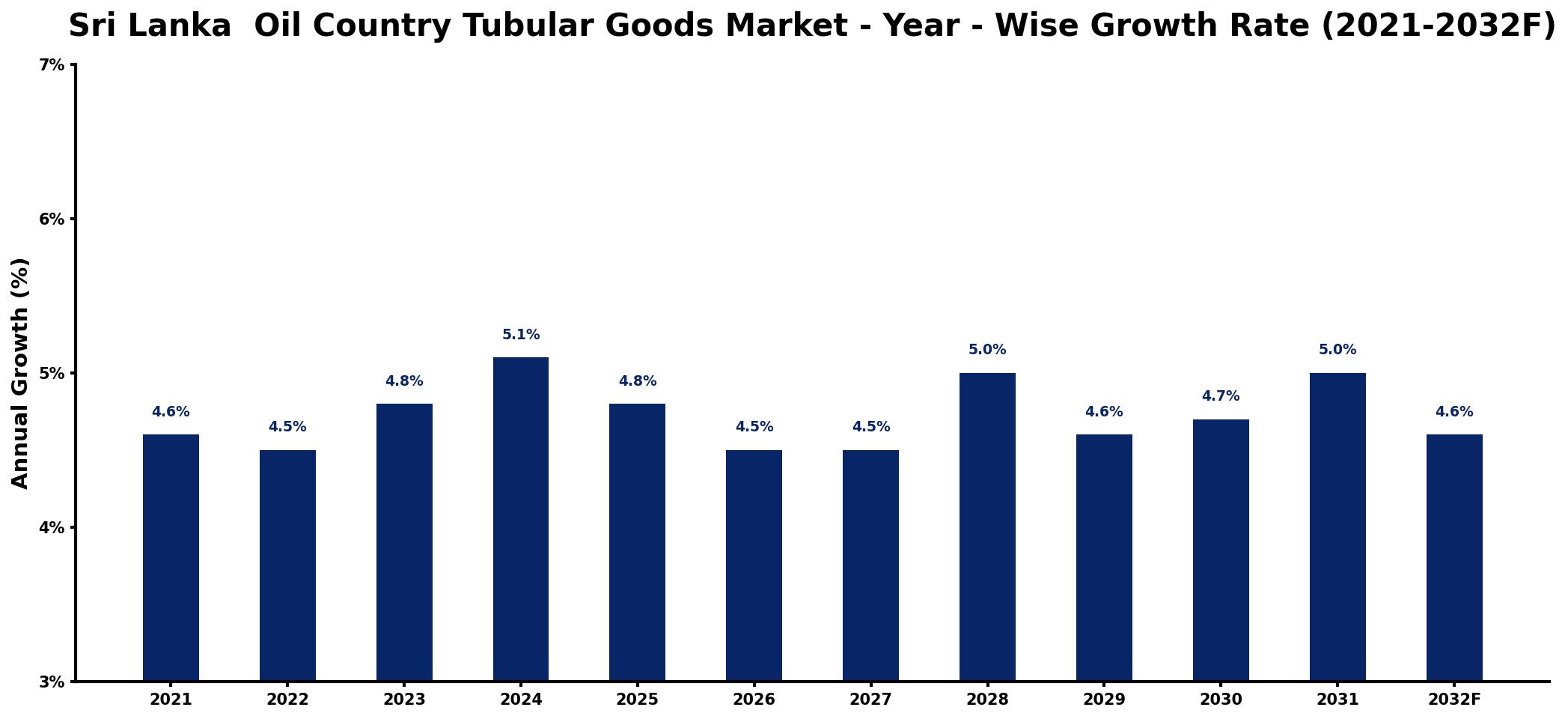
The table below presents the year‑wise growth rates along with the key drivers influencing the market
| Year | Growth Rate | Major Drivers |
| 2021 | 4.6% | Increased energy sector investments |
| 2022 | 4.5% | Rising demand from construction projects |
| 2023 | 4.8% | Expansion of renewable energy initiatives |
| 2024 | 5.1% | Growth in infrastructure development |
| 2025 | 4.8% | Surge in global energy consumption |
| 2026 | 4.5% | Boost in mining sector activities |
| 2027 | 4.5% | Increased foreign direct investments |
| 2028 | 5.0% | stronger distribution network expansion |
| 2029 | 4.6% | strengthening underlying market demand |
| 2030 | 4.7% | growing commercial sector adoption |
| 2031 | 5.0% | Increased focus on sustainability practices |
| 2032 | 4.6% | increased overall sector activity |
Note: Market size estimations and growth projections presented in this report are based on 6Wresearch's proprietary forecasting methodology, utilizing the latest available industry data, government publications, and primary research inputs.
Sri Lanka Oil Country Tubular Goods Market Synopsis
The strongest force currently shaping the Sri Lanka Oil Country Tubular Goods Market is the resurgence of oil and gas exploration efforts. Despite being a non-major oil producer, Sri Lanka's strategic initiatives are invigorating the industry, resulting in a robust demand for OCTG products.
Technological advancements in drilling techniques are also transforming the market landscape. Enhanced manufacturing processes are enabling the production of high-quality, durable OCTG products, which are essential for meeting the rigorous standards of today's oil and gas operations.
Sri Lanka Oil Country Tubular Goods Market Key Takeaways
- The market is experiencing steady growth fueled by increased exploration and production activities.
- Domestic production initiatives by the government are encouraging investment in local manufacturing capabilities.
- Technological advancements are improving the quality and durability of OCTG products.
- Challenges such as import dependency and regulatory hurdles remain prevalent in the market landscape.
- Strategic partnerships with global suppliers are essential for navigating local dynamics.
Evaluation of Restraints in Sri Lanka Oil Country Tubular Goods Market
The Sri Lanka Oil Country Tubular Goods Market faces notable restraints that could impede its growth trajectory. One primary concern is the reliance on global oil prices, which can fluctuate significantly, impacting local investments and exploration. Furthermore, limited domestic manufacturing capabilities necessitate a heavy dependence on imports, which can lead to increased lead times and higher costs. Navigating complex regulatory frameworks adds an additional layer of difficulty, often delaying project timelines and complicating market entry for new players.
Sri Lanka Oil Country Tubular Goods Market Trends
Current trends in the Sri Lanka Oil Country Tubular Goods Market highlight a growing focus on technological innovations in manufacturing. These advancements are geared towards producing OCTG products that can withstand challenging operational conditions in oil and gas wells. Moreover, there is a palpable shift toward sustainability, with companies increasingly looking to implement eco-friendly practices in their operations. Enhanced quality standards and regulatory compliance are also significant factors influencing market dynamics.
Sri Lanka Oil Country Tubular Goods Market Opportunities
The Sri Lanka Oil Country Tubular Goods Market presents genuine growth opportunities for investors, particularly in local manufacturing of OCTG products. As the country ramps up its oil and gas exploration initiatives, the demand for locally sourced OCTG products is set to increase, diminishing reliance on imports. Additionally, there is a burgeoning need for efficient distribution and logistics services as the market expands, which offers further investment prospects for stakeholders looking to capitalize on the growth potential.
Government Initiatives in the Sri Lanka Oil Country Tubular Goods Market
The Sri Lankan government has enacted several initiatives to foster the development of the Oil Country Tubular Goods Market. These include the implementation of tariffs on imported OCTG to bolster local manufacturers and the establishment of quality standards to ensure the reliability of products used in the oil and gas sector. Furthermore, the government is promoting domestic production through various incentives and subsidies, aimed at attracting investments and enhancing the overall business environment.
Future Insights of the Sri Lanka Oil Country Tubular Goods Market
Looking ahead to 2026-2032, the outlook for the Sri Lanka Oil Country Tubular Goods Market appears optimistic. The focus on boosting domestic energy production, coupled with increasing foreign investment, is expected to drive the demand for OCTG products. Infrastructure development projects will further extend the applications of OCTG beyond oil and gas, possibly opening new markets in construction and transportation. However, navigating challenges such as regulatory uncertainties and fluctuating global oil prices will remain crucial for sustained growth.
Sri Lanka Oil Country Tubular Goods Market Latest Developments (2025 - 2026)
Recent developments in the Sri Lanka Oil Country Tubular Goods Market indicate a strong push towards local manufacturing capabilities, as government policies increasingly favor domestic production. Additionally, there has been a notable increase in exploratory drilling activities in both onshore and offshore sites, further invigorating the demand for OCTG products. Companies are also investing in advanced manufacturing technologies to enhance product quality and operational efficiency, adapting to the evolving needs of the oil and gas sector.
Sri Lanka Oil Country Tubular Goods Market - Key Attractiveness of the Report
- 10 Years of Market Numbers
- Historical Data Starting from 2022 to 2025
- Base Year: 2025
- Forecast Data until 2032
- Key Performance Indicators Impacting the Market
- Major Upcoming Developments and Projects
Key Highlights of the Report:
- Sri Lanka Oil Country Tubular Goods Market Outlook
- Market Size of Sri Lanka Oil Country Tubular Goods Market, 2025
- Forecast of Sri Lanka Oil Country Tubular Goods Market, 2032
- Historical Data and Forecast of Sri Lanka Oil Country Tubular Goods Revenues & Volume for the Period 2022-2032F
- Sri Lanka Oil Country Tubular Goods Market Trend Evolution
- Sri Lanka Oil Country Tubular Goods Market Drivers and Challenges
- Sri Lanka Oil Country Tubular Goods Price Trends
- Sri Lanka Oil Country Tubular Goods Porter's Five Forces
- Sri Lanka Oil Country Tubular Goods Industry Life Cycle
- Historical Data and Forecast of Sri Lanka Oil Country Tubular Goods Market Revenues & Volume By Manufacturing Process for the Period 2022-2032F
- Historical Data and Forecast of Sri Lanka Oil Country Tubular Goods Market Revenues & Volume By Seamless for the Period 2022-2032F
- Historical Data and Forecast of Sri Lanka Oil Country Tubular Goods Market Revenues & Volume By Electric Resistance Welded for the Period 2022-2032F
- Historical Data and Forecast of Sri Lanka Oil Country Tubular Goods Market Revenues & Volume By Grade for the Period 2022-2032F
- Historical Data and Forecast of Sri Lanka Oil Country Tubular Goods Market Revenues & Volume By Premium Grade for the Period 2022-2032F
- Historical Data and Forecast of Sri Lanka Oil Country Tubular Goods Market Revenues & Volume By API Grade for the Period 2022-2032F
- Sri Lanka Oil Country Tubular Goods Import Export Trade Statistics
- Market Opportunity Assessment By Manufacturing Process
- Market Opportunity Assessment By Grade
- Sri Lanka Oil Country Tubular Goods Top Companies Market Share
- Sri Lanka Oil Country Tubular Goods Competitive Benchmarking By Technical and Operational Parameters
- Sri Lanka Oil Country Tubular Goods Company Profiles
- Sri Lanka Oil Country Tubular Goods Key Strategic Recommendations






































