Sri Lanka Online Grocery Market Size, Share & Growth Rate
The Sri Lanka Online Grocery Market was estimated at USD 166 Million in 2025 and is projected to reach USD 223 Million by 2032, growing at a CAGR of 4.3% from 2026 to 2032. This impressive growth trajectory is fueled by heightened internet and smartphone penetration, transforming how consumers access grocery products. As urban lifestyles become increasingly busy and time-constrained, the allure of the convenience offered by online grocery shopping continues to capture the interest of consumers across the nation.
Sri Lanka Online Grocery Market Year-wise Growth Rate and Key Drivers
This graph highlights how the Sri Lanka Online Grocery Market has steadily grown over the years, supported by major growth factors.
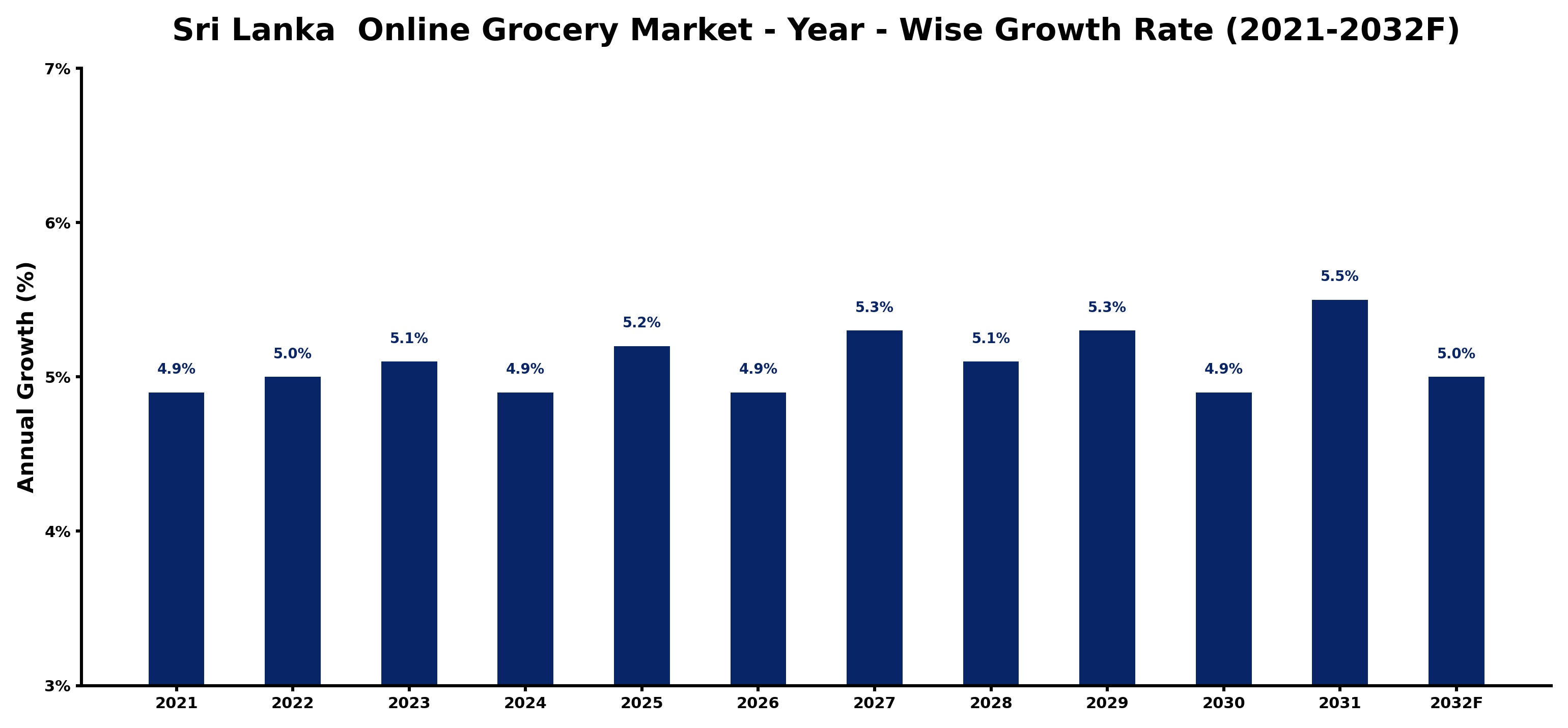
The table below presents the year‑wise growth rates along with the key drivers influencing the market
| Year | Growth Rate | Major Drivers |
| 2021 | 4.9% | Increased smartphone penetration enabled access |
| 2022 | 5.0% | E-commerce adoption accelerated consumer habits |
| 2023 | 5.1% | Home delivery services expanded rapidly |
| 2024 | 4.9% | Digital payment options enhanced convenience |
| 2025 | 5.2% | Subscription models gained consumer interest |
| 2026 | 4.9% | Local sourcing improved product freshness |
| 2027 | 5.3% | Health-conscious choices drove sales growth |
| 2028 | 5.1% | Sustainability trends influenced purchasing behavior |
| 2029 | 5.3% | Promotional campaigns attracted new customers |
| 2030 | 4.9% | User-friendly interfaces enhanced shopping experience |
| 2031 | 5.5% | Loyalty programs encouraged repeat purchases |
| 2032 | 5.0% | Social media marketing increased visibility |
Note - Market size estimations and growth projections presented in this report are based on 6Wresearch's advanced forecasting approach, validated with industry datasets as of June 2026.
Sri Lanka Online Grocery Market Synopsis
In recent years, the Sri Lanka Online Grocery Market has experienced substantial momentum, driven by evolving consumer preferences and the demand for convenient shopping solutions. Looking ahead, the market is expected to expand significantly, supported by a growing middle-class population and increased digitalization.
As online grocery shopping becomes a staple for many, traditional retailers are adapting by enhancing their digital platforms to stay competitive. This transition not only improves customer access but also fosters a culture of innovation in logistics and customer service.
Sri Lanka Online Grocery Market Key Takeaways
- Growing consumer preference for convenience drives online grocery purchases.
- Innovative technologies enhance customer experiences and streamline operations.
- Increased penetration of smartphones expands the potential customer base.
- Health-conscious products gain traction, reflecting changing consumer behaviors.
- Competitive pressures lead to innovative marketing and delivery solutions.
Evaluation of Restraints in Sri Lanka Online Grocery Market
Despite the growth potential, the Sri Lanka Online Grocery Market faces several constraints. Limited internet access, particularly in rural regions, creates a significant barrier to broader adoption. Additionally, consumer skepticism regarding online payment security affects purchasing decisions, as many are hesitant to trust digital transactions. Compounding these issues are logistical challenges, including traffic congestion that hampers efficient delivery and a lack of robust last-mile solutions, which can undermine customer satisfaction.
Sri Lanka Online Grocery Market Trends
The online grocery sector in Sri Lanka is witnessing dynamic trends that are reshaping demand. There is a notable rise in on-demand grocery delivery services, driven by consumer desires for immediate access to products. Additionally, the expansion of e-commerce platforms is providing shoppers with an unprecedented variety of options, while contactless delivery—popularized during the COVID-19 pandemic—has become a preferred choice. An increasing focus on organic and health-oriented products is also evident, alongside a rising commitment to sustainability, especially regarding packaging.
Sri Lanka Online Grocery Market Opportunities
Investment opportunities abound in the Sri Lanka Online Grocery Market, particularly as digitalization accelerates. There is a pressing need for user-friendly e-commerce platforms that can cater to the diverse needs of urban and rural consumers alike. Moreover, innovations in last-mile delivery logistics, such as partnerships with local grocery stores and tech solutions for efficient order fulfillment, present promising avenues for growth. Businesses that prioritize enhancing customer experiences and optimizing supply chains are well-positioned to thrive in this evolving landscape.
Government Initiatives in the Sri Lanka Online Grocery Market
The Sri Lankan government is proactive in fostering a transparent online grocery market through various regulations aimed at consumer protection and fair competition. Requirements for licenses and adherence to quality standards ensure that products meet consumer expectations. Data privacy regulations bolster consumer confidence in online shopping, while oversight of pricing practices helps prevent unfair market behaviors. These initiatives reflect the government's commitment to supporting a competitive and efficient online grocery ecosystem.
Future Insights of the Sri Lanka Online Grocery Market
Looking ahead to 2026-2032, the Sri Lanka Online Grocery Market is positioned for substantial growth. The combination of increasing internet access, a shift in consumer behavior towards the convenience of online ordering, and the ongoing push for digital transformation suggests that market dynamics will remain favorable. As players in the sector continue to innovate—introducing features like same-day delivery and personalized shopping experiences—consumer adoption is expected to rise. This evolution will likely attract further investment and competition, enhancing the overall robustness of the market.
Sri Lanka Online Grocery Market Latest Developments (May 2025 - June 2026)
Recent developments in the Sri Lanka Online Grocery Market indicate a significant shift towards enhanced digital services and user experience. Companies are increasingly implementing advanced analytics to better understand consumer preferences and optimize supply chains. Additionally, there is a noticeable uptick in strategic collaborations aimed at improving delivery logistics, ensuring that customer demands are met promptly and efficiently. The focus on sustainability continues to grow, with businesses exploring eco-friendly packaging and sourcing options to appeal to environmentally conscious consumers.
Sri Lanka Online Grocery Market - Key Attractiveness of the Report
- 10 Years of Market Numbers
- Historical Data Starting from 2022 to 2025
- Base Year: 2025
- Forecast Data until 2032
- Key Performance Indicators Impacting the Market
- Major Upcoming Developments and Projects
Key Highlights of the Report:
- Sri Lanka Online Grocery Market Outlook
- Market Size of Sri Lanka Online Grocery Market, 2025
- Forecast of Sri Lanka Online Grocery Market, 2032
- Historical Data and Forecast of Sri Lanka Online Grocery Revenues & Volume for the Period 2022-2032F
- Sri Lanka Online Grocery Market Trend Evolution
- Sri Lanka Online Grocery Market Drivers and Challenges
- Sri Lanka Online Grocery Price Trends
- Sri Lanka Online Grocery Porter's Five Forces
- Sri Lanka Online Grocery Industry Life Cycle
- Historical Data and Forecast of Sri Lanka Online Grocery Market Revenues & Volume By Product Type for the Period 2022-2032F
- Historical Data and Forecast of Sri Lanka Online Grocery Market Revenues & Volume By Food Grains for the Period 2022-2032F
- Historical Data and Forecast of Sri Lanka Online Grocery Market Revenues & Volume By Bread, Bakery and Dairy Products for the Period 2022-2032F
- Historical Data and Forecast of Sri Lanka Online Grocery Market Revenues & Volume By Fruits and Vegetables for the Period 2022-2032F
- Historical Data and Forecast of Sri Lanka Online Grocery Market Revenues & Volume By Personal Care for the Period 2022-2032F
- Historical Data and Forecast of Sri Lanka Online Grocery Market Revenues & Volume By Dry and Baking Products for the Period 2022-2032F
- Historical Data and Forecast of Sri Lanka Online Grocery Market Revenues & Volume By Household Products for the Period 2022-2032F
- Historical Data and Forecast of Sri Lanka Online Grocery Market Revenues & Volume By Meat and Meat Products for the Period 2022-2032F
- Historical Data and Forecast of Sri Lanka Food Grains Online Grocery Market Revenues & Volume By Others for the Period 2022-2032F
- Historical Data and Forecast of Sri Lanka Online Grocery Market Revenues & Volume By Platform for the Period 2022-2032F
- Historical Data and Forecast of Sri Lanka Online Grocery Market Revenues & Volume By App-based for the Period 2022-2032F
- Historical Data and Forecast of Sri Lanka Online Grocery Market Revenues & Volume By Web-based for the Period 2022-2032F
- Sri Lanka Online Grocery Import Export Trade Statistics
- Market Opportunity Assessment By Product Type
- Market Opportunity Assessment By Platform
- Sri Lanka Online Grocery Top Companies Market Share
- Sri Lanka Online Grocery Competitive Benchmarking By Technical and Operational Parameters
- Sri Lanka Online Grocery Company Profiles
- Sri Lanka Online Grocery Key Strategic Recommendations






































