Sri Lanka Ornamental Fish Market Size, Share & Growth Rate
The Sri Lanka Ornamental Fish Market was estimated at USD 368 Million in 2025 and is projected to reach USD 501 Million by 2032, growing at a CAGR of 4.5% from 2026 to 2032. This growth trajectory is driven by the increasing global fascination with home aquariums and the rising popularity of ornamental fishkeeping among enthusiasts. Furthermore, the country's advantageous climate facilitates the breeding of diverse and vibrant fish species, enhancing export opportunities and market reach.
Sri Lanka Ornamental Fish Market Year-wise Growth Rate and Key Drivers
This graph highlights how the Sri Lanka Ornamental Fish Market has steadily grown over the years, supported by major growth factors.
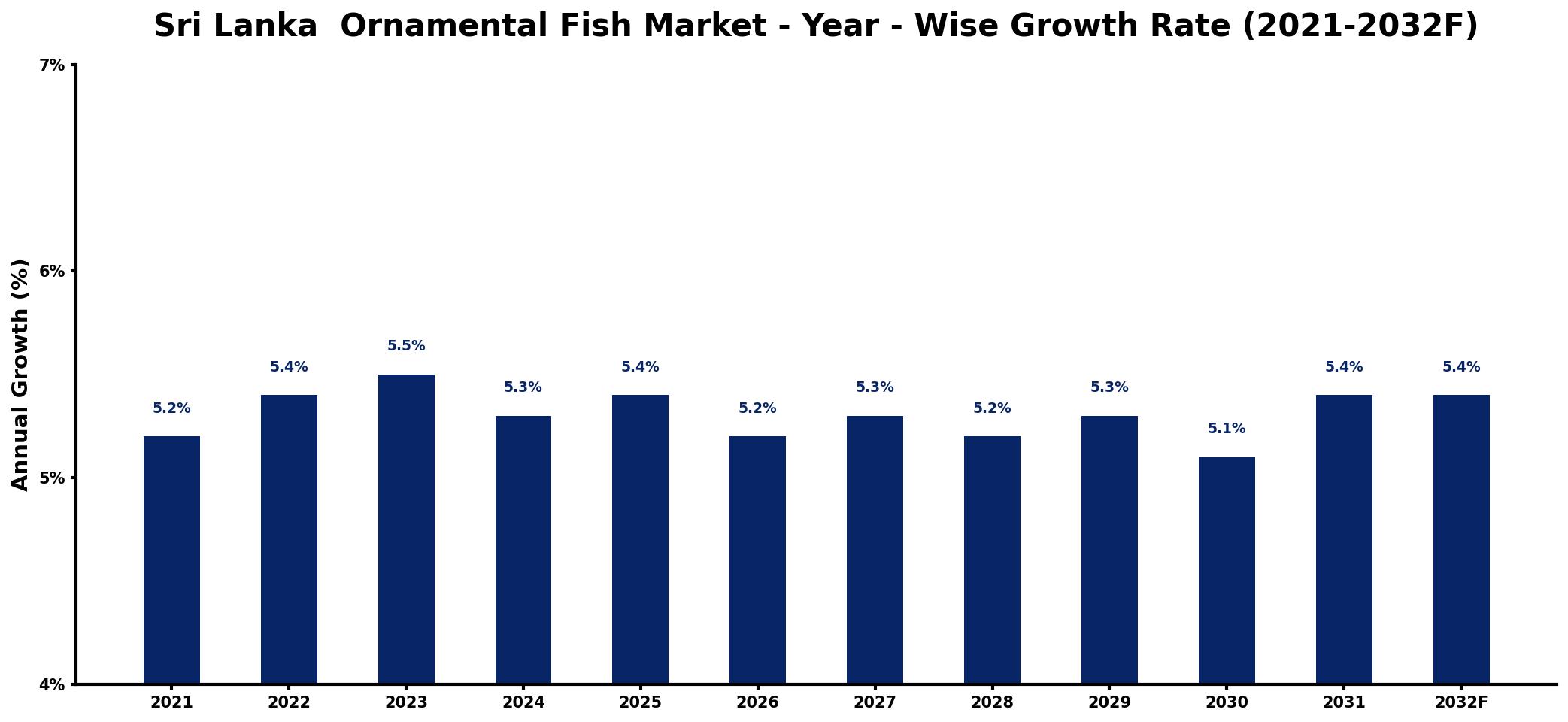
The table below presents the year‑wise growth rates along with the key drivers influencing the market
| Year | Growth Rate | Major Drivers |
| 2021 | 5.2% | Rising global aquaculture investments |
| 2022 | 5.4% | Increased domestic breeding initiatives |
| 2023 | 5.5% | Growing export market opportunities |
| 2024 | 5.3% | Expansion of retail distribution channels |
| 2025 | 5.4% | Enhanced consumer awareness campaigns |
| 2026 | 5.2% | Development of sustainable practices |
| 2027 | 5.3% | Surge in online sales platforms |
| 2028 | 5.2% | Boost in tourism-related demand |
| 2029 | 5.3% | Emergence of new hobbyist communities |
| 2030 | 5.1% | Strengthening of regulatory frameworks |
| 2031 | 5.4% | Investment in technological advancements |
| 2032 | 5.4% | Collaboration with international partners |
Note: Market size estimations and growth projections presented in this report are based on 6Wresearch's proprietary forecasting methodology, utilizing the latest available industry data, government publications, and primary research inputs.
Sri Lanka Ornamental Fish Market Synopsis
The foremost force shaping the Sri Lanka Ornamental Fish Market is the surge in demand for exotic and colorful fish species. As more consumers invest in home aquariums, the market is witnessing a robust rise in interest, which is further complemented by a shift towards sustainable breeding practices that prioritize conservation.
In addition, Sri Lanka's strategic geographic positioning provides an efficient pathway for exports to major markets in Europe, Asia, and the Middle East. This advantageous location, coupled with a dedicated network of breeders and government support, establishes a conducive environment for the industry's expansion while adhering to high-quality standards.
Sri Lanka Ornamental Fish Market Key Takeaways
- The market is experiencing steady growth, fueled by increasing demand for exotic fish and home aquariums.
- Sustainable breeding practices are gaining traction, reflecting a broader consumer awareness of conservation.
- The online retail sector is emerging as a significant distribution channel, broadening access to diverse fish species.
- Strategic government policies aim to bolster the industry while maintaining environmental and animal welfare standards.
- Investment opportunities abound, particularly in breeding farms, aquarium supplies, and technology for sustainable practices.
Evaluation of Restraints in Sri Lanka Ornamental Fish Market
Despite its growth potential, the Sri Lanka Ornamental Fish Market is hindered by several key restraints. Limited access to advanced technology and information poses a significant challenge for breeders striving for quality and efficiency. Additionally, the lack of proper infrastructure for breeding and transport can compromise fish health and quality during distribution. Compliance with international export standards remains a hurdle for many local exporters, affecting their competitiveness on the global stage. Moreover, the market grapples with competition from established players in Southeast Asia, necessitating continuous innovation and support for local breeders to enhance their capabilities.
Sri Lanka Ornamental Fish Market Trends
The Sri Lanka Ornamental Fish Market is evolving rapidly, with several trends shaping its landscape. There is a noticeable shift towards sustainable practices, with many breeders adopting eco-friendly methods and focusing on captive breeding to minimize impact on wild populations. Additionally, enthusiasts are increasingly seeking rare and unique species, creating a niche market for specialty fish. The online retail sector is also expanding significantly, allowing consumers greater access to a wider range of ornamental fish than ever before.
Sri Lanka Ornamental Fish Market Opportunities
Investors looking at the Sri Lanka Ornamental Fish Market can explore several lucrative avenues. The demand for innovative aquarium supplies and accessories presents opportunities for businesses catering to both novice and experienced hobbyists. Furthermore, technological advancements in water quality control and monitoring systems can enhance breeding efficiency and fish health, attracting investment. Collaborating with local breeders and exporters will offer strategic advantages in penetrating global markets and meeting consumer demands for sustainable and unique ornamental fish species.
Government Initiatives in the Sri Lanka Ornamental Fish Market
The Sri Lankan government has introduced a range of initiatives aimed at supporting and regulating the ornamental fish market. The establishment of the National Aquaculture Development Authority plays a crucial role in overseeing industry practices, providing training for breeders, and promoting sustainable methods. Policies include stringent quarantine measures to prevent disease spread and regulations that protect biodiversity by limiting the collection of wild fish. These initiatives not only ensure the growth of the ornamental fish market but also emphasize the importance of environmental sustainability.
Future Insights of the Sri Lanka Ornamental Fish Market
Looking ahead to the period from 2026 to 2032, the Sri Lanka Ornamental Fish Market is well-positioned for growth, with increasing interest in aquarium keeping expected to drive demand. The rise in disposable income among the middle class will likely encourage more households to explore ornamental fish as a hobby. Furthermore, the industry stands to benefit from sustainable practices and innovations that meet both consumer preferences and conservation goals. However, the market must navigate challenges such as regulatory compliance and fierce competition from international counterparts to fully realize its potential.
Sri Lanka Ornamental Fish Market Latest Developments (2025 - 2026)
Recent developments in the Sri Lanka Ornamental Fish Market indicate a heightened focus on sustainability and innovation. Breeders are increasingly adopting advanced technologies to improve breeding practices and fish health. There has been a notable uptick in online sales platforms, providing greater access to a diverse range of ornamental fish for consumers. The government continues to refine its policies to support industry growth while ensuring the health and welfare of aquatic species in the market.
Sri Lanka Ornamental Fish Market - Key Attractiveness of the Report
- 10 Years of Market Numbers
- Historical Data Starting from 2022 to 2025
- Base Year: 2025
- Forecast Data until 2032
- Key Performance Indicators Impacting the Market
- Major Upcoming Developments and Projects
Key Highlights of the Report:
- Sri Lanka Ornamental Fish Market Outlook
- Market Size of Sri Lanka Ornamental Fish Market, 2025
- Forecast of Sri Lanka Ornamental Fish Market, 2032
- Historical Data and Forecast of Sri Lanka Ornamental Fish Revenues & Volume for the Period 2022-2032F
- Sri Lanka Ornamental Fish Market Trend Evolution
- Sri Lanka Ornamental Fish Market Drivers and Challenges
- Sri Lanka Ornamental Fish Price Trends
- Sri Lanka Ornamental Fish Porter's Five Forces
- Sri Lanka Ornamental Fish Industry Life Cycle
- Historical Data and Forecast of Sri Lanka Ornamental Fish Market Revenues & Volume By Product for the Period 2022-2032F
- Historical Data and Forecast of Sri Lanka Ornamental Fish Market Revenues & Volume By Tropical Freshwater for the Period 2022-2032F
- Historical Data and Forecast of Sri Lanka Ornamental Fish Market Revenues & Volume By Temperate for the Period 2022-2032F
- Historical Data and Forecast of Sri Lanka Ornamental Fish Market Revenues & Volume By Marine for the Period 2022-2032F
- Historical Data and Forecast of Sri Lanka Ornamental Fish Market Revenues & Volume By Application for the Period 2022-2032F
- Historical Data and Forecast of Sri Lanka Ornamental Fish Market Revenues & Volume By Commercial for the Period 2022-2032F
- Historical Data and Forecast of Sri Lanka Ornamental Fish Market Revenues & Volume By Household for the Period 2022-2032F
- Sri Lanka Ornamental Fish Import Export Trade Statistics
- Market Opportunity Assessment By Product
- Market Opportunity Assessment By Application
- Sri Lanka Ornamental Fish Top Companies Market Share
- Sri Lanka Ornamental Fish Competitive Benchmarking By Technical and Operational Parameters
- Sri Lanka Ornamental Fish Company Profiles
- Sri Lanka Ornamental Fish Key Strategic Recommendations






































