Sri Lanka Orphan Drugs Market Size, Share & Growth Rate
The Sri Lanka Orphan Drugs Market was estimated at USD 1326 Million in 2025 and is projected to reach USD 1920 Million by 2032, growing at a CAGR of 5.4% from 2026 to 2032. This significant growth can be attributed to the increasing prevalence of rare diseases within the population and heightened awareness surrounding their treatment. Additionally, government initiatives aimed at facilitating access to orphan drugs are bolstering investment and interest in this critical healthcare sector.
Sri Lanka Orphan Drugs Market Year-wise Growth Rate and Key Drivers
This graph highlights how the Sri Lanka Orphan Drugs Market has steadily grown over the years, supported by major growth factors.
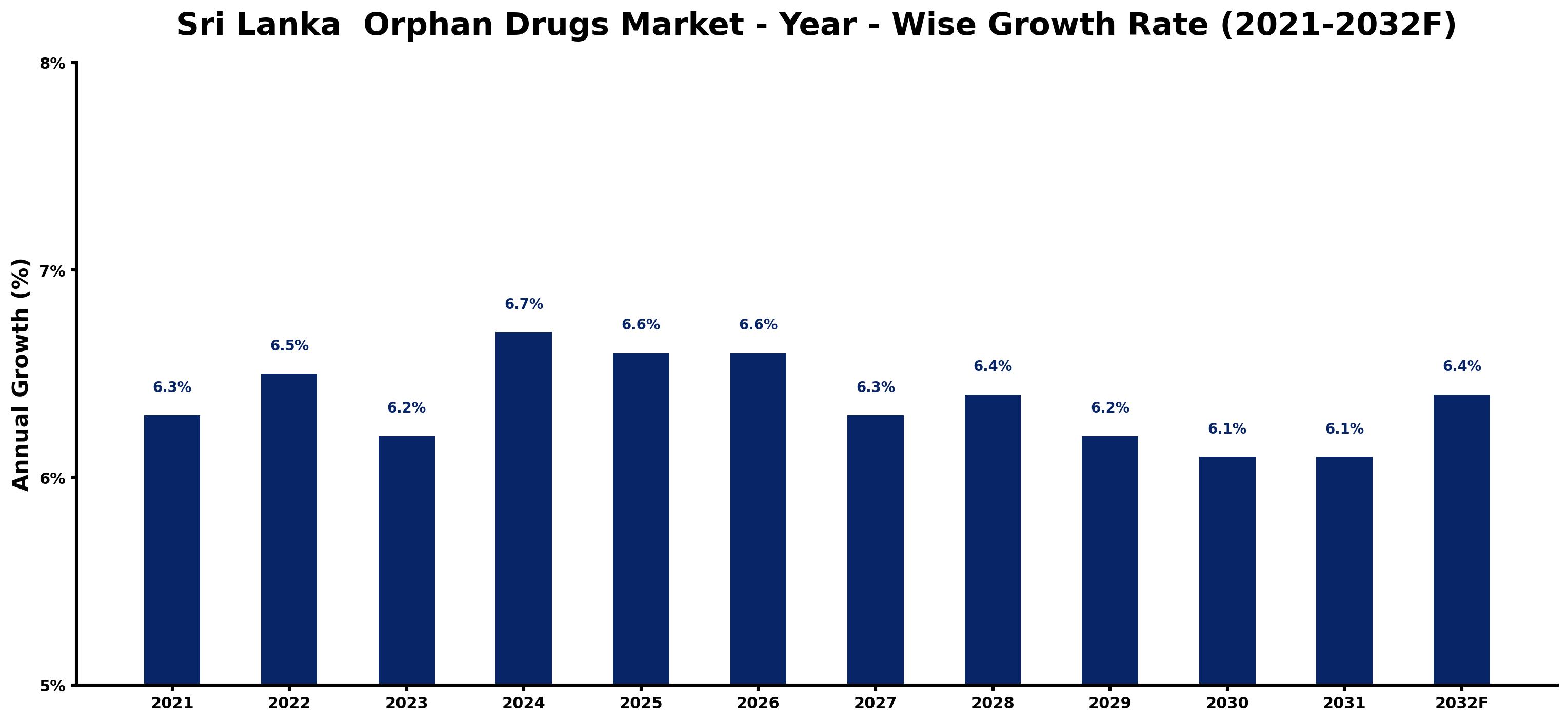
The table below presents the year‑wise growth rates along with the key drivers influencing the market
| Year | Growth Rate | Major Drivers |
| 2021 | 6.3% | Increasing adoption of advanced technologies |
| 2022 | 6.5% | Increasing industrial infrastructure investments |
| 2023 | 6.2% | Rapid growth in telecom and data center sectors |
| 2024 | 6.7% | Increasing industrial infrastructure investments |
| 2025 | 6.6% | Increasing industrial infrastructure investments |
| 2026 | 6.6% | Expansion of manufacturing activities |
| 2027 | 6.3% | Increasing industrial infrastructure investments |
| 2028 | 6.4% | Increasing industrial automation investments |
| 2029 | 6.2% | Increasing smart city development projects |
| 2030 | 6.1% | Rising electricity demand across industries |
| 2031 | 6.1% | Increasing industrial infrastructure investments |
| 2032 | 6.4% | Expansion of commercial construction activities |
Note - Market size estimations and growth projections presented in this report are based on 6Wresearch’s advanced forecasting approach, validated with industry datasets as of June 2026.
Sri Lanka Orphan Drugs Market Synopsis
The Sri Lanka Orphan Drugs Market is on an upward trajectory, characterized by a growing recognition of rare diseases and the urgent need for effective treatments. With the country's healthcare framework increasingly focusing on rare conditions, patients are beginning to see more support and potential treatment options, paving the way for further growth in this specialized segment.
In recent years, there has been a notable rise in partnerships between pharmaceutical companies and healthcare providers, facilitating innovation in drug development. This collaborative approach, along with advancements in biotechnology, has led to the emergence of new therapies, aiming to address the unmet medical needs of patients grappling with rare diseases in Sri Lanka.
Sri Lanka Orphan Drugs Market Key Takeaways
- Increasing prevalence of rare diseases is driving demand for orphan drugs.
- Government initiatives are enhancing accessibility and affordability of treatments.
- Advancements in biotechnology are leading to innovative therapies for rare conditions.
- Collaborations between stakeholders are fostering research and development in the sector.
- Patient access programs are gaining momentum, ensuring treatment for those in need.
Evaluation of Restraints in Sri Lanka Orphan Drugs Market
Despite the growth opportunities in the Sri Lanka orphan drugs market, several constraints remain. Limited awareness of rare diseases among healthcare professionals and the general population can lead to delays in diagnosis and treatment. Moreover, the high cost of orphan drugs poses a significant barrier in a healthcare landscape where resources are already stretched. Insufficient specialized healthcare facilities and diagnostic tools further hinder effective management of these diseases. Regulatory hurdles, particularly lengthy approval processes, also impede timely access to necessary treatments for patients.
Sri Lanka Orphan Drugs Market Trends
A prominent trend within the Sri Lanka orphan drugs market is the increasing focus on education and awareness campaigns regarding rare diseases. These initiatives aim to inform healthcare providers and the public about the signs, symptoms, and treatment options available. Additionally, there is a noticeable shift towards personalized medicine, which is shaping the development of tailored therapies that cater to the unique needs of patients with rare conditions. As technology advances, it is becoming easier to develop and manufacture orphan drugs, further driving market demand.
Sri Lanka Orphan Drugs Market Opportunities
The Sri Lanka orphan drugs market is ripe with opportunities for growth and investment. The increasing prevalence of rare diseases signals a demand for innovative therapies that can cater to this niche patient population. Investors can look towards collaborating with local healthcare providers and regulatory bodies to navigate the complexities of the market. Moreover, government support and incentives present an attractive avenue for pharmaceutical companies seeking to develop and distribute orphan drugs, enhancing their market presence.
Government Initiatives in the Sri Lanka Orphan Drugs Market
The Sri Lankan government is taking significant steps to enhance the availability of orphan drugs. The National Medicines Regulatory Authority (NMRA) is focused on streamlining the registration processes, facilitating the importation and distribution of these essential medications. Additionally, financial assistance programs are in place to help patients procure orphan drugs, ensuring that they can afford the necessary treatments. Educational initiatives led by the Ministry of Health are aimed at raising awareness about rare diseases and the available options, further underscoring the government's commitment to improving healthcare outcomes in this area.
Future Insights of the Sri Lanka Orphan Drugs Market
Looking ahead to 2026-2032, the Sri Lanka orphan drugs market is expected to witness robust growth. Factors such as increased public awareness of rare diseases, improved healthcare infrastructure, and proactive government initiatives will contribute to this positive trajectory. As more orphan drugs secure regulatory approvals, the market will continue to expand, supported by ongoing investments in research and development. The rising prevalence of rare diseases will further drive the demand for targeted therapies, positioning the market for significant advancements.
Sri Lanka Orphan Drugs Market Latest Developments (May 2025 - June 2026)
Recent developments in the Sri Lanka orphan drugs market indicate a growing alignment among stakeholders to prioritize rare diseases. Increased investment in research initiatives, as well as the launch of awareness campaigns aimed at both patients and healthcare professionals, reflects a concerted effort to tackle the challenges associated with rare diseases. Additionally, strategic collaborations between pharmaceutical companies and healthcare providers are likely to yield innovative treatment options, ultimately improving patient outcomes.
Sri Lanka Orphan Drugs Market - Key Attractiveness of the Report
- 10 Years of Market Numbers
- Historical Data Starting from 2022 to 2025
- Base Year: 2025
- Forecast Data until 2032
- Key Performance Indicators Impacting the Market
- Major Upcoming Developments and Projects
Key Highlights of the Report:
- Sri Lanka Orphan Drugs Market Outlook
- Market Size of Sri Lanka Orphan Drugs Market, 2025
- Forecast of Sri Lanka Orphan Drugs Market, 2032
- Historical Data and Forecast of Sri Lanka Orphan Drugs Revenues & Volume for the Period 2022-2032F
- Sri Lanka Orphan Drugs Market Trend Evolution
- Sri Lanka Orphan Drugs Market Drivers and Challenges
- Sri Lanka Orphan Drugs Price Trends
- Sri Lanka Orphan Drugs Porter's Five Forces
- Sri Lanka Orphan Drugs Industry Life Cycle
- Historical Data and Forecast of Sri Lanka Orphan Drugs Market Revenues & Volume By Drugs for the Period 2022-2032F
- Historical Data and Forecast of Sri Lanka Orphan Drugs Market Revenues & Volume By Revlimid for the Period 2022-2032F
- Historical Data and Forecast of Sri Lanka Orphan Drugs Market Revenues & Volume By Rituxan for the Period 2022-2032F
- Historical Data and Forecast of Sri Lanka Orphan Drugs Market Revenues & Volume By Opdivo for the Period 2022-2032F
- Historical Data and Forecast of Sri Lanka Orphan Drugs Market Revenues & Volume By Keytruda for the Period 2022-2032F
- Historical Data and Forecast of Sri Lanka Orphan Drugs Market Revenues & Volume By Imbruvica for the Period 2022-2032F
- Historical Data and Forecast of Sri Lanka Orphan Drugs Market Revenues & Volume By Soliris for the Period 2022-2032F
- Historical Data and Forecast of Sri Lanka Orphan Drugs Market Revenues & Volume By Other Orphan Drugs for the Period 2022-2032F
- Historical Data and Forecast of Sri Lanka Orphan Drugs Market Revenues & Volume By Drug Type for the Period 2022-2032F
- Historical Data and Forecast of Sri Lanka Orphan Drugs Market Revenues & Volume By Biologics for the Period 2022-2032F
- Historical Data and Forecast of Sri Lanka Orphan Drugs Market Revenues & Volume By Non-Biologics for the Period 2022-2032F
- Historical Data and Forecast of Sri Lanka Orphan Drugs Market Revenues & Volume By Therapy Class for the Period 2022-2032F
- Historical Data and Forecast of Sri Lanka Orphan Drugs Market Revenues & Volume By Oncology for the Period 2022-2032F
- Historical Data and Forecast of Sri Lanka Orphan Drugs Market Revenues & Volume By Blood for the Period 2022-2032F
- Historical Data and Forecast of Sri Lanka Orphan Drugs Market Revenues & Volume By Endocrine for the Period 2022-2032F
- Historical Data and Forecast of Sri Lanka Orphan Drugs Market Revenues & Volume By Central Nervous Systems for the Period 2022-2032F
- Historical Data and Forecast of Sri Lanka Orphan Drugs Market Revenues & Volume By Cardiovascular for the Period 2022-2032F
- Historical Data and Forecast of Sri Lanka Orphan Drugs Market Revenues & Volume By Respiratory for the Period 2022-2032F
- Sri Lanka Orphan Drugs Import Export Trade Statistics
- Market Opportunity Assessment By Drugs
- Market Opportunity Assessment By Drug Type
- Market Opportunity Assessment By Therapy Class
- Sri Lanka Orphan Drugs Top Companies Market Share
- Sri Lanka Orphan Drugs Competitive Benchmarking By Technical and Operational Parameters
- Sri Lanka Orphan Drugs Company Profiles
- Sri Lanka Orphan Drugs Key Strategic Recommendations






































