Sri Lanka Outdoor LED Lighting Market Summary
The sri lanka outdoor led lighting market was estimated at USD 386 Million in 2025 and is projected to reach USD 531 Million by 2032, growing at a CAGR of 5.5% from 2026 to 2032.
Sri Lanka Outdoor LED Lighting Market Year-wise Growth Rate and Key Drivers
This graph highlights how the Sri Lanka Outdoor LED Lighting Market has steadily grown over the past five years, supported by major growth factors.
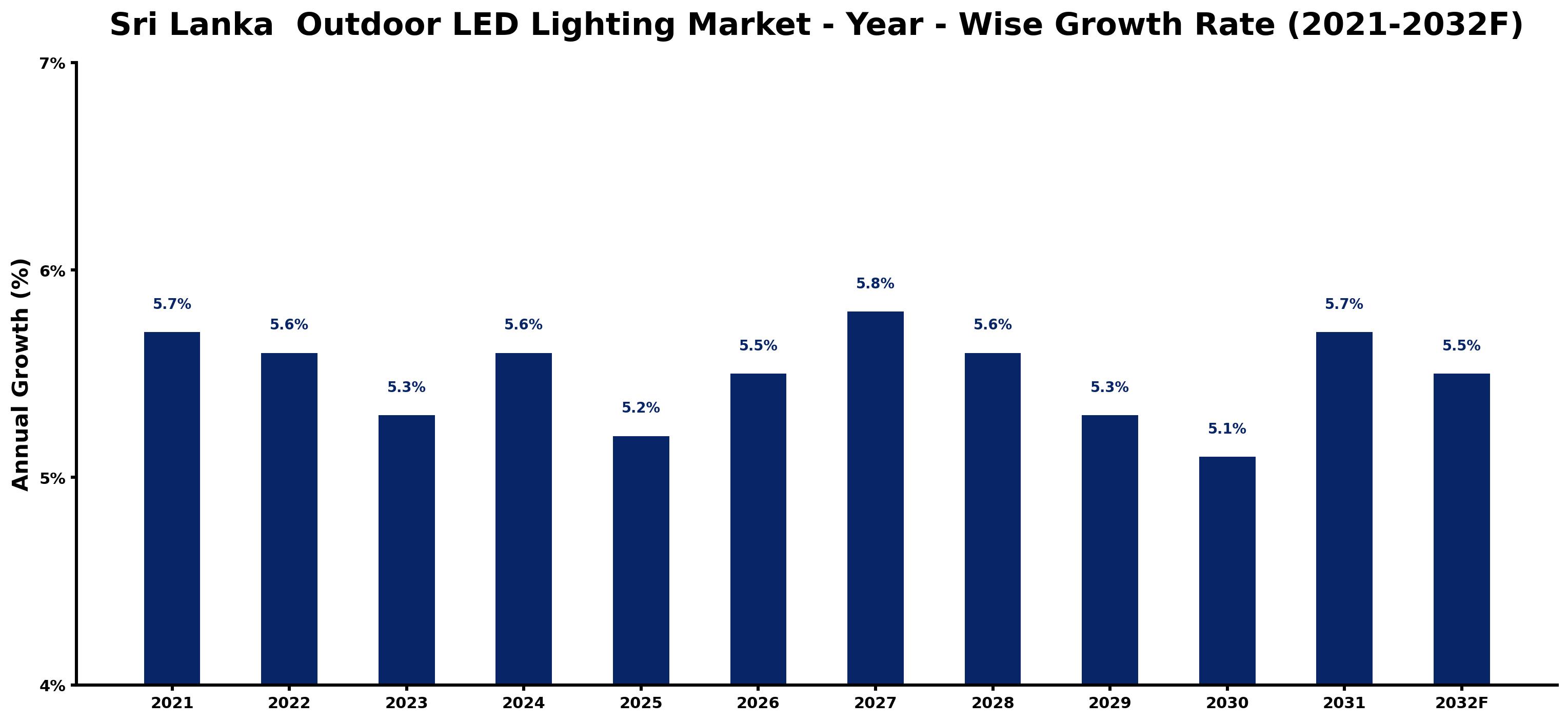
The table below presents the year wise growth rates along with the key drivers influencing the market
| Year | Growth Rate | Major Drivers |
| 2021 | 5.7% | Post-pandemic recovery efforts prompted infrastructure upgrades in urban lighting projects. |
| 2022 | 5.6% | Local manufacturers began optimizing LED technology for energy efficiency in outdoor applications. |
| 2023 | 5.3% | Smart city initiatives gained traction, leading to increased outdoor lighting modernization efforts. |
| 2024 | 5.6% | Public-private partnerships emerged to enhance sustainable lighting solutions across communities. |
| 2025 | 5.2% | Rising urbanization rates necessitated improved public safety and visibility through lighting. |
| 2026 | 5.5% | Technological integration of IoT in outdoor lighting systems began changing operational strategies. |
| 2027 | 5.8% | Competitive pricing among manufacturers contributed to wider market accessibility for consumers. |
| 2028 | 5.6% | Continued investment in tourism infrastructure demanded enhanced lighting aesthetics and functionality. |
| 2029 | 5.3% | Cultural events boosted demand for decorative lighting, influencing outdoor installations nationwide. |
| 2030 | 5.1% | Environmental consciousness increased emphasis on reducing energy consumption in public spaces. |
| 2031 | 5.7% | Challenges in existing grid systems accelerated the shift towards solar-powered LED solutions. |
| 2032 | 5.5% | National campaigns on sustainability created awareness, driving further adoption of outdoor LED lighting. |
Note - Market size estimations and growth projections presented in this report are based on 6Wresearch's advanced forecasting approach, validated with industry datasets as of June 2026.
Sri Lanka Outdoor LED Lighting Market Synopsis
The Sri Lanka Outdoor LED Lighting Market is projected to reach 5.5% and witness significant growth during the forecast period (2026-2032). This expansion is primarily attributed to rapid urbanization, heightened infrastructure development activities, and a concerted emphasis on energy efficiency. As local governments advocate for sustainable lighting technologies, the demand for outdoor LED lighting solutions has surged, supported by a growing awareness among consumers regarding the advantages of LED technology, including energy conservation and longevity.
Sri Lanka Outdoor LED Lighting Market Growth Drivers
A variety of factors are propelling the growth of the Sri Lanka Outdoor LED Lighting Market. One of the primary drivers is the ongoing urbanization that necessitates enhanced street lighting and public area illumination. This trend is coupled with significant infrastructure development projects aimed at modernizing urban spaces.
- The focus on reducing energy consumption has led to a higher adoption rate of LED lighting solutions, which are recognized for their efficiency and prolonged lifespan.
- Government initiatives encouraging the use of energy-efficient lighting technologies have fostered a favorable environment for market expansion.
- Increased consumer awareness regarding environmental impacts is pushing businesses and households toward eco-friendly lighting alternatives.
- Technological advancements in outdoor LED lighting, including smart features such as motion sensors and remote control capabilities, are enhancing consumer interest and adoption.
- The growing trend of developing smart cities in Sri Lanka is driving the demand for cutting-edge outdoor LED lighting solutions that integrate with other smart technologies.
Sri Lanka Outdoor LED Lighting Market Trends and Opportunities
The Sri Lanka Outdoor LED Lighting Market is witnessing several compelling trends that present numerous opportunities for stakeholders. Notably, there is a marked shift toward sustainable and energy-efficient solutions amongst consumers.
- The integration of smart technologies into outdoor LED lighting systems is becoming increasingly popular, offering enhanced functionality and improved energy management.
- Public and private investment in smart street lighting projects is on the rise, contributing to the demand for sophisticated LED solutions.
- As urbanization accelerates, there is a growing need for outdoor lighting in parks, gardens, and public spaces, driving further adoption of LED technologies.
- The emergence of energy-as-a-service models is providing innovative solutions for businesses looking to retrofit traditional lighting with LEDs without significant upfront capital costs.
- Collaborations among public and private entities to facilitate awareness regarding the benefits of LEDs are expected to bolster market growth.
Sri Lanka Outdoor LED Lighting Market Challenges and Restraints
While the Sri Lanka Outdoor LED Lighting Market offers ample growth potential, it also faces several challenges that could inhibit its progress. One significant constraint is the price sensitivity of consumers, leading to hesitance in adopting higher-cost LED technologies.
- High initial investment costs associated with LED lighting products deter consumers from transitioning from traditional lighting solutions.
- Limited awareness about the long-term benefits of LED technology among some consumer segments continues to hinder market penetration.
- Competition from cheaper alternatives, including traditional lighting solutions, poses a significant challenge, particularly in price-sensitive markets.
- Concerns regarding product quality and reliability can affect consumer trust and willingness to invest in LED technologies.
- Inconsistent government regulations and policies regarding energy efficiency standards may create uncertainty for manufacturers and investors alike.
Sri Lanka Outdoor LED Lighting Market Government Investment and Initiatives
The Sri Lankan government has proactively implemented policies and initiatives aimed at enhancing the Outdoor LED Lighting Market. The Ministry of Power and Renewable Energy has introduced energy efficiency standards designed to encourage the adoption of LED lighting solutions across the nation. Additionally, the government has established regulations to ensure the quality and safety of these products, fostering consumer confidence in their reliability and effectiveness.
- The provision of incentives and subsidies for the adoption of energy-efficient lighting technologies is part of the government's strategy to reduce overall energy consumption and carbon emissions.
- Public spending on infrastructure projects is expected to include allocations for upgrading existing lighting systems to more efficient LED configurations.
- Government-funded initiatives aimed at educating consumers about the benefits of LED technology are likely to broaden the market base.
- Collaborative efforts between government agencies and industry stakeholders aim to address barriers to market entry, further promoting growth prospects.
- Long-term development plans emphasize sustainable urban lighting, aligning with global trends toward energy conservation and efficiency.
Sri Lanka Outdoor LED Lighting Market Latest Developments (May 2025 - June 2026)
Recent developments in the Sri Lanka Outdoor LED Lighting Market reflect an ongoing commitment to enhancing energy efficiency and sustainability. Various initiatives have been announced aimed at transitioning public lighting systems toward LED solutions, highlighting the urgency for modernization amid urbanization pressures.
- Government-led pilot projects in selected urban areas have demonstrated the efficacy of LED lighting, leading to plans for larger-scale implementations across the country.
- Advancements in smart lighting technologies, such as wireless controls and smart sensors, are being integrated into new outdoor lighting solutions.
- Industry stakeholders are engaging in partnerships to co-develop innovative lighting solutions tailored to regional needs and requirements.
- Public-private collaborations are sparking awareness campaigns to educate consumers about the cost benefits and environmental advantages of LED technology.
- The market is experiencing an uptick in research activities focused on improving LED efficiency and longevity, further driving technological innovation.
Sri Lanka Outdoor LED Lighting Market - Key Attractiveness of the Report
- 10 Years of Market Numbers
- Historical Data Starting from 2022 to 2025
- Base Year: 2025
- Forecast Data until 2032
- Key Performance Indicators Impacting the Market
- Major Upcoming Developments and Projects
Key Highlights of the Report:
- Sri Lanka Outdoor LED Lighting Market Outlook
- Market Size of Sri Lanka Outdoor LED Lighting Market, 2025
- Forecast of Sri Lanka Outdoor LED Lighting Market, 2032F
- Historical Data and Forecast of Sri Lanka Outdoor LED Lighting Revenues & Volume for the Period 2022-2032F
- Sri Lanka Outdoor LED Lighting Market Trend Evolution
- Sri Lanka Outdoor LED Lighting Market Drivers and Challenges
- Sri Lanka Outdoor LED Lighting Price Trends
- Sri Lanka Outdoor LED Lighting Porter's Five Forces
- Sri Lanka Outdoor LED Lighting Industry Life Cycle
- Historical Data and Forecast of Sri Lanka Outdoor LED Lighting Market Revenues & Volume By Installation Type for the Period 2022-2032F
- Historical Data and Forecast of Sri Lanka Outdoor LED Lighting Market Revenues & Volume By New for the Period 2022-2032F
- Historical Data and Forecast of Sri Lanka Outdoor LED Lighting Market Revenues & Volume By Retrofit for the Period 2022-2032F
- Historical Data and Forecast of Sri Lanka Outdoor LED Lighting Market Revenues & Volume By Wattage Type for the Period 2022-2032F
- Historical Data and Forecast of Sri Lanka Outdoor LED Lighting Market Revenues & Volume By Less than 50W for the Period 2022-2032F
- Historical Data and Forecast of Sri Lanka Outdoor LED Lighting Market Revenues & Volume By 50W to 100W for the Period 2022-2032F
- Historical Data and Forecast of Sri Lanka Outdoor LED Lighting Market Revenues & Volume By More than 100W for the Period 2022-2032F
- Sri Lanka Outdoor LED Lighting Import Export Trade Statistics
- Market Opportunity Assessment By Installation Type
- Market Opportunity Assessment By Wattage Type
- Sri Lanka Outdoor LED Lighting Top Companies Market Share
- Sri Lanka Outdoor LED Lighting Competitive Benchmarking By Technical and Operational Parameters
- Sri Lanka Outdoor LED Lighting Company Profiles
- Sri Lanka Outdoor LED Lighting Key Strategic Recommendations






































