Sri Lanka Penicillin Market Size Growth Rate
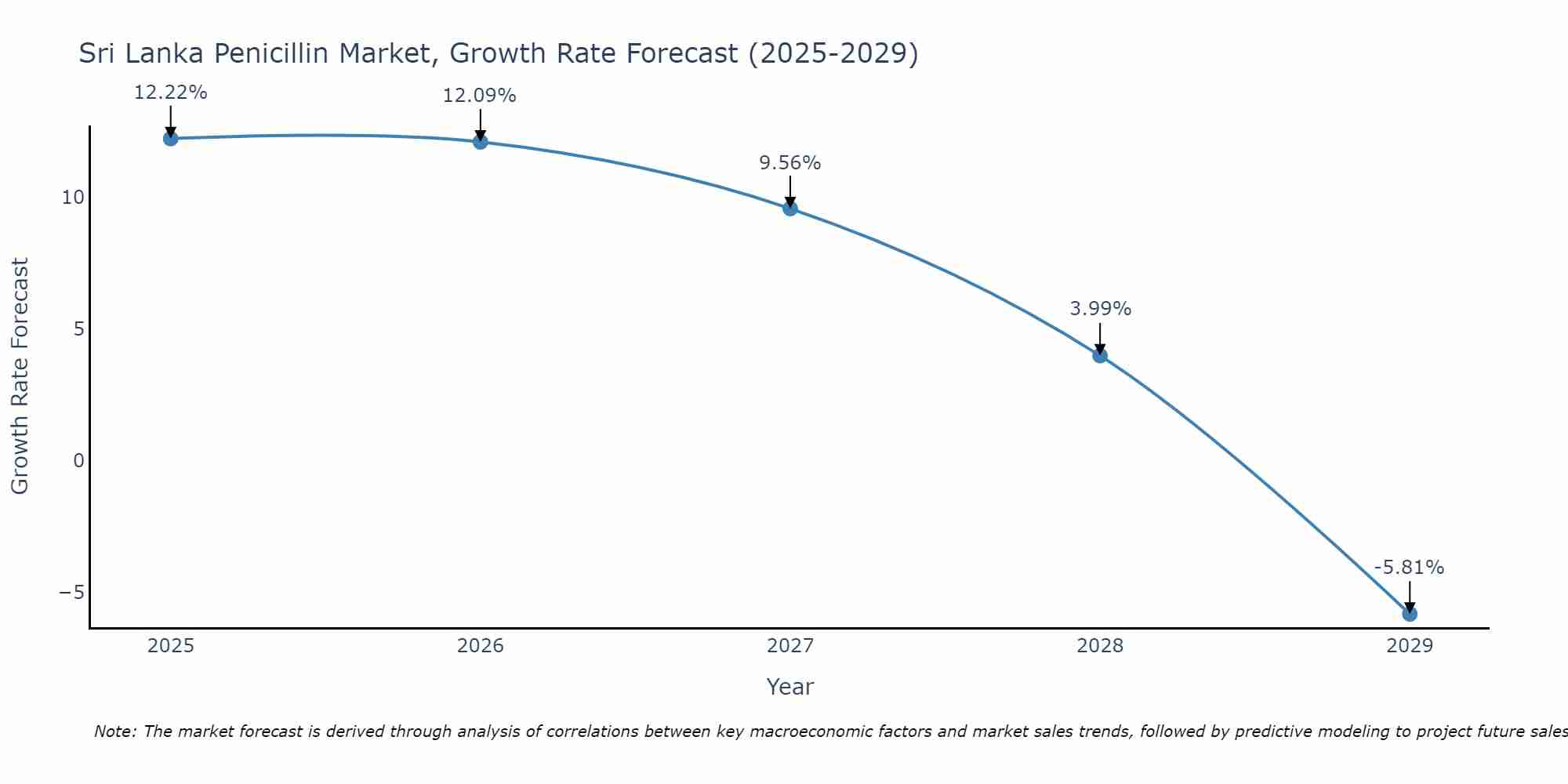
The Sri Lanka Penicillin Market could see a tapering of growth rates over 2025 to 2029. Although the growth rate starts strong at 12.22% in 2025, it steadily loses momentum, ending at -5.81% by 2029.
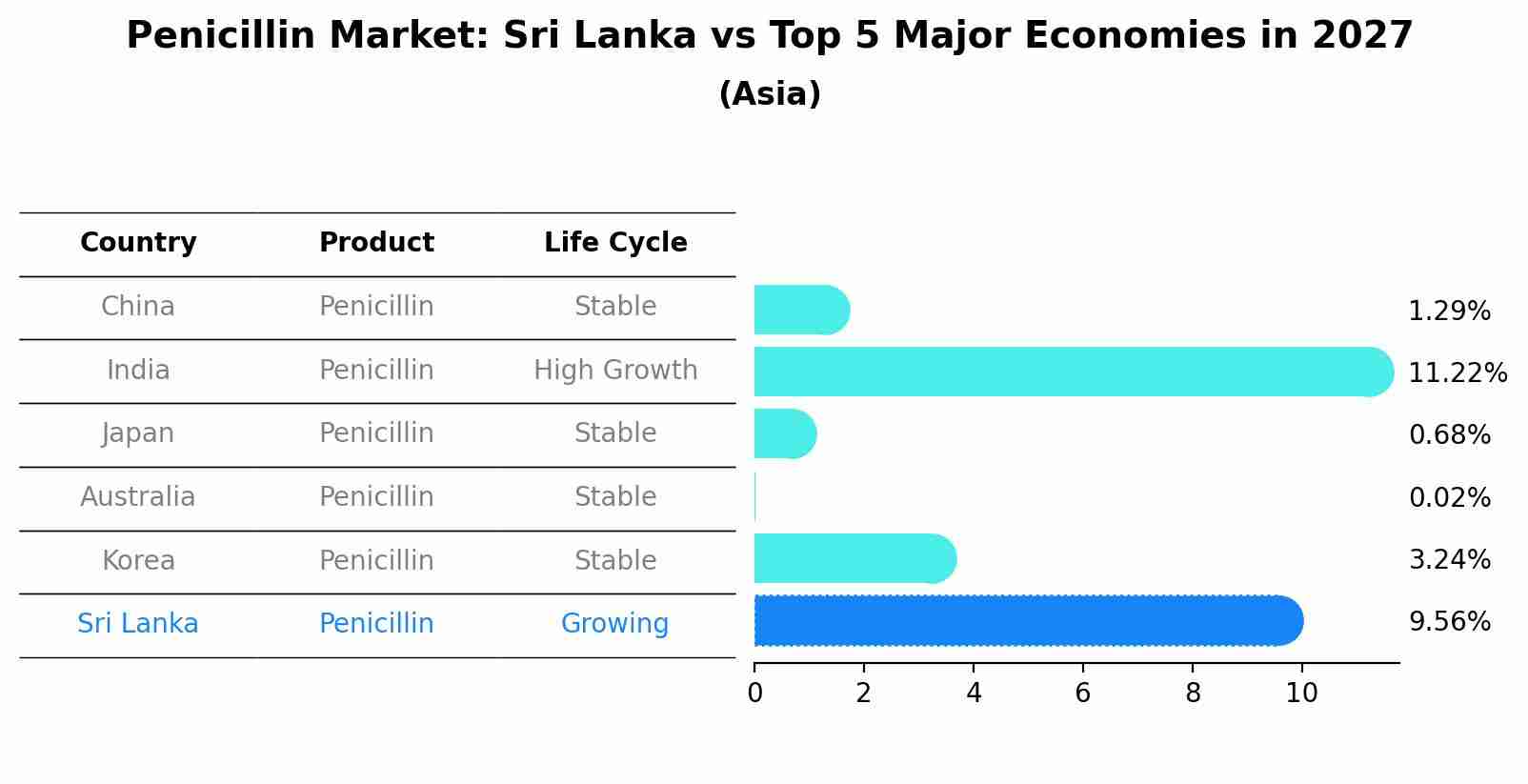
Penicillin Market: Sri Lanka vs Top 5 Major Economies in 2027 (Asia)
By 2027, the Penicillin market in Sri Lanka is anticipated to reach a growth rate of 9.56%, as part of an increasingly competitive Asia region, where China remains at the forefront, supported by India, Japan, Australia and South Korea, driving innovations and market adoption across sectors.
Sri Lanka Penicillin Market Overview
The Sri Lanka Penicillin market is characterized by steady growth driven by increasing awareness about the effectiveness of penicillin antibiotics in treating various bacterial infections. The market is primarily dominated by key players offering a wide range of penicillin-based medications, catering to both hospital and retail segments. With the rising incidence of infections and the need for effective antibiotics, the demand for penicillin products is expected to continue to grow. Factors such as government initiatives to improve healthcare infrastructure, growing healthcare expenditure, and increasing access to healthcare services in rural areas are further contributing to the market`s expansion. However, challenges such as the emergence of antibiotic-resistant bacteria and stringent regulatory requirements pose potential obstacles to market growth in Sri Lanka.
Sri Lanka Penicillin Market Trends
The Sri Lanka Penicillin market is experiencing steady growth driven by the increased prevalence of bacterial infections and the rising awareness about the effectiveness of Penicillin in treating such infections. There is a growing demand for both oral and injectable forms of Penicillin across hospitals, clinics, and retail pharmacies in the country. The market is also witnessing a shift towards the use of generic Penicillin products due to their cost-effectiveness. Manufacturers are focusing on product innovation, quality assurance, and strategic partnerships to expand their market presence. With the government`s initiatives to improve healthcare infrastructure and access to essential medicines, the Penicillin market in Sri Lanka is expected to continue its growth trajectory in the coming years.
Sri Lanka Penicillin Market Challenges
In the Sri Lanka Penicillin Market, several challenges are faced, including increasing antibiotic resistance due to misuse and overuse of penicillin, leading to a decrease in efficacy of these drugs. Limited access to quality healthcare services in certain regions of the country also hinders the proper administration and monitoring of penicillin treatments. Additionally, the presence of counterfeit or substandard penicillin products in the market poses a significant risk to patient safety and contributes to the development of antibiotic resistance. Regulatory issues and lack of stringent enforcement further exacerbate the challenge of ensuring the availability of safe and effective penicillin products in Sri Lanka. Addressing these challenges would require a collaborative effort from healthcare providers, regulatory authorities, and pharmaceutical companies to promote responsible antibiotic use and improve access to quality healthcare services.
Sri Lanka Penicillin Market Investment Opportunities
The Sri Lanka Penicillin Market presents promising investment opportunities fueled by factors such as increasing prevalence of bacterial infections, growing healthcare infrastructure, and rising awareness about the importance of antibiotics. With a growing population and expanding healthcare sector, there is a rising demand for penicillin-based antibiotics in Sri Lanka. Investors can explore opportunities in pharmaceutical companies involved in the manufacturing and distribution of penicillin drugs, as well as in research and development initiatives focused on developing new formulations or improving existing ones. Additionally, partnerships with local healthcare providers and government agencies can facilitate market penetration and expansion. It is important for investors to conduct thorough market research, assess regulatory landscape, and understand the competitive environment to make informed investment decisions in the Sri Lanka Penicillin Market.
Sri Lanka Penicillin Market Government Policy
The Sri Lankan government has implemented policies to regulate the Penicillin Market, aiming to ensure the safety and efficacy of penicillin products available in the country. These policies include guidelines for manufacturing standards, quality control measures, and distribution practices to safeguard public health. Additionally, there are regulations in place to monitor pricing practices, promote competition, and prevent monopolies in the market. The government also emphasizes the importance of proper labeling and packaging of penicillin products to provide clear information to consumers. Overall, these policies seek to uphold high standards in the Penicillin Market, protect consumer interests, and maintain a healthy and competitive market environment in Sri Lanka.
Sri Lanka Penicillin Market Future Outlook
The future outlook for the Sri Lanka Penicillin Market appears positive, driven by factors such as increasing healthcare expenditure, rising awareness about infectious diseases, and the growing prevalence of bacterial infections. The market is expected to witness steady growth due to the rising demand for antibiotics, including penicillin, in both hospital and community settings. Additionally, advancements in healthcare infrastructure and the introduction of new penicillin formulations are likely to further boost market growth. However, challenges such as the emergence of antibiotic resistance and regulatory hurdles may pose constraints to market expansion. Overall, with the increasing focus on healthcare and the need for effective treatment options, the Sri Lanka Penicillin Market is anticipated to experience growth in the coming years.
Key Highlights of the Report:
- Sri Lanka Penicillin Market Outlook
- Market Size of Sri Lanka Penicillin Market, 2021
- Forecast of Sri Lanka Penicillin Market, 2031
- Historical Data and Forecast of Sri Lanka Penicillin Revenues & Volume for the Period 2021 - 2031
- Sri Lanka Penicillin Market Trend Evolution
- Sri Lanka Penicillin Market Drivers and Challenges
- Sri Lanka Penicillin Price Trends
- Sri Lanka Penicillin Porter's Five Forces
- Sri Lanka Penicillin Industry Life Cycle
- Historical Data and Forecast of Sri Lanka Penicillin Market Revenues & Volume By Product for the Period 2021 - 2031
- Historical Data and Forecast of Sri Lanka Penicillin Market Revenues & Volume By Bulk for the Period 2021 - 2031
- Historical Data and Forecast of Sri Lanka Penicillin Market Revenues & Volume By Dosage for the Period 2021 - 2031
- Historical Data and Forecast of Sri Lanka Penicillin Market Revenues & Volume By Type for the Period 2021 - 2031
- Historical Data and Forecast of Sri Lanka Penicillin Market Revenues & Volume By Aminopenicillin for the Period 2021 - 2031
- Historical Data and Forecast of Sri Lanka Penicillin Market Revenues & Volume By Antipseudomonal Penicillin for the Period 2021 - 2031
- Historical Data and Forecast of Sri Lanka Penicillin Market Revenues & Volume By Beta-lactamase Inhibitor for the Period 2021 - 2031
- Historical Data and Forecast of Sri Lanka Penicillin Market Revenues & Volume By Natural Penicillin for the Period 2021 - 2031
- Historical Data and Forecast of Sri Lanka Penicillin Market Revenues & Volume By Penicillinase-resistant Penicillin for the Period 2021 - 2031
- Historical Data and Forecast of Sri Lanka Penicillin Market Revenues & Volume By Manufacturing Process for the Period 2021 - 2031
- Historical Data and Forecast of Sri Lanka Penicillin Market Revenues & Volume By Synthetic Process for the Period 2021 - 2031
- Historical Data and Forecast of Sri Lanka Penicillin Market Revenues & Volume By Natural Process for the Period 2021 - 2031
- Historical Data and Forecast of Sri Lanka Penicillin Market Revenues & Volume By Semisynthetic Process for the Period 2021 - 2031
- Historical Data and Forecast of Sri Lanka Penicillin Market Revenues & Volume By Mode of Delivery for the Period 2021 - 2031
- Historical Data and Forecast of Sri Lanka Penicillin Market Revenues & Volume By Oral for the Period 2021 - 2031
- Historical Data and Forecast of Sri Lanka Penicillin Market Revenues & Volume By Intramuscular for the Period 2021 - 2031
- Historical Data and Forecast of Sri Lanka Penicillin Market Revenues & Volume By Intravenous for the Period 2021 - 2031
- Historical Data and Forecast of Sri Lanka Penicillin Market Revenues & Volume By End User for the Period 2021 - 2031
- Historical Data and Forecast of Sri Lanka Penicillin Market Revenues & Volume By Hospitals for the Period 2021 - 2031
- Historical Data and Forecast of Sri Lanka Penicillin Market Revenues & Volume By Clinics for the Period 2021 - 2031
- Historical Data and Forecast of Sri Lanka Penicillin Market Revenues & Volume By Research Institutes for the Period 2021 - 2031
- Historical Data and Forecast of Sri Lanka Penicillin Market Revenues & Volume By Others for the Period 2021 - 2031
- Sri Lanka Penicillin Import Export Trade Statistics
- Market Opportunity Assessment By Product
- Market Opportunity Assessment By Type
- Market Opportunity Assessment By Manufacturing Process
- Market Opportunity Assessment By Mode of Delivery
- Market Opportunity Assessment By End User
- Sri Lanka Penicillin Top Companies Market Share
- Sri Lanka Penicillin Competitive Benchmarking By Technical and Operational Parameters
- Sri Lanka Penicillin Company Profiles
- Sri Lanka Penicillin Key Strategic Recommendations






































