Sri Lanka Perchloroethylene Market Size, Share & Growth Rate
The Sri Lanka Perchloroethylene Market was estimated at USD 419 Million in 2025 and is projected to reach USD 576 Million by 2032, growing at a CAGR of 4.7% from 2026 to 2032. This growth trajectory is primarily fueled by the burgeoning textile and dry cleaning sectors, which are witnessing increased demand for efficient cleaning and degreasing solutions. Additionally, urbanization and a rise in disposable incomes are further propelling the market's expansion, as consumers increasingly seek professional dry cleaning services.
Sri Lanka Perchloroethylene Market Year-wise Growth Rate and Key Drivers
This graph highlights how the Sri Lanka Perchloroethylene Market has steadily grown over the years, supported by major growth factors.
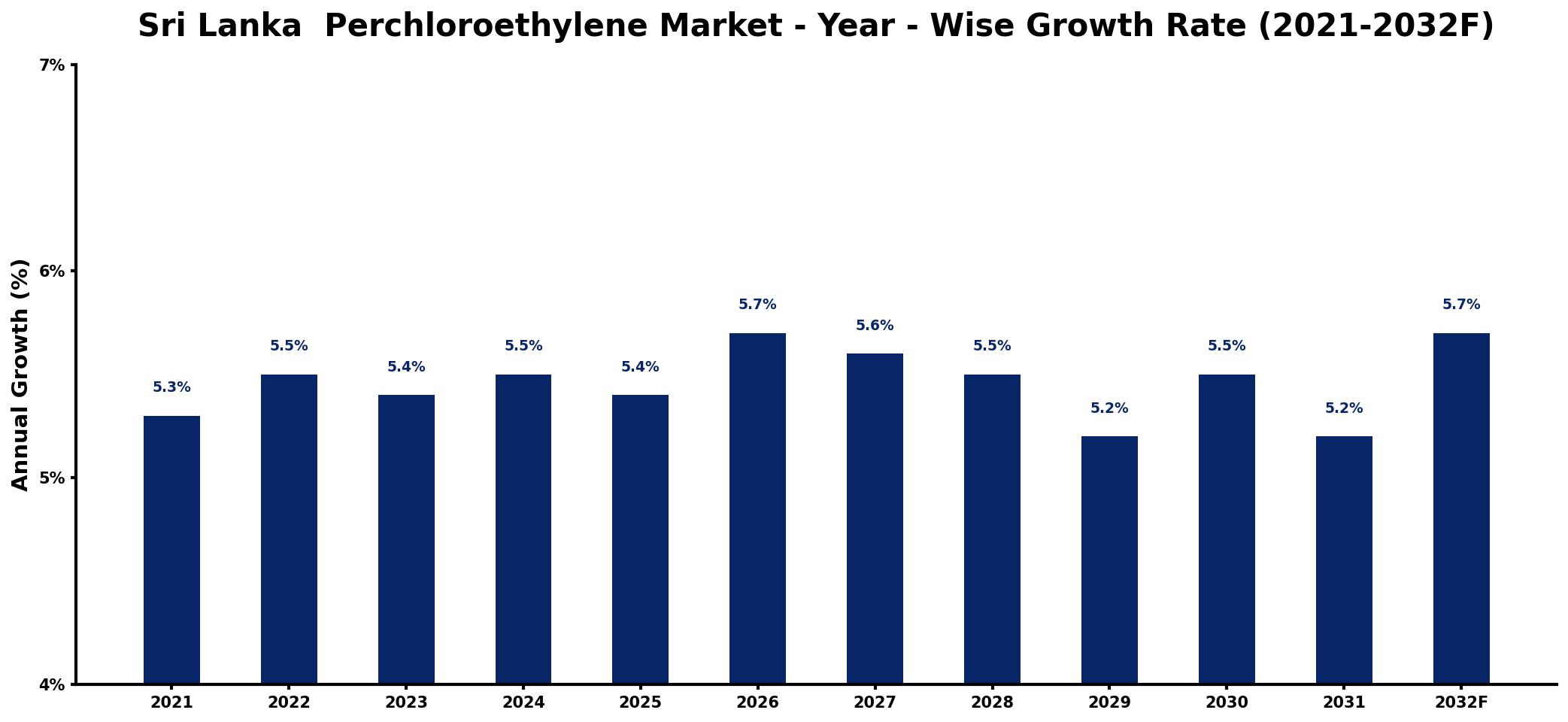
The table below presents the year‑wise growth rates along with the key drivers influencing the market
| Year | Growth Rate | Major Drivers |
| 2021 | 5.3% | Growing demand in dry cleaning |
| 2022 | 5.5% | Expansion of textile manufacturing sector |
| 2023 | 5.4% | Increase in automotive parts cleaning |
| 2024 | 5.5% | Rising demand from electronics industry |
| 2025 | 5.4% | Growth in industrial cleaning applications |
| 2026 | 5.7% | Boost in environmental regulations compliance |
| 2027 | 5.6% | Increased investment in manufacturing facilities |
| 2028 | 5.5% | Higher consumption in healthcare sector |
| 2029 | 5.2% | Demand from chemical processing industry |
| 2030 | 5.5% | expanding manufacturing base activity |
| 2031 | 5.2% | rising procurement volume requirements |
| 2032 | 5.7% | growing commercial sector adoption |
Note: Market size estimations and growth projections presented in this report are based on 6Wresearch's proprietary forecasting methodology, utilizing the latest available industry data, government publications, and primary research inputs.
Sri Lanka Perchloroethylene Market Synopsis
The demand for Perchloroethylene in Sri Lanka is sharply driven by its critical role in the textile and dry cleaning industries, where it serves as an essential solvent for maintaining fabric integrity. As local textile manufacturers focus on enhancing product quality, the usage of Perchloroethylene for degreasing and dry cleaning processes is set to increase.
However, the market is not without its complexities. Environmental regulations are tightening, necessitating that businesses adapt to stricter compliance measures. This has spurred interest in eco-friendly alternatives, leading to a gradual shift in some segments of the market.
Sri Lanka Perchloroethylene Market Key Takeaways
- Significant growth in the textile and dry cleaning sectors is boosting demand for Perchloroethylene.
- Urbanization and rising disposable incomes are influencing consumer preferences for professional cleaning services.
- Regulatory challenges related to environmental concerns are encouraging a move toward sustainable solvents.
- Investment in production and distribution infrastructure could provide lucrative opportunities for stakeholders.
- The market is expected to innovate in response to both demand and regulatory pressures for eco-friendly practices.
Evaluation of Restraints in Sri Lanka Perchloroethylene Market
The Sri Lanka Perchloroethylene market is hindered by several factors, notably the mounting regulatory pressures regarding the chemical's environmental impact. The waste disposal and emissions associated with Perchloroethylene require companies to invest in advanced technologies and processes, which can be cost-prohibitive. Additionally, the increasing availability of alternative solvents presents a competitive threat, compelling manufacturers to innovate continually or risk obsolescence. While demand remains robust, these restraints necessitate strategic planning and investment to ensure compliance and maintain market position.
Sri Lanka Perchloroethylene Market Trends
The market is currently witnessing a trend towards the adoption of more sustainable and environmentally friendly solvents, driven by both consumer preference and regulatory mandates. Furthermore, advances in cleaning technology are enhancing the efficiency of Perchloroethylene applications, making it a more attractive option in certain contexts. The growth of the automotive and manufacturing sectors is also propelling demand for Perchloroethylene, particularly in metal degreasing processes.
Sri Lanka Perchloroethylene Market Opportunities
Investment opportunities abound within the Sri Lanka Perchloroethylene market, especially in areas aligned with the expanding textile and dry cleaning industries. As urban centers grow and consumer lifestyles evolve, the need for professional cleaning services is poised to rise. Additionally, developing infrastructure for Perchloroethylene production or establishing robust distribution networks could yield substantial returns. Stakeholders should be attuned to both regulatory frameworks and environmental concerns to ensure responsible investment and long-term sustainability.
Government Initiatives in the Sri Lanka Perchloroethylene Market
The Sri Lankan government has put in place a series of regulations aimed at overseeing the use of Perchloroethylene, particularly within the dry cleaning sector. Policies designed to limit the concentration of Perchloroethylene in products highlight a commitment to safeguarding both public health and the environment. This includes directives for proper handling, storage, and disposal of the chemical, along with compliance monitoring frameworks that help mitigate risks associated with its use.
Future Insights of the Sri Lanka Perchloroethylene Market
Looking ahead to 2026-2032, the Sri Lanka Perchloroethylene Market is projected to grow steadily, bolstered by the sustained demand from various sectors such as textile processing, dry cleaning, and metal degreasing. Urbanization and industrialization trends will likely continue to propel market demand, while regulatory pressures could catalyze innovation in greener alternatives. Companies that adapt proactively to these evolving dynamics and invest in compliance will be well-positioned to thrive in this developing landscape.
Sri Lanka Perchloroethylene Market Latest Developments (2025 - 2026)
Recent developments in the Sri Lanka Perchloroethylene market indicate a stronger focus on sustainable practices and regulatory compliance. Industry participants are increasingly investing in cleaner technologies to meet evolving standards while addressing environmental concerns. There has been a noticeable shift towards exploring alternative solvents, reflecting the ongoing dialogue surrounding chemical safety and sustainability.
Sri Lanka Perchloroethylene Market - Key Attractiveness of the Report
- 10 Years of Market Numbers
- Historical Data Starting from 2022 to 2025
- Base Year: 2025
- Forecast Data until 2032
- Key Performance Indicators Impacting the Market
- Major Upcoming Developments and Projects
Key Highlights of the Report:
- Sri Lanka Perchloroethylene Market Outlook
- Market Size of Sri Lanka Perchloroethylene Market, 2025
- Forecast of Sri Lanka Perchloroethylene Market, 2032
- Historical Data and Forecast of Sri Lanka Perchloroethylene Revenues & Volume for the Period 2022-2032F
- Sri Lanka Perchloroethylene Market Trend Evolution
- Sri Lanka Perchloroethylene Market Drivers and Challenges
- Sri Lanka Perchloroethylene Price Trends
- Sri Lanka Perchloroethylene Porter's Five Forces
- Sri Lanka Perchloroethylene Industry Life Cycle
- Historical Data and Forecast of Sri Lanka Perchloroethylene Market Revenues & Volume By Type for the Period 2022-2032F
- Historical Data and Forecast of Sri Lanka Perchloroethylene Market Revenues & Volume By Ethylene Oxychlorination for the Period 2022-2032F
- Historical Data and Forecast of Sri Lanka Perchloroethylene Market Revenues & Volume By Acetylene Method for the Period 2022-2032F
- Historical Data and Forecast of Sri Lanka Perchloroethylene Market Revenues & Volume By Ethylene Direct Chlorination for the Period 2022-2032F
- Historical Data and Forecast of Sri Lanka Perchloroethylene Market Revenues & Volume By End-use for the Period 2022-2032F
- Historical Data and Forecast of Sri Lanka Perchloroethylene Market Revenues & Volume By Dry Cleaning Agent for the Period 2022-2032F
- Historical Data and Forecast of Sri Lanka Perchloroethylene Market Revenues & Volume By Solvent for the Period 2022-2032F
- Historical Data and Forecast of Sri Lanka Perchloroethylene Market Revenues & Volume By Others for the Period 2022-2032F
- Sri Lanka Perchloroethylene Import Export Trade Statistics
- Market Opportunity Assessment By Type
- Market Opportunity Assessment By End-use
- Sri Lanka Perchloroethylene Top Companies Market Share
- Sri Lanka Perchloroethylene Competitive Benchmarking By Technical and Operational Parameters
- Sri Lanka Perchloroethylene Company Profiles
- Sri Lanka Perchloroethylene Key Strategic Recommendations






































