Sri Lanka Planting Equipment Market Size, Share & Growth Rate
The Sri Lanka Planting Equipment Market was estimated at USD 447 Million in 2025 and is projected to reach USD 618 Million by 2032, growing at a CAGR of 4.7% from 2026 to 2032. This growth trajectory is primarily driven by the increasing adoption of modern farming techniques among local farmers and the government's strong emphasis on agricultural mechanization. As labor costs continue to rise, farmers are turning to advanced planting equipment to improve efficiency and productivity in their operations.
Sri Lanka Planting Equipment Market Year-wise Growth Rate and Key Drivers
This graph highlights how the Sri Lanka Planting Equipment Market has steadily grown over the years, supported by major growth factors.
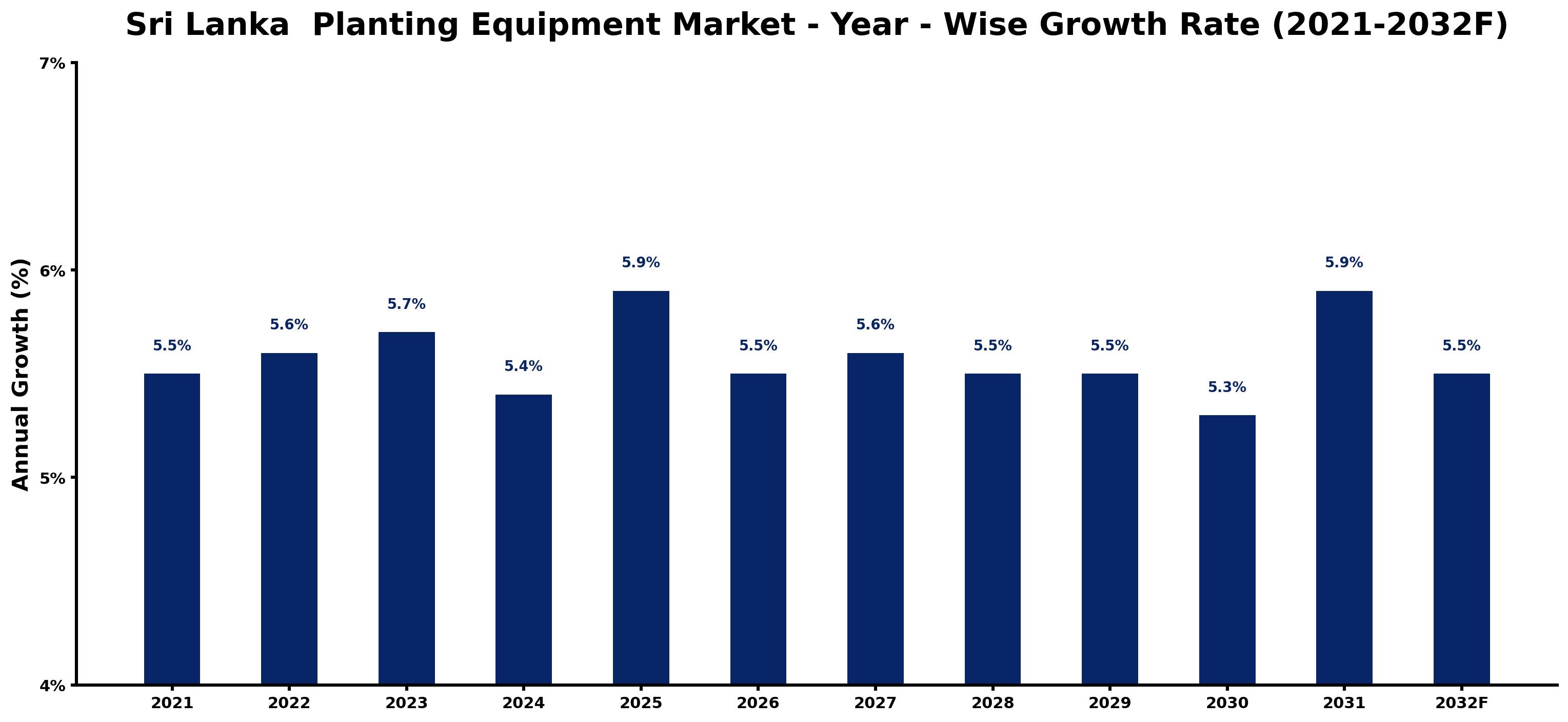
The table below presents the year‑wise growth rates along with the key drivers influencing the market
| Year | Growth Rate | Major Drivers |
| 2021 | 5.5% | Expansion of commercial construction activities |
| 2022 | 5.6% | Rapid growth in telecom and data center sectors |
| 2023 | 5.7% | Increasing industrial infrastructure investments |
| 2024 | 5.4% | Expansion of commercial construction activities |
| 2025 | 5.9% | Rapid growth in telecom and data center sectors |
| 2026 | 5.5% | Growing renewable energy integration projects |
| 2027 | 5.6% | Increasing smart city development projects |
| 2028 | 5.5% | Increasing adoption of advanced technologies |
| 2029 | 5.5% | Expansion of transportation and logistics networks |
| 2030 | 5.3% | Increasing industrial automation investments |
| 2031 | 5.9% | Expansion of manufacturing activities |
| 2032 | 5.5% | Growing urbanization and commercial development |
Note - Market size estimations and growth projections presented in this report are based on 6Wresearch's advanced forecasting approach, validated with industry datasets as of June 2026.
Sri Lanka Planting Equipment Market Synopsis
In recent years, the Sri Lanka Planting Equipment Market has gained momentum due to heightened awareness of mechanization's benefits and favorable government policies. As we look ahead, the market is positioned for continuous evolution, characterized by an increase in demand for precision farming technologies that optimize seed placement and enhance crop yields.
The growing focus on sustainable agriculture and eco-friendly farming practices is further influencing the market dynamics. Farmers are now more inclined to invest in equipment that aligns with these values, and this shift is likely to reshape the landscape of the planting equipment market in Sri Lanka.
Sri Lanka Planting Equipment Market Key Takeaways
- The market is witnessing steady growth due to modern farming practices and government initiatives.
- Mechanization is becoming increasingly essential as labor costs rise and efficiency demands grow.
- Adoption of precision planting techniques is on the rise, significantly impacting yield maximization.
- Investment in sustainable and eco-friendly planting solutions is gaining traction among farmers.
- Government support through subsidies and training programs is enhancing equipment adoption.
Evaluation of Restraints in Sri Lanka Planting Equipment Market
Despite the promising growth, the Sri Lanka Planting Equipment Market faces several significant challenges. Limited access to modern technology and high import costs hinder many farmers from adopting advanced planting solutions. Furthermore, a lack of awareness about specialized planting equipment among the predominantly smallholder farming community restricts the market's potential. Infrastructure issues, including insufficient credit facilities for equipment purchases and inadequate technical support, continue to impede broader mechanization efforts. Addressing these barriers is critical for the sustainable growth of the market.
Sri Lanka Planting Equipment Market Trends
A clear trend towards mechanization and automation is shaping the Sri Lanka Planting Equipment Market. Farmers are increasingly incorporating advanced seed drills, planters, and transplanters, which optimize planting efficiency while reducing reliance on manual labor. The demand for precision equipment, capable of placing seeds at optimal depths and spacing, is rising significantly. Additionally, a shift towards sustainable planting solutions that reduce environmental impact is becoming more pronounced, reflecting a growing global consciousness about eco-friendly agriculture.
Sri Lanka Planting Equipment Market Opportunities
Investment opportunities within the Sri Lanka Planting Equipment Market are abundant, particularly as modernization efforts gather momentum. Suppliers of high-quality planting equipment can find fertile ground here, especially if they align with local farming needs and offer training and support services. There is also significant potential for innovation through technology-driven solutions tailored for Sri Lanka's unique agricultural landscape. Furthermore, investors could capitalize on the government's initiatives promoting mechanization by developing eco-friendly planting equipment to meet rising environmental concerns.
Government Initiatives in the Sri Lanka Planting Equipment Market
The Sri Lankan government has enacted several supportive policies aimed at boosting the planting equipment market. Key initiatives include providing subsidies and financial assistance to farmers for the purchase of modern equipment and promoting technological advancements in the agriculture sector. Additionally, the government has implemented training programs focused on educating farmers about the efficient use of new planting technologies. Such efforts are integral to the broader strategy of enhancing agricultural productivity and ensuring food security in the country.
Future Insights of the Sri Lanka Planting Equipment Market
Looking ahead to 2026-2032, the Sri Lanka Planting Equipment Market is poised for robust expansion, driven by increasing mechanization trends and technological advancements. As the demand for efficient farming practices continues to grow, farmers are likely to increasingly adopt advanced planting equipment that maximizes productivity. Rising labor costs and a heightened awareness of precision farming will be critical factors influencing this growth. Overall, the market's trajectory is optimistic, providing substantial opportunities for both domestic and international stakeholders.
Sri Lanka Planting Equipment Market Latest Developments (May 2025 - June 2026)
Recent developments in the Sri Lanka Planting Equipment Market indicate a growing inclination among farmers towards modern agricultural practices. Various training programs have been initiated, targeting smallholder farmers to enhance their understanding and use of planting equipment. Simultaneously, manufacturers are increasing their focus on innovative and sustainable planting solutions, aligning with global trends toward eco-friendly farming. These developments signal a transition in the market, fostering a conducive environment for future investments and growth.
Sri Lanka Planting Equipment Market - Key Attractiveness of the Report
- 10 Years of Market Numbers
- Historical Data Starting from 2022 to 2025
- Base Year: 2025
- Forecast Data until 2032
- Key Performance Indicators Impacting the Market
- Major Upcoming Developments and Projects
Key Highlights of the Report:
- Sri Lanka Planting Equipment Market Outlook
- Market Size of Sri Lanka Planting Equipment Market, 2025
- Forecast of Sri Lanka Planting Equipment Market, 2032
- Historical Data and Forecast of Sri Lanka Planting Equipment Revenues & Volume for the Period 2022-2032F
- Sri Lanka Planting Equipment Market Trend Evolution
- Sri Lanka Planting Equipment Market Drivers and Challenges
- Sri Lanka Planting Equipment Price Trends
- Sri Lanka Planting Equipment Porter's Five Forces
- Sri Lanka Planting Equipment Industry Life Cycle
- Historical Data and Forecast of Sri Lanka Planting Equipment Market Revenues & Volume By Type for the Period 2022-2032F
- Historical Data and Forecast of Sri Lanka Planting Equipment Market Revenues & Volume By Air seeders for the Period 2022-2032F
- Historical Data and Forecast of Sri Lanka Planting Equipment Market Revenues & Volume By Seed drills for the Period 2022-2032F
- Historical Data and Forecast of Sri Lanka Planting Equipment Market Revenues & Volume By Planters for the Period 2022-2032F
- Historical Data and Forecast of Sri Lanka Planting Equipment Market Revenues & Volume By Others for the Period 2022-2032F
- Historical Data and Forecast of Sri Lanka Planting Equipment Market Revenues & Volume By Design for the Period 2022-2032F
- Historical Data and Forecast of Sri Lanka Planting Equipment Market Revenues & Volume By Mechanical for the Period 2022-2032F
- Historical Data and Forecast of Sri Lanka Planting Equipment Market Revenues & Volume By Automatic for the Period 2022-2032F
- Historical Data and Forecast of Sri Lanka Planting Equipment Market Revenues & Volume By Crop Type for the Period 2022-2032F
- Historical Data and Forecast of Sri Lanka Planting Equipment Market Revenues & Volume By Cereals & grains for the Period 2022-2032F
- Historical Data and Forecast of Sri Lanka Planting Equipment Market Revenues & Volume By Oilseeds & pulses for the Period 2022-2032F
- Historical Data and Forecast of Sri Lanka Planting Equipment Market Revenues & Volume By Fruits & vegetables for the Period 2022-2032F
- Historical Data and Forecast of Sri Lanka Planting Equipment Market Revenues & Volume By Others for the Period 2022-2032F
- Sri Lanka Planting Equipment Import Export Trade Statistics
- Market Opportunity Assessment By Type
- Market Opportunity Assessment By Design
- Market Opportunity Assessment By Crop Type
- Sri Lanka Planting Equipment Top Companies Market Share
- Sri Lanka Planting Equipment Competitive Benchmarking By Technical and Operational Parameters
- Sri Lanka Planting Equipment Company Profiles
- Sri Lanka Planting Equipment Key Strategic Recommendations






































