Sri Lanka Renewable Chemicals Market Size, Share & Growth Rate
The Sri Lanka Renewable Chemicals Market was estimated at USD 183 Million in 2025 and is projected to reach USD 241 Million by 2032, growing at a CAGR of 4.0% from 2026 to 2032. This growth trajectory is largely influenced by the increasing adoption of sustainable practices in various sectors, coupled with a heightened consumer awareness regarding environmental impacts. As industries seek to replace traditional petrochemicals with biodegradable options, the market is poised to benefit from innovations in technology and robust government support for renewable initiatives.
Sri Lanka Renewable Chemicals Market Year-wise Growth Rate and Key Drivers
This graph highlights how the Sri Lanka Renewable Chemicals Market has steadily grown over the years, supported by major growth factors.
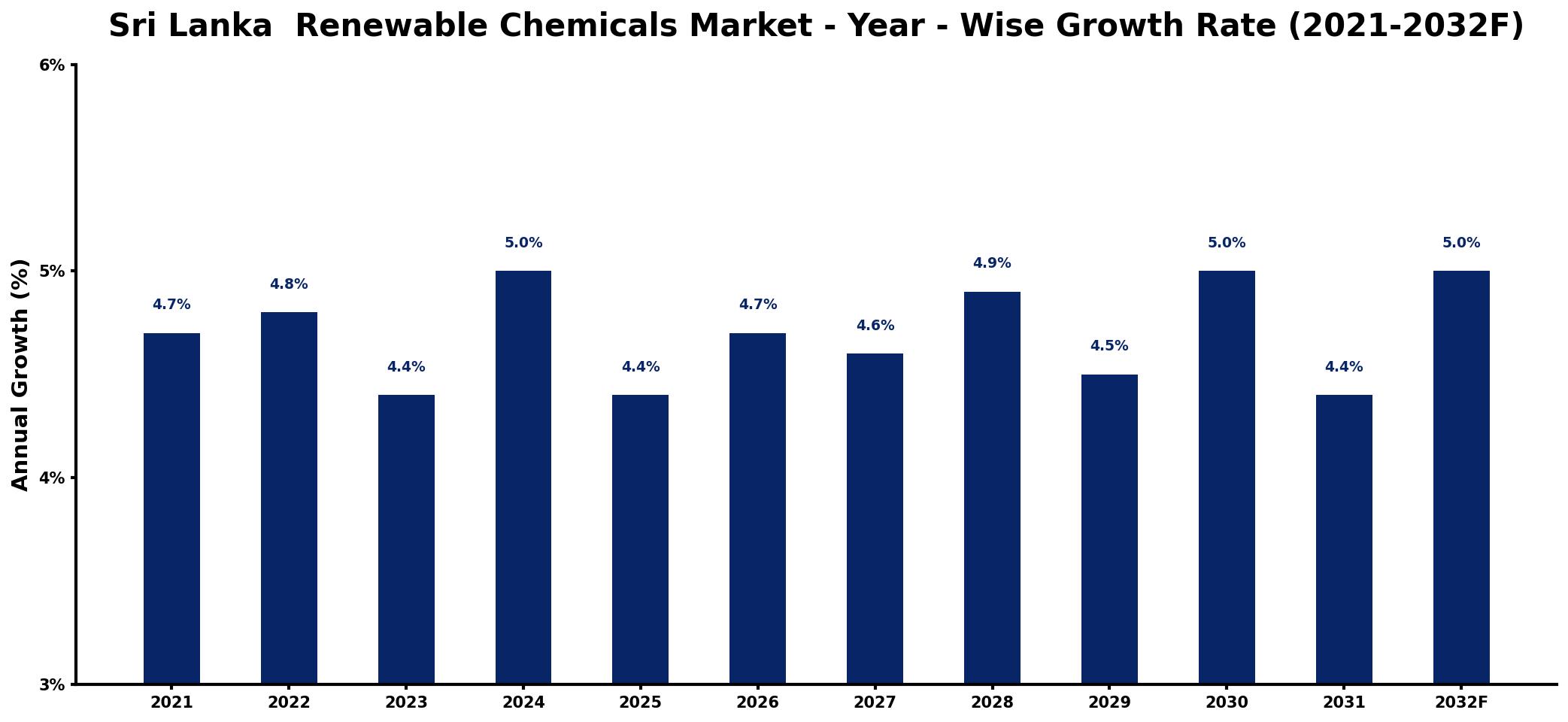
The table below presents the year‑wise growth rates along with the key drivers influencing the market
| Year | Growth Rate | Major Drivers |
| 2021 | 4.7% | Rising consumer sustainability preferences |
| 2022 | 4.8% | Increased investment in biofuels |
| 2023 | 4.4% | Growing demand for eco-friendly products |
| 2024 | 5.0% | Expansion of green manufacturing facilities |
| 2025 | 4.4% | Enhanced government support initiatives |
| 2026 | 4.7% | Surge in alternative energy sources |
| 2027 | 4.6% | Boost in corporate sustainability goals |
| 2028 | 4.9% | Development of innovative bioproducts |
| 2029 | 4.5% | Strengthened international trade partnerships |
| 2030 | 5.0% | Advancements in sustainable technologies |
| 2031 | 4.4% | Increased awareness of environmental impact |
| 2032 | 5.0% | Rising collaboration among stakeholders |
Note: Market size estimations and growth projections presented in this report are based on 6Wresearch's proprietary forecasting methodology, utilizing the latest available industry data, government publications, and primary research inputs.
Sri Lanka Renewable Chemicals Market Synopsis
The strongest force shaping the Sri Lanka Renewable Chemicals Market is the escalating government commitment to environmental sustainability. Various initiatives aimed at promoting bio-based products and eco-friendly alternatives are driving significant change across multiple sectors, including cosmetics and packaging. This governmental push is being complemented by a rising consumer demand for non-toxic, biodegradable chemicals, reflecting a broader shift towards sustainable consumption.
In addition to government efforts, ongoing innovations in biotechnology and green chemistry processes are transforming the landscape. By leveraging local biomass and agricultural residues, companies are finding new avenues for growth, which not only reduces reliance on fossil fuels but also opens up opportunities within the circular economy framework, reinforcing the market's potential in the years to come.
Sri Lanka Renewable Chemicals Market Key Takeaways
- The market is expected to grow significantly due to increased demand for sustainable and biodegradable chemicals.
- Government initiatives are crucial in promoting research and development for renewable chemical technologies.
- Innovations in biotechnology are a driving force behind the production of eco-friendly alternatives.
- Consumer awareness regarding environmental sustainability continues to rise, impacting purchasing decisions.
- Challenges related to raw material costs and regulatory complexities remain significant barriers to growth.
Evaluation of Restraints in Sri Lanka Renewable Chemicals Market
Despite its promising outlook, the Sri Lanka Renewable Chemicals Market is grappling with several restraints that hinder growth. The high cost associated with raw materials and production processes is particularly challenging for smaller manufacturers, creating barriers to entry in an industry that demands substantial investment. Furthermore, regulatory requirements regarding the production and disposal of renewable chemicals add layers of complexity, raising operational costs and discouraging new entrants. The scarcity of skilled labor in this specialized field, alongside the need for rigorous quality control, further complicates the landscape for companies striving to establish themselves in this competitive market.
Sri Lanka Renewable Chemicals Market Trends
One of the most notable trends is the shift towards the adoption of circular economy principles, where waste materials are reintegrated into production processes. This not only minimizes environmental impact but also enhances resource efficiency. Additionally, advancements in biotechnology are leading to the development of novel renewable chemicals that can outperform traditional alternatives in various applications, including textiles and packaging. Moreover, the trend of corporate sustainability commitments is pushing businesses to seek out renewable chemical solutions, signaling a significant shift in industrial priorities.
Sri Lanka Renewable Chemicals Market Opportunities
The Sri Lanka Renewable Chemicals Market presents numerous opportunities for growth and investment. Key areas include the development of innovative biodegradable materials suitable for packaging and agricultural applications, which are gaining traction as businesses look to reduce plastic waste. Furthermore, the alignment of local industries with global sustainability goals opens the door for collaborative ventures that can leverage Sri Lankas agricultural resources. With increased government incentives and a growing consumer base eager for eco-friendly options, the market is poised for significant expansion in the coming years.
Government Initiatives in the Sri Lanka Renewable Chemicals Market
The Sri Lankan government is actively fostering a favorable environment for the renewable chemicals market through various initiatives aimed at promoting sustainability and innovation. Policies encouraging the use of bio-based products are complemented by financial incentives for research and development in renewable chemical technologies. Public spending is focused on enhancing capabilities within the bio-economy, ensuring that the regulatory framework supports eco-friendly manufacturing practices while facilitating industry growth.
Future Insights of the Sri Lanka Renewable Chemicals Market
Looking ahead to 2026-2032, the Sri Lanka Renewable Chemicals Market is expected to undergo transformative changes driven by technology and policy. As the government continues to prioritize sustainability, industry players will likely respond by developing innovative solutions that meet the growing demand for environmentally friendly products. Additionally, increased investment in renewable energy sources will enhance feedstock availability, ultimately boosting production capabilities. The focus on bioplastics and biodegradable alternatives will likely redefine market dynamics, steering the industry toward long-term growth and resilience.
Sri Lanka Renewable Chemicals Market Latest Developments (2025 - 2026)
Recent developments in the Sri Lanka Renewable Chemicals Market indicate a heightened focus on collaborative research efforts between universities and industry stakeholders. These partnerships aim to drive innovation in biochemistry and green manufacturing processes. Additionally, several government initiatives are underway to streamline the regulatory landscape for renewable chemicals, making it easier for businesses to navigate the requirements. Investments in sustainable technologies are also being prioritized, setting the stage for future advancements in eco-friendly chemical production.
Sri Lanka Renewable Chemicals Market - Key Attractiveness of the Report
- 10 Years of Market Numbers
- Historical Data Starting from 2022 to 2025
- Base Year: 2025
- Forecast Data until 2032
- Key Performance Indicators Impacting the Market
- Major Upcoming Developments and Projects
Key Highlights of the Report:
- Sri Lanka Renewable Chemicals Market Outlook
- Market Size of Sri Lanka Renewable Chemicals Market, 2025
- Forecast of Sri Lanka Renewable Chemicals Market, 2032
- Historical Data and Forecast of Sri Lanka Renewable Chemicals Revenues & Volume for the Period 2022-2032F
- Sri Lanka Renewable Chemicals Market Trend Evolution
- Sri Lanka Renewable Chemicals Market Drivers and Challenges
- Sri Lanka Renewable Chemicals Price Trends
- Sri Lanka Renewable Chemicals Porter's Five Forces
- Sri Lanka Renewable Chemicals Industry Life Cycle
- Historical Data and Forecast of Sri Lanka Renewable Chemicals Market Revenues & Volume By Product Type for the Period 2022-2032F
- Historical Data and Forecast of Sri Lanka Renewable Chemicals Market Revenues & Volume By Alcohols for the Period 2022-2032F
- Historical Data and Forecast of Sri Lanka Renewable Chemicals Market Revenues & Volume By Organic Acids for the Period 2022-2032F
- Historical Data and Forecast of Sri Lanka Renewable Chemicals Market Revenues & Volume By Ketones for the Period 2022-2032F
- Historical Data and Forecast of Sri Lanka Renewable Chemicals Market Revenues & Volume By Platform Chemicals for the Period 2022-2032F
- Historical Data and Forecast of Sri Lanka Renewable Chemicals Market Revenues & Volume By Biopolymers for the Period 2022-2032F
- Historical Data and Forecast of Sri Lanka Renewable Chemicals Market Revenues & Volume By Others for the Period 2022-2032F
- Historical Data and Forecast of Sri Lanka Renewable Chemicals Market Revenues & Volume By Applications for the Period 2022-2032F
- Historical Data and Forecast of Sri Lanka Renewable Chemicals Market Revenues & Volume By Transportation for the Period 2022-2032F
- Historical Data and Forecast of Sri Lanka Renewable Chemicals Market Revenues & Volume By Textiles for the Period 2022-2032F
- Historical Data and Forecast of Sri Lanka Renewable Chemicals Market Revenues & Volume By Food safety for the Period 2022-2032F
- Historical Data and Forecast of Sri Lanka Renewable Chemicals Market Revenues & Volume By Environment for the Period 2022-2032F
- Historical Data and Forecast of Sri Lanka Renewable Chemicals Market Revenues & Volume By Communication for the Period 2022-2032F
- Historical Data and Forecast of Sri Lanka Renewable Chemicals Market Revenues & Volume By Housing for the Period 2022-2032F
- Historical Data and Forecast of Sri Lanka Renewable Chemicals Market Revenues & Volume By Recreation for the Period 2022-2032F
- Historical Data and Forecast of Sri Lanka Renewable Chemicals Market Revenues & Volume By Other Applications for the Period 2022-2032F
- Sri Lanka Renewable Chemicals Import Export Trade Statistics
- Market Opportunity Assessment By Product Type
- Market Opportunity Assessment By Applications
- Sri Lanka Renewable Chemicals Top Companies Market Share
- Sri Lanka Renewable Chemicals Competitive Benchmarking By Technical and Operational Parameters
- Sri Lanka Renewable Chemicals Company Profiles
- Sri Lanka Renewable Chemicals Key Strategic Recommendations






































