Sri Lanka Spinning Machinery Market Size, Share & Growth Rate
The Sri Lanka Spinning Machinery Market was estimated at USD 318 Million in 2025 and is projected to reach USD 450 Million by 2032, growing at a CAGR of 5.1% from 2026 to 2032. This growth trajectory is largely fueled by the rapid expansion of the textile industry, which is increasingly demanding high-quality spinning machinery to enhance production capabilities. Furthermore, technological advancements and government support are creating a favorable environment for market participants, allowing them to innovate and modernize.
Sri Lanka Spinning Machinery Market Year-wise Growth Rate and Key Drivers
This graph highlights how the Sri Lanka Spinning Machinery Market has steadily grown over the years, supported by major growth factors.
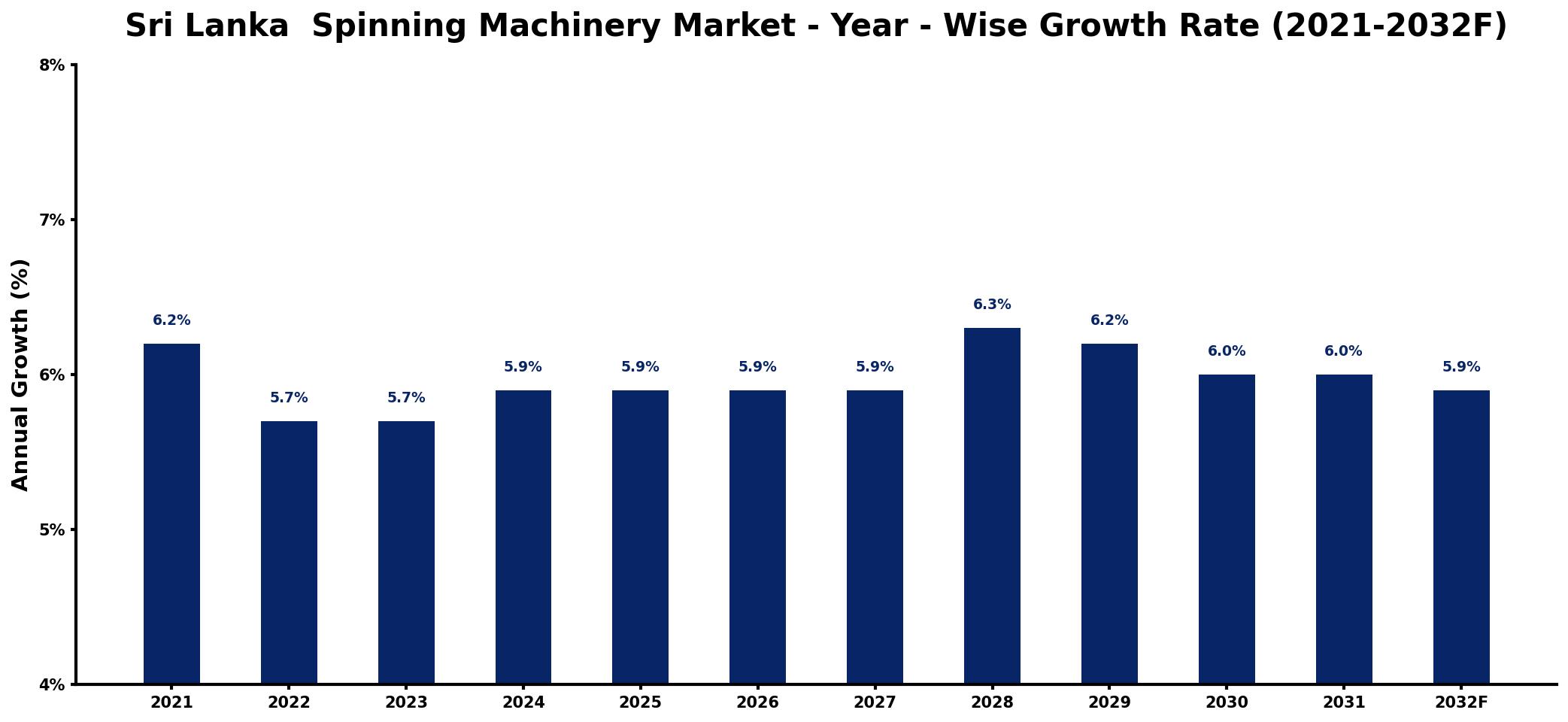
The table below presents the year‑wise growth rates along with the key drivers influencing the market
| Year | Growth Rate | Major Drivers |
| 2021 | 6.2% | Rising textile production capacities |
| 2022 | 5.7% | Increase in export opportunities |
| 2023 | 5.7% | Growing domestic textile demand |
| 2024 | 5.9% | Investment in modern technologies |
| 2025 | 5.9% | Expansion of garment manufacturing |
| 2026 | 5.9% | Strengthening global supply chains |
| 2027 | 5.9% | Development of sustainable practices |
| 2028 | 6.3% | Increased fashion industry collaboration |
| 2029 | 6.2% | Emergence of new textile startups |
| 2030 | 6.0% | Focus on eco-friendly materials |
| 2031 | 6.0% | Boost in regional trade agreements |
| 2032 | 5.9% | Advancements in automation technologies |
Note: Market size estimations and growth projections presented in this report are based on 6Wresearch's proprietary forecasting methodology, utilizing the latest available industry data, government publications, and primary research inputs.
Sri Lanka Spinning Machinery Market Synopsis
The Sri Lanka Spinning Machinery Market is currently experiencing a dynamic shift, transitioning from traditional machinery towards more advanced, automated solutions. This trend aligns with the burgeoning textile sector, which is increasingly focused on quality and efficiency to compete in a globalized market.
Looking ahead, the market is poised for consistent growth, driven by investments in modernizing spinning facilities and incorporating sustainable practices. The rise of automation and digitalization in spinning processes is transforming operational efficiency, setting the stage for long-term market evolution in line with global textile demands.
Sri Lanka Spinning Machinery Market Key Takeaways
- The market is projected to grow steadily, reflecting strong demand from the expanding textile industry.
- Technological advancements, including IoT integration and AI, are enhancing the efficiency of spinning operations.
- Government initiatives are bolstering investments and promoting sustainability in spinning machinery manufacturing.
- The industry is increasingly focusing on eco-friendly spinning solutions to meet global environmental standards.
- Compact and versatile spinning machinery is gaining popularity, catering to diverse fiber and yarn needs.
Evaluation of Restraints in Sri Lanka Spinning Machinery Market
Despite the positive momentum, several restraints hinder the Sri Lanka Spinning Machinery Market's full potential. The high initial capital investment necessary for establishing spinning mills remains a significant barrier for new entrants, often limiting market diversity. Additionally, established players dominate the market, making it challenging for newcomers to establish a foothold. Economic fluctuations impacting raw material prices and energy costs further complicate operational stability. Adapting to rapid technological changes requires significant resources, adding another layer of complexity for manufacturers in this competitive landscape.
Sri Lanka Spinning Machinery Market Trends
A notable trend in the Sri Lanka spinning machinery market is the increasing adoption of automation and advanced technologies. Manufacturers are investing in machinery that incorporates features such as robotics and IoT capabilities, allowing for more efficient production processes. Sustainability is also a growing focus, with demand rising for eco-friendly machines that minimize energy consumption and waste. Furthermore, the market is witnessing a shift toward compact and versatile spinning systems, enabling producers to diversify their offerings by accommodating various fiber types.
Sri Lanka Spinning Machinery Market Opportunities
The Sri Lanka spinning machinery market presents significant investment opportunities driven by the robust growth of the textile sector. There is a rising need for modern spinning machinery that can enhance production capabilities and efficiency. Opportunities abound for investors looking to introduce advanced technologies such as ring spinning and open-end spinning systems. Moreover, the integration of automation can streamline operations, reducing labor costs while improving output quality. These factors position the market favorably for investors aiming to capitalize on its growth potential.
Government Initiatives in the Sri Lanka Spinning Machinery Market
The Sri Lankan government has implemented several initiatives to support the spinning machinery market, aiming to stimulate growth and modernization. These policies include providing incentives like tax breaks and duty concessions to attract investment in the sector. There is a strong emphasis on promoting research and development to enhance local technological capabilities, further fostering innovation. Additionally, regulations are enforced to ensure compliance with quality standards and environmentally sustainable practices, which underpin the governments commitment to advancing the textile industry.
Future Insights of the Sri Lanka Spinning Machinery Market
Looking ahead to 2026-2032, the Sri Lanka spinning machinery market is positioned for steady growth. The increasing demand for textiles, coupled with advancements in spinning technology, will continue to drive investment in this sector. Enhanced focus on sustainability and energy efficiency will further shape product development and manufacturing practices. As the market evolves to meet shifting consumer preferences and environmental considerations, stakeholders can expect ongoing opportunities for innovation and growth.
Sri Lanka Spinning Machinery Market Latest Developments (2025 - 2026)
In recent months, the Sri Lanka spinning machinery market has seen a wave of advancements as manufacturers focus on adopting cutting-edge technologies. Initiatives aimed at enhancing operational efficiency through automation and digital tools have gained traction, enabling producers to streamline their processes. Moreover, industry stakeholders are increasingly engaged in dialogue regarding sustainability practices, resulting in collaborations that prioritize eco-friendly production methods. Such developments are indicative of a market committed to innovation and modernization.
Sri Lanka Spinning Machinery Market - Key Attractiveness of the Report
- 10 Years of Market Numbers
- Historical Data Starting from 2022 to 2025
- Base Year: 2025
- Forecast Data until 2032
- Key Performance Indicators Impacting the Market
- Major Upcoming Developments and Projects
Key Highlights of the Report:
- Sri Lanka Spinning Machinery Market Outlook
- Market Size of Sri Lanka Spinning Machinery Market, 2025
- Forecast of Sri Lanka Spinning Machinery Market, 2032
- Historical Data and Forecast of Sri Lanka Spinning Machinery Revenues & Volume for the Period 2022-2032F
- Sri Lanka Spinning Machinery Market Trend Evolution
- Sri Lanka Spinning Machinery Market Drivers and Challenges
- Sri Lanka Spinning Machinery Price Trends
- Sri Lanka Spinning Machinery Porter's Five Forces
- Sri Lanka Spinning Machinery Industry Life Cycle
- Historical Data and Forecast of Sri Lanka Spinning Machinery Market Revenues & Volume By Type for the Period 2022-2032F
- Historical Data and Forecast of Sri Lanka Spinning Machinery Market Revenues & Volume By Ring for the Period 2022-2032F
- Historical Data and Forecast of Sri Lanka Spinning Machinery Market Revenues & Volume By Rotor Spinning for the Period 2022-2032F
- Historical Data and Forecast of Sri Lanka Spinning Machinery Market Revenues & Volume By Material for the Period 2022-2032F
- Historical Data and Forecast of Sri Lanka Spinning Machinery Market Revenues & Volume By Natural for the Period 2022-2032F
- Historical Data and Forecast of Sri Lanka Spinning Machinery Market Revenues & Volume By Synthetic for the Period 2022-2032F
- Historical Data and Forecast of Sri Lanka Spinning Machinery Market Revenues & Volume By Others for the Period 2022-2032F
- Historical Data and Forecast of Sri Lanka Spinning Machinery Market Revenues & Volume By End-Use Industry for the Period 2022-2032F
- Historical Data and Forecast of Sri Lanka Spinning Machinery Market Revenues & Volume By Clothing for the Period 2022-2032F
- Historical Data and Forecast of Sri Lanka Spinning Machinery Market Revenues & Volume By Textile for the Period 2022-2032F
- Historical Data and Forecast of Sri Lanka Spinning Machinery Market Revenues & Volume By Other Industry for the Period 2022-2032F
- Sri Lanka Spinning Machinery Import Export Trade Statistics
- Market Opportunity Assessment By Type
- Market Opportunity Assessment By Material
- Market Opportunity Assessment By End-Use Industry
- Sri Lanka Spinning Machinery Top Companies Market Share
- Sri Lanka Spinning Machinery Competitive Benchmarking By Technical and Operational Parameters
- Sri Lanka Spinning Machinery Company Profiles
- Sri Lanka Spinning Machinery Key Strategic Recommendations






































