Sri Lanka Sports Equipment Market Size, Share & Growth Rate
The Sri Lanka Sports Equipment Market was estimated at USD 1290 Million in 2025 and is projected to reach USD 1857 Million by 2032, growing at a CAGR of 5.3% from 2026 to 2032. This growth is propelled by a significant uptick in health consciousness among Sri Lankans, coupled with increasing disposable incomes that are enabling more people to invest in quality sports gear. As participation in various sports continues to rise, the demand for diverse equipment—including cricket, volleyball, and fitness accessories—will only strengthen.
Sri Lanka Sports Equipment Market Year-wise Growth Rate and Key Drivers
This graph highlights how the Sri Lanka Sports Equipment Market has steadily grown over the years, supported by major growth factors.
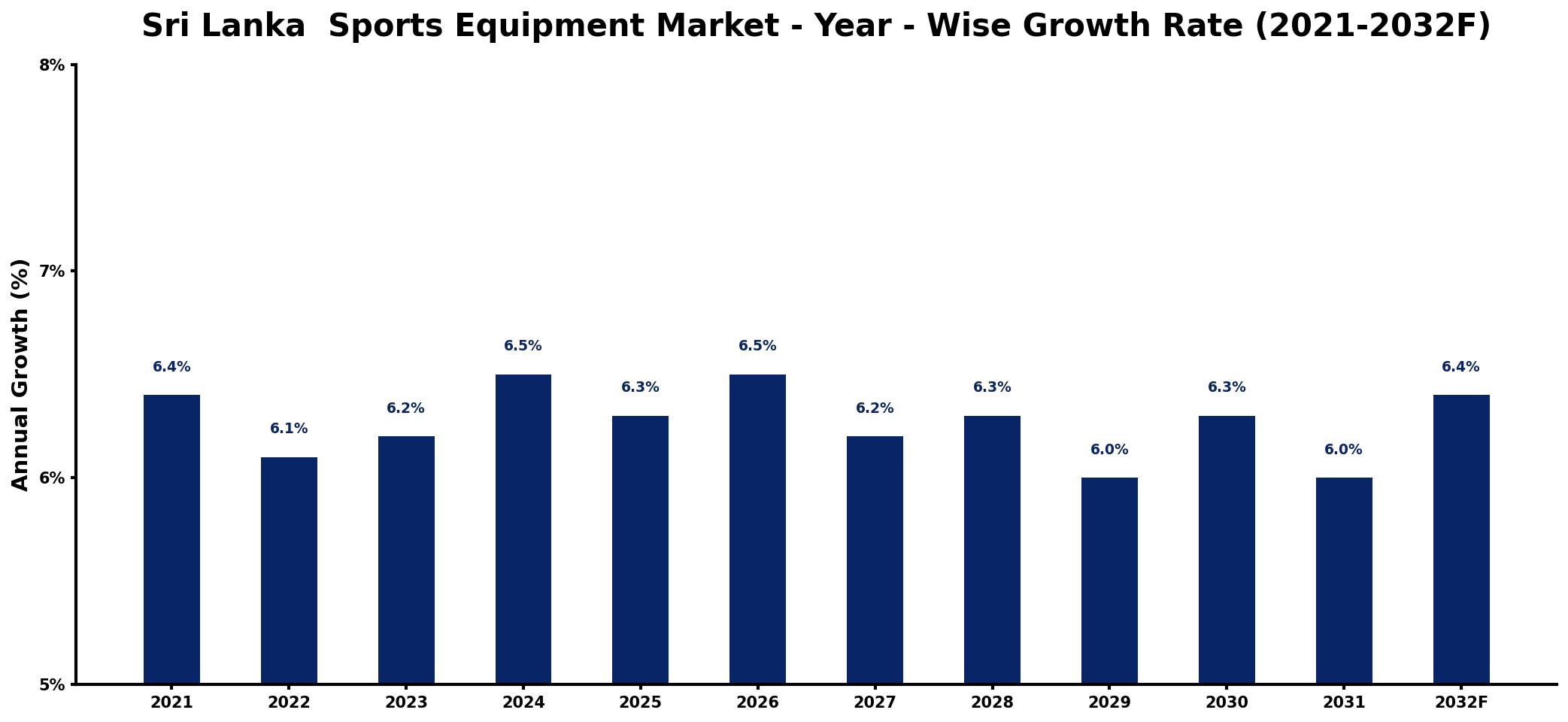
The table below presents the year‑wise growth rates along with the key drivers influencing the market
| Year | Growth Rate | Major Drivers |
| 2021 | 6.4% | increased fitness awareness among consumers |
| 2022 | 6.1% | growing youth participation in activities |
| 2023 | 6.2% | rising health consciousness post pandemic |
| 2024 | 6.5% | expansion of retail distribution channels |
| 2025 | 6.3% | surge in online shopping preferences |
| 2026 | 6.5% | emergence of new recreational trends |
| 2027 | 6.2% | growing sponsorships from brands |
| 2028 | 6.3% | increased investment in local facilities |
| 2029 | 6.0% | rising popularity of wellness programs |
| 2030 | 6.3% | expanding international sporting events |
| 2031 | 6.0% | enhanced government support initiatives |
| 2032 | 6.4% | growing collaboration with fitness influencers |
Note: Market size estimations and growth projections presented in this report are based on 6Wresearch's proprietary forecasting methodology, utilizing the latest available industry data, government publications, and primary research inputs.
Sri Lanka Sports Equipment Market Synopsis
The Sri Lanka sports equipment market is on an upward trajectory, characterized by a burgeoning interest in fitness and sporting activities across diverse demographics. Recent surveys indicate a marked increase in participation in not just traditional sports like cricket but also in fitness-centric activities such as yoga and running.
Moreover, the rise of e-commerce platforms has revolutionized how consumers access sports equipment, allowing for a broader selection of products that cater to varying needs and price points. This digital transformation is making quality equipment more accessible, thereby promoting an active lifestyle among the population.
Sri Lanka Sports Equipment Market Key Takeaways
- The market is driven by rising health consciousness and increased disposable incomes.
- E-commerce is transforming access to a diverse range of sports equipment.
- Government initiatives are supporting local manufacturing and sports participation.
- Technological advancements are leading to higher demand for specialized fitness gear.
- Outdoor sports equipment is gaining traction, reflecting a growing interest in adventure activities.
Evaluation of Restraints in Sri Lanka Sports Equipment Market
Despite the positive growth trajectory, the Sri Lanka sports equipment market faces some significant barriers. Limited distribution channels restrict access to high-quality products, making it challenging for consumers to find what they need. Moreover, competition from counterfeit and lower-priced items undermines the sales of authentic brands, eroding consumer trust. Import duties on sports equipment also inflate retail prices, making it less feasible for many households to invest in quality gear.
Sri Lanka Sports Equipment Market Trends
Current trends in the market show a pronounced shift toward fitness and wellness. There is an increasing demand for high-tech equipment, including smartwatches and fitness trackers, reflecting a consumer base that is more informed and health-focused than ever before. Additionally, outdoor recreational activities are on the rise, driving demand for camping gear, hiking accessories, and equipment for water sports.
Sri Lanka Sports Equipment Market Opportunities
Investment opportunities abound in the Sri Lanka sports equipment market, especially for products tailored to local needs. Companies that prioritize innovation and affordability are likely to capture significant market share. Moreover, there is potential for developing sports infrastructure such as complexes and training facilities, which would further elevate the sports culture in the country. Collaborating with local sports clubs can enhance brand visibility and foster community engagement, presenting another avenue for growth.
Government Initiatives in the Sri Lanka Sports Equipment Market
The Sri Lankan government is actively promoting sports participation through various policies aimed at enhancing local manufacturing and distribution of sports equipment. Initiatives such as tax incentives for manufacturers and protective tariffs on imported goods serve to bolster the local industry while ensuring product quality. Furthermore, efforts to improve access to sports facilities in schools and communities reflect a commitment to fostering a healthy lifestyle among the populace.
Future Insights of the Sri Lanka Sports Equipment Market
Looking ahead to 2026-2032, the future of the Sri Lanka sports equipment market appears bright, underpinned by an increase in health awareness and government-backed initiatives to promote sports. With a dynamic and young population driving demand, coupled with the rise of digital commerce, the market is positioned for sustained growth. Advancements in technology will continue to influence consumer preferences, leading to a diversification of products available in the market.
Sri Lanka Sports Equipment Market Latest Developments (2025 - 2026)
Recent developments in the Sri Lanka sports equipment market indicate a clear shift towards integrating technology in sports gear, with companies increasingly launching innovative products tailored to enhance performance. Additionally, partnerships with local sports organizations are becoming more common, helping brands to establish a stronger presence in the community and elevate their profiles through targeted sponsorships and events.
Sri Lanka Sports Equipment Market - Key Attractiveness of the Report
- 10 Years of Market Numbers
- Historical Data Starting from 2022 to 2025
- Base Year: 2025
- Forecast Data until 2032
- Key Performance Indicators Impacting the Market
- Major Upcoming Developments and Projects
Key Highlights of the Report:
- Sri Lanka Sports Equipment Market Outlook
- Market Size of Sri Lanka Sports Equipment Market, 2025
- Forecast of Sri Lanka Sports Equipment Market, 2032
- Historical Data and Forecast of Sri Lanka Sports Equipment Revenues & Volume for the Period 2022-2032F
- Sri Lanka Sports Equipment Market Trend Evolution
- Sri Lanka Sports Equipment Market Drivers and Challenges
- Sri Lanka Sports Equipment Price Trends
- Sri Lanka Sports Equipment Porter's Five Forces
- Sri Lanka Sports Equipment Industry Life Cycle
- Historical Data and Forecast of Sri Lanka Sports Equipment Market Revenues & Volume By Product for the Period 2022-2032F
- Historical Data and Forecast of Sri Lanka Sports Equipment Market Revenues & Volume By Ball over net games for the Period 2022-2032F
- Historical Data and Forecast of Sri Lanka Sports Equipment Market Revenues & Volume By Ball games for the Period 2022-2032F
- Historical Data and Forecast of Sri Lanka Sports Equipment Market Revenues & Volume By Fitness/Strength equipment for the Period 2022-2032F
- Historical Data and Forecast of Sri Lanka Sports Equipment Market Revenues & Volume By Athletic training equipment for the Period 2022-2032F
- Historical Data and Forecast of Sri Lanka Sports Equipment Market Revenues & Volume By Others for the Period 2022-2032F
- Historical Data and Forecast of Sri Lanka Sports Equipment Market Revenues & Volume By Distribution Channel for the Period 2022-2032F
- Historical Data and Forecast of Sri Lanka Sports Equipment Market Revenues & Volume By Online retail for the Period 2022-2032F
- Historical Data and Forecast of Sri Lanka Sports Equipment Market Revenues & Volume By Specialty & sports shops for the Period 2022-2032F
- Historical Data and Forecast of Sri Lanka Sports Equipment Market Revenues & Volume By Department & discount stores for the Period 2022-2032F
- Sri Lanka Sports Equipment Import Export Trade Statistics
- Market Opportunity Assessment By Product
- Market Opportunity Assessment By Distribution Channel
- Sri Lanka Sports Equipment Top Companies Market Share
- Sri Lanka Sports Equipment Competitive Benchmarking By Technical and Operational Parameters
- Sri Lanka Sports Equipment Company Profiles
- Sri Lanka Sports Equipment Key Strategic Recommendations






































