Sri Lanka Sports Nutrition Market Size, Share & Growth Rate
The Sri Lanka Sports Nutrition Market was estimated at USD 382 Million in 2025 and is projected to reach USD 510 Million by 2032, growing at a CAGR of 4.2% from 2026 to 2032. This upward trajectory is primarily driven by the increasing health and fitness awareness among Sri Lankans. As more individuals embrace active lifestyles, the demand for products designed to enhance athletic performance and support fitness goals has surged, positioning the market for sustained growth.
Sri Lanka Sports Nutrition Market Year-wise Growth Rate and Key Drivers
This graph highlights how the Sri Lanka Sports Nutrition Market has steadily grown over the years, supported by major growth factors.
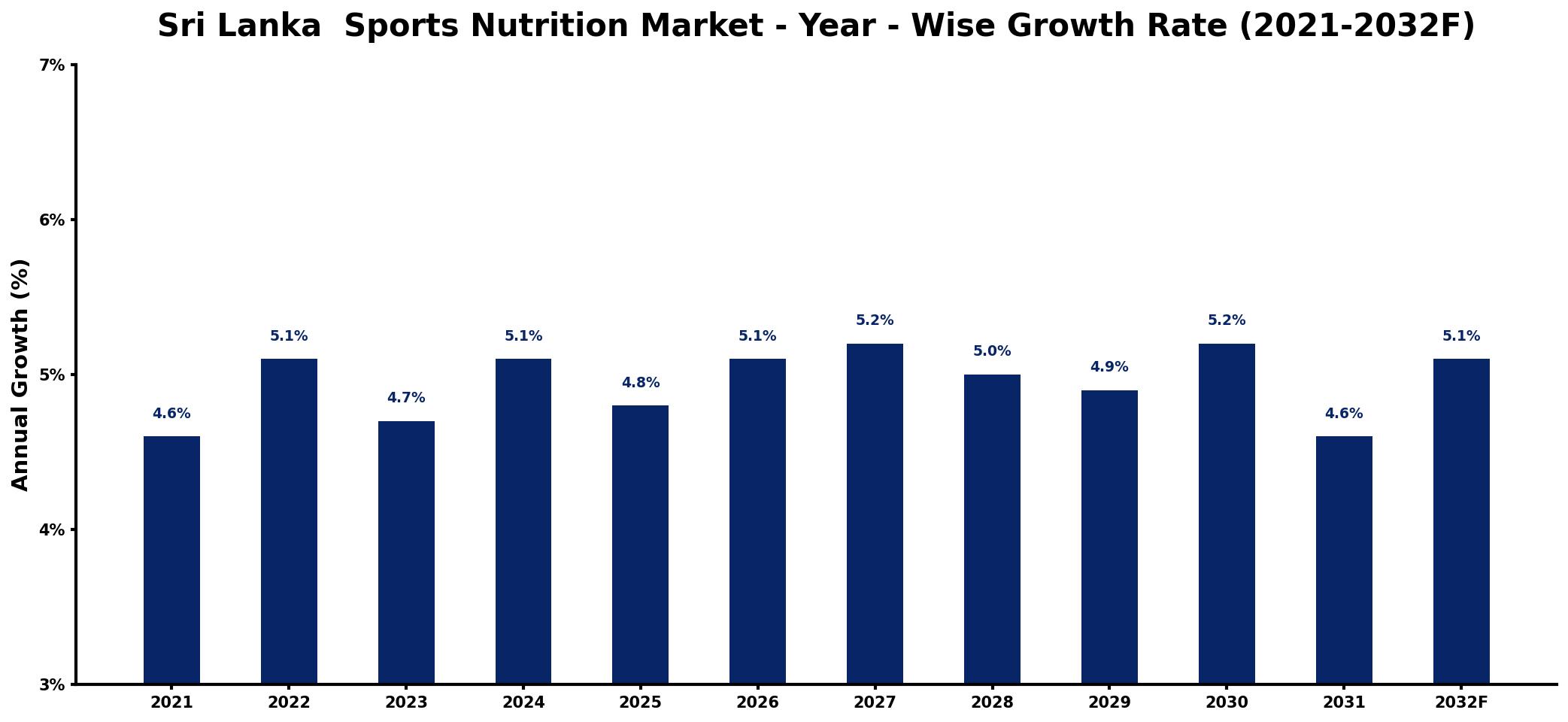
The table below presents the year‑wise growth rates along with the key drivers influencing the market
| Year | Growth Rate | Major Drivers |
| 2021 | 4.6% | Rising health consciousness among consumers |
| 2022 | 5.1% | Increased fitness awareness initiatives |
| 2023 | 4.7% | Growing online retail platforms |
| 2024 | 5.1% | Expansion of fitness centers |
| 2025 | 4.8% | Surge in lifestyle diseases awareness |
| 2026 | 5.1% | Enhanced marketing strategies adopted |
| 2027 | 5.2% | Emergence of new consumer segments |
| 2028 | 5.0% | Government support for wellness programs |
| 2029 | 4.9% | Innovations in product formulations |
| 2030 | 5.2% | Collaboration with fitness influencers |
| 2031 | 4.6% | Diverse distribution channels evolution |
| 2032 | 5.1% | Rising disposable income levels |
Note: Market size estimations and growth projections presented in this report are based on 6Wresearch's proprietary forecasting methodology, utilizing the latest available industry data, government publications, and primary research inputs.
Sri Lanka Sports Nutrition Market Synopsis
The Sri Lanka sports nutrition market has witnessed a marked acceleration in recent years, propelled by a burgeoning culture of health consciousness. Consumers are now actively seeking innovative solutions to boost their athletic performance, which has led to a notable increase in the variety of products available, ranging from protein powders to performance-enhancing supplements.
Looking ahead, the market is set to evolve as more consumers prioritize their well-being amidst rising disposable incomes and changing dietary habits. This evolution presents a landscape ripe with opportunities for both established and emerging brands keen to tap into the growing consumer base.
Sri Lanka Sports Nutrition Market Key Takeaways
- Increasing health and fitness awareness among consumers is driving market demand.
- There is a significant shift towards natural and organic sports nutrition products.
- Online sales and e-commerce platforms are becoming the preferred shopping channels.
- Investment opportunities are expanding within local and international brands.
- Consumer education on sports nutrition remains essential for market growth.
Evaluation of Restraints in Sri Lanka Sports Nutrition Market
Despite its promising outlook, the Sri Lanka sports nutrition market faces significant challenges. A key restraint is the general lack of awareness about the importance of sports nutrition among a substantial segment of the population. This gap in knowledge limits product penetration and consumer acceptance. Furthermore, the market is affected by the high costs associated with importing quality sports nutrition products, which can deter budget-conscious consumers from making purchases. The prevalence of counterfeit products also adds to the complexity, posing risks to consumer safety and brand integrity.
Sri Lanka Sports Nutrition Market Trends
Current trends indicate a strong consumer preference for natural and organic sports nutrition products. With a rise in health consciousness, there is an increasing demand for clean label products that disclose ingredient sourcing transparently. Athletes and fitness enthusiasts are gravitating toward plant-based proteins, which offer sustainable and cruelty-free options. Moreover, the trend towards personalized nutrition solutions is gaining traction, with brands tailoring supplements and meal plans to meet individual dietary needs and fitness goals.
Sri Lanka Sports Nutrition Market Opportunities
The growth trajectory of the Sri Lanka sports nutrition market opens up significant investment opportunities. With disposable incomes rising, brands that align their offerings with the health and wellness trend are well-positioned for success. Collaborating with local gyms and fitness centers can create exclusive partnerships, while the burgeoning e-commerce landscape offers a convenient platform for reaching wider audiences. By focusing on clean label and plant-based products, investors can cater to the growing segment of environmentally conscious consumers.
Government Initiatives in the Sri Lanka Sports Nutrition Market
While there are no specific policies directly targeting the sports nutrition sector, the Sri Lankan government is actively promoting health and wellness through initiatives such as the National Nutrition Policy. This policy aims to enhance the nutritional status of the population. The Ministry of Health, Nutrition, and Indigenous Medicine also regulates food product labeling to ensure consumer safety. Additionally, the Sri Lankan Sports Ministry indirectly supports the industry by providing athletes with training facilities and resources, thus encouraging the use of sports nutrition products.
Future Insights of the Sri Lanka Sports Nutrition Market
Looking ahead to the period between 2026 and 2032, the Sri Lanka sports nutrition market is expected to expand steadily. As health and fitness trends become more ingrained in the culture, consumer demand for products such as protein supplements, energy bars, and sports drinks will likely intensify. Social media and celebrity endorsements will play a pivotal role in shaping purchasing decisions, driving further market growth. Overall, as health becomes a top priority, the sports nutrition landscape will continue to evolve dynamically.
Sri Lanka Sports Nutrition Market Latest Developments (2025 - 2026)
Recent developments in the Sri Lanka sports nutrition market have highlighted a shift towards innovative product offerings, particularly in the realm of plant-based nutrition. Brands are increasingly leveraging digital platforms to engage consumers, offering personalized nutrition solutions and enhancing accessibility. Furthermore, partnerships with local fitness influencers are becoming commonplace, bolstering brand visibility and driving sales growth. As e-commerce becomes a dominant sales channel, companies are refining their online strategies to cater to a tech-savvy consumer base.
Sri Lanka Sports Nutrition Market - Key Attractiveness of the Report
- 10 Years of Market Numbers
- Historical Data Starting from 2022 to 2025
- Base Year: 2025
- Forecast Data until 2032
- Key Performance Indicators Impacting the Market
- Major Upcoming Developments and Projects
Key Highlights of the Report:
- Sri Lanka Sports Nutrition Market Outlook
- Market Size of Sri Lanka Sports Nutrition Market, 2025
- Forecast of Sri Lanka Sports Nutrition Market, 2032
- Historical Data and Forecast of Sri Lanka Sports Nutrition Revenues & Volume for the Period 2022-2032F
- Sri Lanka Sports Nutrition Market Trend Evolution
- Sri Lanka Sports Nutrition Market Drivers and Challenges
- Sri Lanka Sports Nutrition Price Trends
- Sri Lanka Sports Nutrition Porter's Five Forces
- Sri Lanka Sports Nutrition Industry Life Cycle
- Historical Data and Forecast of Sri Lanka Sports Nutrition Market Revenues & Volume By Type for the Period 2022-2032F
- Historical Data and Forecast of Sri Lanka Sports Nutrition Market Revenues & Volume By Sports Food for the Period 2022-2032F
- Historical Data and Forecast of Sri Lanka Sports Nutrition Market Revenues & Volume By Sports Drinks for the Period 2022-2032F
- Historical Data and Forecast of Sri Lanka Sports Nutrition Market Revenues & Volume By Sports Supplements for the Period 2022-2032F
- Historical Data and Forecast of Sri Lanka Sports Nutrition Market Revenues & Volume By Distribution Channel for the Period 2022-2032F
- Historical Data and Forecast of Sri Lanka Sports Nutrition Market Revenues & Volume By Supermarkets/Hypermarkets for the Period 2022-2032F
- Historical Data and Forecast of Sri Lanka Sports Nutrition Market Revenues & Volume By Specialty Stores for the Period 2022-2032F
- Historical Data and Forecast of Sri Lanka Sports Nutrition Market Revenues & Volume By Convenience Stores for the Period 2022-2032F
- Historical Data and Forecast of Sri Lanka Sports Nutrition Market Revenues & Volume By Online Stores for the Period 2022-2032F
- Historical Data and Forecast of Sri Lanka Sports Nutrition Market Revenues & Volume By Other Distribution Channels for the Period 2022-2032F
- Sri Lanka Sports Nutrition Import Export Trade Statistics
- Market Opportunity Assessment By Type
- Market Opportunity Assessment By Distribution Channel
- Sri Lanka Sports Nutrition Top Companies Market Share
- Sri Lanka Sports Nutrition Competitive Benchmarking By Technical and Operational Parameters
- Sri Lanka Sports Nutrition Company Profiles
- Sri Lanka Sports Nutrition Key Strategic Recommendations






































