Sri Lanka Stone Crushing Equipment Market Size, Share & Growth Rate
The Sri Lanka Stone Crushing Equipment Market was estimated at USD 209 Million in 2025 and is projected to reach USD 229 Million by 2032, growing at a CAGR of 1.3% from 2026 to 2032. This trajectory is primarily driven by robust construction activities, significant infrastructure development projects, and a consistent rise in the demand for aggregates. The ongoing government initiatives aimed at enhancing the construction landscape further solidify the market's growth prospects.
Sri Lanka Stone Crushing Equipment Market Year-wise Growth Rate and Key Drivers
This graph highlights how the Sri Lanka Stone Crushing Equipment Market has steadily grown over the years, supported by major growth factors.
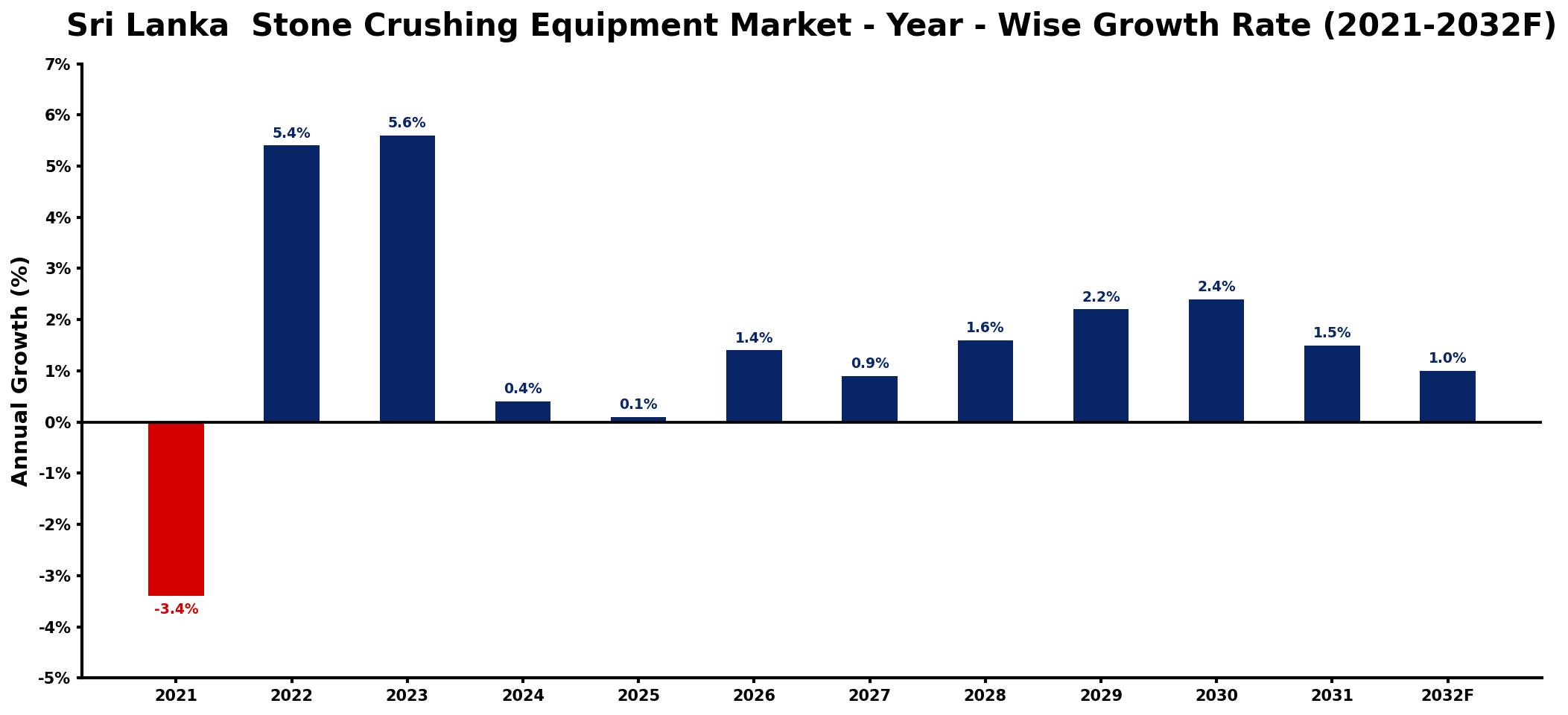
The table below presents the year‑wise growth rates along with the key drivers influencing the market
| Year | Growth Rate | Major Drivers |
| 2021 | -3.4% | decrease in construction activities |
| 2022 | 5.4% | increased infrastructure development projects |
| 2023 | 5.6% | rise in urbanization trends |
| 2024 | 0.4% | growth in mining sector investments |
| 2025 | 0.1% | expansion of road construction initiatives |
| 2026 | 1.4% | surge in real estate development |
| 2027 | 0.9% | boost in public works funding |
| 2028 | 1.6% | growing regional consumption patterns |
| 2029 | 2.2% | increase in export opportunities |
| 2030 | 2.4% | rising demand from electronics |
| 2031 | 1.5% | increased capital investment inflows |
| 2032 | 1.0% | improved raw material availability |
Note: Market size estimations and growth projections presented in this report are based on 6Wresearch's proprietary forecasting methodology, utilizing the latest available industry data, government publications, and primary research inputs.
Sri Lanka Stone Crushing Equipment Market Synopsis
The most significant force driving the Sri Lanka Stone Crushing Equipment Market currently is the expanding construction industry. With government-funded infrastructure projects on the rise, there is an increasing requirement for crushed stones, which are integral to road construction, building development, and landscaping.
Furthermore, technological advancements and a growing focus on sustainable practices are reshaping the market. Manufacturers are leveraging innovative technologies to produce equipment that meets the evolving demands of eco-conscious construction practices, thereby enhancing their competitiveness.
Sri Lanka Stone Crushing Equipment Market Key Takeaways
- The market is experiencing consistent growth due to ongoing infrastructure development and construction projects.
- Technological advancements are paving the way for increased operational efficiency and product innovation.
- Environmental sustainability is a key focus, leading to the demand for eco-friendly stone crushing equipment.
- Strategic partnerships and collaborations are shaping competitive dynamics in the market.
- Raw material availability and compliance with regulations present ongoing challenges for industry players.
Evaluation of Restraints in Sri Lanka Stone Crushing Equipment Market
Despite the growth potential, the Sri Lanka Stone Crushing Equipment Market faces several significant restraints. Regulatory hurdles regarding the acquisition of permits and adherence to environmental standards can cause delays and escalate project costs. Moreover, the volatility of raw material prices, particularly aggregates and sand, can adversely impact profitability, forcing companies to navigate complex market dynamics. Additionally, the influx of low-cost imported equipment challenges local manufacturers, pressuring them to maintain competitiveness and market share.
Sri Lanka Stone Crushing Equipment Market Trends
The market is witnessing a notable shift towards automation and the Internet of Things (IoT) integration, enhancing operational efficiency and reducing downtime. Manufacturers are increasingly prioritizing the development of portable and mobile equipment, responding to the growing demand for flexibility in on-site operations. Furthermore, the emphasis on eco-friendly solutions is leading to an uptick in demand for sustainable stone crushing technologies, which align with global trends towards environmental conservation.
Sri Lanka Stone Crushing Equipment Market Opportunities
Investors are presented with compelling opportunities in the Sri Lanka Stone Crushing Equipment Market, particularly due to the country's extensive infrastructure projects and the burgeoning construction sector. The demand for high-quality stone crushing equipment, such as crushers and screeners, is poised to increase significantly. Moreover, investments in technological enhancements to improve the sustainability and efficiency of equipment will likely yield lucrative returns. Collaborating with local construction firms and engaging in government-backed initiatives further opens avenues for market penetration and growth.
Government Initiatives in the Sri Lanka Stone Crushing Equipment Market
The Sri Lankan government is committed to promoting sustainable practices within the stone crushing equipment sector through various initiatives and regulatory frameworks. The Central Environmental Authority (CEA) plays a pivotal role in issuing licenses and permits, emphasizing compliance with stringent environmental standards. Furthermore, policies under the Mines and Minerals Act ensure the sustainable extraction of stone aggregates. The government actively incentivizes the adoption of modern and environmentally friendly equipment, reinforcing its commitment to balancing economic development with ecological preservation.
Future Insights of the Sri Lanka Stone Crushing Equipment Market
Looking ahead to 2026-2032, the Sri Lanka Stone Crushing Equipment Market is expected to flourish, driven by an upsurge in construction materials demand. Infrastructure initiatives, including residential and commercial developments, will bolster the market's prospects. Additionally, the integration of advanced technologies such as automation will enhance productivity, attracting further investments. With a governmental focus on the construction industry through various schemes, the market is set for considerable expansion, presenting numerous opportunities for stakeholders.
Sri Lanka Stone Crushing Equipment Market Latest Developments (2025 - 2026)
Recent developments within the Sri Lanka Stone Crushing Equipment Market reflect a growing trend towards technological advancements and eco-friendly practices. There has been a marked increase in the introduction of innovative equipment designed to meet the specific needs of local construction projects. Additionally, partnerships between industry players and government bodies are being fostered to enhance operational efficiencies and align with sustainable practices, ensuring that the market remains responsive to emerging demands and regulatory requirements.
Sri Lanka Stone Crushing Equipment Market - Key Attractiveness of the Report
- 10 Years of Market Numbers
- Historical Data Starting from 2022 to 2025
- Base Year: 2025
- Forecast Data until 2032
- Key Performance Indicators Impacting the Market
- Major Upcoming Developments and Projects
Key Highlights of the Report:
- Sri Lanka Stone Crushing Equipment Market Outlook
- Market Size of Sri Lanka Stone Crushing Equipment Market, 2025
- Forecast of Sri Lanka Stone Crushing Equipment Market, 2032
- Historical Data and Forecast of Sri Lanka Stone Crushing Equipment Revenues & Volume for the Period 2022-2032F
- Sri Lanka Stone Crushing Equipment Market Trend Evolution
- Sri Lanka Stone Crushing Equipment Market Drivers and Challenges
- Sri Lanka Stone Crushing Equipment Price Trends
- Sri Lanka Stone Crushing Equipment Porter's Five Forces
- Sri Lanka Stone Crushing Equipment Industry Life Cycle
- Historical Data and Forecast of Sri Lanka Stone Crushing Equipment Market Revenues & Volume By Type for the Period 2022-2032F
- Historical Data and Forecast of Sri Lanka Stone Crushing Equipment Market Revenues & Volume By Jaw Crusher for the Period 2022-2032F
- Historical Data and Forecast of Sri Lanka Stone Crushing Equipment Market Revenues & Volume By Cone Crusher for the Period 2022-2032F
- Historical Data and Forecast of Sri Lanka Stone Crushing Equipment Market Revenues & Volume By Impact Crusher for the Period 2022-2032F
- Historical Data and Forecast of Sri Lanka Stone Crushing Equipment Market Revenues & Volume By Others for the Period 2022-2032F
- Historical Data and Forecast of Sri Lanka Stone Crushing Equipment Market Revenues & Volume By End Users for the Period 2022-2032F
- Historical Data and Forecast of Sri Lanka Stone Crushing Equipment Market Revenues & Volume By Mining for the Period 2022-2032F
- Historical Data and Forecast of Sri Lanka Stone Crushing Equipment Market Revenues & Volume By Quarrying for the Period 2022-2032F
- Historical Data and Forecast of Sri Lanka Stone Crushing Equipment Market Revenues & Volume By Recycling for the Period 2022-2032F
- Historical Data and Forecast of Sri Lanka Stone Crushing Equipment Market Revenues & Volume By Construction & Infrastructure for the Period 2022-2032F
- Historical Data and Forecast of Sri Lanka Stone Crushing Equipment Market Revenues & Volume By Others for the Period 2022-2032F
- Sri Lanka Stone Crushing Equipment Import Export Trade Statistics
- Market Opportunity Assessment By Type
- Market Opportunity Assessment By End Users
- Sri Lanka Stone Crushing Equipment Top Companies Market Share
- Sri Lanka Stone Crushing Equipment Competitive Benchmarking By Technical and Operational Parameters
- Sri Lanka Stone Crushing Equipment Company Profiles
- Sri Lanka Stone Crushing Equipment Key Strategic Recommendations






































