Sri Lanka Tire Machinery Market Size, Share & Growth Rate
The Sri Lanka Tire Machinery Market was estimated at USD 154 Million in 2025 and is projected to reach USD 204 Million by 2032, growing at a CAGR of 4.1% from 2026 to 2032. This growth trajectory is largely driven by the expanding automotive industry, alongside heightened infrastructure development initiatives within the country. Increased demand for vehicles and construction projects is compelling manufacturers to seek advanced machinery, ensuring a robust future for the tire machinery sector.
Sri Lanka Tire Machinery Market Year-wise Growth Rate and Key Drivers
This graph highlights how the Sri Lanka Tire Machinery Market has steadily grown over the years, supported by major growth factors.
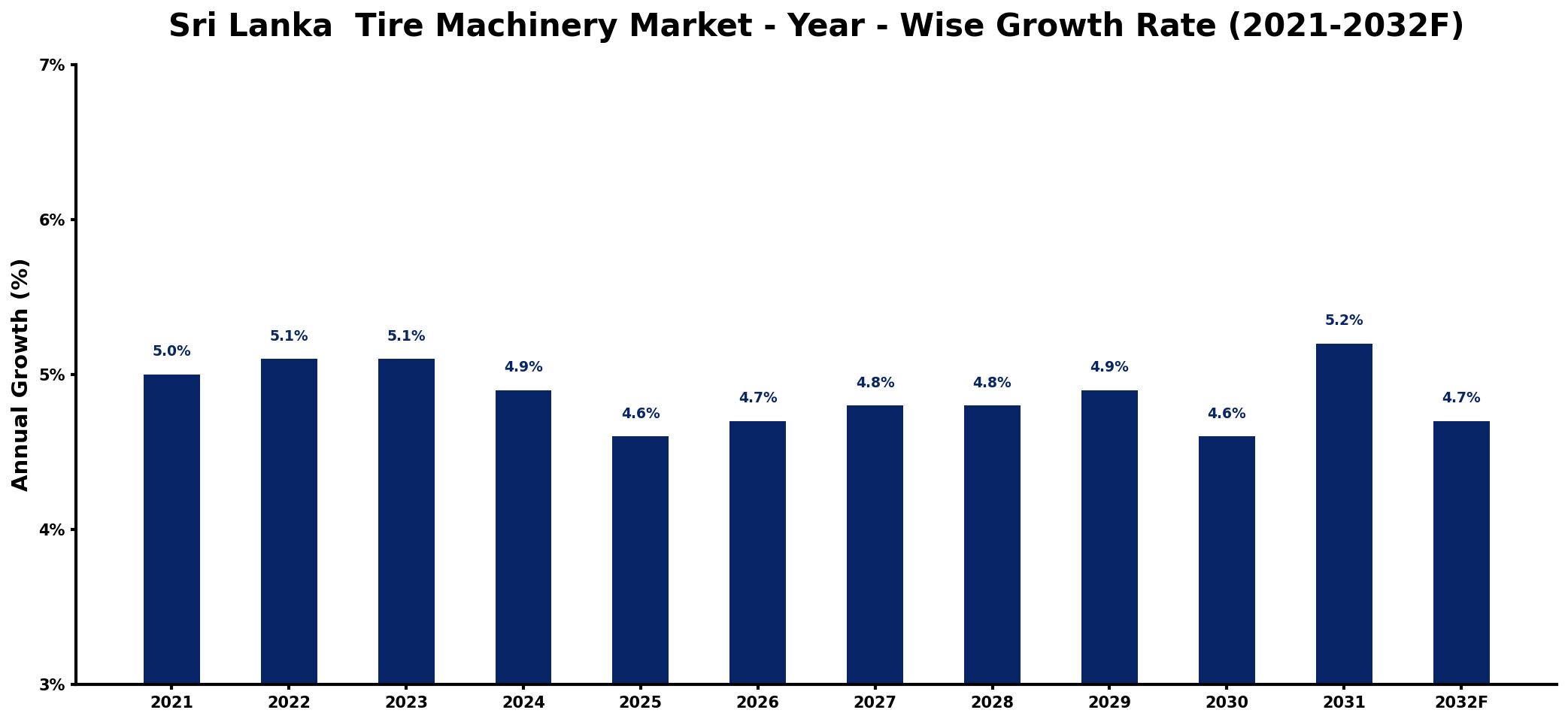
The table below presents the year‑wise growth rates along with the key drivers influencing the market
| Year | Growth Rate | Major Drivers |
| 2021 | 5.0% | Rising automotive production levels |
| 2022 | 5.1% | Increased consumer vehicle ownership |
| 2023 | 5.1% | Growing demand for exports |
| 2024 | 4.9% | Expansion of manufacturing capabilities |
| 2025 | 4.6% | Development of renewable resources |
| 2026 | 4.7% | Investment in infrastructure projects |
| 2027 | 4.8% | Technological advancements in production |
| 2028 | 4.8% | Strengthening of local supply chains |
| 2029 | 4.9% | Surge in electric vehicle adoption |
| 2030 | 4.6% | Enhanced regulatory support initiatives |
| 2031 | 5.2% | Boost in foreign direct investments |
| 2032 | 4.7% | Diversification of industrial applications |
Note: Market size estimations and growth projections presented in this report are based on 6Wresearch's proprietary forecasting methodology, utilizing the latest available industry data, government publications, and primary research inputs.
Sri Lanka Tire Machinery Market Synopsis
The Sri Lanka Tire Machinery Market has recently gained momentum, fueled by the rising demand for high-quality tires in both the automotive and construction sectors. As local manufacturers enhance their production capabilities, the market is expected to sustain this growth well into the future. However, challenges such as import dependency for advanced machinery still loom.
Looking ahead, the synergy between government initiatives promoting local manufacturing and advancements in technology is set to further accelerate market expansion. There is a clear focus on innovation, sustainability, and efficiency that will dictate the direction of the industry in the coming years.
Sri Lanka Tire Machinery Market Key Takeaways
- The market is projected to grow from USD 154 Million in 2025 to USD 204 Million by 2032.
- Government policies are actively promoting local manufacturing to reduce import dependency.
- Technological advancements, including automation and IoT integration, are increasingly shaping production processes.
- There is a notable shift towards sustainable and eco-friendly tire manufacturing practices.
- The growing construction sector significantly boosts the demand for tire machinery in Sri Lanka.
Evaluation of Restraints in Sri Lanka Tire Machinery Market
Despite its promising growth prospects, the Sri Lanka Tire Machinery Market faces several constraints that could impede progress. A significant challenge lies in the limited technological advancements, which often result in reliance on outdated machinery. High import costs for modern manufacturing equipment further strain local producers. Additionally, the industry grapples with a shortage of skilled labor necessary to operate and maintain sophisticated tire machinery. This skills gap can delay production efficiencies. Lastly, regulatory hurdles such as import restrictions can complicate market dynamics, necessitating strategic navigation to overcome these obstacles.
Sri Lanka Tire Machinery Market Trends
The Sri Lanka Tire Machinery Market is currently witnessing a shift towards greater technological adoption and automation in manufacturing. As competition intensifies, tire manufacturers are investing in advanced machinery that enhances efficiency and reduces costs. Concurrently, there is a growing emphasis on sustainability, prompting the development of eco-friendly tire manufacturing solutions. Digital transformations, including the incorporation of IoT technologies and data analytics, are also emerging as pivotal trends aimed at optimizing production processes and improving overall operational efficiency.
Sri Lanka Tire Machinery Market Opportunities
The burgeoning automotive sector in Sri Lanka presents several lucrative investment opportunities within the tire machinery market. As vehicle demand continues to rise, the need for cutting-edge tire production equipment such as curing presses and tire building machines becomes increasingly evident. Additionally, the focus on sustainable manufacturing processes creates pathways for investment in environmentally friendly machinery technologies. Local collaborations or establishing new tire machinery production facilities are strategic moves that can leverage the expanding market demand while promoting self-sufficiency.
Government Initiatives in the Sri Lanka Tire Machinery Market
The Sri Lankan government is proactively supporting the Tire Machinery Market through a series of initiatives aimed at fostering local manufacturing capabilities. Policies such as import tariffs on foreign machinery are designed to encourage domestic production, while incentives and subsidies are offered to businesses that establish manufacturing facilities locally. Moreover, regulations ensuring quality standards and environmental sustainability are being implemented to align with global industry trends, positioning Sri Lanka favorably in the international tire production landscape.
Future Insights of the Sri Lanka Tire Machinery Market
Looking towards 2026 and beyond, the Sri Lanka Tire Machinery Market is poised for sustained growth, propelled by the ongoing expansion of the automotive sector and infrastructure projects. Rising disposable incomes and urbanization trends will fuel tire demand, subsequently boosting the machinery market. Moreover, the ongoing push for technological advancements and sustainable practices will continue to drive innovation in tire production. Nevertheless, fluctuations in raw material prices and regulatory complexities remain concerns, but overall, the outlook remains optimistic with significant growth prospects on the horizon.
Sri Lanka Tire Machinery Market Latest Developments (2025 - 2026)
Recent developments in the Sri Lanka Tire Machinery Market highlight a shift towards modernization and innovation. Manufacturers are increasingly incorporating digital technologies to streamline their production processes and enhance operational efficiencies. Additionally, partnerships between local producers and technology providers are emerging, aimed at elevating machinery standards. Ongoing investments in sustainable manufacturing practices are also notable, reflecting a broader commitment to environmental stewardship within the industry.
Sri Lanka Tire Machinery Market - Key Attractiveness of the Report
- 10 Years of Market Numbers
- Historical Data Starting from 2022 to 2025
- Base Year: 2025
- Forecast Data until 2032
- Key Performance Indicators Impacting the Market
- Major Upcoming Developments and Projects
Key Highlights of the Report:
- Sri Lanka Tire Machinery Market Outlook
- Market Size of Sri Lanka Tire Machinery Market, 2025
- Forecast of Sri Lanka Tire Machinery Market, 2032
- Historical Data and Forecast of Sri Lanka Tire Machinery Revenues & Volume for the Period 2022-2032F
- Sri Lanka Tire Machinery Market Trend Evolution
- Sri Lanka Tire Machinery Market Drivers and Challenges
- Sri Lanka Tire Machinery Price Trends
- Sri Lanka Tire Machinery Porter's Five Forces
- Sri Lanka Tire Machinery Industry Life Cycle
- Historical Data and Forecast of Sri Lanka Tire Machinery Market Revenues & Volume By Type for the Period 2022-2032F
- Historical Data and Forecast of Sri Lanka Tire Machinery Market Revenues & Volume By Mixing Machine/ Rubber Mixers for the Period 2022-2032F
- Historical Data and Forecast of Sri Lanka Tire Machinery Market Revenues & Volume By Calendaring Machine for the Period 2022-2032F
- Historical Data and Forecast of Sri Lanka Tire Machinery Market Revenues & Volume By Extrusion Machines for the Period 2022-2032F
- Historical Data and Forecast of Sri Lanka Tire Machinery Market Revenues & Volume By Multi Extrusion Lines for the Period 2022-2032F
- Historical Data and Forecast of Sri Lanka Tire Machinery Market Revenues & Volume By Inner Liner Lines for the Period 2022-2032F
- Historical Data and Forecast of Sri Lanka Tire Machinery Market Revenues & Volume By Extruders for the Period 2022-2032F
- Historical Data and Forecast of Sri Lanka Tire Machinery Market Revenues & Volume By Cooling Units for the Period 2022-2032F
- Historical Data and Forecast of Sri Lanka Mixing Machine/ Rubber Mixers Tire Machinery Market Revenues & Volume By Cutting Machines for the Period 2022-2032F
- Historical Data and Forecast of Sri Lanka Tire Machinery Market Revenues & Volume By Tire Type for the Period 2022-2032F
- Historical Data and Forecast of Sri Lanka Tire Machinery Market Revenues & Volume By Radial Tire for the Period 2022-2032F
- Historical Data and Forecast of Sri Lanka Tire Machinery Market Revenues & Volume By Bias Tire for the Period 2022-2032F
- Historical Data and Forecast of Sri Lanka Tire Machinery Market Revenues & Volume By Application for the Period 2022-2032F
- Historical Data and Forecast of Sri Lanka Tire Machinery Market Revenues & Volume By Two-wheeler tires for the Period 2022-2032F
- Historical Data and Forecast of Sri Lanka Tire Machinery Market Revenues & Volume By Passenger Vehicle Tires for the Period 2022-2032F
- Historical Data and Forecast of Sri Lanka Tire Machinery Market Revenues & Volume By Hatchback for the Period 2022-2032F
- Historical Data and Forecast of Sri Lanka Tire Machinery Market Revenues & Volume By Sedan for the Period 2022-2032F
- Historical Data and Forecast of Sri Lanka Tire Machinery Market Revenues & Volume By Utility Vehicles for the Period 2022-2032F
- Historical Data and Forecast of Sri Lanka Tire Machinery Market Revenues & Volume By Light Commercial Vehicle Tires for the Period 2022-2032F
- Historical Data and Forecast of Sri Lanka Tire Machinery Market Revenues & Volume By Medium & Heavy Commercial Vehicle Tires for the Period 2022-2032F
- Historical Data and Forecast of Sri Lanka Tire Machinery Market Revenues & Volume By Off-road Vehicle Tires for the Period 2022-2032F
- Sri Lanka Tire Machinery Import Export Trade Statistics
- Market Opportunity Assessment By Type
- Market Opportunity Assessment By Tire Type
- Market Opportunity Assessment By Application
- Sri Lanka Tire Machinery Top Companies Market Share
- Sri Lanka Tire Machinery Competitive Benchmarking By Technical and Operational Parameters
- Sri Lanka Tire Machinery Company Profiles
- Sri Lanka Tire Machinery Key Strategic Recommendations






































