Eswatini Sweet Biscuits Market Growth Rate Analysis (2021-2031)
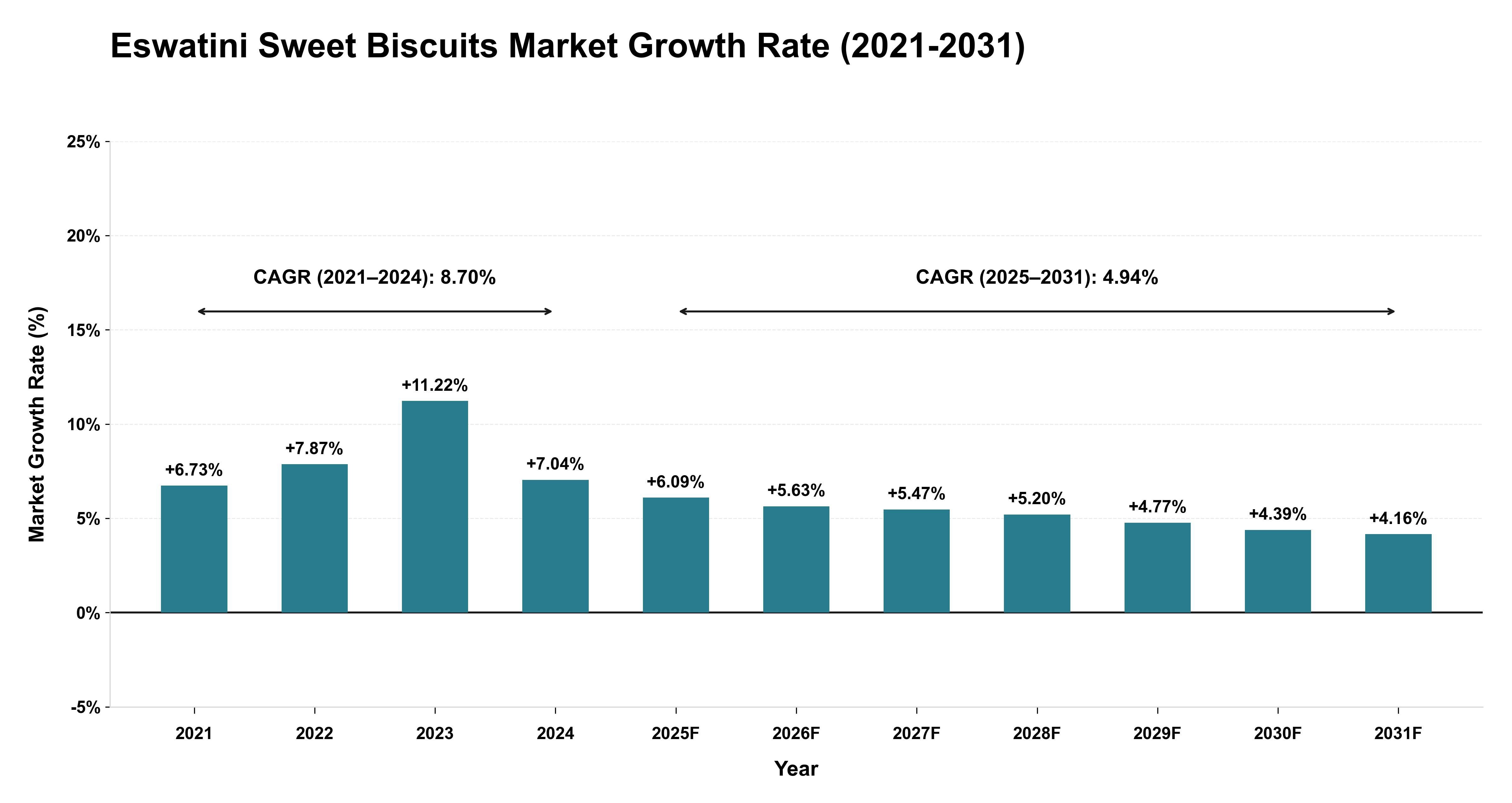
The Eswatini Sweet Biscuits Market experienced robust growth from 2021 to 2024, with a CAGR of 8.70%, driven by increasing consumer demand and market expansion. However, in the forecast period from 2025 to 2031, the market is anticipated to exhibit a slower but still positive growth trajectory, with a CAGR of 4.94%. This deceleration reflects a phase of stabilizing expansion and market maturation following the earlier period of rapid growth. The years 2021-2024 saw consistent annual growth rates ranging from 6.73% to 11.22%, indicating strong market dynamics. Moving forward, the market is expected to continue growing steadily but at a more moderate pace, with growth rates gradually declining from 6.09% in 2025 to 4.16% in 2031, signaling a period of consolidation and sustainable development in the Eswatini Sweet Biscuits Market.
Key Highlights of the Report:
- Swaziland Sweet Biscuits Market Outlook
- Market Size of Swaziland Sweet Biscuits Market, 2024
- Forecast of Swaziland Sweet Biscuits Market, 2031
- Historical Data and Forecast of Swaziland Sweet Biscuits Revenues & Volume for the Period 2021-2031
- Swaziland Sweet Biscuits Market Trend Evolution
- Swaziland Sweet Biscuits Market Drivers and Challenges
- Swaziland Sweet Biscuits Price Trends
- Swaziland Sweet Biscuits Porter`s Five Forces
- Swaziland Sweet Biscuits Industry Life Cycle
- Historical Data and Forecast of Swaziland Sweet Biscuits Market Revenues & Volume By Product Type for the Period 2021-2031
- Historical Data and Forecast of Swaziland Sweet Biscuits Market Revenues & Volume By Chocolate-coated Biscuits for the Period 2021-2031
- Historical Data and Forecast of Swaziland Sweet Biscuits Market Revenues & Volume By Cookies for the Period 2021-2031
- Historical Data and Forecast of Swaziland Sweet Biscuits Market Revenues & Volume By Filled Biscuits for the Period 2021-2031
- Historical Data and Forecast of Swaziland Sweet Biscuits Market Revenues & Volume By Plain Biscuits for the Period 2021-2031
- Historical Data and Forecast of Swaziland Sweet Biscuits Market Revenues & Volume By Sandwich Biscuits for the Period 2021-2031
- Historical Data and Forecast of Swaziland Sweet Biscuits Market Revenues & Volume By Other Sweet Biscuits for the Period 2021-2031
- Historical Data and Forecast of Swaziland Sweet Biscuits Market Revenues & Volume By Distribution Channel for the Period 2021-2031
- Historical Data and Forecast of Swaziland Sweet Biscuits Market Revenues & Volume By Supermarkets/Hypermarkets for the Period 2021-2031
- Historical Data and Forecast of Swaziland Sweet Biscuits Market Revenues & Volume By Specialist Retailers for the Period 2021-2031
- Historical Data and Forecast of Swaziland Sweet Biscuits Market Revenues & Volume By Convenience Stores for the Period 2021-2031
- Historical Data and Forecast of Swaziland Sweet Biscuits Market Revenues & Volume By Online Stores for the Period 2021-2031
- Historical Data and Forecast of Swaziland Sweet Biscuits Market Revenues & Volume By Other Distribution Channels for the Period 2021-2031
- Swaziland Sweet Biscuits Import Export Trade Statistics
- Market Opportunity Assessment By Product Type
- Market Opportunity Assessment By Distribution Channel
- Swaziland Sweet Biscuits Top Companies Market Share
- Swaziland Sweet Biscuits Competitive Benchmarking By Technical and Operational Parameters
- Swaziland Sweet Biscuits Company Profiles
- Swaziland Sweet Biscuits Key Strategic Recommendations






































