Sweden Fragrance Ingredients Market Top 5 Importing Countries and Market Competition (HHI) Analysis
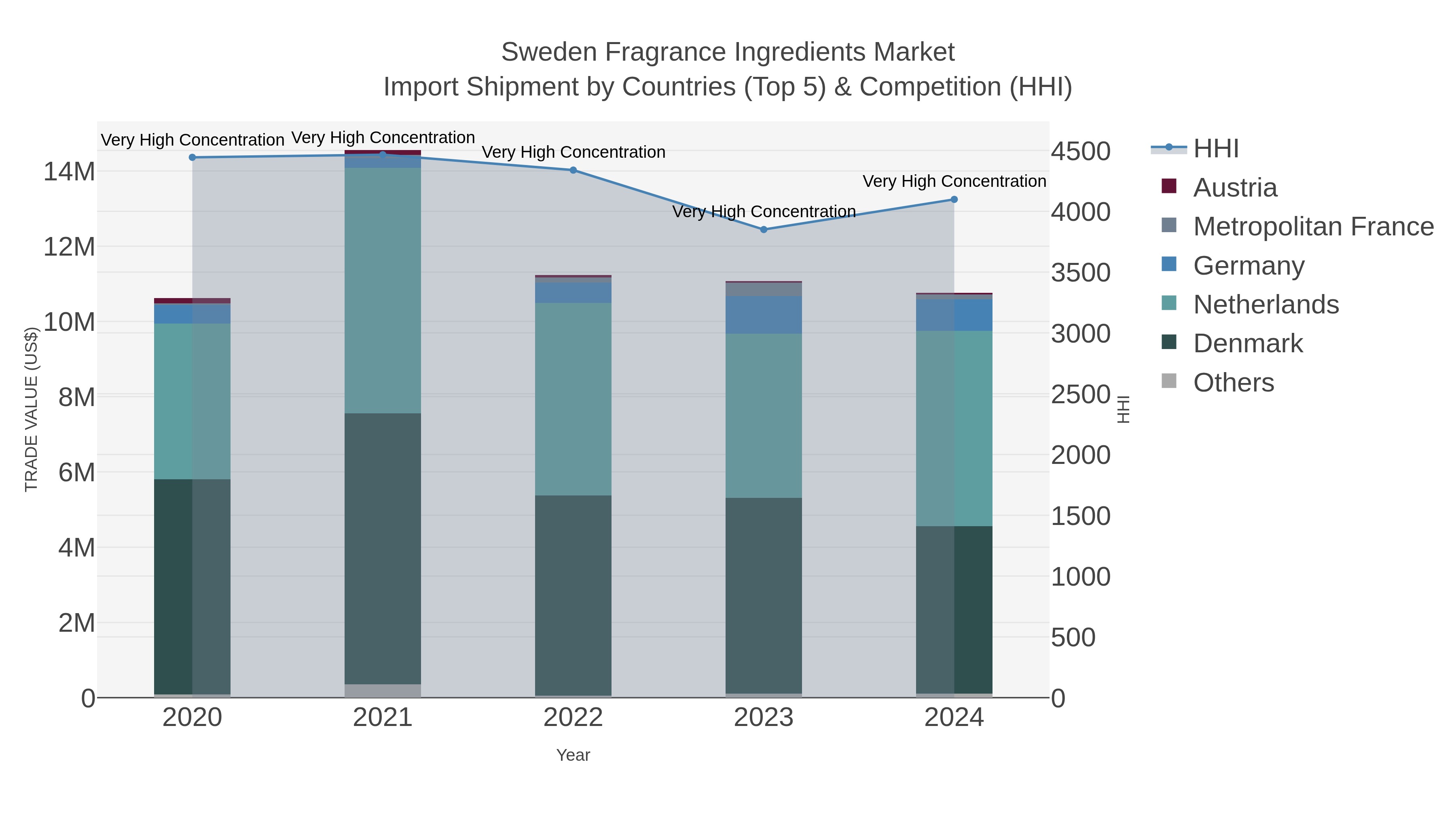
In 2024, Sweden continued to rely on imports for fragrance ingredients, with top suppliers including Netherlands, Denmark, Germany, Metropolitan France, and the UK. The high Herfindahl-Hirschman Index (HHI) indicates a concentrated market. Despite a modest compound annual growth rate (CAGR) of 0.34% from 2020-24, the negative growth rate of -2.81% in 2023-24 suggests a potential slowdown. Monitoring market dynamics and supplier relationships will be crucial for stakeholders in the fragrance industry operating in Sweden.
Sweden Fragrance Ingredients Market Overview
The fragrance ingredients market in Sweden plays a pivotal role in the cosmetics, personal care, and household products industries. With a focus on natural and sustainable ingredients, this market is witnessing a shift toward eco-friendly alternatives in response to consumer preferences. The increasing demand for customized fragrances, particularly in the luxury segment, is further propelling market growth. Innovations in fragrance formulations, including the use of biotechnology, are expanding the range of available ingredients. As consumers become more aware of ingredient sourcing and sustainability, the market is likely to continue evolving toward greener practices.
Drivers of the market
The fragrance ingredients market in Sweden is influenced by the rising demand for innovative and unique scents in various applications, including personal care, home fragrances, and fine fragrances. The increasing consumer preference for natural and organic ingredients over synthetic alternatives drives manufacturers to develop sustainable and eco-friendly fragrance solutions. Additionally, the growth of the cosmetics and personal care sectors, fueled by trends in grooming and self-care, further supports the expansion of the fragrance ingredients market.
Challenges of the market
The Sweden Fragrance Ingredients market faces challenges stemming from increasing regulations regarding the use of synthetic and natural ingredients. Compliance with strict safety standards requires significant investment in research and development to identify and test new fragrance components. Moreover, competition from emerging markets can put pressure on pricing, leading to a need for differentiation in product offerings. The market must also address consumer concerns about sustainability and ethical sourcing practices, which are becoming increasingly important in purchasing decisions.
Government Policy of the market
Government regulations in Sweden concerning fragrance ingredients emphasize transparency and safety. The Swedish Chemicals Agency enforces regulations that require manufacturers to disclose all chemical components in fragrance products. Additionally, the EU Cosmetic Regulation impacts this market by banning certain harmful substances, pushing companies to innovate and seek safe, sustainable alternatives in fragrance formulation.
Key Highlights of the Report:
- Sweden Fragrance Ingredients Market Outlook
- Market Size of Sweden Fragrance Ingredients Market, 2025
- Forecast of Sweden Fragrance Ingredients Market, 2032
- Historical Data and Forecast of Sweden Fragrance Ingredients Revenues & Volume for the Period 2022 - 2032
- Sweden Fragrance Ingredients Market Trend Evolution
- Sweden Fragrance Ingredients Market Drivers and Challenges
- Sweden Fragrance Ingredients Price Trends
- Sweden Fragrance Ingredients Porter`s Five Forces
- Sweden Fragrance Ingredients Industry Life Cycle
- Historical Data and Forecast of Sweden Fragrance Ingredients Market Revenues & Volume By Type for the Period 2022 - 2032
- Historical Data and Forecast of Sweden Fragrance Ingredients Market Revenues & Volume By Essential Oils for the Period 2022 - 2032
- Historical Data and Forecast of Sweden Fragrance Ingredients Market Revenues & Volume By Aroma Chemicals for the Period 2022 - 2032
- Historical Data and Forecast of Sweden Fragrance Ingredients Market Revenues & Volume By Application for the Period 2022 - 2032
- Historical Data and Forecast of Sweden Fragrance Ingredients Market Revenues & Volume By Cosmetics & toiletries for the Period 2022 - 2032
- Historical Data and Forecast of Sweden Fragrance Ingredients Market Revenues & Volume By Fine fragrances for the Period 2022 - 2032
- Historical Data and Forecast of Sweden Fragrance Ingredients Market Revenues & Volume By Soaps & detergents for the Period 2022 - 2032
- Historical Data and Forecast of Sweden Fragrance Ingredients Market Revenues & Volume By Others for the Period 2022 - 2032
- Sweden Fragrance Ingredients Import Export Trade Statistics
- Market Opportunity Assessment By Type
- Market Opportunity Assessment By Application
- Sweden Fragrance Ingredients Top Companies Market Share
- Sweden Fragrance Ingredients Competitive Benchmarking By Technical and Operational Parameters
- Sweden Fragrance Ingredients Company Profiles
- Sweden Fragrance Ingredients Key Strategic Recommendations






































