Switzerland Automotive Parts and Components Market Growth Rate Analysis (2025 - 2031)
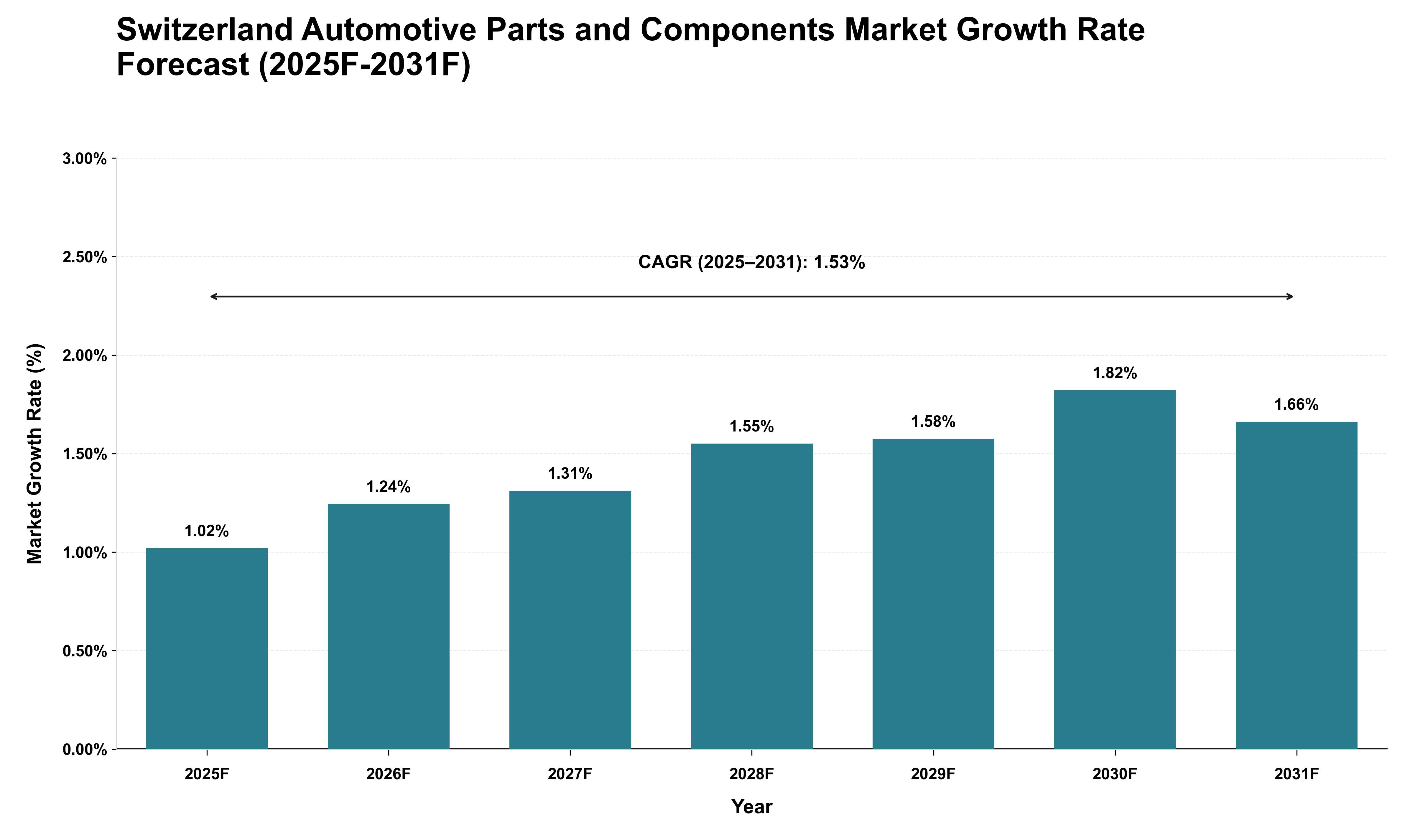
The projected growth trajectory for the Switzerland automotive parts and components market will exhibit a gradual acceleration, as indicated by the increasing annual growth rates from 2025 to 2030, culminating in a slight deceleration in 2031. This pattern suggests that technological advancements and product substitution will play pivotal roles in shaping market dynamics. As manufacturers increasingly adopt innovative materials and automation technologies, efficiency gains are expected to enhance production capabilities, thereby supporting the forecasted CAGR of 1.53%. Additionally, the anticipated rise in electric vehicle adoption will likely drive demand for specialized components, further influencing import dependencies as local suppliers adapt to evolving consumer preferences. The cyclical nature of automotive demand may also contribute to fluctuations in growth rates; however, the overall trend indicates a robust response to technological shifts and competitive pressures within the sector during this period.
Key Highlights of the Report:
- Switzerland Automotive Parts and Components Market Outlook
- Market Size of Switzerland Automotive Parts and Components Market, 2024
- Forecast of Switzerland Automotive Parts and Components Market, 2031
- Historical Data and Forecast of Switzerland Automotive Parts and Components Revenues & Volume for the Period 2021- 2031
- Switzerland Automotive Parts and Components Market Trend Evolution
- Switzerland Automotive Parts and Components Market Drivers and Challenges
- Switzerland Automotive Parts and Components Price Trends
- Switzerland Automotive Parts and Components Porter's Five Forces
- Switzerland Automotive Parts and Components Industry Life Cycle
- Historical Data and Forecast of Switzerland Automotive Parts and Components Market Revenues & Volume By Type for the Period 2021- 2031
- Historical Data and Forecast of Switzerland Automotive Parts and Components Market Revenues & Volume By Driveline and Powertrain for the Period 2021- 2031
- Historical Data and Forecast of Switzerland Automotive Parts and Components Market Revenues & Volume By Interiors and Exteriors for the Period 2021- 2031
- Historical Data and Forecast of Switzerland Automotive Parts and Components Market Revenues & Volume By Electronics for the Period 2021- 2031
- Historical Data and Forecast of Switzerland Automotive Parts and Components Market Revenues & Volume By Bodies and Chassis for the Period 2021- 2031
- Historical Data and Forecast of Switzerland Automotive Parts and Components Market Revenues & Volume By Wheel and Tires for the Period 2021- 2031
- Historical Data and Forecast of Switzerland Automotive Parts and Components Market Revenues & Volume By Other for the Period 2021- 2031
- Historical Data and Forecast of Switzerland Automotive Parts and Components Market Revenues & Volume By Application for the Period 2021- 2031
- Historical Data and Forecast of Switzerland Automotive Parts and Components Market Revenues & Volume By Original Equipment Manufacturers (OEMs) for the Period 2021- 2031
- Historical Data and Forecast of Switzerland Automotive Parts and Components Market Revenues & Volume By Aftermarket for the Period 2021- 2031
- Switzerland Automotive Parts and Components Import Export Trade Statistics
- Market Opportunity Assessment By Type
- Market Opportunity Assessment By Application
- Switzerland Automotive Parts and Components Top Companies Market Share
- Switzerland Automotive Parts and Components Competitive Benchmarking By Technical and Operational Parameters
- Switzerland Automotive Parts and Components Company Profiles
- Switzerland Automotive Parts and Components Key Strategic Recommendations






































