Switzerland Dairy Market Growth Rate Analysis (2025 - 2031)
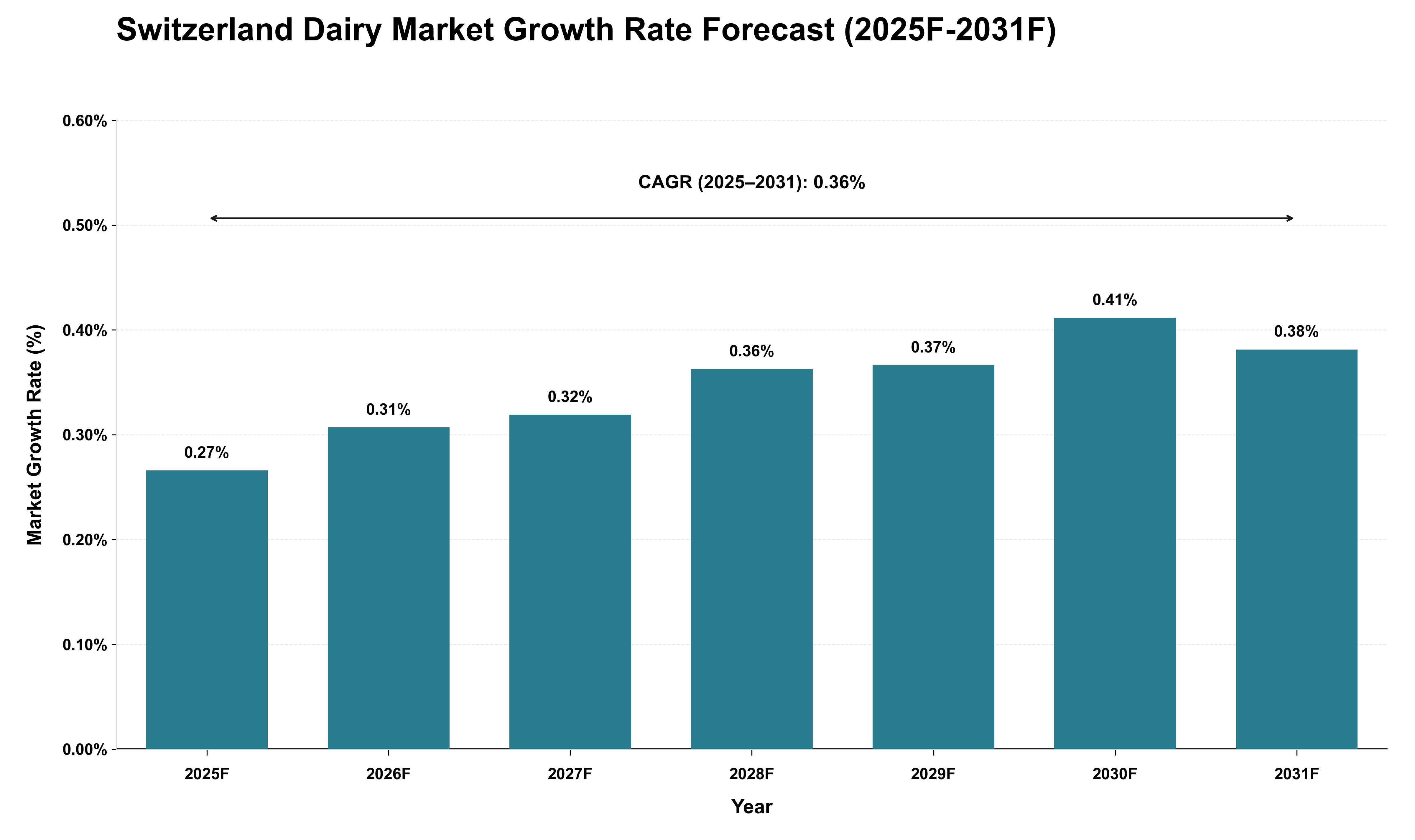
The projected compound annual growth rate of 0.36% for the Swiss dairy market from 2025 to 2031 indicates a gradual upward trajectory in demand, reflecting a competitive landscape characterized by stable consumption patterns and evolving consumer preferences. As annual growth rates incrementally rise from 0.27% in 2025 to a peak of 0.41% in 2030, this suggests that market players will likely adapt their strategies to enhance product differentiation and capitalize on niche segments, such as organic and specialty dairy products. Furthermore, Switzerland's reliance on imports for certain dairy components may influence pricing dynamics and supply chain resilience, particularly as global trade policies evolve. The cyclical nature of dairy consumption, often tied to economic conditions and health trends, will also play a crucial role in shaping market performance during this period, driving producers to innovate while managing operational efficiencies effectively.
Key Highlights of the Report:
- Switzerland Dairy Market Outlook
- Market Size of Switzerland Dairy Market, 2024
- Forecast of Switzerland Dairy Market, 2031
- Historical Data and Forecast of Switzerland Dairy Revenues & Volume for the Period 2021- 2031
- Switzerland Dairy Market Trend Evolution
- Switzerland Dairy Market Drivers and Challenges
- Switzerland Dairy Price Trends
- Switzerland Dairy Porter's Five Forces
- Switzerland Dairy Industry Life Cycle
- Historical Data and Forecast of Switzerland Dairy Market Revenues & Volume By Category for the Period 2021- 2031
- Historical Data and Forecast of Switzerland Dairy Market Revenues & Volume By Butter for the Period 2021- 2031
- Historical Data and Forecast of Switzerland Dairy Market Revenues & Volume By Cheese for the Period 2021- 2031
- Historical Data and Forecast of Switzerland Dairy Market Revenues & Volume By Cream for the Period 2021- 2031
- Historical Data and Forecast of Switzerland Dairy Market Revenues & Volume By Dairy Desserts for the Period 2021- 2031
- Historical Data and Forecast of Switzerland Dairy Market Revenues & Volume By Milk for the Period 2021- 2031
- Historical Data and Forecast of Switzerland Dairy Market Revenues & Volume By Yogurt for the Period 2021- 2031
- Historical Data and Forecast of Switzerland Dairy Market Revenues & Volume By Distribution Channel for the Period 2021- 2031
- Historical Data and Forecast of Switzerland Dairy Market Revenues & Volume By Off-Trade for the Period 2021- 2031
- Historical Data and Forecast of Switzerland Dairy Market Revenues & Volume By On-Trade for the Period 2021- 2031
- Switzerland Dairy Import Export Trade Statistics
- Market Opportunity Assessment By Category
- Market Opportunity Assessment By Distribution Channel
- Switzerland Dairy Top Companies Market Share
- Switzerland Dairy Competitive Benchmarking By Technical and Operational Parameters
- Switzerland Dairy Company Profiles
- Switzerland Dairy Key Strategic Recommendations






































