Switzerland Forklift Market Growth Rate Analysis (2025 - 2031)
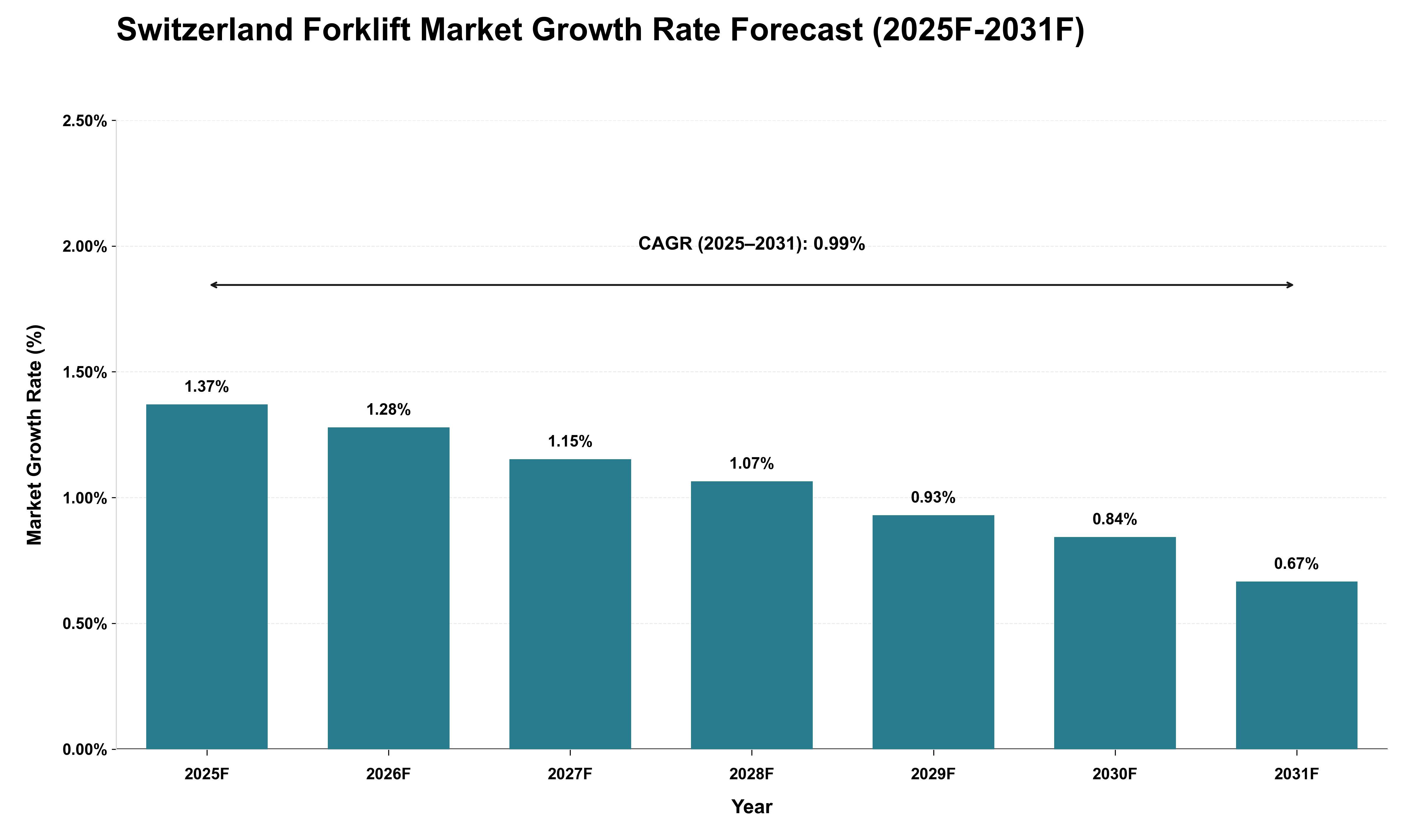
From 2025 onward, the Swiss forklift market will likely experience a gradual deceleration in growth, with an anticipated compound annual growth rate (CAGR) of 0.99%. This trend will reflect the interplay between supply chain dynamics and input costs, particularly as global logistics networks continue to adapt post-pandemic. The initial years of this forecast period will see relatively stronger growth rates, peaking at 1.37% in 2025, driven by ongoing investments in automation and warehouse efficiency. However, as input costs stabilize and potential import dependencies on key components become more pronounced, growth rates are expected to decline progressively—falling to 0.67% by 2031. This trajectory suggests that while demand for forklifts remains steady due to e-commerce and industrial activity, external economic pressures and cyclical fluctuations in manufacturing output will increasingly influence market performance over this period.
Key Highlights of the Report:
- Switzerland Forklift Market Outlook
- Market Size of Switzerland Forklift Market, 2025
- Forecast of Switzerland Forklift Market, 2032
- Historical Data and Forecast of Switzerland Forklift Revenues & Volume for the Period 2022-2032F
- Switzerland Forklift Market Trend Evolution
- Switzerland Forklift Market Drivers and Challenges
- Switzerland Forklift Price Trends
- Switzerland Forklift Porter`s Five Forces
- Switzerland Forklift Industry Life Cycle
- Historical Data and Forecast of Switzerland Forklift Market Revenues & Volume By Class for the Period 2022-2032F
- Historical Data and Forecast of Switzerland Forklift Market Revenues & Volume By Class 1 for the Period 2022-2032F
- Historical Data and Forecast of Switzerland Forklift Market Revenues & Volume By 2 for the Period 2022-2032F
- Historical Data and Forecast of Switzerland Forklift Market Revenues & Volume By 3 for the Period 2022-2032F
- Historical Data and Forecast of Switzerland Forklift Market Revenues & Volume By 4/5 for the Period 2022-2032F
- Historical Data and Forecast of Switzerland Forklift Market Revenues & Volume By Propulsion for the Period 2022-2032F
- Historical Data and Forecast of Switzerland Forklift Market Revenues & Volume By Electric for the Period 2022-2032F
- Historical Data and Forecast of Switzerland Forklift Market Revenues & Volume By ICE for the Period 2022-2032F
- Historical Data and Forecast of Switzerland Forklift Market Revenues & Volume By Battery Type for the Period 2022-2032F
- Historical Data and Forecast of Switzerland Forklift Market Revenues & Volume By Li-Ion for the Period 2022-2032F
- Historical Data and Forecast of Switzerland Forklift Market Revenues & Volume By Lead Acid for the Period 2022-2032F
- Switzerland Forklift Import Export Trade Statistics
- Market Opportunity Assessment By Class
- Market Opportunity Assessment By Propulsion
- Market Opportunity Assessment By Battery Type
- Switzerland Forklift Top Companies Market Share
- Switzerland Forklift Competitive Benchmarking By Technical and Operational Parameters
- Switzerland Forklift Company Profiles
- Switzerland Forklift Key Strategic Recommendations






































