Switzerland Renewable Diesel Market: Import Trend Analysis
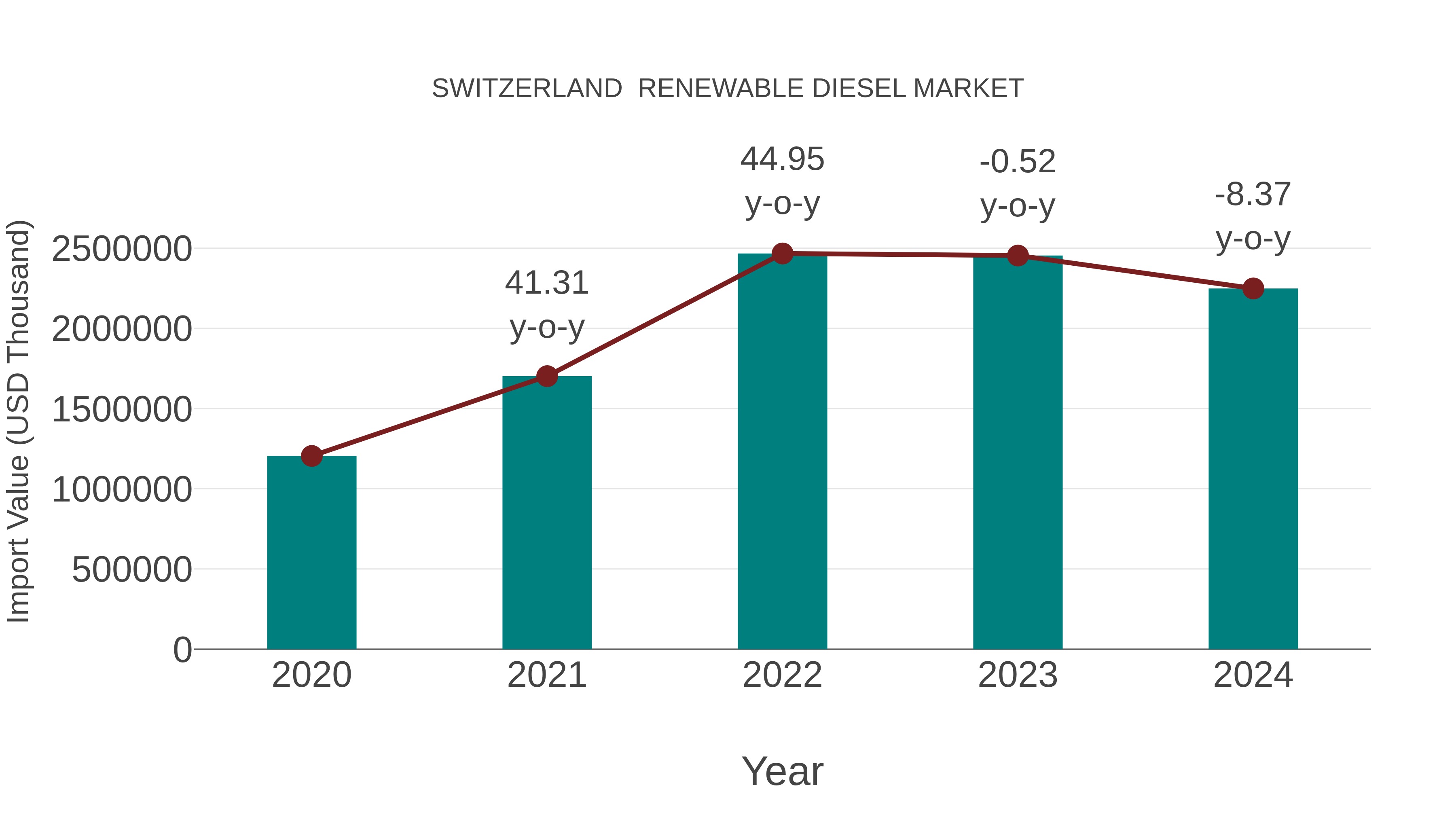
Switzerland import trend for renewable diesel saw a -8.37% decline from 2023 to 2024, with a CAGR of 16.89% from 2020 to 2024. This decline could be attributed to shifting market demands or regulatory changes impacting trade dynamics.
Switzerland Renewable Diesel Market Overview
The renewable diesel market in Switzerland caters to the demand for sustainable fuel alternatives. Challenges include high production costs and competition from traditional diesel.
Drivers of the market
The renewable diesel market in Switzerland is driven by the increasing emphasis on reducing greenhouse gas emissions and transitioning to sustainable energy sources. Renewable diesel, derived from bio-based feedstocks, provides a cleaner alternative to conventional diesel fuel. The growing demand for low-carbon fuels and the implementation of stricter emission regulations are propelling the market growth. Additionally, advancements in production technologies and the rising availability of renewable diesel are supporting market expansion.
Challenges of the market
The renewable diesel market faces challenges related to fluctuating raw material prices, which can impact production costs and profit margins for manufacturers. Additionally, regulatory compliance concerning environmental standards necessitates ongoing investment in quality assurance and adherence to industry regulations. Competition from traditional diesel fuels can hinder the adoption of renewable diesel in various industries. Furthermore, changing consumer preferences towards more sustainable energy sources can shift demand away from conventional diesel, requiring manufacturers to adapt their product offerings accordingly.
Government Policy of the market
In the renewable diesel market, Swiss government policies focus on promoting sustainable fuel alternatives to reduce greenhouse gas emissions. Regulations support the production and use of renewable diesel, encouraging investments in biofuel technologies. The governments commitment to sustainability influences the market dynamics for renewable diesel, aligning with broader energy transition goals.
Key Highlights of the Report:
- Switzerland Renewable Diesel Market Outlook
- Market Size of Switzerland Renewable Diesel Market, 2025
- Forecast of Switzerland Renewable Diesel Market, 2032
- Historical Data and Forecast of Switzerland Renewable Diesel Revenues & Volume for the Period 2022-2032F
- Switzerland Renewable Diesel Market Trend Evolution
- Switzerland Renewable Diesel Market Drivers and Challenges
- Switzerland Renewable Diesel Price Trends
- Switzerland Renewable Diesel Porter`s Five Forces
- Switzerland Renewable Diesel Industry Life Cycle
- Historical Data and Forecast of Switzerland Renewable Diesel Market Revenues & Volume By Feedstock Type for the Period 2022-2032F
- Historical Data and Forecast of Switzerland Renewable Diesel Market Revenues & Volume By Waste oils for the Period 2022-2032F
- Historical Data and Forecast of Switzerland Renewable Diesel Market Revenues & Volume By Vegetable oils for the Period 2022-2032F
- Switzerland Renewable Diesel Import Export Trade Statistics
- Market Opportunity Assessment By Feedstock Type
- Switzerland Renewable Diesel Top Companies Market Share
- Switzerland Renewable Diesel Competitive Benchmarking By Technical and Operational Parameters
- Switzerland Renewable Diesel Company Profiles
- Switzerland Renewable Diesel Key Strategic Recommendations






































