Taiwan 3D Printing Construction Market Growth Rate
According to 6Wresearch internal database and industry insights, the Taiwan 3D Printing Construction Market is projected to grow at a compound annual growth rate (CAGR) of 7.8% during the forecast period 2026–2032.
Taiwan 3D Printing Construction Market Year-wise Growth Rate and Key Drivers
This graph illustrates the annual growth rates of the Taiwan 3D Printing Construction Market from 2021 to 2032, highlighting steady upward trajectory and projected market expansion over the forecast period.
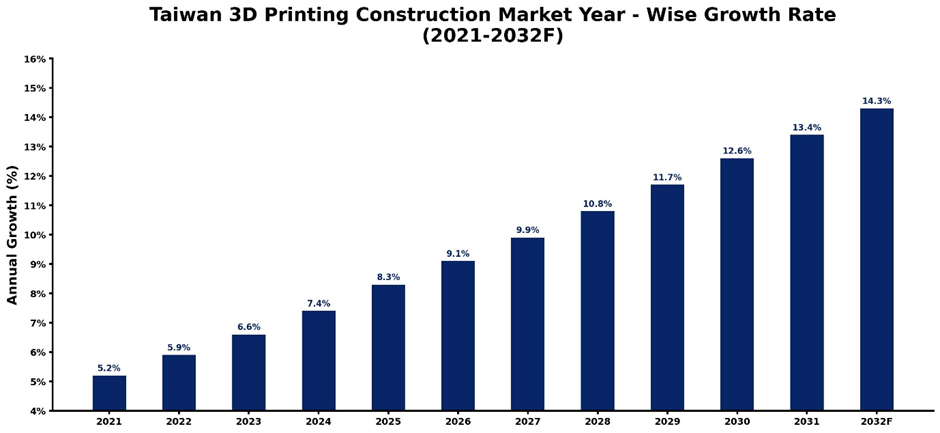
The following table summarizes the historical and forecasted growth rates of the Taiwan 3D Printing Construction Market, along with the rationale behind each year’s performance.
| Year | Est. Annual Growth (%) | Market Rationale |
| 2021 | 5.2% | Early application of 3D printing for construction prototyping and design validation. |
| 2022 | 5.9% | Growing use in architectural modelling and small structural elements. |
| 2023 | 6.6% | Expanding additive manufacturing in building material testing and R&D. |
| 2024 | 7.4% | Rising demand for sustainable and cost-effective construction solutions. |
| 2025 | 8.3% | Development of Cement and Composite 3D Printing Materials. |
| 2026 | 9.1% | Application of automated construction printing systems in infrastructure projects. |
| 2027 | 9.9% | Increasing use in modular housing and disaster-relief structures. |
| 2028 | 10.8% | Construction printing with integrated AI-enabled design optimization. |
| 2029 | 11.7% | Huge infrastructure and smart city project growth. |
| 2030 | 12.6% | Smart material innovation for high strength printed structures. |
| 2031 | 13.4% | 3D printed homes and commercial buildings become commonplace. |
| 2032 | 14.3% | Mature ecosystem for large-scale construction 3D printing automation. |
Topics Covered in the Taiwan 3D Printing Construction Market Report
The Taiwan 3D Printing Construction Market report covers market By Technology, Material and Application. It provides an in-depth analysis of ongoing market trends, opportunities, and growth drivers, enabling stakeholders to align strategies with current and future market dynamics.
Taiwan 3D Printing Construction Market Highlights
| Report Name | Taiwan 3D Printing Construction Market |
| Forecast period | 2026-2032 |
| CAGR | 7.8% |
| Growing Sector | Infrastructure & Smart Cities |
Taiwan 3D Printing Construction Market Synopsis
Taiwan 3D Printing Construction Market is a new segment of advanced construction technology that uses additive manufacturing to build structural elements, architectural models, and full-scale infrastructure elements. The market includes cement-based printing, polymer composites, and hybrid materials for construction. Demand for sustainable construction practices, shorter project completion times, and the use of automation in building processes fuel the growth. Taiwan’s strong manufacturing ecosystem and smart city initiatives also support market expansion.
Evaluation of Growth Drivers in Taiwan 3D Printing Construction Market (2026–2032)
Below are some major drivers and their influence on the market dynamics:
| Drivers | Primary Segment Affected | Why It Matters |
| Increasing need for sustainable construction | Infrastructure | Minimizes material wastage and environmental impact by promoting efficient use of resources and encouraging recycling. |
| Growth in smart city development | Urban planning | Encourages digital and automatic building systems by integrating IoT-enabled infrastructure and real-time data monitoring. |
| Advancements in construction printing technology | Building systems | Improves structural accuracy and scalability by enabling precise and automated fabrication of complex building components. |
| Labor shortage in construction industry | Residential & commercial | Drives automation and robotics adoption by increasing reliance on AI-powered machinery and robotic construction systems. |
| Government infrastructure modernization | Public projects | Supports adoption of advanced construction methods by funding large-scale upgrades and implementing stricter efficiency. |
The Taiwan 3D Printing Construction Market is projected to grow at a CAGR of 7.8% during 2026–2032, driven by rising demand for cost-efficient, sustainable, and automated construction solutions. The construction industry is in transition, with the growing use of AI, robotics and advanced material technologies transforming the speed, accuracy and scale of construction work, and also enables the development of modern infrastructure and smart building initiatives in both residential and commercial markets.
Evaluation of Restraints in Taiwan 3D Printing Construction Market
Below are some major restraints and their influence on the market dynamics:
| Restraints | Primary Segment Affected | What This Means |
| High cost to get started | Infrastructure projects | Small contractors face limited adoption due to high initial investment requirements, expensive equipment, and technology setup costs. |
| Material restrictions | Structural applications | In some cases, limits load-carrying capacity by restricting the choice of materials that can be used, leading to reduced structural performance. |
| Regulatory challenges | Construction approvals | Slows large-scale deployment by introducing lengthy approval processes, strict compliance requirements, and frequent revisions. |
| Lack of skilled workforce | Industry-wide | Reduces operational efficiency by limiting the availability of trained professionals capable of operating advanced construction technologies. |
| Limited large-scale proven projects | Commercial buildings | Slows market confidence and scaling by creating uncertainty around long-term performance, making investors and contractors hesitant. |
Taiwan 3D Printing Construction Market Challenges
The Taiwan 3D Printing Construction Market has strong growth potential, but it also faces challenges, including high equipment and setup costs, limited availability of standardized construction-grade printable materials, and regulatory hurdles in building approvals. Scalability constraints and a shortage of skilled professionals further slow adoption across the industry. Although the market shows strong long-term potential, these factors collectively restrict the rapid commercialization and large-scale deployment of 3D printed infrastructure and construction projects in Taiwan.
Taiwan 3D Printing Construction Market Trends
Key trends shaping the Taiwan 3D Printing Construction Market:
- Increasing adoption of 3D printing: Improved environmental sustainability of construction projects is resulting in increased adoption of environmentally friendly, resource efficient, and low-waste building techniques.
- Modular Construction Technique Adoption: Increasing need for 3D printed pre-fabricated and modular building parts is resulting in fast project completion, cost reduction and adaptable design customization.
- Integration of AI and Robotics: Rising usage of AI-allowed design optimization, automation and robotic systems to improve accuracy, reduce dependence on labour and helped in increasing overall efficiency in construction operations.
Investment Opportunities in Taiwan 3D Printing Construction Market
The Taiwan 3D Printing Construction Market offers several key investment opportunities:
- Smart Infrastructure Projects: AI-allowed, automatic construction systems for new urban infrastructure, improving efficiency, accuracy and speed of project completion with the help of advanced 3D printing technology.
- Low-Cost Housing Solutions: Increasing acceptance of 3D printing to cut construction costs, limit material waste and allowing fast improvement of low-cost and callable housing units.
- Structures Built for Disaster Safety: The structures can be printed quickly in case of emergency housing and disaster recovery, giving a fast and a better result, structural protection and the ability to be built on site.
- Material Innovation: Design new high-strength cementitious and composite materials for large-scale 3D printing to enhance durability, load-bearing ability, and structural performance over time.
Top 3 Leading Companies in Taiwan 3D Printing Construction Market
Here are some key companies contributing to the Taiwan 3D Printing Construction Market:
1. National Cheng Kung University (NCKU)
| Company Name | National Cheng Kung University (NCKU) |
|---|---|
| Established Year | 1931 |
| Headquarters | Tainan, Taiwan |
| Official Website | Click Here |
One of Taiwan’s leading research universities with strong focus on engineering, architecture, and smart construction technologies. Actively involved in 3D printing construction research, including concrete additive manufacturing.
2. Everplast Machinery Co., Ltd.
| Company Name | Everplast Machinery Co., Ltd. |
|---|---|
| Established Year | 1993 |
| Headquarters | Tainan, Taiwan |
| Official Website | Click Here |
Specializes in extrusion-based 3D printing systems used for construction-scale additive manufacturing, including cementitious materials, polymer composites, and industrial prototyping applications.
3. COBOD International
| Company Name | COBOD International |
|---|---|
| Established Year | 2018 |
| Headquarters | Taastrup, Denmark |
| Official Website | Click Here |
Leading global manufacturer of 3D construction printing technology and robotic building systems, specializing in large-scale gantry 3D printers (BOD2, BOD3, BOD XL) used for residential housing, infrastructure, and commercial construction projects.
Government Initiatives in Taiwan 3D Printing Construction Market
Based on Taiwan’s smart infrastructure and manufacturing development strategy, key initiatives include:
Smart Construction & Infrastructure Modernization Program: Allows the usage of automatic construction systems, digital planning tools and 3D printing technologies for quick execution and decrease the cost of infrastructure improvement.
Advanced Materials & Sustainable Building Program: Improves the development of high-accuracy concrete, composite materials and environment friendly construction inputs for large-scale 3D printing applications for better durability.
Industry 4.0 & Construction Digitalization Initiative: Encourages the use of AI, robotics, automation and digital twin tools to increase the accuracy of construction, decrease reliance on labour and increase the overall efficiency of modern building projects.
Future Insights of the Taiwan 3D Printing Construction Market
The Taiwan 3D Printing Construction Market is expected to experience steady growth due to rising demand for fast construction techniques, sustainable building solutions, and automation in infrastructure development. Further adoption across the sector is being driven by advancements in extrusion-based printing systems, AI-assisted structural design and high-strength printable materials. The market will experience continued long-term growth in residential, commercial and infrastructure applications, driven by Taiwan's strong manufacturing ecosystem and smart city initiatives.
Market Segmentation Analysis
The report provides an in-depth analysis of the Taiwan 3D Printing Construction Market segments and their leading categories:
By Technology – Extrusion-Based Dominated, Binder Jetting is set to expand Rapidly
As per Bhawna Singh, Senior Research Analyst, 6Wresearch, in 2025, extrusion-based printing has a market share of around 61.3% due to its wide application in residential and infrastructure projects. The binder jetting is expected to grow at a CAGR of 15.4% (2026–2032) owing to its ability to produce high-precision structural components and complex architectural designs.
By Material – Concrete Dominated, Polymers is set to expand rapidly
The concrete segment held around 68.7% market share in 2025, driven by extensive use in housing and infrastructure projects. Meanwhile, polymers are expected to register the fastest CAGR of 14.8% during 2026–2032 due to lightweight applications, modular construction, and rapid prototyping.
By Application – Residential Dominated, Infrastructure is set to expand Rapidly
The residential segment accounted for nearly 52.6% of the market share in 2025, driven by urbanization and housing needs. The infrastructure projects segment is expected to expand at the fastest CAGR of 16.1% during 2026-2032, due to smart city development, transportation infrastructure, and modernization initiatives by the government.
Note: Market size estimations and growth projections presented in this report are based on 6Wresearch’s advanced forecasting approach, validated with industry datasets as of June 2026.
Key Attractiveness of the Report
- 10 Years of Market Numbers
- Historical Data Starting from 2022 to 2025
- Base Year: 2025
- Forecast Data until 2032
- Key Performance Indicators Impacting the Market
- Major Upcoming Developments and Projects
Key Highlights of the Report:
- Taiwan 3D Printing Construction Market Outlook
- Market Size of Taiwan 3D Printing Construction Market, 2025
- Forecast of Taiwan 3D Printing Construction Market, 2032
- Historical Data and Forecast of Taiwan 3D Printing Construction Revenues & Volume for the Period 2022-2032
- Taiwan 3D Printing Construction Market Trend Evolution
- Taiwan 3D Printing Construction Market Drivers and Challenges
- Taiwan 3D Printing Construction Price Trends
- Taiwan 3D Printing Construction Porter's Five Forces
- Taiwan 3D Printing Construction Industry Life Cycle
- Historical Data and Forecast of Taiwan 3D Printing Construction Market Revenues & Volume by Technology for the Period 2022-2032
- Historical Data and Forecast of Taiwan 3D Printing Construction Market Revenues & Volume by Extrusion-based Printing for the Period 2022-2032
- Historical Data and Forecast of Taiwan 3D Printing Construction Market Revenues & Volume by Powder-based Printing for the Period 2022-2032
- Historical Data and Forecast of Taiwan 3D Printing Construction Market Revenues & Volume by Binder Jetting for the Period 2022-2032
- Historical Data and Forecast of Taiwan 3D Printing Construction Market Revenues & Volume by Material for the Period 2022-2032
- Historical Data and Forecast of Taiwan 3D Printing Construction Market Revenues & Volume by Concrete for the Period 2022-2032
- Historical Data and Forecast of Taiwan 3D Printing Construction Market Revenues & Volume by Metals for the Period 2022-2032
- Historical Data and Forecast of Taiwan 3D Printing Construction Market Revenues & Volume by Polymers for the Period 2022-2032
- Historical Data and Forecast of Taiwan 3D Printing Construction Market Revenues & Volume by Application for the Period 2022-2032
- Historical Data and Forecast of Taiwan 3D Printing Construction Market Revenues & Volume by Residential Buildings for the Period 2022-2032
- Historical Data and Forecast of Taiwan 3D Printing Construction Market Revenues & Volume by Commercial Buildings for the Period 2022-2032
- Historical Data and Forecast of Taiwan 3D Printing Construction Market Revenues & Volume by Infrastructure Projects for the Period 2022-2032
- Taiwan 3D Printing Construction Import Export Trade Statistics
- Market Opportunity Assessment by Technology
- Market Opportunity Assessment by Material
- Market Opportunity Assessment by Application
- Taiwan 3D Printing Construction Top Companies Market Share
- Taiwan 3D Printing Construction Competitive Benchmarking by Technical and Operational Parameters
- Taiwan 3D Printing Construction Company Profiles
- Taiwan 3D Printing Construction Key Strategic Recommendations
Market Covered
The report offers an extensive study of the following Taiwan 3D Printing Construction Market segments:
By Technology
- Extrusion-based Printing
- Powder-based Printing
- Binder Jetting
By Material
- Concrete
- Metals
- Polymers
By Application
- Residential Buildings
- Commercial Buildings
- Infrastructure Projects






































