Taiwan 3D Technology Market Growth Rate
According to 6Wresearch internal database and industry insights, the Taiwan 3D Technology Market is projected to grow at a compound annual growth rate (CAGR) of 5.8% during the forecast period 2026–2032.
Taiwan 3D Technology Market Year-wise Growth Rate and Key Drivers (2022–2032)
This graph illustrates the annual growth rates of the Taiwan 3D Technology Market from 2022 to 2032, highlighting a steady upward trajectory driven by rising demand for high-performance printing materials across industrial applications.
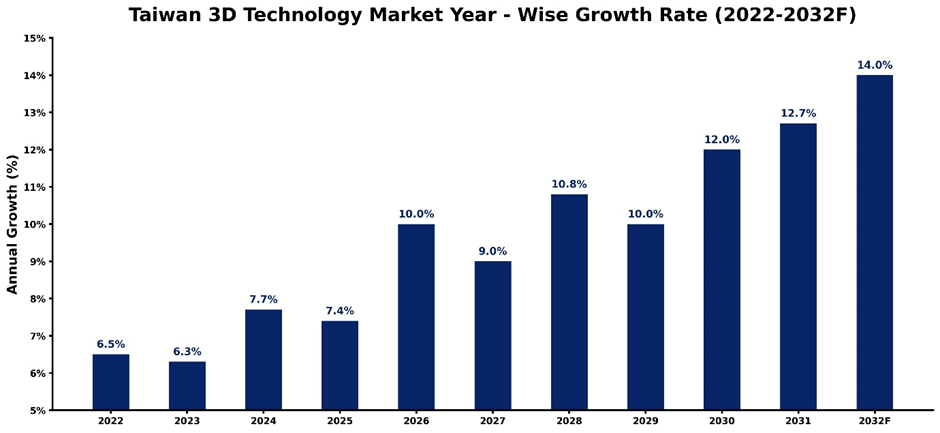 The following table summarizes the historical and forecasted growth rates of the Taiwan 3D Technology Market, along with the rationale behind each year’s performance.
| Year | Est. Annual Growth (%) | Market Rationale |
| 2022 | 6.5% | Increased adoption of 3D printing across industrial and prototyping applications in Taiwan. |
| 2023 | 6.3% | Increased demand for advanced 3D modelling, scanning, and rapid prototyping solutions across automotive sector. |
| 2024 | 7.7% | Increased implementation of 3D technology solutions in semiconductor manufacturing. |
| 2025 | 7.4% | Expanded adoption of 3D printing among enterprises seeking improved production efficiency. |
| 2026 | 10% | Increasing investments in Industry 4.0 initiatives, and customized production solutions driving 3D technology adoption in Taiwan. |
| 2027 | 9% | Growing demand for 3D design, simulation, and additive manufacturing solutions across aerospace sectors. |
| 2028 | 10.8% | Rising adoption of high-precision 3D technologies for semiconductor production. |
| 2029 | 10% | Increasing deployment of advanced 3D scanning integrated with AI and automation platforms. |
| 2030 | 12% | Advancements in additive manufacturing driving wider industrial adoption. |
| 2031 | 12.7% | Expansion of integrated 3D technology ecosystems supporting smart factories. |
| 2032 | 14% | Increased adoption of next-generation 3D technologies across manufacturing, and healthcare. |
Topics Covered in the Taiwan 3D Technology Market Report
The Taiwan 3D Technology Market report covers the market by Type and Application. It provides an in-depth analysis of technological advancements, competitive landscape, market opportunities, industry trends, and key growth drivers, enabling stakeholders to understand current and future market dynamics.
Taiwan 3D Technology Market Highlights
| Report Name | Taiwan 3D Technology Market |
| Forecast period | 2026-2032 |
| CAGR | 5.8% |
| Growing Sector | Additive Manufacturing |
Taiwan 3D Technology Market Synopsis
Increasing demand for 3D printing, additive manufacturing, scanning, modelling, and simulation technologies in semiconductor, automotive, aerospace, healthcare, and electronics industries will accelerate the growth of the Taiwan 3D Technology Market during 2026-2032. 3D technology enables fast prototyping, personalized manufacturing, precision engineering, and enhanced manufacturing efficiency through digital twins and advanced solutions. The adoption of Industry 4.0, smart factories, and automation technologies is increasing at a faster pace, which is leading to market growth, innovation, and cost-effective production capabilities in Taiwan.
Evaluation of Growth Drivers in Taiwan 3D Technology Market (2026–2032)
Below are some major drivers and their influence on the Taiwan 3D Technology Market dynamics:
| Drivers | Primary Segment Affected | Why It Matters |
| Rising adoption of additive manufacturing technologies | Industrial Manufacturing | Enables faster prototyping and cost-effective customized production. |
| Growth of semiconductor and electronics industries | Semiconductor & Electronics | Supports precision manufacturing and complex component development. |
| Growing Industry 4.0 and smart factory initiatives | Manufacturing | Enhanced automation, efficiency, and digital production capabilities. |
| Progress in 3D scanning and digital twin technologies | Engineering & Design | Improves visualization, simulation, and product optimization processes. |
| Increasing Need for Individualized Healthcare Solutions | Healthcare | Allows customized medical devices and patient-specific applications. |
Taiwan 3D Technology Market is projected to expand at a CAGR of 5.8% during the forecast period (2026-2032) due to the increasing acceptance of additive manufacturing technologies, rising demand for advanced 3D printing and scanning solutions, and expanding applications in the semiconductor, automotive, healthcare, aerospace, and industrial manufacturing industries. Taiwan’s strong technology ecosystem, advanced electronics manufacturing capabilities, and focus on smart manufacturing and digital transformation are driving the adoption of 3D printing, digital twin technologies, 3D modelling solutions, and advanced manufacturing systems.
Evaluation of Restraints in Taiwan 3D Technology Market
Below are some major restraints and their influence on the Taiwan 3D Technology Market dynamics:
| Restraints | Primary Segment Affected | What This Means |
| High initial capital costs of 3D technology solutions | Small and Medium-sized Enterprises | Limits adoption among companies with limited budgets. |
| Difficulty of running sophisticated 3D systems | Industrial Users | Requires skilled professionals and special training. |
| Limited knowledge of the benefits of 3D technology | Emerging Applications | Slows adoption in potential end-user industries. |
| Costly in maintenance and equipment | Manufacturing Sector | Increases the costs of operation for the technology user. |
| Compatibility issues with existing systems | Enterprises | Faces integration challenges with existing infrastructure. |
Taiwan 3D Technology Market Challenges
The Taiwan 3D Technology Market faces challenges including high manufacturing costs, limited availability of advanced equipment, and supply chain constraints. The development of 3D technologies such as 3D IC integration, TSV, and advanced packaging requires significant capital investment and specialized technical expertise. Along with that, thermal management issues, yield optimization challenges, and difficulties in achieving large-scale production remain key barriers. Increasing competition among semiconductor manufacturing hubs and the need for continuous innovation further pressure companies to invest heavily in research.
Taiwan 3D Technology Market Trends
Key trends shaping the Taiwan 3D Technology Market include:
- Expanding use of additive manufacturing: The market growth is being driven by the increasing adoption of 3D printing technologies in semiconductor, automotive, aerospace, healthcare, and industrial manufacturing.
- The use of AI and automation: AI-powered design optimization, automated production workflows, and smart 3D modelling solutions are improving manufacturing efficiency and reducing the production time.
- Increasing adoption of digital twin technologies: The increasing adoption of digital twins facilitates the real-time simulation, monitoring, and optimization of industrial processes and smart factory operations.
Investment Opportunities in Taiwan 3D Technology Market
Key investment opportunities in the Taiwan 3D Technology Industry include:
- Expansion of additive manufacturing solutions: Investments in advanced 3D printing technologies, materials, and equipment can support the growing demand from the semiconductor, automotive, aerospace, and industrial sectors.
- Development of smart manufacturing technologies: Opportunities exist in the union of 3D technology with Industry 4.0, automation, IoT, and digital twin solutions to enhance production efficiency.
- Investment potential in 3D solutions for semiconductor production: Growth in semiconductor applications due to increasing demand for accurate components, inspection systems, and progressive prototyping.
Top Leading Companies in Taiwan 3D Technology Market
A comprehensive list of major companies providing 3D technology solutions and operating within the Taiwan 3D Technology Market is provided below:
1. Stratasys
| Company Name | Stratasys |
|---|---|
| Established Year | 1989 |
| Headquarters | Eden Prairie, USA |
| Official Website | Click Here |
Stratasys provides advanced 3D printing systems, additive manufacturing solutions, and 3D materials used across industrial manufacturing, aerospace, automotive, healthcare, and prototyping applications.
2. 3D Systems
| Company Name | 3D Systems |
|---|---|
| Established Year | 1986 |
| Headquarters | Rock Hill, USA |
| Official Website | Click Here |
3D Systems develops professional 3D printing technologies, software, and materials supporting rapid prototyping, production manufacturing, healthcare applications, and precision engineering.
3. Autodesk
| Company Name | Autodesk |
|---|---|
| Established Year | 1982 |
| Headquarters | San Francisco, USA |
| Official Website | Click Here |
Autodesk offers 3D design, modelling, simulation, and manufacturing software solutions used across architecture, engineering, product development, and industrial design sectors.
4. Formlabs
| Company Name | Formlabs |
|---|---|
| Established Year | 2011 |
| Headquarters | Somerville, USA |
| Official Website | Click Here |
Form labs develop professional 3D printers, materials, and digital fabrication solutions supporting engineering, healthcare, education, and product development applications.
5. Materialise
| Company Name | Materialise |
|---|---|
| Established Year | 1990 |
| Headquarters | Leuven, Belgium |
| Official Website | Click Here |
Materialise provides 3D printing software, simulation tools, and manufacturing services that enable customized production, medical applications, and industrial-scale additive manufacturing.
Government & Industry Initiatives in Taiwan 3D Technology Market
According to Taiwanese government data, key initiatives include:
Promotion of Smart Manufacturing and Industry 4.0: Taiwan is supporting the acceptance of progressive manufacturing technologies, including 3D printing, digital twins, automation, and smart production systems, to improve industrial competitiveness.
Advanced Semiconductor Manufacturing Development: Government support for semiconductor innovation is accelerating the adoption of 3D technologies like advanced packaging, 3D chip integration, and precision manufacturing solutions.
Digital Transformation Programs for Industries: Enterprise digitalization programs are driving the adoption of 3D modelling, simulation, and smart factory technologies in the manufacturing industry.
Future Insights of the Taiwan 3D Technology Market
The Taiwan 3D Technology Market is expected to experience strong growth during 2026–2032, supported by rising adoption of additive manufacturing, digital twins, 3D scanning, and smart factory solutions. The market is projected to grow driven by Taiwan’s semiconductor ecosystem, Industry 4.0 initiatives, and advanced manufacturing capabilities. As Taiwan accounts for over 50% of global semiconductor foundry revenue, demand for precision 3D technologies will continue to expand.
Market Segmentation Analysis
This report presents a detailed analysis of the Taiwan 3D Technology Market segments along with their leading categories.
By Type – 3D Printing Segment Dominated, 3D Scanning Segment Set to Expand Rapidly
As per Ravi Bhandari, Senior Research Analyst, 6Wresearch, the 3D Printing segment is dominating with an approximate share of 42.6% in 2025, driven by increasing adoption of additive manufacturing across semiconductor. The 3D Scanning segment is projected to witness the highest CAGR of 14.5% during 2026–2032, supported by rising demand for quality inspection.
By Application – Consumer Electronics Segment Dominated, Healthcare Segment Set to Expand Rapidly
The Consumer Electronics segment accounted for the largest market share of around 35.2% in 2025, owing to Taiwan’s strong electronics manufacturing ecosystem. The Healthcare segment is estimated to witness the highest CAGR of 15.3% during the forecast period 2026–2032, driven by increasing adoption of 3D-printed medical devices.
Note- Market size estimations and growth projections presented in this report are based on 6Wresearch's proprietary forecasting methodology, utilizing the latest available industry data, company disclosures, government publications, and primary research inputs.
Key Attractiveness of the Report
- 10 Years of Market Numbers
- Historical Data Starting from 2022 to 2025
- Base Year: 2025
- Forecast Data until 2032
- Key Performance Indicators Impacting the Market
- Major Upcoming Developments and Projects
Key Highlights of the Report:
- Taiwan 3D Technology Market Outlook.
- Market Size of Taiwan 3D Technology Market, 2025.
- Forecast of Taiwan 3D Technology Market, 2032.
- Historical Data and Forecast of Taiwan 3D Technology Revenues & Volume for the Period 2022-2032.
- Taiwan 3D Technology Market Trend Evolution.
- Taiwan 3D Technology Market Drivers and Challenges.
- Taiwan 3D Technology Price Trends.
- Taiwan 3D Technology Porter's Five Forces.
- Taiwan 3D Technology Industry Life Cycle.
- Historical Data and Forecast of Taiwan 3D Technology Market Revenues & Volume By Type for the Period 2022-2032.
- Historical Data and Forecast of Taiwan 3D Technology Market Revenues & Volume By 3D Printing for the Period 2022-2032.
- Historical Data and Forecast of Taiwan 3D Technology Market Revenues & Volume By 3D Display for the Period 2022-2032.
- Historical Data and Forecast of Taiwan 3D Technology Market Revenues & Volume By 3D Scanning for the Period 2022-2032.
- Historical Data and Forecast of Taiwan 3D Technology Market Revenues & Volume By 3D Imaging for the Period 2022-2032.
- Historical Data and Forecast of Taiwan 3D Technology Market Revenues & Volume By Others for the Period 2022-2032.
- Historical Data and Forecast of Taiwan 3D Technology Market Revenues & Volume By Application for the Period 2022-2032.
- Historical Data and Forecast of Taiwan 3D Technology Market Revenues & Volume By Healthcare for the Period 2022-2032.
- Historical Data and Forecast of Taiwan 3D Technology Market Revenues & Volume By Automotive for the Period 2022-2032.
- Historical Data and Forecast of Taiwan 3D Technology Market Revenues & Volume By Aerospace & Defence for the Period 2022-2032.
- Historical Data and Forecast of Taiwan 3D Technology Market Revenues & Volume By Consumer Electronics for the Period 2022-2032.
- Historical Data and Forecast of Taiwan 3D Technology Market Revenues & Volume By Others for the Period 2022-2032.
- Taiwan 3D Technology Import Export Trade Statistics.
- Market Opportunity Assessment By Type.
- Market Opportunity Assessment By Application.
- Taiwan 3D Technology Top Companies Market Share.
- Taiwan 3D Technology Competitive Benchmarking By Technical and Operational Parameters.
- Taiwan 3D Technology Company Profiles.
- Taiwan 3D Technology Key Strategic Recommendations.
Market Covered
The report offers an extensive study of the following Taiwan 3D Technology Market segments:
By Type
- 3D Printing
- 3D Display
- 3D Scanning
- 3D Imaging
- Others
By Application
- Healthcare
- Automotive
- Aerospace & Defence
- Consumer Electronics
- Others






































