Taiwan Cybersecurity Market Growth Rate
According to 6Wresearch internal databases and industry insights, the Taiwan Cybersecurity Market is projected to grow at a steady compound annual growth rate (CAGR) of 8.4% during the forecast period 2026–2032.
Taiwan Cybersecurity Market Year-wise Growth Rate and Key Drivers (2022-2032)
This graph illustrates the annual growth rates of the Taiwan Cybersecurity Market from 2022 to 2032, highlighting a steady upward trajectory and projected market expansion over the forecast period.
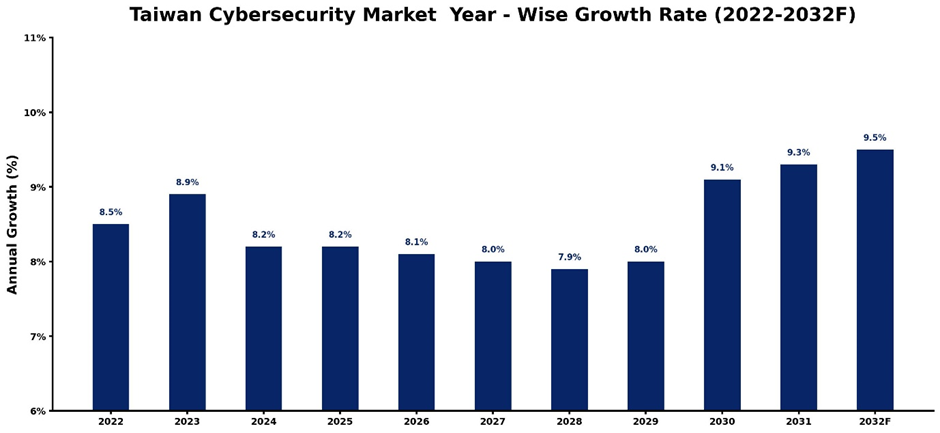
The following table summarizes the historical and forecasted growth rates of Taiwan Cybersecurity Market, along with the rationale behind each year’s performance.
| Year | Estimated Growth (%) | Market Rationale |
| 2022 | 8.5% | Baseline year; increased cyber threats and formation of national cybersecurity frameworks |
| 2023 | 8.9% | Surged ransomware and phishing attacks targeting government and finance sectors |
| 2024 | 8.2% | Increased AI adoption and rising semiconductor supply chain cyber risks |
| 2025 | 8.2% | Rapid cloud migration and stronger cybersecurity compliance requirements |
| 2026 | 8.1% | Expansion of national cyber defense systems and enterprise AI security tools |
| 2027 | 8% | Growing adoption of Zero Trust architecture across enterprises |
| 2028 | 7.9% | 5G and IoT expansion significantly increases attack surface |
| 2029 | 8% | Rise of AI-powered cyberattacks drives defensive cybersecurity spending |
| 2030 | 9.1% | Government mandates stricter cybersecurity compliance across critical sectors |
| 2031 | 9.3% | Early adoption of quantum-safe encryption and advanced threat detection systems |
| 2032 | 9.5% | Mature digital infrastructure security ecosystem and full-scale enterprise protection |
Topics Covered in the Taiwan Cybersecurity Market Report
The Taiwan Cybersecurity Industry report covers the market by security type, deployment, and end-user. The report provides a detailed analysis of ongoing cyber threat trends, security technology adoption, regulatory frameworks, and high-growth opportunity areas. It also highlights key market drivers which helps stakeholders align strategies based on current and future cybersecurity market dynamics.
Taiwan Cybersecurity Market Highlights
| Report Name | Taiwan Cybersecurity Market |
| Forecast period | 2026-2032 |
| CAGR | 8.4% |
| Growing Sector | Cybersecurity |
Taiwan Cybersecurity Market Synopsis
Taiwan Cybersecurity Market is projected for strong structural expansion during the forecast period due to rising geopolitical cyber risks, increasing frequency of advanced persistent threats (APTs), and rapid digital transformation across enterprises and government infrastructure. The vital reasons for market growth are strong semiconductor industry exposure, expanding cloud adoption, and growing dependence on connected systems. The shift toward AI-driven security, Zero Trust architecture, and real-time threat intelligence platforms is further accelerating cybersecurity adoption across critical sectors.
Evaluation of Growth Drivers in Taiwan Cybersecurity Market (2026–2032)
Below are some major drivers and their influence on the market dynamics:
| Drivers | Primary Segment Affected | Why It Matters (Evidence) |
| Rising Geopolitical Cyber Threats | Government & Defense Sector | Taiwan faces high exposure to state-sponsored cyberattacks targeting critical infrastructure |
| Semiconductor Supply Chain Security Needs | Semiconductor & Electronics Industry | Protection of TSMC ecosystem and chip design infrastructure drives security investments |
| Rapid Cloud Adoption | IT & Telecom / Enterprise Sector | Cloud migration increases demand for cloud security and identity management solutions |
| Expansion of AI-Powered Cybersecurity | Software & Security Platforms | AI enhances threat detection, automation, and real-time response capabilities |
| Growth of Zero Trust Architecture | BFSI & Enterprise Networks | Enterprises adopt strict identity verification to reduce insider and external threats |
| Increasing Regulatory Compliance | Government & BFSI Sector | Stronger cybersecurity laws force organizations to upgrade security frameworks |
Taiwan Cybersecurity Market Share is set to witness steady expansion with a CAGR of 8.4% during 2026–2032. Overall enterprise resilience across critical infrastructure sectors strengthened by the shift from traditional perimeter-based security to intelligent, AI-driven, and cloud-native cybersecurity frameworks for improved threat detection accuracy. Increasing digital dependency across industries, combined with the rising sophistication, frequency, and automation of cyberattacks, continues to act as a major force driving sustained market expansion and long-term cybersecurity investment growth.
Evaluation of Restraints in Taiwan Cybersecurity Market
Below are some major restraints and their influence on the market dynamics:
| Restraints | Primary Segment Affected | What This Means (Evidence) |
| High Implementation Costs | SMEs and Mid Enterprises | Advanced cybersecurity tools require high investment in infrastructure and skilled personnel |
| Cybersecurity Skill Shortage | IT & Security Workforce | Lack of trained professional limits deployment and monitoring capabilities |
| Complex Legacy System Integration | Industrial & Government Sector | Older systems are difficult to secure and integrate with modern cybersecurity solutions |
| High False Positive Rates | Security Operations Centers | AI-based systems may generate alert fatigue and operational inefficiencies |
| Data Privacy & Sovereignty Concerns | Cloud & Enterprise Sector | Restrictions on data sharing limit full-scale cloud security adoption |
Taiwan Cybersecurity Market Challenges
The Taiwan cybersecurity market faces several critical challenges, including increasingly sophisticated and AI-driven cyberattacks, persistent shortage of skilled cybersecurity professionals, and significant integration issues with legacy IT infrastructure. Hiking costs of advanced security solutions further restrict adoption, especially among SMEs. In addition to, managing real-time threat intelligence at scale and reducing operational complexity within Security Operations Centers (SOCs) remain major constraints. However, organizations are still prioritizing automation and AI-based threat detection systems to strengthen long-term cybersecurity resilience.
Taiwan Cybersecurity Market Trends
Major trends responsible for Taiwan Cybersecurity Market growth include:
- Rise of AI-Powered Cyber Defense Systems: Complex enterprise environments actively use machine learning and AI for threat detection and anomaly identification in real-time.
- Expansion of Zero Trust Security Frameworks: Enterprises are transitioning to identity-first security models that verify every access request across distributed networks.
- Growth of Cloud Security Solutions: Rising cloud adaption is moulding demand for advanced encryption, IAM, and cloud workload protection across hybrid and multi-cloud environments.
- Rising Importance of Managed Security Services (MSS): Due to talent shortages and complexity of threats, organizations are outsourcing cybersecurity operations.
Investment Opportunities in Taiwan Cybersecurity Market
Below are the investment opportunities available in Taiwan Cybersecurity Market:
- Cloud Security Infrastructure Development: Growing demand for secure cloud environments creates opportunities for scalable security platforms supporting hybrid cloud architectures.
- Managed Security Service Providers (MSSPs): Increasing outsourcing trends open strong recurring revenue opportunities especially for incident response and compliance management across industries.
- Semiconductor Cybersecurity Solutions: Specialized security systems for chip design and fabrication, assure resilience against intellectual property theft and geopolitical cyber espionage risks.
- Critical Infrastructure Protection Systems: Government and energy sectors require advanced security systems for national resilience, utilities, and communication networks.
Top 5 Leading Players in Taiwan Cybersecurity Market
Below are some of the leading companies in the Taiwan Cybersecurity Market:
1. Trend Micro Incorporated
| Company Name | Trend Micro Incorporated |
|---|---|
| Established Year | 1988 |
| Headquarters | Taipei, Taiwan |
| Official Website | Click Here |
Trend Micro is a major global cybersecurity leader founded in Taiwan, specializing in enterprise threat defense, cloud security, and AI-driven cybersecurity platforms.
2. CyCraft Technology
| Company Name | CyCraft Technology |
|---|---|
| Established Year | 2017 |
| Headquarters | Taipei, Taiwan |
| Official Website | Click Here |
CyCraft is a leading AI-powered cybersecurity company focused on autonomous threat detection, digital forensics, and enterprise-grade incident response solutions designed for large-scale cyber defense operations.
3. Chunghwa Telecom
| Company Name | Chunghwa Telecom |
|---|---|
| Established Year | 1996 |
| Headquarters | Taipei, Taiwan |
| Official Website | Click Here |
Chunghwa Telecom is Taiwan’s largest telecom provider, offering managed security services, secure communication infrastructure, and critical national cybersecurity protection.
4. Fortinet
| Company Name | Fortinet |
|---|---|
| Established Year | 2000 |
| Headquarters | Sunnyvale, California, USA |
| Official Website | Click Here |
Fortinet is a global cybersecurity company delivering SASE architecture, firewall solutions, cloud security, and integrated network protection.
5. Acer Cyber Security Inc. (ACSI)
| Company Name | Acer Cyber Security Inc. (ACSI) |
|---|---|
| Established Year | 2017 |
| Headquarters | Taipei, Taiwan |
| Official Website | Click Here |
Acer Cyber Security Inc. is a subsidiary of Acer Group providing cybersecurity consulting, threat intelligence, system integration, and enterprise security solutions.
Government Initiatives being implemented in the Taiwan Cybersecurity Market
According to the Taiwanese government data, the market is strengthened through national-level initiatives focused on critical infrastructure protection, digital resilience, and AI-driven threat defense. The Administration for Cyber Security (ACS) evaluates policy implementation, incident response coordination, and security standards development. The Taiwan Cybersecurity Market size expands by the Executive Yuan’s “National Cyber Security Program” which boosts inter-agency defense readiness and real-time threat intelligence sharing. Also, Taiwan’s Computer Emergency Response Team/Coordination Center (TWCERT/CC) assists vulnerability reporting and cyber incident response.
Future Insights of the Taiwan Cybersecurity Market
The market is expected to witness sustained growth as digital transformation accelerates across government, manufacturing, and semiconductor industries. AI-powered threat detection, and increasing cloud-native security deployments are the key factors for market growth. Rising geopolitical tensions and advanced persistent cyber-crime will further push investments in national cyber defense systems, results in hiking the Taiwan Cybersecurity Market revenue. Cybersecurity will become deeply integrated into Taiwan’s critical infrastructure, enabling real-time threat intelligence, automated response systems, and quantum-safe encryption technologies.
Market Segmentation Analysis
The report offers a comprehensive study of the following market segments and their leading categories:
By Security Type - Network Security Led the Market and Cloud Security Set for Rapid Growth
According to Ravi Bhandari, Senior Research Analyst, 6Wresearch, by security type, in 2025, Network Security led Taiwan’s cybersecurity market with 28% share, driven by rising DDoS attacks, geopolitical cyber risks, and semiconductor industries. While, by 2032, Cloud Security is projected to emerge as the leading segment with a CAGR of 10.5%, fueled by rapid adoption of hybrid and multi-cloud environments.
By Deployment - On-Premise Dominated the Market and Cloud Set for Rapid Expansion
By Deployment, in 2025, On-Premise deployment led the market by holding share of Taiwan’s cybersecurity market, accounting for 55%, driven by strong demand from government agencies, semiconductor firms, and defense-related infrastructure. However, by 2032, Cloud deployment is projected to lead with the CAGR of 11%, supported by rapid cloud migration, hybrid IT environments, and increased adoption of SaaS-based security solutions.
By End-User - Government and Defense Led the Market and IT and Telecommunication Set for Rapid Growth
By End-User, in 2025, the Government and Defense segment dominated the Taiwan’s cybersecurity market with 30% share, driven by high exposure to geopolitical cyber threats, and protection of critical infrastructure. Meanwhile, by 2032, the IT and Telecommunication segment is projected to grow at the fastest with a CAGR of 9.5%, fueled by rapid digital transformation, 5G expansion, and increasing cloud and network security adoption.
Note: Market size estimations and growth projections presented in this report are based on 6Wresearch’s advanced forecasting approach, validated with industry datasets as of June 2026.
Key Attractiveness of the Report:
- 10 Years of Market Numbers
- Historical Data Starting from 2022 to 2025
- Base Year: 2025
- Forecast Data until 2032
- Key Performance Indicators Impacting the Market
- Major Upcoming Developments and Projects
Key Highlights of the Report:
- Taiwan Cybersecurity Market Outlook
- Market Size of Taiwan Cybersecurity Market, 2025
- Forecast of Taiwan Cybersecurity Market, 2032
- Historical Data and Forecast of Taiwan Cybersecurity Revenues & Volume for the Period 2022-2032
- Taiwan Cybersecurity Market Trend Evolution
- Taiwan Cybersecurity Market Drivers and Challenges
- Taiwan Cybersecurity Price Trends
- Taiwan Cybersecurity Porter's Five Forces
- Taiwan Cybersecurity Industry Life Cycle
- Historical Data and Forecast of Taiwan Cybersecurity Market Revenues & Volume By Security Type for the Period 2022-2032
- Historical Data and Forecast of Taiwan Cybersecurity Market Revenues & Volume By Cloud Security for the Period 2022-2032
- Historical Data and Forecast of Taiwan Cybersecurity Market Revenues & Volume By Data Security for the Period 2022-2032
- Historical Data and Forecast of Taiwan Cybersecurity Market Revenues & Volume By Identity Access Management for the Period 2022-2032
- Historical Data and Forecast of Taiwan Cybersecurity Market Revenues & Volume By Network Security for the Period 2022-2032
- Historical Data and Forecast of Taiwan Cybersecurity Market Revenues & Volume By Consumer Security for the Period 2022-2032
- Historical Data and Forecast of Taiwan Cybersecurity Market Revenues & Volume By Infrastructure Protection for the Period 2022-2032
- Historical Data and Forecast of Taiwan Cybersecurity Market Revenues & Volume By Others for the Period 2022-2032
- Historical Data and Forecast of Taiwan Cybersecurity Market Revenues & Volume By Deployment for the Period 2022-2032
- Historical Data and Forecast of Taiwan Cybersecurity Market Revenues & Volume By Cloud for the Period 2022-2032
- Historical Data and Forecast of Taiwan Cybersecurity Market Revenues & Volume By On-Premise for the Period 2022-2032
- Historical Data and Forecast of Taiwan Cybersecurity Market Revenues & Volume By End-User for the Period 2022-2032
- Historical Data and Forecast of Taiwan Cybersecurity Market Revenues & Volume By BFSI for the Period 2022-2032
- Historical Data and Forecast of Taiwan Cybersecurity Market Revenues & Volume By Healthcare for the Period 2022-2032
- Historical Data and Forecast of Taiwan Cybersecurity Market Revenues & Volume By Manufacturing for the Period 2022-2032
- Historical Data and Forecast of Taiwan Cybersecurity Market Revenues & Volume By Government and Defense for the Period 2022-2032
- Historical Data and Forecast of Taiwan Cybersecurity Market Revenues & Volume By IT and Telecommunication for the Period 2022-2032
- Historical Data and Forecast of Taiwan Cybersecurity Market Revenues & Volume By Others for the Period 2022-2032
- Taiwan Cybersecurity Import Export Trade Statistics
- Market Opportunity Assessment By Security Type
- Market Opportunity Assessment By Deployment
- Market Opportunity Assessment By End-User
- Taiwan Cybersecurity Top Companies Market Share
- Taiwan Cybersecurity Competitive Benchmarking By Technical and Operational Parameters
- Taiwan Cybersecurity Company Profiles
- Taiwan Cybersecurity Key Strategic Recommendations
Market Covered
The report offers an extensive study of the following market segments:
By Security Type
- Cloud Security
- Data Security
- Identity Access Management
- Network Security
- Consumer Security
- Infrastructure Protection
- Others
By Deployment
- Cloud
- On-Premise
By End-User
- BFSI
- Healthcare
- Manufacturing
- Government and Defense
- IT and Telecommunication
- Others






































