Taiwan Electric Motor Market Growth Rate
According to 6Wresearch internal database and industry insights, the Taiwan Electric Motor Market is projected to grow at a steady compound annual growth rate (CAGR) of approximately 5.7% during the forecast period 2026–2032.
Taiwan Electric Motor Market Year-wise Growth Rate and Key Drivers
This graph illustrates the annual growth rates of the Taiwan Electric Motor Market from 2021 to 2032, highlighting a steady upward trajectory and projected market expansion over the forecast period.
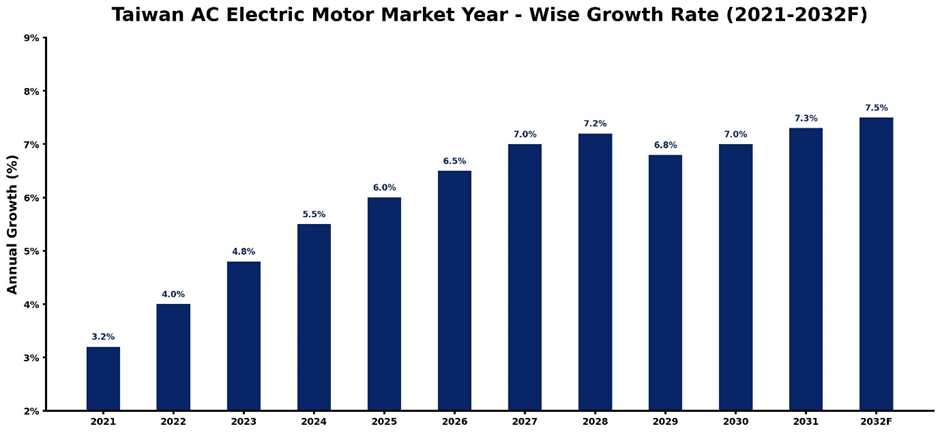
The following table summarizes the historical and forecasted growth rates of the Taiwan Electric Motor Market, along with the rationale behind each year’s performance.
| Year | Estimated Growth (%) | Market Rationale |
| 2021 | 3.2% | Steady industrial and appliance motor demand, recovery after the pandemic. |
| 2022 | 4% | Sustained moderate growth through the process of automation in the electronics and semiconductor industry. |
| 2023 | 4.8% | Increased demand through the use of energy efficient motors in industry. |
| 2024 | 5.5% | Growth driven by government incentives for renewable energy and EVs. |
| 2025 | 6% | Growing demand due to more motors used in robotics along with the growth in the market for electric vehicles. |
| 2026 | 6.5% | The increasing growth rate via smart manufacturing and efficient motors. |
| 2027 | 7% | Increase in the market size and growth rate owing to automation. |
| 2028 | 7.2% | Efficiency regulation leads to increased number of motors being exported. |
| 2029 | 6.8 | Slow growth rates due to logistical constraints and global economic conditions. |
| 2030 | 7% | High performance motors demand in robotics and manufacturing industry. |
| 2031 | 7.3% | Renewable energy integration and smart grid applications expand motor market. |
| 2032 | 7.5% | Strong overall demand from EVs, industrial automation, and appliances maintains growth. |
Topics Covered in the Taiwan Electric Motor Market Report
The Taiwan Electric Motor Industry report covers the market by Motor Type, Output Power, Voltage Range, Application, and Speed (RPM). The report provides a detailed analysis of ongoing market trends, opportunities/high-growth areas, and market drivers that will help stakeholders align strategies based on current and future market dynamics.
Taiwan Electric Motor Marke Highlights
| Report Name | Taiwan Electric Motor Market |
| Forecast period | 2026-2032 |
| CAGR | 5.7% |
| Growing Sector | Electric Vehicle (EV) Motors & Industrial Automation |
Taiwan Electric Motor Market Synopsis
Taiwan electric motor market is set to rise at a steady rate owing to the rising industrial automation, increasing demand for electric vehicles (EVs), and government efforts to promote energy efficiency. Electric motors are commonly used in industrial equipment, heating and cooling units, home appliances and vehicles. An electric motor is a device that converts electricity into mechanical energy. The products in this market range from small fractional-horsepower motors for household appliances to huge industrial-grade motors for manufacturing and robotics.
Evaluation of Growth Drivers in the Taiwan Electric Motor Market (2026–2032)
Below are some major drivers and their influence on the market dynamics:
| Drivers | Primary Segment Impacted | Why It Matters (Evidence) |
| Government Incentives on Energy Efficiency | Uses Industrial and Commercial | The government of Taiwan offers subsidies and tax advantages for energy-efficient motors. |
| Manufacturing & Industrial Facilities | Industrial Automation & Smart Manufacturing | Factories require precision and reliable electric motors with automation. |
| Electric Vehicle (EV) Adoption | Automotive Industry | Taiwan’s expanding EV industry is generating demand for small, high-efficiency motors for propulsion systems. |
| Speciality Distributors and Online Channels | Retail & Community Platforms | Developed motor technologies are becoming more accessible to small and medium enterprises. |
| R&D in High-Efficiency & Intelligent Motors | Research Institutions & Original Equipment Manufacturers | Research on motor design and energy-saving technologies is being conducted, which enhances innovation. |
Taiwan Electric Motor Market is forecast to grow at a robust rate, reaching a CAGR of 5.7% over the period 2026-2032 owing to industrial automation, increasing acceptance of electric cars and demand for energy efficient solutions. The market consists of a wide range of items from small motors used in household appliances to large industrial-grade motors used in manufacturing and robotics. Advanced technologies such as brushless DC motors, high-ease induction motors, and IoT-enabled smart motors are on the rise.
Evaluation of Restraints in the Taiwan Electric Motor Market
Below are some major restraints and their influence on the market dynamics:
| Restraints | Primary Segment Impacted | What This Means (Evidence) |
| High Cost of Advanced Motors | Enterprise & Industrial Users | There is also a considerable capital expenditure required to upgrade to high-efficiency motors, which may lead to adoption from cost-sensitive enterprises. |
| Skills Gap in Workforce | Workforce Development | Limited technical know-how for the operation and maintenance of sophisticated motor systems may limit adoption for industrial use. |
| Supply chain disruption | Specialty Distributors & eCommerce | Dependency on foreign parts and global supply chain volatility may cause late delays in product delivery and higher expenses. |
| Poor awareness of energy efficient solutions | Online & Community | The low market penetration may be due to the fact that small and medium firms are not aware of the government incentives and energy-saving solutions. |
| Regulatory and Compliance Issues | Commercial and Government Customers | Changes in energy efficiency laws and standards may lead to delayed implementation and higher compliance costs. |
Taiwan Electric Motor Market Challenges
The Taiwan electric motor industry is growing steadily, yet there are some drawbacks. The high initial prices of innovative and energy-efficient motors are a hurdle for small businesses to embrace the latest technologies. Also, the lack of experienced personnel who can run and maintain advanced motor systems hinders the efficiency and utilisation of industrial applications.
Complications with supply chains, such as dependence on imported components, have resulted in added costs for manufacturers and suppliers. In addition, another reason why the adoption rate is relatively slow is the lack of information about energy-efficient products within SMEs. Lastly, the changes in regulations have complicated the use of the technology, primarily by businesses and the government.
Taiwan Electric Motor Market Trends
Key trends influencing the patterns of the Taiwan Electric Motor Market Growth include:
- Transition towards energy-saving motors: The market trend is rapidly heading towards efficient motor technologies to cut back on energy consumption while complying with stringent environmental standards.
- Use of BLDC motors and permanent magnet motors: Brushless DC (BLDC) and permanent magnet motors are being adopted due to their high efficiency and reduced maintenance requirements.
- Development of smart and IoT-driven motors: There is a trend emerging in the industry where sensors, IoT capabilities, and other automation technologies are integrated into motors. It aids performance monitoring and maintenance.
- Rise in demand for motors used in EVs: There is an increase in demand for motors used in electric vehicles (EVs). This is due to Taiwan having good electronics and semiconductor manufacturing facilities.
Investment Opportunities in the Taiwan Electric Motor Market
Some lucrative opportunities include:
- EV motors manufacture and logistics: The investors could capitalise on the increasing importance of Taiwan in the global EV industry by making investments into manufacturing motors, including traction motors and EV drive train components.
- Industrial automation motor applications: With the increasing trend towards smarter manufacturing plants, there is a high demand for motors that are used in robotics, semiconductor manufacturing, and precision machinery.
- Motor energy efficiency replacement: Various industries are upgrading their older motors to energy-efficient motors, thus offering many opportunities for replacements.
- Smart motors and IoT technologies: The prospects of manufacturing smart motors and implementing IoT technology into them are promising.
Top 5 Leading Players in the Taiwan Electric Motor Market
Below is a list of prominent companies operating in the Taiwan Electric Motor Market:
1. TECO Electric & Machinery Co., Ltd.
| Company Name | TECO Electric & Machinery Co., Ltd. |
|---|---|
| Established Year | 1956 |
| Headquarters | Taipei, Taiwan |
| Official Website | Click Here |
TECO manufactures a wide range of electric motors, including industrial, commercial, and EV motors. It focuses on energy efficiency, automation solutions, and global exports.
2. Nidec Taiwan Corporation
| Company Name | Nidec Taiwan Corporation |
|---|---|
| Established Year | 1973 |
| Headquarters | Taichung, Taiwan |
| Official Website | Click Here |
Nidec Taiwan produces precision motors for electronics, automotive, and industrial applications, including high-efficiency and brushless motors.
3. Oriental Motor Taiwan Co., Ltd.
| Company Name | Oriental Motor Taiwan Co., Ltd. |
|---|---|
| Established Year | 1971 |
| Headquarters | Taipei, Taiwan |
| Official Website | Click Here |
Oriental Motor focuses on compact motors, stepper motors, and AC/DC motors for industrial automation and precision applications.
4. Delta Electronics, Inc.
| Company Name | Delta Electronics, Inc. |
|---|---|
| Established Year | 1971 |
| Headquarters | Taipei, Taiwan |
| Official Website | Click Here |
Delta Electronics is a major global player offering high-efficiency motors, drives, and power solutions for industrial automation and electric mobility.
5. Shihlin Electric & Engineering Corp.
| Company Name | Shihlin Electric & Engineering Corp. |
|---|---|
| Established Year | 1955 |
| Headquarters | Taipei, Taiwan |
| Official Website | Click Here |
Shihlin Electric is a key Taiwanese electrical engineering company producing industrial motors, switchgear, and automation solutions for infrastructure and heavy industry.
Government Initiatives being implemented in the Taiwan Electric Motor Market
The Taiwanese electric motor market is witnessing tremendous support from numerous government initiatives targeting industry upgrade, energy efficiency, and electrification. In this regard, the government of Taiwan, via the Ministry of Economic Affairs (Taiwan), has been encouraging the adoption of high-efficiency motors through efforts geared towards energy conservation and emission reduction. Such initiatives motivate companies and consumers to upgrade their old motor technologies with new high-efficiency motors, especially in industrial automation, HVAC systems, and electric mobility. Additionally, the roadmap of “Net Zero Emission in 2050” from Taiwan has been contributing significantly to increasing demand for highly efficient electric motors and drive systems. In this regard, Taiwan government policies are focusing on investments related to smart manufacturing, transportation electrification, and green industrialization.
Future Outlook of Taiwan Electric Motor Market
The Taiwan electric motor market is likely to register stable growth during the forecast period 2026-2032, owing to the rising usage of EVs, industrial automation, and smart motor technologies. In industrial applications, high-efficiency motors will still dominate, and IoT-enabled motors will rise rapidly in automotive and electronics. Demand from SMEs will increase, driven by e-commerce channels and niche distributors. Investments in R&D for motor design, automation and predictive maintenance solutions are expected to expand the product portfolio. Further, government regulations supporting energy efficiency are expected to boost market penetration.
Market Segment Analysis
The report offers a comprehensive study of the following market segments and their leading categories:
By Motor Type – AC Motors Dominate Market, DC Motors Set for Strong Expansion
Alternate Current (AC) motors dominated the Taiwan electric motor market with 56.42% share in 2025, driven by widespread industrial and HVAC applications. Meanwhile, Direct Current (DC) motors are projected to expand steadily at a CAGR of 7.68% during 2026–2032, supported by growing EV adoption and precision automation demand.
By Voltage Range – 60 V & Above Leads Market, 21–60 V Segment Shows Fast Growth
According to Ravi Bhandari, Research Head, 6Wresearch, the 60 V & Above segments dominated with 41.88% share in 2025, fueled by strong adoption in EV and industrial automation systems. The 21–60 V segment is anticipated to grow at a CAGR of 7.44% during 2026–2032, supported by expanding commercial and mid-scale industrial applications.
By Application – Industrial Machinery Leads Market, Motor Vehicles Show Rapid Growth
Industrial machinery accounted for 37.63% share in 2025, driven by Taiwan’s strong semiconductor and manufacturing ecosystem. Motor vehicles are projected to expand at a CAGR of 8.62% through 2032, supported by accelerating electric vehicle production and automotive electrification trends.
By Speed (RPM) – Medium-Speed Motors Dominate Market, High-Speed Segment Expands Fastest
Medium-Speed Electric Motors led the market with 46.55% share in 2025, owing to their broad industrial applications. High-Speed Electric Motors are expected to grow at a CAGR of 8.28% during 2026–2032, driven by rising demand in robotics, aerospace, and precision engineering sectors.
Note: Market size estimations and growth projections presented in this report are based on 6Wresearch’s advanced forecasting approach, validated with industry datasets as of June 2026.
Key Attractiveness of the Report:
- 10 Years of Market Numbers
- Historical Data Starting from 2022 to 2025
- Base Year: 2025
- Forecast Data until 2032
- Key Performance Indicators Impacting the Market
- Major Upcoming Developments and Projects
Key Highlights of the Report:
- Taiwan Electric Motor Market Outlook
- Market Size of Taiwan Electric Motor Market, 2025
- Forecast of Taiwan Electric Motor Market, 2032
- Historical Data and Forecast of Taiwan Electric Motor Revenues & Volume for the Period 2022–2032
- Taiwan Electric Motor Market Trend Evolution
- Taiwan Electric Motor Market Drivers and Challenges
- Taiwan Electric Motor Price Trends
- Taiwan Electric Motor Porter`s Five Forces
- Taiwan Electric Motor Industry Life Cycle
- Historical Data and Forecast of Taiwan Electric Motor Market Revenues & Volume By Motor Type for the Period 2022–2032
- Historical Data and Forecast of Taiwan Electric Motor Market Revenues & Volume By Alternate Current (AC) Motor for the Period 2022–2032
- Historical Data and Forecast of Taiwan Electric Motor Market Revenues & Volume By Direct Current (DC) Motor for the Period 2022–2032
- Historical Data and Forecast of Taiwan Electric Motor Market Revenues & Volume By Hermetic Motor for the Period 2022–2032
- Historical Data and Forecast of Taiwan Electric Motor Market Revenues & Volume By Output Power for the Period 2022–2032
- Historical Data and Forecast of Taiwan Electric Motor Market Revenues & Volume By Voltage Range for the Period 2022–2032
- Historical Data and Forecast of Taiwan Electric Motor Market Revenues & Volume By 9 V & Below for the Period 2022–2032
- Historical Data and Forecast of Taiwan Electric Motor Market Revenues & Volume By 10-20 V for the Period 2022–2032
- Historical Data and Forecast of Taiwan Electric Motor Market Revenues & Volume By 21-60 V for the Period 2022–2032
- Historical Data and Forecast of Taiwan Electric Motor Market Revenues & Volume By 60 V & Above for the Period 2022–2032
- Historical Data and Forecast of Taiwan Electric Motor Market Revenues & Volume By Application for the Period 2022–2032
- Historical Data and Forecast of Taiwan Electric Motor Market Revenues & Volume By Industrial machinery for the Period 2022–2032
- Historical Data and Forecast of Taiwan Electric Motor Market Revenues & Volume By Motor vehicles for the Period 2022–2032
- Historical Data and Forecast of Taiwan Electric Motor Market Revenues & Volume By Heating, ventilating, and cooling (HVAC) equipment for the Period 2022–2032
- Historical Data and Forecast of Taiwan Electric Motor Market Revenues & Volume By Aerospace & transportation for the Period 2022–2032
- Historical Data and Forecast of Taiwan Electric Motor Market Revenues & Volume By Household appliances for the Period 2022–2032
- Historical Data and Forecast of Taiwan Electric Motor Market Revenues & Volume By Other for the Period 2022–2032
- Historical Data and Forecast of Taiwan Electric Motor Market Revenues & Volume By Speed (RPM) for the Period 2022–2032
- Historical Data and Forecast of Taiwan Electric Motor Market Revenues & Volume By Low-Speed Electric Motors (Less Than 1,000 RPM) for the Period 2022–2032
- Historical Data and Forecast of Taiwan Electric Motor Market Revenues & Volume By Medium-Speed Electric Motors (1,001-25,000 RPM) for the Period 2022–2032
- Historical Data and Forecast of Taiwan Electric Motor Market Revenues & Volume By High-Speed Electric Motors (25,001-75,000 RPM) for the Period 2022–2032
- Historical Data and Forecast of Taiwan Electric Motor Market Revenues & Volume By Ultrahigh-Speed Electric Motors (Greater Than 75,001 RPM) for the Period 2022–2032
- Taiwan Electric Motor Import Export Trade Statistics
- Market Opportunity Assessment By Motor Type
- Market Opportunity Assessment By Output Power
- Market Opportunity Assessment By Voltage Range
- Market Opportunity Assessment By Application
- Market Opportunity Assessment By Speed (RPM)
- Taiwan Electric Motor Top Companies Market Share
- Taiwan Electric Motor Competitive Benchmarking By Technical and Operational Parameters
- Taiwan Electric Motor Company Profiles
- Taiwan Electric Motor Key Strategic Recommendations
Market Covered
The report offers an extensive study of the following Taiwan Electric Motor Market segments:
By Motor Type
- Alternate Current (AC) Motor
- Direct Current (DC) Motor
- Hermetic Motor
By Voltage Range
- 9 V & Below
- 10–20 V
- 21–60 V
- 60 V & Above
By Application
- Industrial machinery
- Motor vehicles
- Heating, ventilating, and cooling (HVAC) equipment
- Aerospace & transportation
- Household appliances
- Other
By Speed (RPM)
- Low-Speed Electric Motors (Less Than 1,000 RPM)
- Medium-Speed Electric Motors (1,001–25,000 RPM)
- High-Speed Electric Motors (25,001–75,000 RPM)
- Ultrahigh-Speed Electric Motors (Greater Than 75,001 RPM)






































