Tajikistan AI in Telecommunication Market Size & Growth Rate (2026-2032)
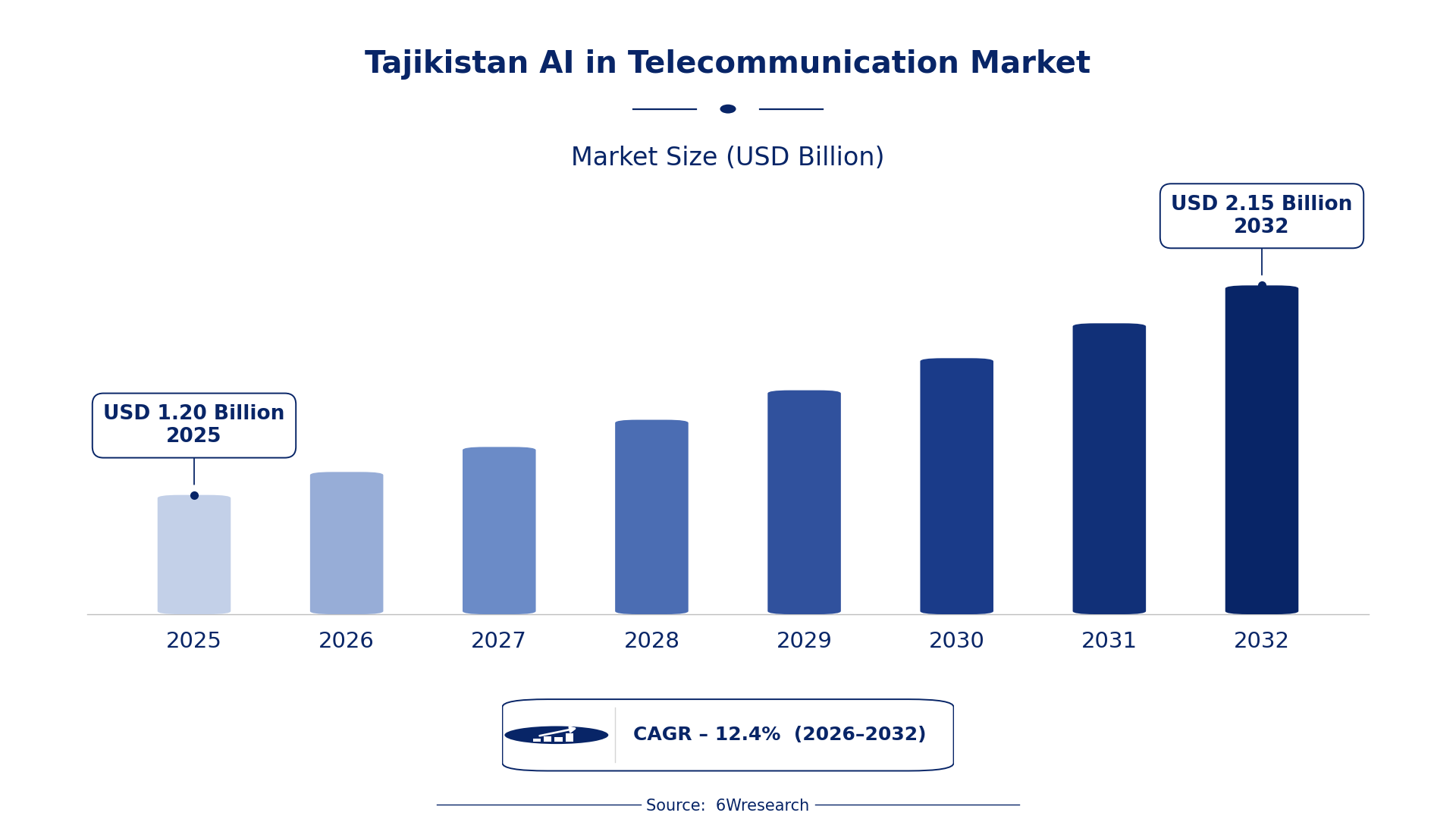
The Tajikistan AI in Telecommunication Market was estimated at USD 1203 Million in 2025 and is projected to reach USD 2154 Million by 2032, growing at a CAGR of 12.4% from 2026 to 2032.
Tajikistan AI in Telecommunication Market Synopsis
The demand for AI-driven solutions in Tajikistan's telecommunication market is escalating, primarily fueled by telecom companies seeking to enhance customer experiences and optimize their operations. The incorporation of AI technologies such as chatbots and predictive analytics has become essential for these companies to keep pace with consumer expectations.
As service providers increasingly face pressure to reduce costs and improve service quality, integrating advanced AI solutions emerges as a key strategy. This trend is driving rapid growth in the market as organizations shift toward automation and enhanced data analytics capabilities.
Tajikistan AI in Telecommunication Market Year-wise Growth Rate and Key Drivers
This graph illustrates the annual growth rates of the Tajikistan AI in Telecommunication Market from 2021 to 2032, highlighting a steady upward trajectory and projected expansion over the forecast period.
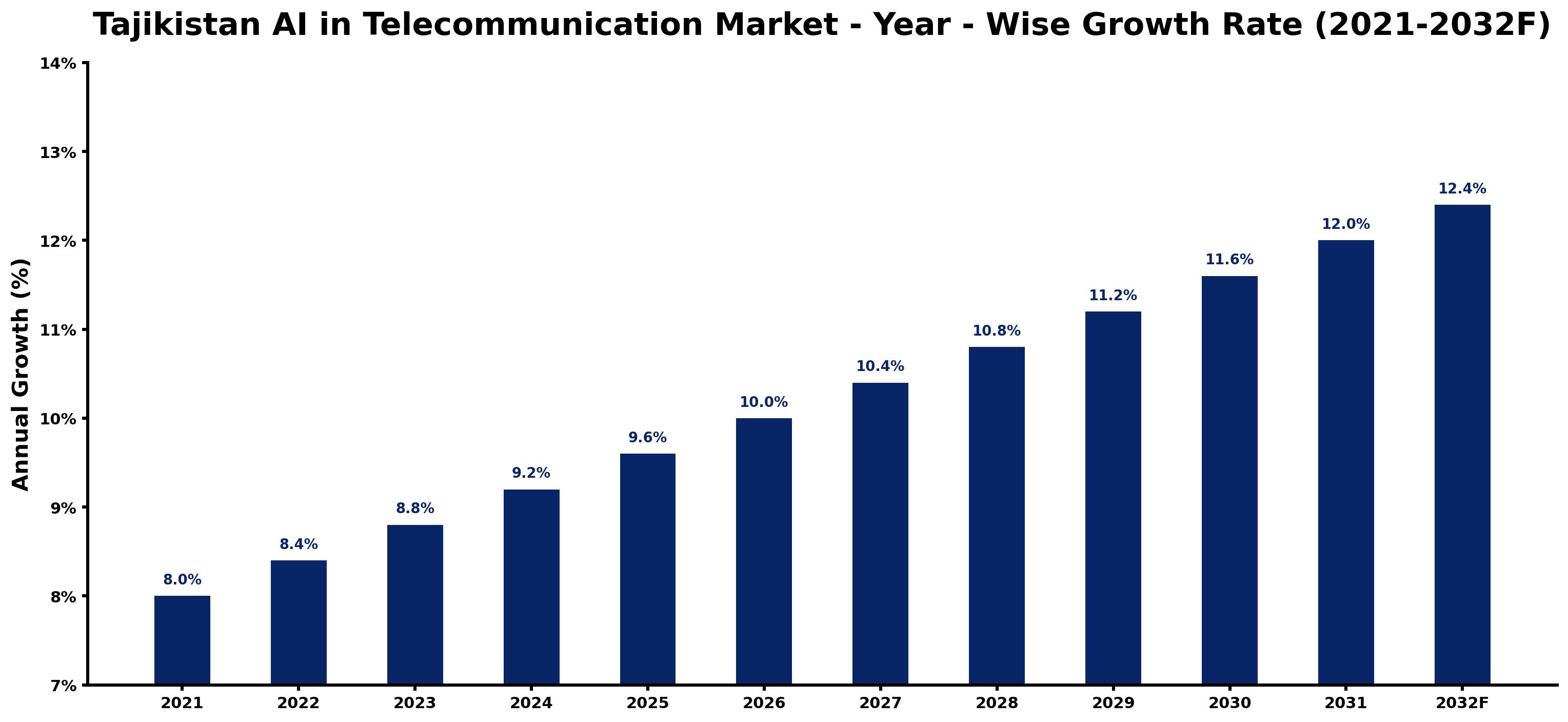
The table below presents the year‑wise growth rates along with the key drivers influencing the market
| Year | Growth Rate | Major Drivers |
| 2021 | 8.0% | Tajikistan's Ministry of Digital Development initiatives promoting AI adoption. |
| 2022 | 8.4% | Increased smartphone penetration enhancing telecom service accessibility. |
| 2023 | 8.8% | Local telecom firms investing in AI-enhanced network management. |
| 2024 | 9.2% | Regulatory incentives for modernizing telecom infrastructure with AI. |
| 2025 | 9.6% | Rising youth population driving demand for innovative telecom solutions. |
| 2026 | 10.0% | International partnerships boosting AI research in telecommunications. |
| 2027 | 10.4% | Growing urbanization leading to higher telecom service subscriptions. |
| 2028 | 10.8% | Government policies supporting ICT sector innovation and growth. |
| 2029 | 11.2% | Increased competition in telecom market spurring AI integration. |
| 2030 | 11.6% | Adoption of 5G technology accelerating AI application in telecom. |
| 2031 | 12.0% | Growing e-commerce trust instigating demand for AI in customer support. |
| 2032 | 12.4% | Enhanced cybersecurity regulations boosting AI use in telecom services. |
Note: Market size estimations and growth projections presented in this report are based on 6Wresearch's proprietary forecasting methodology, utilizing the latest available industry data, government publications, and primary research inputs.
Tajikistan AI in Telecommunication Market Key Takeaways
Below are some of the specific key takeaways from the market, including:
- The market is leveraging AI for improved customer service through tools like chatbots and virtual assistants.
- Predictive analytics are increasingly used for proactive network maintenance and optimization.
- Investment in AI technologies is driven by a need for personalized marketing strategies and enhanced cybersecurity measures.
- Collaboration between telecom companies and tech partners is critical to advancing AI integration.
- Regulatory support from the government is shaping a conducive environment for AI adoption in telecommunications.
Evaluation of Restraints in Tajikistan AI in Telecommunication Market
Despite the promising growth outlook, several restraints hinder the expansion of AI technologies in Tajikistan's telecommunications. A lack of sufficient infrastructure development poses a major obstacle, limiting the deployment of advanced AI solutions. Furthermore, the region suffers from a shortage of skilled professionals proficient in AI, which restricts effective implementation. Regulatory complexities also complicate the adoption process, as companies grapple with navigating data privacy laws and compliance requirements. Addressing these challenges will necessitate concerted efforts from both the private sector and government to build a more favorable ecosystem.
Tajikistan AI in Telecommunication Market Trends
A notable trend in the Tajikistan AI in Telecommunication market is the growing utilization of AI chatbots to streamline customer support. These tools provide quick resolutions to customer inquiries, driving engagement and satisfaction. Additionally, telecom operators are increasingly adopting predictive analytics to anticipate network issues before they disrupt services. This proactive approach helps maintain service quality while reducing operational costs. Another emerging trend is the focus on personalized marketing strategies, which leverage AI to tailor communications and offers to individual customer preferences, thereby enhancing user experience.
Tajikistan AI in Telecommunication Market Opportunities
Investment opportunities abound in Tajikistan's AI in Telecommunication market as the sector gears up for technological advancements. The need for AI-powered tools such as network optimization software and predictive maintenance systems is on the rise. Investors can also explore avenues in developing customer support chatbots and enhancing cybersecurity measures with AI capabilities. Collaborating with local telecom companies presents a strategic advantage for capitalizing on these opportunities. Understanding the regulatory landscape will be crucial for investors looking to make a meaningful impact in this burgeoning market.
Government Initiatives in the Tajikistan AI in Telecommunication Market
The Tajikistan government is actively encouraging the adoption of artificial intelligence within the telecommunication sector. Focused on enhancing digital infrastructure and supporting innovation, government policies aim to create a favorable environment for AI integration. Ensuring data privacy and security is also a priority, aligning with the global push for responsible AI deployment.
- A recent initiative launched in 2025 aimed at upgrading national digital infrastructure, improving access to telecommunications services.
- Current efforts include a collaboration framework between telecom providers and research institutions to foster AI technology development.
- Planned policies set for 2026 intend to introduce new data security regulations aimed at promoting AI trustworthiness in the sector.
- An ongoing programme supports training for telecom professionals in AI and machine learning to address the skills gap.
- The government is currently revising existing regulations to streamline the approval process for AI-related projects in telecommunications.
Future Insights of the Tajikistan AI in Telecommunication Market
Looking ahead to 2026-2032, the Tajikistan AI in Telecommunication market is set for substantial growth as telecom companies increasingly invest in innovative AI technologies. These tools will drive enhancements in customer service and operational efficiencies. As the demand for personalized telecommunication solutions grows, companies will have to adopt AI to remain competitive. However, ongoing challenges, particularly around data privacy and workforce skills, will need to be effectively addressed to sustain this upward trajectory.
Tajikistan AI in Telecommunication Market Latest Developments
In the past year, Tajikistan's AI in Telecommunication market has seen significant activity, characterized by partnerships and investments aimed at fostering AI integration. Telecom operators are increasingly looking to enhance their service offerings and operational efficiencies through AI-driven solutions.
- A major regional operator initiated a pilot project in Q1 2025 to deploy AI chatbots for customer service, reporting positive results in user engagement.
- An ongoing effort by a leading technology vendor aims to improve predictive maintenance capabilities across telecom networks, which began in mid-2025.
- A recent collaboration announced in late 2025 between telecom firms and AI specialists focuses on developing cybersecurity solutions tailored for telecommunications.
- Upcoming plans for late 2026 include the rollout of an AI-based customer feedback analysis system to enhance service improvements.
- Current initiatives are underway to implement machine learning algorithms for optimizing data traffic management within telecommunication networks.
Tajikistan AI in Telecommunication Market - Key Attractiveness of the Report
- 10 Years of Market Numbers
- Historical Data Starting from 2022 to 2025
- Base Year: 2025
- Forecast Data until 2032
- Key Performance Indicators Impacting the Market
- Major Upcoming Developments and Projects
Key Highlights of the Report:
- Tajikistan AI in Telecommunication Market Outlook
- Market Size of Tajikistan AI in Telecommunication Market, 2025
- Forecast of Tajikistan AI in Telecommunication Market, 2032
- Historical Data and Forecast of Tajikistan AI in Telecommunication Revenues & Volume for the Period 2022-2032F
- Tajikistan AI in Telecommunication Market Trend Evolution
- Tajikistan AI in Telecommunication Market Drivers and Challenges
- Tajikistan AI in Telecommunication Price Trends
- Tajikistan AI in Telecommunication Porter's Five Forces
- Tajikistan AI in Telecommunication Industry Life Cycle
- Historical Data and Forecast of Tajikistan AI in Telecommunication Market Revenues & Volume By Application for the Period 2022-2032F
- Historical Data and Forecast of Tajikistan AI in Telecommunication Market Revenues & Volume By Customer analytics for the Period 2022-2032F
- Historical Data and Forecast of Tajikistan AI in Telecommunication Market Revenues & Volume By Network security for the Period 2022-2032F
- Historical Data and Forecast of Tajikistan AI in Telecommunication Market Revenues & Volume By Network optimization for the Period 2022-2032F
- Historical Data and Forecast of Tajikistan AI in Telecommunication Market Revenues & Volume By Self-diagnostics for the Period 2022-2032F
- Historical Data and Forecast of Tajikistan AI in Telecommunication Market Revenues & Volume By Virtual assistance for the Period 2022-2032F
- Historical Data and Forecast of Tajikistan AI in Telecommunication Market Revenues & Volume By Others (contact center analytics and marketing campaign analytics) for the Period 2022-2032F
- Historical Data and Forecast of Tajikistan AI in Telecommunication Market Revenues & Volume By Component for the Period 2022-2032F
- Historical Data and Forecast of Tajikistan AI in Telecommunication Market Revenues & Volume By Solutions for the Period 2022-2032F
- Historical Data and Forecast of Tajikistan AI in Telecommunication Market Revenues & Volume By Services for the Period 2022-2032F
- Historical Data and Forecast of Tajikistan AI in Telecommunication Market Revenues & Volume By Deployment Mode for the Period 2022-2032F
- Historical Data and Forecast of Tajikistan AI in Telecommunication Market Revenues & Volume By Cloud for the Period 2022-2032F
- Historical Data and Forecast of Tajikistan AI in Telecommunication Market Revenues & Volume By On-premises for the Period 2022-2032F
- Historical Data and Forecast of Tajikistan AI in Telecommunication Market Revenues & Volume By Technology for the Period 2022-2032F
- Historical Data and Forecast of Tajikistan AI in Telecommunication Market Revenues & Volume By Machine learning and deep learning for the Period 2022-2032F
- Historical Data and Forecast of Tajikistan AI in Telecommunication Market Revenues & Volume By Natural Language Processing (NLP) for the Period 2022-2032F
- Tajikistan AI in Telecommunication Import Export Trade Statistics
- Market Opportunity Assessment By Application
- Market Opportunity Assessment By Component
- Market Opportunity Assessment By Deployment Mode
- Market Opportunity Assessment By Technology
- Tajikistan AI in Telecommunication Top Companies Market Share
- Tajikistan AI in Telecommunication Competitive Benchmarking By Technical and Operational Parameters
- Tajikistan AI in Telecommunication Company Profiles
- Tajikistan AI in Telecommunication Key Strategic Recommendations






































