Tajikistan Alternators Market Size, Share & Growth Rate
The Tajikistan Alternators Market was estimated at USD 162 Million in 2025 and is projected to reach USD 214 Million by 2032, growing at a CAGR of 4.1% from 2026 to 2032. This growth trajectory is primarily driven by the burgeoning demand for power generation solutions across various sectors such as construction and agriculture. With significant government investment in infrastructure and a persistent push towards enhancing energy access, the alternators market is well-positioned for steady expansion.
Tajikistan Alternators Market Year-wise Growth Rate and Key Drivers
This graph highlights how the Tajikistan Alternators Market has steadily grown over the years, supported by major growth factors.
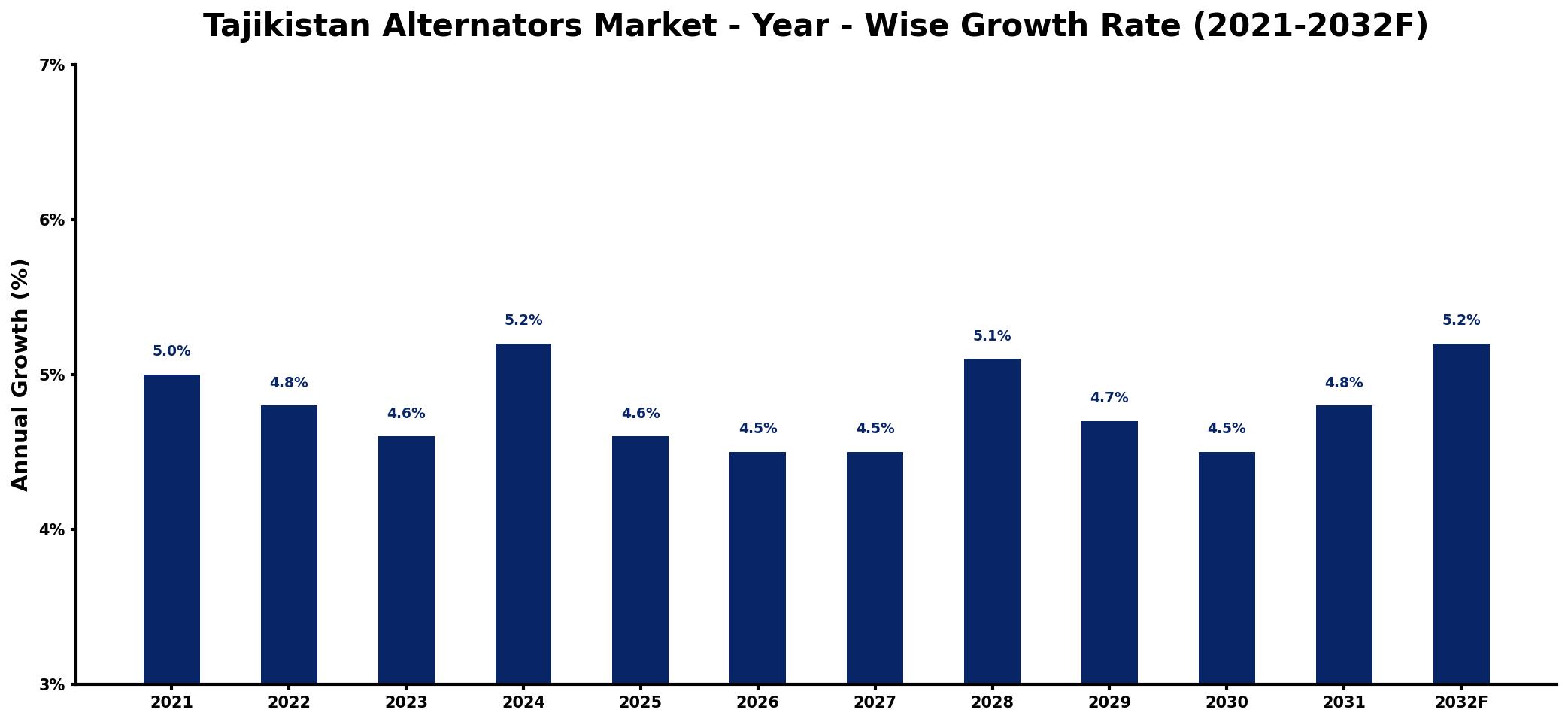
The table below presents the year‑wise growth rates along with the key drivers influencing the market
| Year | Growth Rate | Major Drivers |
| 2021 | 5.0% | Rising demand for renewable energy |
| 2022 | 4.8% | Increased automotive production rates |
| 2023 | 4.6% | Expansion of industrial sectors |
| 2024 | 5.2% | Growth in electric vehicle market |
| 2025 | 4.6% | Investment in infrastructure development |
| 2026 | 4.5% | Surge in energy efficiency initiatives |
| 2027 | 4.5% | Boost in construction activities |
| 2028 | 5.1% | Enhancement of public transportation systems |
| 2029 | 4.7% | Growing agricultural machinery needs |
| 2030 | 4.5% | Development of smart grid technologies |
| 2031 | 4.8% | Rising consumer electronics usage |
| 2032 | 5.2% | Emergence of alternative energy sources |
Note: Market size estimations and growth projections presented in this report are based on 6Wresearch's proprietary forecasting methodology, utilizing the latest available industry data, government publications, and primary research inputs.
Tajikistan Alternators Market Synopsis
A distinctive characteristic of the Tajikistan Alternators Market is the increasing need for reliable power solutions, particularly in remote areas where grid access is limited. The construction and agricultural sectors are particularly driving this demand, as ongoing projects highlight the urgency for efficient power generation.
Moreover, local manufacturers are rising to the challenge by diversifying their offerings, while international players remain a critical part of the landscape. This combination creates a dynamic marketplace where innovation in alternator technology is becoming essential to meet evolving customer expectations.
Tajikistan Alternators Market Key Takeaways
- The market is fueled by increasing investments in infrastructure and energy access initiatives.
- Demand from remote areas for reliable power generation is a primary driver of growth.
- Local manufacturers are collaborating with international firms to enhance product offerings.
- Government policies aim to bolster domestic production while regulating imports.
- Emerging trends include a shift towards energy-efficient and eco-friendly alternators.
Evaluation of Restraints in Tajikistan Alternators Market
Despite positive growth indicators, the Tajikistan Alternators Market faces several constraints that could hinder its potential. Limited access to advanced technology poses a significant barrier for local manufacturers striving to produce high-quality alternators. Additionally, inconsistent electricity supply and the political landscape may create uncertainties for companies looking to operate effectively. Furthermore, local producers face stiff competition from foreign manufacturers that benefit from lower production costs, making it essential for them to innovate and enhance their competitiveness.
Tajikistan Alternators Market Trends
Currently, there is a strong emphasis on developing energy-efficient and environmentally friendly alternator solutions in response to global sustainability trends. The market is also seeing an increased collaboration between local and international manufacturers, which allows for a more extensive range of products to be available. Furthermore, the growing interest in renewable energy sources, particularly hydropower, is expected to significantly influence market dynamics, as stakeholders recognize the advantages of sustainable power generation.
Tajikistan Alternators Market Opportunities
Investment opportunities in the Tajikistan Alternators Market are burgeoning, particularly with the ongoing focus on infrastructure development and energy generation. There is ample scope for supplying alternators for various applications, including residential and industrial setups. Investors can find significant potential in the hydropower sector, where the demand for reliable alternators tailored for hydroelectric facilities is particularly high. Forming partnerships with local manufacturers will also provide valuable insights and access to tailor-made solutions that meet the market's specific needs.
Government Initiatives in the Tajikistan Alternators Market
The government of Tajikistan is actively fostering the growth of the alternators market through several strategic initiatives. Policies aimed at providing incentives and subsidies to local manufacturers help boost production capacities and stimulate the domestic supply of alternators. Import restrictions and tariffs on foreign products are also in place to protect and encourage the development of the local industry. These government efforts are essential for promoting innovation and ensuring adherence to quality and safety standards, paving the way for a robust and competitive market environment.
Future Insights of the Tajikistan Alternators Market
Looking ahead to 2026-2032, the Tajikistan alternators market is poised for significant advancements, driven by ongoing industrialization and infrastructure projects. The increasing demand for reliable power generation solutions across various sectors is expected to remain a key influence. With government initiatives aimed at upgrading the power infrastructure, the market will likely continue attracting investments from both local and international players. However, navigating competitive pressures and economic uncertainties will be crucial for stakeholders to maintain a growth trajectory.
Tajikistan Alternators Market Latest Developments (2025 - 2026)
Recent developments in the Tajikistan alternators market indicate a growing emphasis on innovation and sustainability. Market players are increasingly exploring partnerships to introduce advanced technology in alternator manufacturing. Additionally, government support for local industries continues to strengthen, allowing for better adaptation to the needs of various sectors. With rising awareness around renewable energy, there is a notable uptick in investments focused on eco-friendly power generation solutions.
Tajikistan Alternators Market - Key Attractiveness of the Report
- 10 Years of Market Numbers
- Historical Data Starting from 2022 to 2025
- Base Year: 2025
- Forecast Data until 2032
- Key Performance Indicators Impacting the Market
- Major Upcoming Developments and Projects
Key Highlights of the Report:
- Tajikistan Alternators Market Outlook
- Market Size of Tajikistan Alternators Market, 2025
- Forecast of Tajikistan Alternators Market, 2032
- Historical Data and Forecast of Tajikistan Alternators Revenues & Volume for the Period 2022-2032F
- Tajikistan Alternators Market Trend Evolution
- Tajikistan Alternators Market Drivers and Challenges
- Tajikistan Alternators Price Trends
- Tajikistan Alternators Porter's Five Forces
- Tajikistan Alternators Industry Life Cycle
- Historical Data and Forecast of Tajikistan Alternators Market Revenues & Volume By Type for the Period 2022-2032F
- Historical Data and Forecast of Tajikistan Alternators Market Revenues & Volume By Electro-Magnet (Induction) Alternators for the Period 2022-2032F
- Historical Data and Forecast of Tajikistan Alternators Market Revenues & Volume By Permanent Magnet Alternators for the Period 2022-2032F
- Historical Data and Forecast of Tajikistan Alternators Market Revenues & Volume By Others Alternators for the Period 2022-2032F
- Historical Data and Forecast of Tajikistan Alternators Market Revenues & Volume By Voltage for the Period 2022-2032F
- Historical Data and Forecast of Tajikistan Alternators Market Revenues & Volume By 220V-440V Alternators for the Period 2022-2032F
- Historical Data and Forecast of Tajikistan Alternators Market Revenues & Volume By More than 440V Alternators for the Period 2022-2032F
- Historical Data and Forecast of Tajikistan Alternators Market Revenues & Volume By Less than 220V Alternators for the Period 2022-2032F
- Historical Data and Forecast of Tajikistan Alternators Market Revenues & Volume By Rated Power for the Period 2022-2032F
- Historical Data and Forecast of Tajikistan Alternators Market Revenues & Volume By <1kW for the Period 2022-2032F
- Historical Data and Forecast of Tajikistan Alternators Market Revenues & Volume By 1 kW-5 kW for the Period 2022-2032F
- Historical Data and Forecast of Tajikistan Alternators Market Revenues & Volume By 5 kW-50 kW for the Period 2022-2032F
- Historical Data and Forecast of Tajikistan Alternators Market Revenues & Volume By <50KW-500 kW for the Period 2022-2032F
- Historical Data and Forecast of Tajikistan Alternators Market Revenues & Volume By 500KW-1500 kW for the Period 2022-2032F
- Historical Data and Forecast of Tajikistan Alternators Market Revenues & Volume By 1500KW-5000 kW for the Period 2022-2032F
- Historical Data and Forecast of Tajikistan Alternators Market Revenues & Volume By >5000KW for the Period 2022-2032F
- Historical Data and Forecast of Tajikistan Alternators Market Revenues & Volume By Application for the Period 2022-2032F
- Historical Data and Forecast of Tajikistan Alternators Market Revenues & Volume By Industrial Applications for the Period 2022-2032F
- Historical Data and Forecast of Tajikistan Alternators Market Revenues & Volume By Automotive and Transportation for the Period 2022-2032F
- Historical Data and Forecast of Tajikistan Alternators Market Revenues & Volume By Power Generation for the Period 2022-2032F
- Historical Data and Forecast of Tajikistan Alternators Market Revenues & Volume By Standby Power for the Period 2022-2032F
- Historical Data and Forecast of Tajikistan Alternators Market Revenues & Volume By Others for the Period 2022-2032F
- Historical Data and Forecast of Tajikistan Alternators Market Revenues & Volume By Speed for the Period 2022-2032F
- Historical Data and Forecast of Tajikistan Alternators Market Revenues & Volume By Low Speed Alternators for the Period 2022-2032F
- Historical Data and Forecast of Tajikistan Alternators Market Revenues & Volume By Medium Speed Alternators for the Period 2022-2032F
- Historical Data and Forecast of Tajikistan Alternators Market Revenues & Volume By High Speed Alternators for the Period 2022-2032F
- Historical Data and Forecast of Tajikistan Alternators Market Revenues & Volume By Ultra High-Speed Alternators for the Period 2022-2032F
- Historical Data and Forecast of Tajikistan Alternators Market Revenues & Volume By Weight for the Period 2022-2032F
- Historical Data and Forecast of Tajikistan Alternators Market Revenues & Volume By Low Weight Alternators for the Period 2022-2032F
- Historical Data and Forecast of Tajikistan Alternators Market Revenues & Volume By Medium Weight Alternators for the Period 2022-2032F
- Historical Data and Forecast of Tajikistan Alternators Market Revenues & Volume By High Weight Alternators for the Period 2022-2032F
- Historical Data and Forecast of Tajikistan Alternators Market Revenues & Volume By End-Use Sector for the Period 2022-2032F
- Historical Data and Forecast of Tajikistan Alternators Market Revenues & Volume By Industrial for the Period 2022-2032F
- Historical Data and Forecast of Tajikistan Alternators Market Revenues & Volume By Commercial for the Period 2022-2032F
- Historical Data and Forecast of Tajikistan Alternators Market Revenues & Volume By Residential for the Period 2022-2032F
- Historical Data and Forecast of Tajikistan Alternators Market Revenues & Volume By Fuel Used for the Period 2022-2032F
- Historical Data and Forecast of Tajikistan Alternators Market Revenues & Volume By Fossil fuel for the Period 2022-2032F
- Historical Data and Forecast of Tajikistan Alternators Market Revenues & Volume By Natural for the Period 2022-2032F
- Tajikistan Alternators Import Export Trade Statistics
- Market Opportunity Assessment By Type
- Market Opportunity Assessment By Voltage
- Market Opportunity Assessment By Rated Power
- Market Opportunity Assessment By Application
- Market Opportunity Assessment By Speed
- Market Opportunity Assessment By Weight
- Market Opportunity Assessment By End-Use Sector
- Market Opportunity Assessment By Fuel Used
- Tajikistan Alternators Top Companies Market Share
- Tajikistan Alternators Competitive Benchmarking By Technical and Operational Parameters
- Tajikistan Alternators Company Profiles
- Tajikistan Alternators Key Strategic Recommendations






































