Tajikistan Amoxicillin Market Size, Share & Growth Rate
The Tajikistan Amoxicillin Market was estimated at USD 817 Million in 2025 and is projected to reach USD 1183 Million by 2032, growing at a CAGR of 5.4% from 2026 to 2032. This promising trajectory is primarily driven by the escalating prevalence of bacterial infections and an improved healthcare infrastructure that enhances accessibility to antibiotics. The rising awareness surrounding the efficacy of Amoxicillin in treating common infections further propels its demand, indicating a strong growth potential in the upcoming years.
Tajikistan Amoxicillin Market Year-wise Growth Rate and Key Drivers
This graph highlights how the Tajikistan Amoxicillin Market has steadily grown over the years, supported by major growth factors.
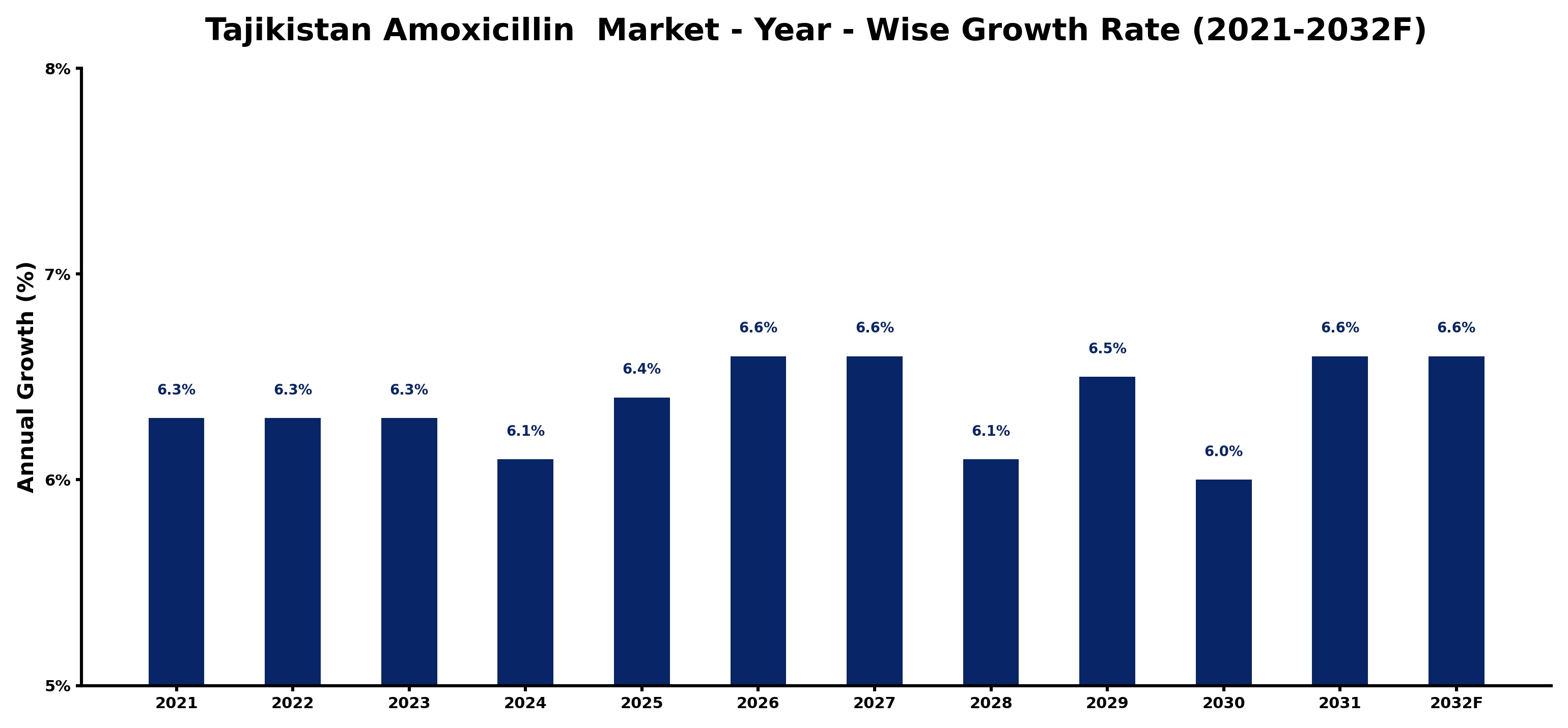
The table below presents the year‑wise growth rates along with the key drivers influencing the market
| Year | Growth Rate | Major Drivers |
| 2021 | 6.3% | New pharmaceutical facility construction boosts local amoxicillin production capacity |
| 2022 | 6.3% | Local pharmaceutical manufacturers adopt advanced robotics for amoxicillin production |
| 2023 | 6.3% | Pharmaceutical supply chain investments boosted amoxicillin production capacity |
| 2024 | 6.1% | Amoxicillin production line upgrades boost overall manufacturing efficiency |
| 2025 | 6.4% | Manufacturing investments boosted local amoxicillin production capabilities significantly |
| 2026 | 6.6% | Domestic pharmaceutical firms boost production capacity for amoxicillin exports |
| 2027 | 6.6% | Pharmaceutical manufacturing investments boost Tajikistan's amoxicillin production capabilities |
| 2028 | 6.1% | Pharmaceutical manufacturing upgrades drive Amoxicillin production capacity expansion |
| 2029 | 6.5% | Production scaling in local pharmacies boosted amoxicillin distribution channels |
| 2030 | 6.0% | Improved Amoxicillin manufacturing capacity drives export market competitiveness |
| 2031 | 6.6% | Domestic pharmaceutical firms expand amoxicillin production to meet demand |
| 2032 | 6.6% | Foreign investment in pharmaceutical facilities boosts amoxicillin production capacity |
Note - Market size estimations and growth projections presented in this report are based on 6Wresearch's advanced forecasting approach, validated with industry datasets as of June 2026.
Tajikistan Amoxicillin Market Synopsis
Recent momentum in the Tajikistan Amoxicillin market has seen a rise in prescriptions, reflecting an increasing reliance on this crucial antibiotic. As the market heads toward a more robust expansion phase, the shift towards generic options and enhanced healthcare initiatives are expected to redefine the landscape, improving patient access to quality medications.
While the current market enjoys a growth spurt fueled by awareness and healthcare improvements, future dynamics may involve addressing existing challenges such as counterfeit products. Ensuring safety and efficacy will be vital as stakeholders navigate the complexities of this evolving market, reinforcing the importance of regulatory frameworks and public education.
Tajikistan Amoxicillin Market Key Takeaways
- Growing demand for Amoxicillin is driven by high bacterial infection rates in Tajikistan.
- Increased focus on generic Amoxicillin to enhance affordability and access.
- Government initiatives are supporting local production and improving distribution networks.
- Quality control measures are essential in combating counterfeit and substandard products.
- The market is poised for steady growth, with significant investment opportunities on the horizon.
Evaluation of Restraints in Tajikistan Amoxicillin Market
Despite its potential, the Tajikistan Amoxicillin market faces notable restraints. The prevalence of counterfeit and substandard products poses significant health risks, undermining the overall trust in pharmaceuticals. Moreover, regulatory oversight remains inadequate, which complicates the enforcement of safety standards. The lack of awareness among consumers and healthcare professionals about the importance of sourcing quality medications further exacerbates these issues, threatening the integrity of the market. Addressing these challenges will require concerted efforts from various stakeholders, including government agencies, manufacturers, and healthcare providers.
Tajikistan Amoxicillin Market Trends
In the Tajikistan Amoxicillin market, a significant trend is the increasing preference for generic formulations due to their affordability. This shift aligns with the broader global movement towards cost-effective healthcare solutions. Moreover, there is an emerging emphasis on integrating Amoxicillin into primary healthcare settings, enabling more effective management of common bacterial infections. As healthcare providers become more aware of the antibiotic's benefits, the commitment to quality control will play a crucial role in shaping the landscape.
Tajikistan Amoxicillin Market Opportunities
The Tajikistan Amoxicillin market presents several lucrative investment opportunities. With the rising demand for antibiotics, manufacturers and importers can thrive by introducing quality products that meet local needs. Collaborations with local pharmaceutical companies could enhance distribution efficiency, while partnerships with government health programs might facilitate access to underserved communities. Additionally, investing in educational initiatives can foster awareness about the importance of quality medications, ultimately contributing to better health outcomes across the population.
Government Initiatives in the Tajikistan Amoxicillin Market
The Tajikistan government has been proactive in implementing policies to enhance the Amoxicillin market. Regulations governing the importation and distribution of pharmaceuticals aim to ensure that safety and quality standards are met. Initiatives promoting local production of antibiotics are also pivotal in reducing reliance on imports and improving access to essential medicines. These efforts are complemented by measures to regulate antibiotic pricing, ensuring that patients can afford necessary treatments while safeguarding public health.
Future Insights of the Tajikistan Amoxicillin Market
Looking ahead to 2026-2032, the Tajikistan Amoxicillin market is poised for notable developments. Factors such as ongoing healthcare infrastructure improvements, increased public awareness about antibiotic use, and a growing population will likely sustain market growth. However, the ongoing battle against counterfeit products and the establishment of more robust regulatory frameworks will be critical to ensuring that this growth trajectory is both sustainable and beneficial to public health. As the market evolves, stakeholders must remain vigilant in addressing challenges while capitalizing on opportunities for expansion.
Tajikistan Amoxicillin Market Latest Developments (May 2025 - June 2026)
Recent developments in the Tajikistan Amoxicillin market include heightened regulatory scrutiny aimed at combating counterfeit products and ensuring quality control among manufacturers. Initiatives focused on increasing local production capabilities have also gained momentum, aligning with the government's efforts to enhance the accessibility of essential medications. Concurrently, awareness campaigns targeted at healthcare providers and consumers are underway to emphasize the importance of using quality antibiotics effectively.
Tajikistan Amoxicillin Market - Key Attractiveness of the Report
- 10 Years of Market Numbers
- Historical Data Starting from 2022 to 2025
- Base Year: 2025
- Forecast Data until 2032
- Key Performance Indicators Impacting the Market
- Major Upcoming Developments and Projects
Key Highlights of the Report:
- Tajikistan Amoxicillin Market Outlook
- Market Size of Tajikistan Amoxicillin Market, 2025
- Forecast of Tajikistan Amoxicillin Market, 2032
- Historical Data and Forecast of Tajikistan Amoxicillin Revenues & Volume for the Period 2022-2032F
- Tajikistan Amoxicillin Market Trend Evolution
- Tajikistan Amoxicillin Market Drivers and Challenges
- Tajikistan Amoxicillin Price Trends
- Tajikistan Amoxicillin Porter's Five Forces
- Tajikistan Amoxicillin Industry Life Cycle
- Historical Data and Forecast of Tajikistan Amoxicillin Market Revenues & Volume By Infection Type for the Period 2022-2032F
- Historical Data and Forecast of Tajikistan Amoxicillin Market Revenues & Volume By Skin Infections for the Period 2022-2032F
- Historical Data and Forecast of Tajikistan Amoxicillin Market Revenues & Volume By ENT (Ear, Nose & Throat) Infections for the Period 2022-2032F
- Historical Data and Forecast of Tajikistan Amoxicillin Market Revenues & Volume By Stomach Infections for the Period 2022-2032F
- Historical Data and Forecast of Tajikistan Amoxicillin Market Revenues & Volume By Lungs Infections for the Period 2022-2032F
- Historical Data and Forecast of Tajikistan Amoxicillin Market Revenues & Volume By Urinary tract infections (UTI) for the Period 2022-2032F
- Historical Data and Forecast of Tajikistan Amoxicillin Market Revenues & Volume By Pneumonia for the Period 2022-2032F
- Historical Data and Forecast of Tajikistan Amoxicillin Market Revenues & Volume By Bronchitis for the Period 2022-2032F
- Historical Data and Forecast of Tajikistan Skin Infections Amoxicillin Market Revenues & Volume By Gonorrhea for the Period 2022-2032F
- Historical Data and Forecast of Tajikistan Amoxicillin Market Revenues & Volume By Route of Administration for the Period 2022-2032F
- Historical Data and Forecast of Tajikistan Amoxicillin Market Revenues & Volume By Oral for the Period 2022-2032F
- Historical Data and Forecast of Tajikistan Amoxicillin Market Revenues & Volume By Intravenous for the Period 2022-2032F
- Historical Data and Forecast of Tajikistan Amoxicillin Market Revenues & Volume By Form for the Period 2022-2032F
- Historical Data and Forecast of Tajikistan Amoxicillin Market Revenues & Volume By Tablets for the Period 2022-2032F
- Historical Data and Forecast of Tajikistan Amoxicillin Market Revenues & Volume By Capsule for the Period 2022-2032F
- Historical Data and Forecast of Tajikistan Amoxicillin Market Revenues & Volume By Suspensions for the Period 2022-2032F
- Historical Data and Forecast of Tajikistan Amoxicillin Market Revenues & Volume By Syrup for the Period 2022-2032F
- Historical Data and Forecast of Tajikistan Amoxicillin Market Revenues & Volume By Powder for the Period 2022-2032F
- Historical Data and Forecast of Tajikistan Amoxicillin Market Revenues & Volume By Distribution Channel for the Period 2022-2032F
- Historical Data and Forecast of Tajikistan Amoxicillin Market Revenues & Volume By Hospitals Pharmacies for the Period 2022-2032F
- Historical Data and Forecast of Tajikistan Amoxicillin Market Revenues & Volume By Retail Pharmacies for the Period 2022-2032F
- Historical Data and Forecast of Tajikistan Amoxicillin Market Revenues & Volume By Online Pharmacies for the Period 2022-2032F
- Historical Data and Forecast of Tajikistan Amoxicillin Market Revenues & Volume By Others for the Period 2022-2032F
- Tajikistan Amoxicillin Import Export Trade Statistics
- Market Opportunity Assessment By Infection Type
- Market Opportunity Assessment By Route of Administration
- Market Opportunity Assessment By Form
- Market Opportunity Assessment By Distribution Channel
- Tajikistan Amoxicillin Top Companies Market Share
- Tajikistan Amoxicillin Competitive Benchmarking By Technical and Operational Parameters
- Tajikistan Amoxicillin Company Profiles
- Tajikistan Amoxicillin Key Strategic Recommendations






































