Tajikistan Bamboo Products Market Size, Share & Growth Rate
The Tajikistan Bamboo Products Market was estimated at USD 318 Million in 2025 and is projected to reach USD 441 Million by 2032, growing at a CAGR of 4.8% from 2026 to 2032. This growth trajectory is propelled by increasing consumer demand for eco-friendly alternatives to traditional materials, coupled with a growing recognition of the environmental benefits associated with bamboo. Factors such as innovative product designs and an expanding range of bamboo applications are further enhancing market prospects.
Tajikistan Bamboo Products Market Year-wise Growth Rate and Key Drivers
This graph highlights how the Tajikistan Bamboo Products Market has steadily grown over the years, supported by major growth factors.
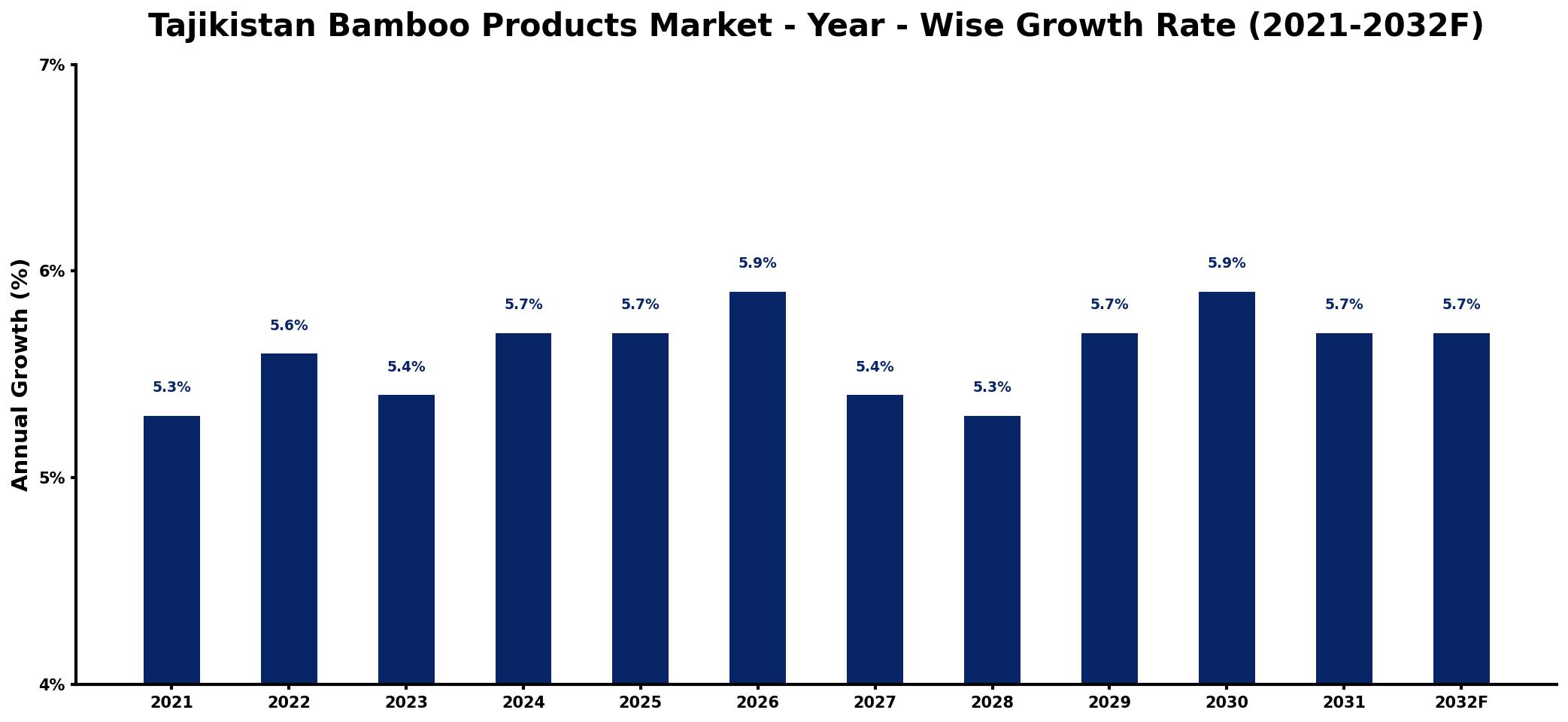
The table below presents the year‑wise growth rates along with the key drivers influencing the market
| Year | Growth Rate | Major Drivers |
| 2021 | 5.3% | Rising eco-friendly material demand |
| 2022 | 5.6% | Increased investments in sustainability |
| 2023 | 5.4% | Growing popularity in construction sector |
| 2024 | 5.7% | Expansion of green building initiatives |
| 2025 | 5.7% | Higher consumer awareness on sustainability |
| 2026 | 5.9% | Boost in local manufacturing capabilities |
| 2027 | 5.4% | Emergence of new export markets |
| 2028 | 5.3% | Increased government support for innovation |
| 2029 | 5.7% | Surge in urbanization trends |
| 2030 | 5.9% | Growth in renewable resource initiatives |
| 2031 | 5.7% | Enhanced distribution network efficiencies |
| 2032 | 5.7% | Rising demand for eco-friendly alternatives |
Note: Market size estimations and growth projections presented in this report are based on 6Wresearch's proprietary forecasting methodology, utilizing the latest available industry data, government publications, and primary research inputs.
Tajikistan Bamboo Products Market Synopsis
The most significant force shaping the Tajikistan Bamboo Products Market is the rising consumer preference for sustainable and eco-friendly products. Awareness of the environmental impact of traditional materials is fostering a shift towards bamboo, known for its rapid growth and biodegradability.
Local artisans and businesses are increasingly tapping into this trend, producing a diverse range of high-quality bamboo products. From furniture to textiles, these offerings showcase not only the durability of bamboo but also its aesthetic appeal, capturing the attention of both domestic consumers and potential export markets.
Tajikistan Bamboo Products Market Key Takeaways
- The market is projected to grow from USD 318 Million in 2025 to USD 441 Million by 2032.
- Increasing demand for eco-friendly products is driving market growth.
- Local artisans play a crucial role in developing unique, high-quality bamboo items.
- The government supports the bamboo sector through policies promoting sustainable practices.
- Investment in bamboo cultivation and processing facilities presents lucrative opportunities.
Evaluation of Restraints in Tajikistan Bamboo Products Market
Despite the growth potential, the Tajikistan Bamboo Products Market faces notable constraints. One major challenge is the limited consumer awareness regarding the benefits and applications of bamboo. Many consumers are still unaware of bamboo's advantages over conventional materials, which can stifle market growth. Additionally, insufficient infrastructure for the cultivation, processing, and distribution of bamboo presents logistical hurdles that inhibit efficiency. Combined with the competition from established materials and fluctuating raw material prices, these factors complicate the landscape for businesses looking to succeed in this market.
Tajikistan Bamboo Products Market Trends
The current trends within the Tajikistan Bamboo Products Market indicate a strong shift towards innovative designs and an expanding variety of products. Consumers are increasingly seeking alternatives to plastic and metal, which is propelling the demand for bamboo kitchenware, furniture, and decorative items. Manufacturers are responding by leveraging the renewable nature of bamboo to create stylish and functional products that resonate with environmentally conscious buyers. Moreover, the aesthetic versatility of bamboo is becoming a crucial selling point in home decor and construction applications.
Tajikistan Bamboo Products Market Opportunities
The opportunities for growth in the Tajikistan Bamboo Products Market are abundant. With a global trend favoring sustainable and eco-friendly materials, investments in bamboo plantations for raw material sourcing are becoming increasingly attractive. Establishing processing facilities to enhance local production capabilities can also yield substantial returns. Furthermore, as international markets increasingly demand green products, promoting Tajikistan's bamboo offerings abroad could significantly boost market growth and profitability.
Government Initiatives in the Tajikistan Bamboo Products Market
The Tajikistan government is actively fostering the bamboo products sector through various supportive policies aimed at sustainable economic growth. These policies include providing financial incentives and subsidies to stimulate the production and export of bamboo goods. Additionally, regulations are being implemented to ensure the sustainable management of bamboo resources. The government is also investing in research and development to enhance the quality and innovation of bamboo products, further solidifying the sector's foundation for future growth.
Future Insights of the Tajikistan Bamboo Products Market
Looking ahead to 2026-2032, the future of the Tajikistan Bamboo Products Market appears bright. As consumer consciousness about sustainability rises, bamboos appeal is expected to further grow due to its renewable characteristics and durability. The government's ongoing support for sustainable practices, combined with increasing awareness of bamboo's environmental benefits, is likely to drive market expansion. Key sectors, particularly furniture and handicrafts, are expected to flourish, presenting avenues for both domestic and export growth.
Tajikistan Bamboo Products Market Latest Developments (2025 - 2026)
Recently, there has been a notable shift in industry direction as local producers collaborate with international partners to enhance design and production capabilities. Innovations in product offerings are emerging, with an emphasis on sustainability and aesthetics. Additionally, public awareness campaigns aimed at educating consumers about the benefits of bamboo products have gained traction, paving the way for increased acceptance and demand in the market.
Tajikistan Bamboo Products Market - Key Attractiveness of the Report
- 10 Years of Market Numbers
- Historical Data Starting from 2022 to 2025
- Base Year: 2025
- Forecast Data until 2032
- Key Performance Indicators Impacting the Market
- Major Upcoming Developments and Projects
Key Highlights of the Report:
- Tajikistan Bamboo Products Market Outlook
- Market Size of Tajikistan Bamboo Products Market, 2025
- Forecast of Tajikistan Bamboo Products Market, 2032
- Historical Data and Forecast of Tajikistan Bamboo Products Revenues & Volume for the Period 2022-2032F
- Tajikistan Bamboo Products Market Trend Evolution
- Tajikistan Bamboo Products Market Drivers and Challenges
- Tajikistan Bamboo Products Price Trends
- Tajikistan Bamboo Products Porter's Five Forces
- Tajikistan Bamboo Products Industry Life Cycle
- Historical Data and Forecast of Tajikistan Bamboo Products Market Revenues & Volume By Species for the Period 2022-2032F
- Historical Data and Forecast of Tajikistan Bamboo Products Market Revenues & Volume By Bambusa Tulda for the Period 2022-2032F
- Historical Data and Forecast of Tajikistan Bamboo Products Market Revenues & Volume By Bambusa Bambos for the Period 2022-2032F
- Historical Data and Forecast of Tajikistan Bamboo Products Market Revenues & Volume By Dendrocalamus Strictus for the Period 2022-2032F
- Historical Data and Forecast of Tajikistan Bamboo Products Market Revenues & Volume By Others for the Period 2022-2032F
- Historical Data and Forecast of Tajikistan Bamboo Products Market Revenues & Volume By Application for the Period 2022-2032F
- Historical Data and Forecast of Tajikistan Bamboo Products Market Revenues & Volume By Raw Material for the Period 2022-2032F
- Historical Data and Forecast of Tajikistan Bamboo Products Market Revenues & Volume By Industrial Products for the Period 2022-2032F
- Historical Data and Forecast of Tajikistan Bamboo Products Market Revenues & Volume By Furniture for the Period 2022-2032F
- Historical Data and Forecast of Tajikistan Bamboo Products Market Revenues & Volume By Shoots for the Period 2022-2032F
- Historical Data and Forecast of Tajikistan Bamboo Products Market Revenues & Volume By Others for the Period 2022-2032F
- Historical Data and Forecast of Tajikistan Bamboo Products Market Revenues & Volume By End User Industry for the Period 2022-2032F
- Historical Data and Forecast of Tajikistan Bamboo Products Market Revenues & Volume By Wood and Furniture for the Period 2022-2032F
- Historical Data and Forecast of Tajikistan Bamboo Products Market Revenues & Volume By Construction for the Period 2022-2032F
- Historical Data and Forecast of Tajikistan Bamboo Products Market Revenues & Volume By Paper and Pulp for the Period 2022-2032F
- Historical Data and Forecast of Tajikistan Bamboo Products Market Revenues & Volume By Chopsticks for the Period 2022-2032F
- Historical Data and Forecast of Tajikistan Bamboo Products Market Revenues & Volume By Toothpicks for the Period 2022-2032F
- Tajikistan Bamboo Products Import Export Trade Statistics
- Market Opportunity Assessment By Species
- Market Opportunity Assessment By Application
- Market Opportunity Assessment By End User Industry
- Tajikistan Bamboo Products Top Companies Market Share
- Tajikistan Bamboo Products Competitive Benchmarking By Technical and Operational Parameters
- Tajikistan Bamboo Products Company Profiles
- Tajikistan Bamboo Products Key Strategic Recommendations






































