Tajikistan BBQ Charcoal Market Size, Share & Growth Rate
The Tajikistan BBQ Charcoal Market was estimated at USD 454 Million in 2025 and is projected to reach USD 606 Million by 2032, growing at a CAGR of 4.2% from 2026 to 2032. This growth trajectory is primarily fueled by a rising interest in outdoor cooking, particularly grilling and picnicking, as more consumers embrace social gatherings and culinary experiences. Additionally, increased disposable incomes are driving the demand for higher quality, eco-friendly charcoal options, further stimulating market expansion.
Tajikistan BBQ Charcoal Market Year-wise Growth Rate and Key Drivers
This graph highlights how the Tajikistan BBQ Charcoal Market has steadily grown over the years, supported by major growth factors.
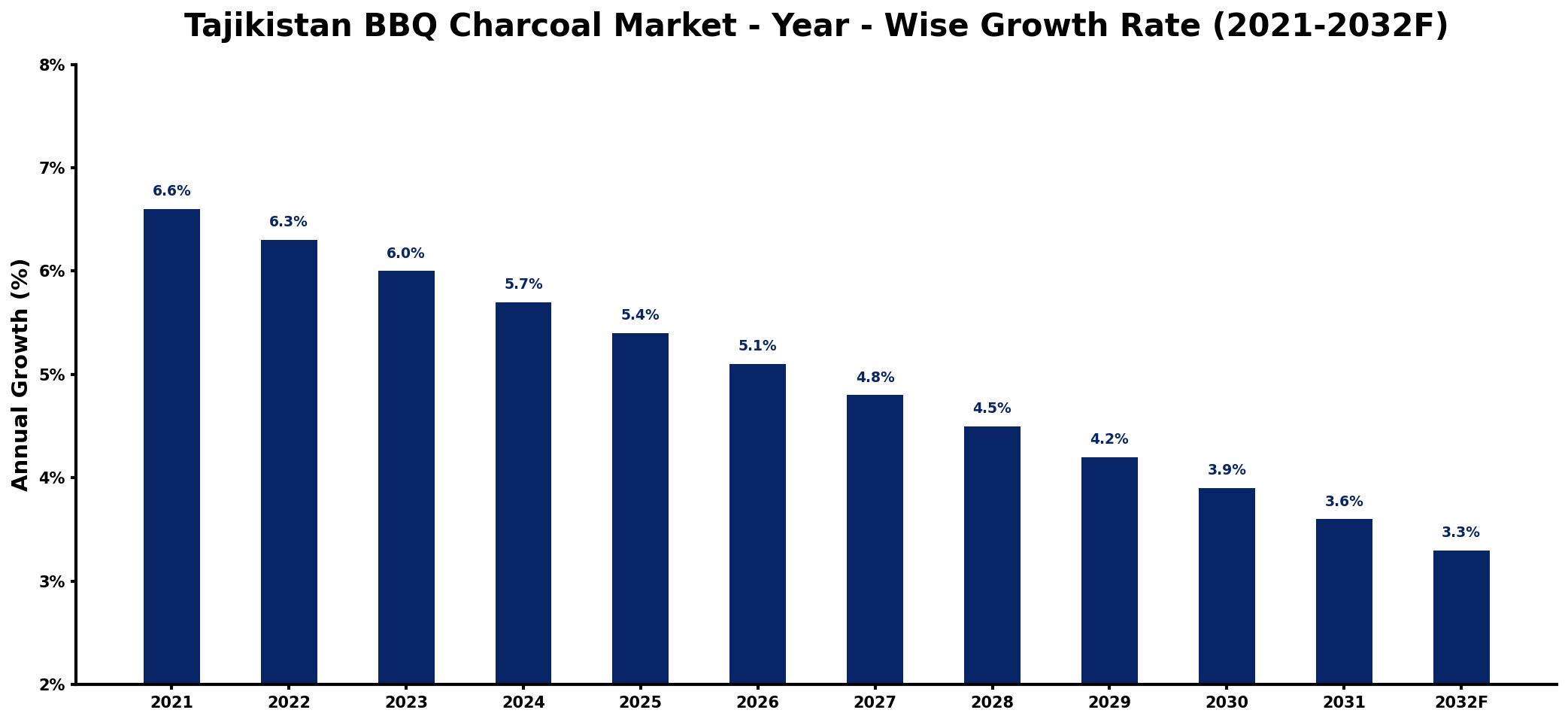
The table below presents the year‑wise growth rates along with the key drivers influencing the market
| Year | Growth Rate | Major Drivers |
| 2021 | 6.6% | Rising outdoor cooking popularity |
| 2022 | 6.3% | Increased consumer spending habits |
| 2023 | 6.0% | Expansion of retail distribution networks |
| 2024 | 5.7% | Growth in home entertainment trends |
| 2025 | 5.4% | Surge in tourism and hospitality |
| 2026 | 5.1% | Investment in sustainable sourcing initiatives |
| 2027 | 4.8% | Emergence of gourmet cooking experiences |
| 2028 | 4.5% | Development of new grilling technologies |
| 2029 | 4.2% | Popularity of backyard gatherings |
| 2030 | 3.9% | Enhancements in urban living spaces |
| 2031 | 3.6% | Shift towards eco-friendly products |
| 2032 | 3.3% | Focus on health-conscious cooking methods |
Note: Market size estimations and growth projections presented in this report are based on 6Wresearch's proprietary forecasting methodology, utilizing the latest available industry data, government publications, and primary research inputs.
Tajikistan BBQ Charcoal Market Synopsis
The demand for high-quality BBQ charcoal in Tajikistan is on the rise, largely influenced by the growing popularity of outdoor grilling. Consumers are increasingly seeking products that offer consistent heat, longevity, and minimal ash residue, which enhances their overall grilling experience. Local manufacturers leverage traditional methods, utilizing hardwood sourced from sustainable forests, ensuring an eco-friendly approach to charcoal production.
The competitive landscape is marked by a mix of domestic producers and imported brands, each vying for market share. Marketing strategies often highlight the natural aspects of charcoal products, appealing to environmentally conscious consumers. This dynamic encourages innovation in product quality and packaging as manufacturers aim to meet evolving consumer preferences.
Tajikistan BBQ Charcoal Market Key Takeaways
- The market is experiencing a robust growth fueled by the increasing popularity of outdoor cooking and grilling.
- There is a notable consumer shift towards high-quality, sustainable, and eco-friendly charcoal options.
- Challenges include inconsistent product quality and competition from alternative cooking fuels.
- Investment opportunities are present in local production facilities and premium product imports.
- Government policies support sustainable sourcing and quality assurance in charcoal manufacturing.
Evaluation of Restraints in Tajikistan BBQ Charcoal Market
Despite promising growth, the Tajikistan BBQ charcoal market faces several notable restraints. One significant challenge is the inconsistency in charcoal quality, often stemming from limited production capacities and reliance on traditional methods. Moreover, the rise of alternative fuels like gas and electric grills presents competitive pressures that can affect market demand. Infrastructure constraints, such as poor transportation networks and insufficient storage facilities, further complicate the distribution of charcoal products, limiting access and availability across different regions of the country. Economic volatility, including fluctuating exchange rates, can impact pricing, making quality charcoal less affordable for consumers.
Tajikistan BBQ Charcoal Market Trends
Current trends in the Tajikistan BBQ charcoal market reflect a growing preference for convenience and sustainability. Consumers are increasingly drawn to instant-light charcoal briquettes, which offer ease of use alongside consistent performance. Furthermore, the demand for environmentally friendly options, such as coconut shell charcoal and sustainably sourced hardwood, is rising. Manufacturers are responding by innovating their products to align with these preferences, enhancing quality while also focusing on eco-friendly practices.
Tajikistan BBQ Charcoal Market Opportunities
The market presents several viable investment opportunities, particularly in establishing local production facilities that utilize Tajikistan's rich forestry resources. As outdoor cooking gains popularity, there is a clear demand for premium charcoal products, which opens the door for imports catering to the higher end of the market. Moreover, with consumers increasingly willing to invest in quality, focusing on marketing and distribution strategies that highlight eco-friendly and natural products could yield lucrative returns. Establishing strategic partnerships with suppliers and retailers will also play a critical role in successfully navigating this evolving landscape.
Government Initiatives in the Tajikistan BBQ Charcoal Market
The government of Tajikistan has instituted various policies aimed at regulating and promoting the BBQ charcoal market. These initiatives emphasize the sustainable sourcing of raw materials to prevent deforestation and to encourage responsible environmental practices. Additionally, quality assurance regulations ensure that production processes meet safety standards, which benefits both producers and consumers. By providing incentives and training programs, the government supports local manufacturers, enhancing their competitiveness while safeguarding environmental interests.
Future Insights of the Tajikistan BBQ Charcoal Market
Looking ahead to the period of 2026-2032, the Tajikistan BBQ charcoal market is set for steady growth. Increasing disposable incomes and an enthusiastic shift towards outdoor cooking experiences will drive demand for BBQ charcoal products. The burgeoning tourism sector is also expected to influence this market positively as visitors seek authentic culinary experiences. As consumer preferences evolve towards natural and sustainable products, manufacturers will need to focus on innovation, quality improvements, and sustainable practices to stay competitive in a rapidly changing landscape.
Tajikistan BBQ Charcoal Market Latest Developments (2025 - 2026)
Recent developments in the Tajikistan BBQ charcoal market indicate a growing emphasis on product innovation and sustainability. Local manufacturers are exploring advanced production techniques to enhance the quality of their offerings, while marketing strategies increasingly highlight eco-friendly attributes to attract environmentally conscious consumers. There is also a noted increase in promotional campaigns focused on educating consumers about the benefits of BBQ charcoal, as well as collaborations aimed at improving distribution networks.
Tajikistan BBQ Charcoal Market - Key Attractiveness of the Report
- 10 Years of Market Numbers
- Historical Data Starting from 2022 to 2025
- Base Year: 2025
- Forecast Data until 2032
- Key Performance Indicators Impacting the Market
- Major Upcoming Developments and Projects
Key Highlights of the Report:
- Tajikistan BBQ Charcoal Market Outlook
- Market Size of Tajikistan BBQ Charcoal Market, 2025
- Forecast of Tajikistan BBQ Charcoal Market, 2032
- Historical Data and Forecast of Tajikistan BBQ Charcoal Revenues & Volume for the Period 2022-2032F
- Tajikistan BBQ Charcoal Market Trend Evolution
- Tajikistan BBQ Charcoal Market Drivers and Challenges
- Tajikistan BBQ Charcoal Price Trends
- Tajikistan BBQ Charcoal Porter's Five Forces
- Tajikistan BBQ Charcoal Industry Life Cycle
- Historical Data and Forecast of Tajikistan BBQ Charcoal Market Revenues & Volume By Form for the Period 2022-2032F
- Historical Data and Forecast of Tajikistan BBQ Charcoal Market Revenues & Volume By Briquettes BBQ Charcoal for the Period 2022-2032F
- Historical Data and Forecast of Tajikistan BBQ Charcoal Market Revenues & Volume By Lump Wood BBQ Charcoal for the Period 2022-2032F
- Historical Data and Forecast of Tajikistan BBQ Charcoal Market Revenues & Volume By Sales Channel for the Period 2022-2032F
- Historical Data and Forecast of Tajikistan BBQ Charcoal Market Revenues & Volume By Direct BBQ Charcoal Sales for the Period 2022-2032F
- Historical Data and Forecast of Tajikistan BBQ Charcoal Market Revenues & Volume By Retail BBQ Charcoal Sales for the Period 2022-2032F
- Historical Data and Forecast of Tajikistan BBQ Charcoal Market Revenues & Volume By End User for the Period 2022-2032F
- Historical Data and Forecast of Tajikistan BBQ Charcoal Market Revenues & Volume By BBQ Charcoal for Hotels, Restaurants and Catering (HoReCa) for the Period 2022-2032F
- Historical Data and Forecast of Tajikistan BBQ Charcoal Market Revenues & Volume By BBQ Charcoal for Households for the Period 2022-2032F
- Historical Data and Forecast of Tajikistan BBQ Charcoal Market Revenues & Volume By Source for the Period 2022-2032F
- Historical Data and Forecast of Tajikistan BBQ Charcoal Market Revenues & Volume By BBQ Charcoal made from Agricultural Waste for the Period 2022-2032F
- Historical Data and Forecast of Tajikistan BBQ Charcoal Market Revenues & Volume By BBQ Charcoal made from Coconut Shells for the Period 2022-2032F
- Historical Data and Forecast of Tajikistan BBQ Charcoal Market Revenues & Volume By BBQ Charcoal made from Nutshells for the Period 2022-2032F
- Historical Data and Forecast of Tajikistan BBQ Charcoal Market Revenues & Volume By BBQ Charcoal made from Hardwood for the Period 2022-2032F
- Historical Data and Forecast of Tajikistan BBQ Charcoal Market Revenues & Volume By BBQ Charcoal made from Bamboo for the Period 2022-2032F
- Tajikistan BBQ Charcoal Import Export Trade Statistics
- Market Opportunity Assessment By Form
- Market Opportunity Assessment By Sales Channel
- Market Opportunity Assessment By End User
- Market Opportunity Assessment By Source
- Tajikistan BBQ Charcoal Top Companies Market Share
- Tajikistan BBQ Charcoal Competitive Benchmarking By Technical and Operational Parameters
- Tajikistan BBQ Charcoal Company Profiles
- Tajikistan BBQ Charcoal Key Strategic Recommendations






































