Tajikistan Canvas Market Size, Share & Growth Rate
The Tajikistan Canvas Market was estimated at USD 374 Million in 2025 and is projected to reach USD 489 Million by 2032, growing at a CAGR of 3.9% from 2026 to 2032. This growth trajectory is fueled by the rising demand for high-quality canvas materials across various applications, including artistic endeavors, home décor, and outdoor usage. Additionally, the increasing trend of eco-conscious consumerism has stimulated interest in sustainable canvas options, further propelling the market's expansion.
Tajikistan Canvas Market Year-wise Growth Rate and Key Drivers
This graph highlights how the Tajikistan Canvas Market has steadily grown over the years, supported by major growth factors.
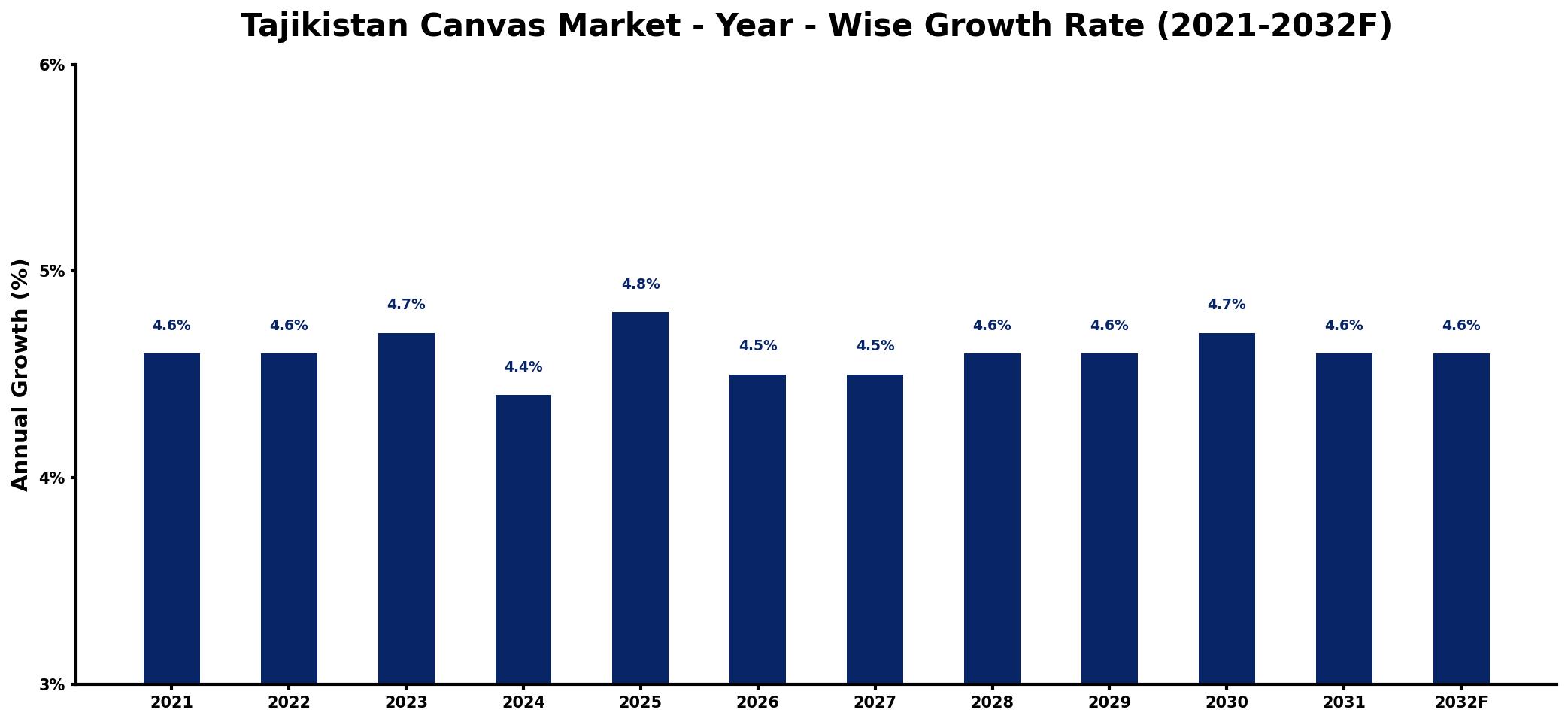
The table below presents the year‑wise growth rates along with the key drivers influencing the market
| Year | Growth Rate | Major Drivers |
| 2021 | 4.6% | Emerging art community initiatives |
| 2022 | 4.6% | Increased tourism and cultural events |
| 2023 | 4.7% | Growing interest in local craftsmanship |
| 2024 | 4.4% | Expansion of educational programs |
| 2025 | 4.8% | Rising disposable income levels |
| 2026 | 4.5% | Strengthened local manufacturing capabilities |
| 2027 | 4.5% | Enhanced digital marketing strategies |
| 2028 | 4.6% | Development of collaborative art spaces |
| 2029 | 4.6% | Diversified product offerings available |
| 2030 | 4.7% | Strengthened international trade agreements |
| 2031 | 4.6% | Increased participation in art fairs |
| 2032 | 4.6% | Growing support for local artists |
Note: Market size estimations and growth projections presented in this report are based on 6Wresearch's proprietary forecasting methodology, utilizing the latest available industry data, government publications, and primary research inputs.
Tajikistan Canvas Market Synopsis
The canvas market in Tajikistan is currently witnessing a surge in demand for high-quality canvas products, driven largely by local artisans and an emerging DIY culture. This interest is not only limited to artistic applications but extends to home décor and outdoor functionalities, showcasing the material's versatility.
Furthermore, the tourism industry in Tajikistan is blossoming, leading to an increased need for durable canvas items such as tents and bags. With both local production and imports catering to this growing demand, the market is poised for a steady upward trajectory.
Tajikistan Canvas Market Key Takeaways
- The market is driven by high demand from local artisans and growing interest in DIY projects.
- Consumer preferences are shifting towards sustainable, eco-friendly canvas options.
- Tourism growth in Tajikistan is catalyzing demand for outdoor canvas gear.
- Customization and digital printing are emerging trends influencing market dynamics.
- Investment opportunities exist in manufacturing and retail sectors for canvas products.
Evaluation of Restraints in Tajikistan Canvas Market
Despite its potential, the Tajikistan canvas market faces significant challenges. One of the foremost constraints is the limited availability of high-quality raw materials, as local production often relies on imports, which can introduce inconsistencies and elevate costs. Additionally, the outdated technology in local manufacturing facilities hampers efficiency and competitiveness, restricting the market's ability to fully meet growing consumer demands. Compounding these issues is a shortage of skilled labor and inadequate infrastructure, which affect the supply chain and overall market responsiveness.
Tajikistan Canvas Market Trends
The Tajikistan canvas market is undergoing transformation, primarily marked by a heightened consumer inclination towards environmentally friendly products. Organic and recycled canvas materials are gaining traction as sustainability becomes a critical focus for consumers. Moreover, the personalization trend is evident, with more consumers seeking unique, bespoke designs that reflect individual tastes. The advent of digital printing technology is enabling intricate and customized designs, thus enriching the consumer experience in both artistic and practical applications.
Tajikistan Canvas Market Opportunities
The canvas market in Tajikistan presents compelling investment opportunities across various sectors. With a growing demand for canvas products in construction and agriculture, investments in local manufacturing facilities could yield significant returns. Furthermore, developing distribution channels and retail outlets will be vital in meeting the consumer thirst for quality canvas goods. Collaborations with local artists and designers to create culturally resonant products can also enhance market appeal and profitability.
Government Initiatives in the Tajikistan Canvas Market
The Tajikistan government is proactively supporting the canvas market through policies aimed at bolstering domestic production and reducing import dependency. Subsidies and incentives have been extended to local manufacturers, enhancing their competitiveness. Moreover, partnerships with neighboring countries aim to facilitate trade and promote the export of Tajikistani canvas products. Environmental regulations and quality standards are also being implemented to ensure sustainable practices within the industry.
Future Insights of the Tajikistan Canvas Market
Looking ahead to the years 2026-2032, the Tajikistan canvas market is expected to flourish, spurred by diverse applications in construction, agriculture, and the arts. As economic conditions improve and disposable incomes rise, there will be an increased appetite for canvas materials in various sectors. The government's infrastructure investments and commitment to fostering a competitive market will further enhance demand for high-quality canvas products, creating favorable conditions for both local manufacturers and international investors.
Tajikistan Canvas Market Latest Developments (2025 - 2026)
Recently, the Tajikistan canvas market has been experiencing noticeable shifts, with increasing investments in both local manufacturing and sustainable practices. The collaboration between local artists and manufacturers has led to unique product lines that reflect local heritage. Simultaneously, advancements in digital printing technology are making customized canvas options more accessible to a broader audience, enhancing market dynamism.
Tajikistan Canvas Market - Key Attractiveness of the Report
- 10 Years of Market Numbers
- Historical Data Starting from 2022 to 2025
- Base Year: 2025
- Forecast Data until 2032
- Key Performance Indicators Impacting the Market
- Major Upcoming Developments and Projects
Key Highlights of the Report:
- Tajikistan Canvas Market Outlook
- Market Size of Tajikistan Canvas Market, 2025
- Forecast of Tajikistan Canvas Market, 2032
- Historical Data and Forecast of Tajikistan Canvas Revenues & Volume for the Period 2022-2032F
- Tajikistan Canvas Market Trend Evolution
- Tajikistan Canvas Market Drivers and Challenges
- Tajikistan Canvas Price Trends
- Tajikistan Canvas Porter's Five Forces
- Tajikistan Canvas Industry Life Cycle
- Historical Data and Forecast of Tajikistan Canvas Market Revenues & Volume By Types for the Period 2022-2032F
- Historical Data and Forecast of Tajikistan Canvas Market Revenues & Volume By Plane Canvas for the Period 2022-2032F
- Historical Data and Forecast of Tajikistan Canvas Market Revenues & Volume By Duck Canvas for the Period 2022-2032F
- Historical Data and Forecast of Tajikistan Canvas Market Revenues & Volume By Application for the Period 2022-2032F
- Historical Data and Forecast of Tajikistan Canvas Market Revenues & Volume By Tent for the Period 2022-2032F
- Historical Data and Forecast of Tajikistan Canvas Market Revenues & Volume By Luggage Fabric for the Period 2022-2032F
- Historical Data and Forecast of Tajikistan Canvas Market Revenues & Volume By Automotive Fabric for the Period 2022-2032F
- Historical Data and Forecast of Tajikistan Canvas Market Revenues & Volume By Apparel for the Period 2022-2032F
- Historical Data and Forecast of Tajikistan Canvas Market Revenues & Volume By Others for the Period 2022-2032F
- Tajikistan Canvas Import Export Trade Statistics
- Market Opportunity Assessment By Types
- Market Opportunity Assessment By Application
- Tajikistan Canvas Top Companies Market Share
- Tajikistan Canvas Competitive Benchmarking By Technical and Operational Parameters
- Tajikistan Canvas Company Profiles
- Tajikistan Canvas Key Strategic Recommendations






































