Tajikistan Carbon Fibre Market Size, Share & Growth Rate
The Tajikistan Carbon Fibre Market was estimated at USD 441 Million in 2025 and is projected to reach USD 622 Million by 2032, growing at a CAGR of 5.0% from 2026 to 2032. This growth trajectory is fueled by increasing demand across key sectors such as aerospace, automotive, and sporting goods, where the emphasis on lightweight and durable materials is becoming more pronounced. Additionally, government initiatives aimed at enhancing domestic manufacturing capacity are set to bolster local production capabilities, further driving market expansion.
Tajikistan Carbon Fibre Market Year-wise Growth Rate and Key Drivers
This graph highlights how the Tajikistan Carbon Fibre Market has steadily grown over the years, supported by major growth factors.
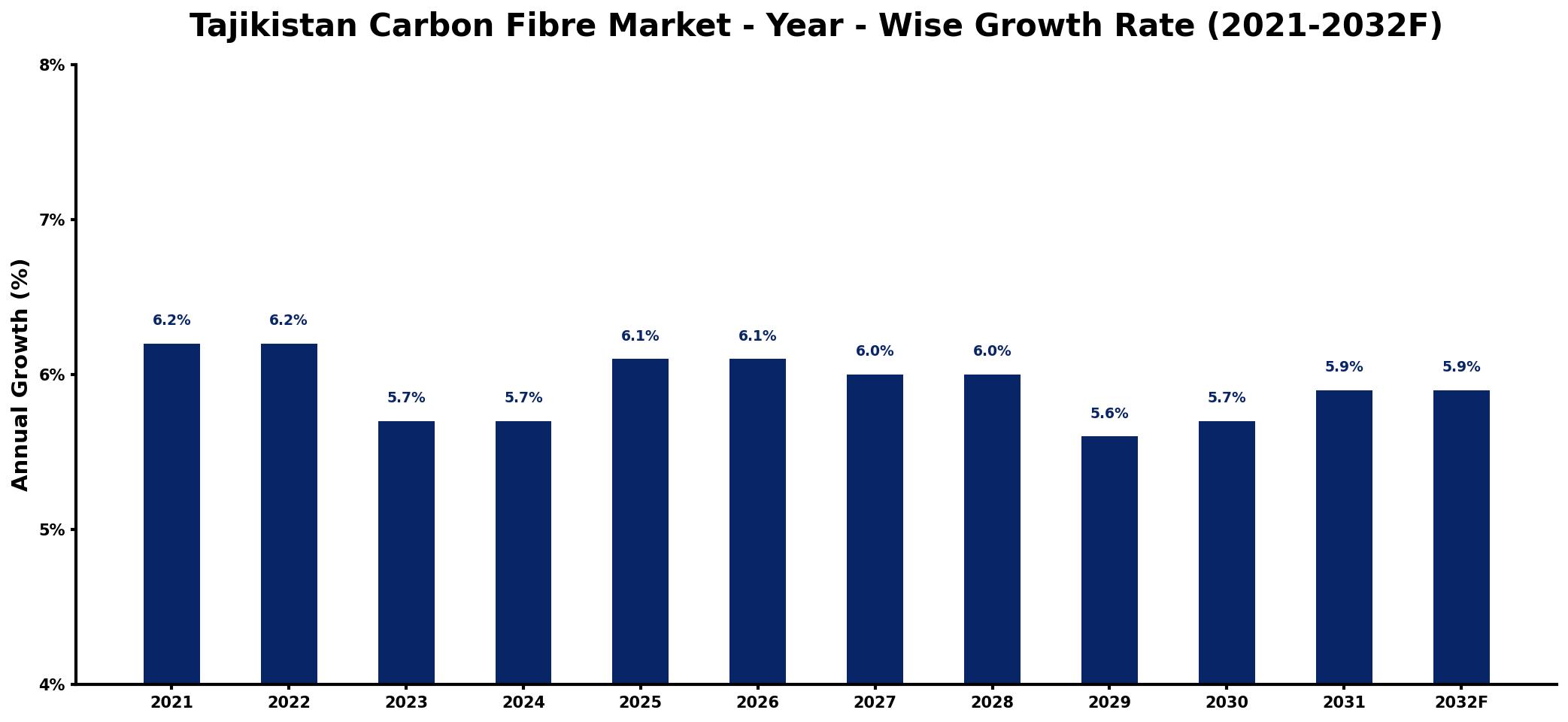
The table below presents the year‑wise growth rates along with the key drivers influencing the market
| Year | Growth Rate | Major Drivers |
| 2021 | 6.2% | Rising aerospace industry investments |
| 2022 | 6.2% | Increased automotive lightweighting initiatives |
| 2023 | 5.7% | Growing demand for renewable energy |
| 2024 | 5.7% | Expansion of construction sector projects |
| 2025 | 6.1% | Technological advancements in manufacturing |
| 2026 | 6.1% | Surge in sporting goods production |
| 2027 | 6.0% | Boost in defense applications funding |
| 2028 | 6.0% | Increased interest in luxury goods |
| 2029 | 5.6% | Higher focus on sustainable practices |
| 2030 | 5.7% | Growth in urban transportation solutions |
| 2031 | 5.9% | Development of advanced consumer electronics |
| 2032 | 5.9% | Emerging markets driving new applications |
Note: Market size estimations and growth projections presented in this report are based on 6Wresearch's proprietary forecasting methodology, utilizing the latest available industry data, government publications, and primary research inputs.
Tajikistan Carbon Fibre Market Synopsis
The Tajikistan Carbon Fibre Market is an emerging sector that showcases the country's potential in advanced material production. Despite its current reliance on imports, the industry is witnessing a gradual shift as local interest in carbon fibre technology grows, propelled by the need for high-performance materials.
With a burgeoning focus on lightweight applications, Tajikistan stands to benefit from its natural resources essential for carbon fibre production, such as coal tar pitch. As sectors like aerospace and automotive increasingly adopt carbon fibre for improved efficiency and performance, the market is poised for dynamic growth.
Tajikistan Carbon Fibre Market Key Takeaways
- The market is currently in a developmental phase, with significant room for growth driven by both local and international demand.
- Investments in manufacturing capabilities and technology are critical to reducing reliance on imports and enhancing market competitiveness.
- Government initiatives aimed at sustainability and industrial advancement are pivotal to market growth.
- The growing emphasis on environmental benefits and energy efficiency is boosting the adoption of carbon fibre materials.
- Collaboration with international partners could expedite the development of a robust domestic carbon fibre industry.
Evaluation of Restraints in Tajikistan Carbon Fibre Market
The Tajikistan Carbon Fibre Market faces several notable restraints that impede its growth trajectory. Limited local manufacturing capabilities mean that much of the required raw materials and finished products are imported, which increases costs and reliance on foreign suppliers. Additionally, high production expenses coupled with a lack of technical expertise pose further hurdles. The relatively small size of the domestic market does not yet justify extensive investment, making it challenging for local enterprises to compete against established global manufacturers. Strategic initiatives aimed at building a skilled workforce and enhancing infrastructure will be essential to surmount these barriers.
Tajikistan Carbon Fibre Market Trends
The market for carbon fibre in Tajikistan is observing key trends that are reshaping its landscape. A significant trend is the increasing integration of carbon fibre into manufacturing processes across various sectors, particularly in automotive and aerospace applications, where lightweight materials are vital for improving fuel efficiency. Furthermore, advancements in production techniques are enabling more cost-effective manufacturing, which may lower barriers to entry for domestic players. The heightened awareness of environmental sustainability is also steering demand towards carbon fibre, given its potential to reduce overall carbon footprints in manufacturing.
Tajikistan Carbon Fibre Market Opportunities
Amidst the challenges, the Tajikistan Carbon Fibre Market holds numerous investment opportunities. The local availability of raw materials such as cotton and coal tar pitch positions the country advantageously for cost-effective carbon fibre production. As the aviation and automotive sectors increasingly seek to improve performance and reduce weight, local manufacturers can step in to meet this demand. Furthermore, the government's push for industrial development and foreign partnerships presents a landscape ripe for investment, where stakeholders can capitalize on the market's growth potential while simultaneously fostering local industry.
Government Initiatives in the Tajikistan Carbon Fibre Market
The Tajikistan government has implemented various initiatives to stimulate the growth of the carbon fibre market. Policies aimed at promoting technological innovation and industrial development have been introduced, providing incentives such as tax breaks and subsidies for research and development. Furthermore, partnerships with international organizations are being encouraged to facilitate knowledge transfer and capacity building within the local industry. By fostering a supportive environment for sustainability, the government aims to enhance competitiveness in the carbon fibre sector and boost overall economic growth.
Future Insights of the Tajikistan Carbon Fibre Market
Looking ahead to 2026-2032, the Tajikistan Carbon Fibre Market is expected to continue its upward trajectory, driven by rising demand across multiple industries. The increasing recognition of the benefits of carbon fibre, such as enhanced strength-to-weight ratios and energy efficiency, will propel its adoption. Additionally, advancements in technology that make production more affordable will likely attract investments. However, it will be crucial for the market to address existing challenges related to production capacity and competition to achieve its full potential.
Tajikistan Carbon Fibre Market Latest Developments (2025 - 2026)
Recent developments in the Tajikistan Carbon Fibre Market indicate a growing momentum towards domestic production. Various initiatives are underway to establish manufacturing facilities aimed at harnessing local resources for carbon fibre production. Additionally, there is an increasing number of collaborative efforts between local enterprises and international companies, focused on technology transfer and skill development. These steps are essential as Tajikistan positions itself to better compete in the global carbon fibre arena.
Tajikistan Carbon Fibre Market - Key Attractiveness of the Report
- 10 Years of Market Numbers
- Historical Data Starting from 2022 to 2025
- Base Year: 2025
- Forecast Data until 2032
- Key Performance Indicators Impacting the Market
- Major Upcoming Developments and Projects
Key Highlights of the Report:
- Tajikistan Carbon Fibre Market Outlook
- Market Size of Tajikistan Carbon Fibre Market, 2025
- Forecast of Tajikistan Carbon Fibre Market, 2032
- Historical Data and Forecast of Tajikistan Carbon Fibre Revenues & Volume for the Period 2022-2032F
- Tajikistan Carbon Fibre Market Trend Evolution
- Tajikistan Carbon Fibre Market Drivers and Challenges
- Tajikistan Carbon Fibre Price Trends
- Tajikistan Carbon Fibre Porter's Five Forces
- Tajikistan Carbon Fibre Industry Life Cycle
- Historical Data and Forecast of Tajikistan Carbon Fibre Market Revenues & Volume By Raw Material for the Period 2022-2032F
- Historical Data and Forecast of Tajikistan Carbon Fibre Market Revenues & Volume By Pan??based Carbon Fiber for the Period 2022-2032F
- Historical Data and Forecast of Tajikistan Carbon Fibre Market Revenues & Volume By Pitch??based Carbon Fiber for the Period 2022-2032F
- Historical Data and Forecast of Tajikistan Carbon Fibre Market Revenues & Volume By Product Type for the Period 2022-2032F
- Historical Data and Forecast of Tajikistan Carbon Fibre Market Revenues & Volume By Continuous Carbon Fiber for the Period 2022-2032F
- Historical Data and Forecast of Tajikistan Carbon Fibre Market Revenues & Volume By Long Carbon Fiber for the Period 2022-2032F
- Historical Data and Forecast of Tajikistan Carbon Fibre Market Revenues & Volume By Short Carbon Fiber for the Period 2022-2032F
- Historical Data and Forecast of Tajikistan Carbon Fibre Market Revenues & Volume By Fiber Type for the Period 2022-2032F
- Historical Data and Forecast of Tajikistan Carbon Fibre Market Revenues & Volume By Virgin Carbon Fiber for the Period 2022-2032F
- Historical Data and Forecast of Tajikistan Carbon Fibre Market Revenues & Volume By Recycled Carbon Fiber for the Period 2022-2032F
- Historical Data and Forecast of Tajikistan Carbon Fibre Market Revenues & Volume By Modulus for the Period 2022-2032F
- Historical Data and Forecast of Tajikistan Carbon Fibre Market Revenues & Volume By Standard Modulus for the Period 2022-2032F
- Historical Data and Forecast of Tajikistan Carbon Fibre Market Revenues & Volume By Intermediate Modulus for the Period 2022-2032F
- Historical Data and Forecast of Tajikistan Carbon Fibre Market Revenues & Volume By High Modulus for the Period 2022-2032F
- Historical Data and Forecast of Tajikistan Carbon Fibre Market Revenues & Volume By Application for the Period 2022-2032F
- Historical Data and Forecast of Tajikistan Carbon Fibre Market Revenues & Volume By Composite for the Period 2022-2032F
- Historical Data and Forecast of Tajikistan Carbon Fibre Market Revenues & Volume By Non-composite for the Period 2022-2032F
- Historical Data and Forecast of Tajikistan Carbon Fibre Market Revenues & Volume By End-use for the Period 2022-2032F
- Historical Data and Forecast of Tajikistan Carbon Fibre Market Revenues & Volume By Aerospace & Defense for the Period 2022-2032F
- Historical Data and Forecast of Tajikistan Carbon Fibre Market Revenues & Volume By Automotive for the Period 2022-2032F
- Historical Data and Forecast of Tajikistan Carbon Fibre Market Revenues & Volume By Wind Energy for the Period 2022-2032F
- Historical Data and Forecast of Tajikistan Carbon Fibre Market Revenues & Volume By Sporting Goods for the Period 2022-2032F
- Historical Data and Forecast of Tajikistan Carbon Fibre Market Revenues & Volume By Electrical & Electronics for the Period 2022-2032F
- Historical Data and Forecast of Tajikistan Carbon Fibre Market Revenues & Volume By Civil Engineering for the Period 2022-2032F
- Historical Data and Forecast of Tajikistan Carbon Fibre Market Revenues & Volume By Pipe & Tank for the Period 2022-2032F
- Historical Data and Forecast of Tajikistan Carbon Fibre Market Revenues & Volume By Marine for the Period 2022-2032F
- Tajikistan Carbon Fibre Import Export Trade Statistics
- Market Opportunity Assessment By Raw Material
- Market Opportunity Assessment By Product Type
- Market Opportunity Assessment By Fiber Type
- Market Opportunity Assessment By Modulus
- Market Opportunity Assessment By Application
- Market Opportunity Assessment By End-use
- Tajikistan Carbon Fibre Top Companies Market Share
- Tajikistan Carbon Fibre Competitive Benchmarking By Technical and Operational Parameters
- Tajikistan Carbon Fibre Company Profiles
- Tajikistan Carbon Fibre Key Strategic Recommendations






































